
What Is Calibration Gas? Mixtures, Balance Gas, and How to Pick the Right Bottle
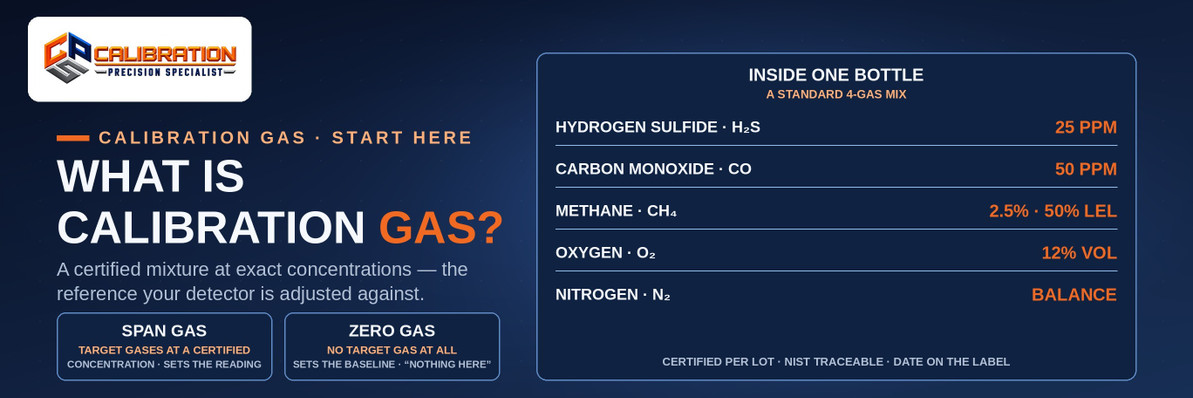
Calibration gas is a certified mixture of target gases at exact, known concentrations — a typical 4-gas cylinder carries 25 ppm hydrogen sulfide, 50 ppm carbon monoxide, 2.5% methane (50% LEL), and 12% oxygen in a nitrogen balance — that you flow over a gas detector's sensors so the instrument can be bump tested and adjusted to read accurately. It comes in two working forms: span gas, which contains the target gases at a set concentration, and zero gas, which contains none of them. The certified concentration is the reference every adjustment is made against — if the gas is wrong, expired, or mismatched to the instrument, the calibration is wrong no matter how carefully it was performed.
A gas detector cannot know what 25 ppm of hydrogen sulfide "looks like" on its own. It infers concentration from a sensor signal, and that signal drifts with age, temperature, and poisoning. Calibration gas is how you show the instrument a known truth and correct it. This post breaks down what's inside the bottle, what span and zero mean, why the balance gas matters, and how to pick the right cylinder for your detector.
What Is Actually Inside a Calibration Gas Cylinder?
Most calibration gas is not one gas — it's a recipe. Each component has a job, and the cylinder's label and Certificate of Analysis list every one of them with its certified concentration. Here is a real, standard 4-gas mixture, component by component:
| Component | Certified concentration | Its job in the mix |
|---|---|---|
| Hydrogen sulfide (H₂S) | 25 ppm | Span value for the H₂S channel — 25 ppm is the industry-standard span concentration |
| Carbon monoxide (CO) | 50 ppm | Span value for the CO channel |
| Methane (CH₄) | 2.5% by volume | 50% of methane's lower explosive limit (LEL) — the span value for the combustible channel |
| Oxygen (O₂) | 12% by volume | A reduced-oxygen component the O₂ channel is spanned against |
| Nitrogen (N₂) | Balance | The carrier — everything in the cylinder that isn't a measured component |
Two things to notice. First, the concentrations are not round accidents: they are chosen to sit near the alarm and exposure levels the detector works around, so the adjustment is made where accuracy matters most. Second, the mixture is only as trustworthy as its certification — which is why every cylinder's paperwork matters (more on that below, and in our post on how to read a calibration gas label).
What Is Span Gas, and What Is Zero Gas?
Span gas is the mixture above: target gases at known concentrations. During a calibration, the detector samples it and is adjusted until its reading matches the certificate. Zero gas is gas with none of the target analyte in it — typically clean air or pure nitrogen — used to set the instrument's baseline in an environment where you're certain no target gas is present. Zero first, then span: the zero sets where "nothing" reads, the span sets what a known amount reads, and the instrument interpolates everything in between. We go deeper in zero gas vs. span gas.
Span gas is also what a bump test uses — a brief exposure that proves each sensor responds and the alarms fire. The difference between a bump and a full calibration is whether you adjust the reading, not which bottle you reach for.
Why Does the Balance Gas Matter — Air or Nitrogen?
The balance is the bulk gas that carries the measured components, and there are two common choices:
| Balance gas | What it means | Typical use |
|---|---|---|
| Air balance | The mixture is made up in purified air, so it contains roughly ambient oxygen (~20.9%) unless oxygen is a listed component | Spans where the combustible sensor needs oxygen present to respond the way it does in the field |
| Nitrogen balance | The mixture is made up in nitrogen, with oxygen present only if it is a listed component (like the 12% O₂ in the 4-gas mix above) | Multi-gas mixes with a reduced-oxygen component, and zero gas for oxygen-free baselines |
Pick the wrong balance and the calibration quietly skews: an oxygen channel zeroed or spanned against the wrong background reads wrong in the field, and a catalytic LEL sensor's response depends on the oxygen available to it. The rule is simple — match the mixture your instrument's manual specifies, including its balance. We compare the two in detail in air balance vs. nitrogen balance.
Single-Gas or Multi-Gas: Which Bottle Do You Need?
Single-gas cylinders carry one target — an H₂S-only cylinder at 25 ppm, a CO-only cylinder, a methane-only span. Multi-gas blends combine the standard set a multi-gas detector carries: the 4-gas mix above, or a 5-gas mix that adds a fifth component — 5-gas mixes that include isobutylene use 100 ppm isobutylene, the standard span for the PID (photoionization) channel.
| You run… | You generally need… |
|---|---|
| A single-gas detector (H₂S, CO, O₂, or LEL only) | A single-gas cylinder matching that channel's span value |
| A standard 4-gas detector (LEL / O₂ / CO / H₂S) | A 4-gas blend matched to the concentrations your instrument expects |
| A 5- or 6-gas detector with PID | A 5-gas blend with 100 ppm isobutylene for the PID channel |
| Several detector brands | One blend per concentration set — the mix must match each instrument's expected span values, not the brand name on the case |
Brand matters less than concentration: a detector is calibrated against the values in its configuration, whatever badge it wears. That's why CPS sells calibration gas matched to every major detector brand — RKI, SENKO, Crowcon, Honeywell/BW, MSA, Industrial Scientific, and others — and why our Calibration Gas Finder works by instrument model, not by brand loyalty. For the 4-gas case specifically, see what calibration gas you need for a 4-gas detector.
What Do "Certified" and "NIST Traceable" Mean on the Label?
A certified cylinder ships with a Certificate of Analysis (CoA) stating the actual measured concentration of each component in that production lot, the lot number, and the expiration date. "NIST traceable" means those measurements are anchored, through an unbroken chain of comparisons, to reference standards held by the National Institute of Standards and Technology — so 25 ppm on the certificate means 25 ppm against a national reference, not against the blender's own last batch. CPS calibration gas is NIST traceable, and on our cylinders the CoA (and the SDS) is printed behind a QR code on the cylinder itself — scan it and the documents for that specific cylinder come up, which we explain in calibration gas with QR codes. The CoA gets its own deep dive in what a calibration gas Certificate of Analysis proves.
Reactive vs. Stable Gases: Why Shelf Life Differs
Not everything in the bottle ages at the same speed. Reactive gases — hydrogen sulfide, chlorine, ammonia, sulfur dioxide, and similar — slowly react with the cylinder walls and valve, and their certified concentration drifts out of tolerance in about 6–12 months. Stable gases — methane, carbon monoxide, oxygen, and other non-reactives — hold their concentration for roughly 36 months. A multi-gas blend inherits the shortest clock in the mix: a 4-gas cylinder's life is set by its H₂S, not by its methane. The exact expiration date is printed on each cylinder — check it when the bottle arrives and again before you calibrate with it. Full detail in calibration gas shelf life, and for how far a bottle actually goes in use, how long a bottle of calibration gas lasts.
Cylinder Sizes and Fittings, Briefly
Calibration gas comes in sizes from small 11L cylinders up through the common 34L, and larger 103L and 120L bottles for shops that calibrate daily. Size is only half the decision — the valve fitting decides which regulator screws on. On steel cylinders, the 34L uses a CGA-600 connection and the 103L uses a C-10. Order the wrong pairing and the bottle won't connect to your regulator. Most manual calibrations use a fixed-flow regulator, which typically delivers 0.5 L/min — the flow most portable detectors are calibrated at. The fitting question is covered head-on in CGA-600 vs. C-10 regulators, cylinder sizes in calibration gas cylinder sizes, and regulator choice in fixed-flow vs. demand-flow regulators.
How Do You Pick the Right Bottle?
Four checks, in order:
- Match the instrument. Start from the detector model and its configured span values — or look the model up in the Calibration Gas Finder.
- Match the concentrations and balance. The blend's certified values, and its air-or-nitrogen balance, must be what the instrument expects.
- Match the fitting. Confirm the cylinder's connection (CGA-600, C-10) against your regulator before you order.
- Check the date. Especially for reactive blends — you want most of that 6–12 month window in front of you, not behind you.
Browse the range in our calibration gas category, or follow the step-by-step in how to choose calibration gas. And if you'd rather hand the whole job over, CPS calibrates in-house — $55 for a single-gas instrument, $90 for 4- and 5-gas instruments, with ship-in service available; details on calibration services. One more standing CPS policy, because it surprises people: we charge no hazmat fee on calibration gas — CPS absorbs it.
Frequently Asked Questions
What is calibration gas used for?
Calibration gas is used to bump test and calibrate gas detectors. You flow a certified mixture — known concentrations of the gases the detector measures — over the sensors, verify each channel responds (bump test), and adjust the readings to match the certificate (calibration). Without it, a detector's displayed numbers are unverified, because sensor signals drift over time.
What is the difference between span gas and zero gas?
Span gas contains the target gases at certified concentrations and is used to set what a known amount reads. Zero gas contains none of the target gas — usually clean air or pure nitrogen — and is used to set the baseline, what "nothing present" reads. A proper calibration uses both, zero first, then span.
What gases are in a standard 4-gas calibration cylinder?
A typical 4-gas blend carries 25 ppm hydrogen sulfide, 50 ppm carbon monoxide, 2.5% methane (50% LEL), and 12% oxygen, with nitrogen as the balance gas. Exact blends vary by instrument configuration — the certificate and label on the cylinder state the actual certified values for that lot.
What is balance gas in a calibration gas mixture?
The balance gas is the bulk carrier that makes up the rest of the cylinder — usually purified air or nitrogen. It matters because the oxygen background it creates affects how the oxygen and combustible channels respond during calibration, so the balance must match what the instrument's manual specifies.
How long does calibration gas last before it expires?
It depends on the gases inside. Reactive gases such as H₂S, chlorine, and ammonia hold certification for about 6–12 months; stable gases such as methane, CO, and oxygen run roughly 36 months. A blend expires on its shortest-lived component, and the exact expiration date is printed on each cylinder.
Does calibration gas have to be NIST traceable?
Traceability is what makes the certificate meaningful: the concentrations were measured against reference standards chained back to NIST, so 25 ppm is verifiably 25 ppm. It is the standard practice for calibration gas used on safety instruments, and all CPS calibration gas is NIST traceable.
Can I use the same calibration gas for different brands of detectors?
Yes — provided the blend's concentrations and balance gas match what each instrument is configured to expect. Detectors calibrate against values, not brands. CPS sells gas matched to RKI, SENKO, Crowcon, Honeywell/BW, MSA, Industrial Scientific, and other instruments; our Calibration Gas Finder matches by model.
What size calibration gas cylinder do I need?
For occasional bump tests and calibrations, the common 34L cylinder is the usual pick; high-volume shops step up to 103L or 120L for cost per calibration, and 11L suits a single instrument used sparingly. Match the fitting as carefully as the size — a steel 34L is CGA-600, a steel 103L is C-10.
What regulator do I need for a calibration gas cylinder?
For manual calibration of portable detectors, a fixed-flow regulator delivering 0.5 L/min is the standard choice, and its inlet fitting must match the cylinder (CGA-600 or C-10). Demand-flow regulators are for pumped instruments and docking stations that draw gas on their own.
Does CPS charge a hazmat fee on calibration gas?
No. Calibration gas ships as hazardous material, but CPS absorbs the hazmat cost — there is no hazmat line item on a CPS gas order.
The Bottom Line
Calibration gas is a certified reference, not a commodity chemical: a mixture whose exact concentrations — like 25 ppm H₂S, 50 ppm CO, 2.5% methane, and 12% O₂ in nitrogen — are guaranteed on a Certificate of Analysis, in span and zero forms, on an air or nitrogen balance. Pick it by instrument, concentration, fitting, and date, in that order. CPS sells calibration gas for every major detector brand, every cylinder carries a QR code that pulls up its own SDS and CoA, and we never charge a hazmat fee on gas. Questions on a specific instrument? Call 865-900-8844 or reach us through Contact Us.
Need a calibration you can file?
In-house calibration at CPS in Rockwood, Tennessee — $55 for single-gas instruments, $90 for 4- and 5-gas — every channel, as-found and as-left data, full certificate.
See Calibration Servicesor call 865-900-8844
Recent Posts
-
Can You Add a Pump to a SENKO SGT-P or MGT?
Yes — SENKO's SP-Pump101 external sampling pump ($330, part AAA006000) fits the SGT, SGT-P, and MGT, …Nov 12th 2026 -

What Refrigerant Detection Does a Grocery Store Need?
A grocery store needs refrigerant detection in three places: low-mounted carbon dioxide (R-744) sens …Nov 11th 2026 -

What Is LEL and UEL? The Explosive Range, Gas by Gas
The LEL is the lowest concentration of a gas in air that can explode, and the UEL is the highest: me …Nov 10th 2026