
How Long Does a Bottle of Calibration Gas Last? How Many Bump Tests and Calibrations Per Cylinder
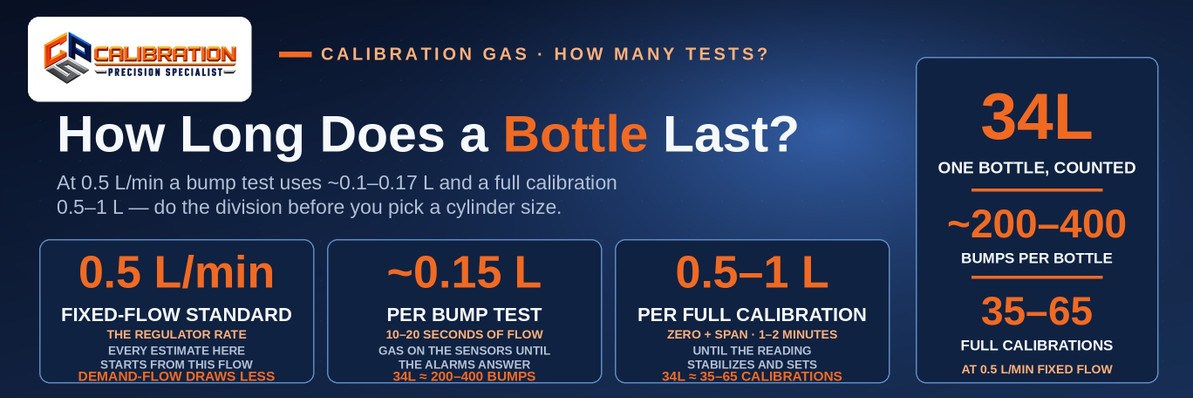
Through a standard fixed-flow regulator flowing 0.5 liters per minute, one bump test uses roughly 0.1 to 0.17 liters of calibration gas — 10 to 20 seconds of flow — and one full zero-and-span calibration uses about 0.5 to 1 liter, or one to two minutes of flow. That makes a 34L cylinder good for roughly 200 to 400 bump tests or about 35 to 65 full calibrations, a 58L for about 350 to 700 bump tests or 60 to 115 calibrations, and a 103L for roughly 600 to 1,200 bump tests or 100 to 200 calibrations. These are planning estimates worked from nameplate volume: hose purges, small leaks, long span times, and the unusable last bit of every bottle all pull the real count down.
Two different questions hide inside "how long does a bottle last?" One is shelf life — how many months the gas stays in spec on the shelf, which we cover in calibration gas shelf life: how long do bottles really last? The other is consumption — how many tests are actually in the bottle. That's this post, and it matters because the two clocks run at the same time: a cylinder can lose to either one.
The One Number Everything Starts From: 0.5 L/min
Fixed-flow regulators for portable gas detectors typically deliver 0.5 liters per minute. That's about 8.3 milliliters per second, and every estimate in this post is built on it:
- 10 seconds of flow ≈ 0.08 L
- 20 seconds of flow ≈ 0.17 L
- 1 minute of flow = 0.5 L
- 2 minutes of flow = 1.0 L
If your regulator flows at a different rate, scale the results — a 1.0 L/min regulator burns a bottle twice as fast. A demand-flow regulator plays by different rules: it delivers only what a pumped instrument draws, so there is no free-flowing gas between tests. The per-test math below is the fixed-flow math, because that's the setup most bump and calibration work runs on.
How Much Gas Does a Bump Test Use?
A bump test means flowing gas over the sensors long enough to confirm each one responds and the alarms fire. Once gas reaches the sensors, that takes about 10 to 20 seconds — so one bump test uses roughly 0.1 to 0.17 liters at 0.5 L/min.
In practice, add a little for the real world: a few seconds to purge the calibration cap or a short hose before the mix reaches the sensor, and a few more while you confirm the last sensor has answered. Budget 0.2 liters per bump if you want a conservative planning number — the tables below use the straight 0.1 to 0.17 liter range so you can see the math.
How Much Gas Does a Full Calibration Use?
A full calibration is a zero plus a span. The span step holds gas on the sensors until the reading stabilizes and the instrument completes its adjustment, and the whole zero-and-span sequence typically runs one to two minutes of flow from the mix cylinder. At 0.5 L/min, that's 0.5 to 1 liter per calibration.
Slow-stabilizing sensors and instruments with long internal countdowns land at the top of the range. A calibration you have to repeat — a failed span you run twice — doubles its share, which is one reason the real-world counts below the table run lower than the arithmetic.
How Many Bump Tests and Calibrations Are in Each Cylinder Size?
Divide the bottle by the serving size:
| Cylinder size | Bump tests (est.) | Full calibrations (est.) |
|---|---|---|
| 17L | ~100–200 | ~17–34 |
| 34L | ~200–400 | ~35–65 |
| 58L | ~350–700 | ~60–115 |
| 103L | ~600–1,200 | ~100–200 |
Assumes a 0.5 L/min fixed-flow regulator and the full nameplate volume. In the field, plan on roughly 10% less: the tail end of a bottle comes out at falling pressure, and a span calibration run on a starving regulator is a calibration you can't trust.
Most shops mix both kinds of use. A worked example: a crew doing 20 bump tests and 4 full calibrations a week burns about 2 to 3.5 L on bumps and 2 to 4 L on calibrations — call it 4 to 7.5 L a week. A 34L cylinder lasts that program roughly 5 to 8 weeks; a 103L, roughly 3.5 to 6 months. If you're deciding between sizes rather than counting tests, calibration gas cylinder sizes compared walks through which bottle fits which job.
What Makes a Bottle Run Out Faster Than the Math?
- Purges. Every foot of sample line, hose, or calibration cap has to fill with mix before the sensor sees full concentration. Long lines quietly tax every test.
- Leaks. A regulator that isn't snug on the cylinder, or a cracked hose, vents gas the whole time it's connected. Finger-tight plus a wrench snug, and listen for the hiss.
- Long spans. Slow sensors, cold instruments, and repeated span attempts all stretch flow time past the 1-to-2-minute plan.
- Shared bottles, no log. The most common real-world cause of an "early" empty: three techs drawing from one bottle and nobody writing it down. A strip of tape on the cylinder with a tally mark per session fixes this for free.
- Instrument count. A six-instrument docking routine is six servings, not one. Count tests, not sessions.
The Catch: Expiry Can Beat Empty
Gas has its own clock. Reactive mixes keep about 6 to 12 months; stable gases around 36 months, and the expiry date is printed on every cylinder. Now run the low-use example: one monitor, bumped every workday — about 0.65 L a week. That program takes roughly a year to empty a 34L, which is right at a reactive mix's shelf-life limit, and roughly three years to empty a 103L it will never finish. The last two-thirds of that big bottle isn't a bargain; it's expired gas you paid for.
The rule that falls out of the math: buy the size your program empties before the date on the label. If you haven't picked a size yet, start with what calibration gas is and the size comparison, then match the bottle to your burn rate.
How Can You Tell How Much Gas Is Left?
Use a regulator with a contents (pressure) gauge. On these compressed-gas cylinders, pressure tracks contents: half the original pressure means roughly half the gas remains. Check it when the bottle goes on and before a calibration session, not after a failed span.
Two habits make the gauge number useful:
- Log the bottle. Date opened, expiry date, and a rough test count on a tag tied to the cylinder. When the gauge and the log agree the end is near, order the replacement — CPS charges no hazmat fee on calibration gas, so the swap costs the bottle and nothing extra.
- Start the clock known. When a new cylinder arrives, scan the QR code on the cylinder — it pulls up that cylinder's SDS and Certificate of Analysis — and confirm the printed expiry. You now know exactly what you have and how long you have to use it.
Frequently Asked Questions
How many bump tests can I get from a 34L calibration gas cylinder?
Roughly 200 to 400, through a 0.5 L/min fixed-flow regulator. Each bump flows gas for about 10 to 20 seconds (0.1 to 0.17 L); purges, leaks, and longer confirmations pull you toward the low end of the range.
How many full calibrations does a 34L bottle last?
About 35 to 65 full zero-and-span calibrations. Each one flows roughly 0.5 to 1 L over one to two minutes, and a repeated span doubles that calibration's share.
How much gas does a bump test use?
About 0.1 to 0.17 liters through a standard 0.5 L/min fixed-flow regulator — 10 to 20 seconds of flow. Budget 0.2 L per bump for conservative planning.
How much gas does a full calibration use?
About 0.5 to 1 liter — one to two minutes of flow at 0.5 L/min, covering the zero and span sequence. Slow-stabilizing sensors use the top of the range.
How long does a 103L calibration gas cylinder last?
On consumption alone, roughly 600 to 1,200 bump tests or 100 to 200 full calibrations. But at low use rates the gas expires first: reactive mixes keep 6 to 12 months, so a lightly used 103L often loses to the calendar, not the gauge.
Does a demand-flow regulator use less gas than a fixed-flow regulator?
Usually, yes. A demand-flow regulator delivers only what a pumped instrument draws, so there's no free-flowing gas during setup or between tests. Our fixed-flow vs. demand-flow comparison covers which setup fits which instrument.
Why did my cylinder run out faster than the estimate?
The usual suspects are leaks at the regulator fitting, long purge volumes in hoses and sample lines, longer-than-planned span flows, repeated calibrations, and several people sharing one bottle with no usage log. The estimate also assumes the full nameplate volume — plan on about 10% less in the field.
Can I use a calibration gas cylinder all the way to empty?
You shouldn't plan to. As pressure falls toward empty, flow can sag below what a span calibration needs, and a calibration run on weak flow is one you can't trust. Swap the bottle when pressure gets low — and never use gas past its printed expiry date, even if the cylinder still has pressure.
Will my calibration gas expire before I use it up?
It can. Reactive mixes keep about 6 to 12 months and stable gases around 36 months, with the expiry printed on the cylinder. If your burn rate is slow, a smaller bottle you finish fresh beats a big bottle that ages out half full.
How can I tell how much gas is left in a cylinder?
Read the contents (pressure) gauge on the regulator: on a compressed-gas cylinder, pressure tracks contents, so half pressure means roughly half the gas. Pair it with a simple dated log on the cylinder and you'll never be surprised mid-calibration.
The Bottom Line
A bottle of calibration gas is a budget of tests: at 0.5 L/min, roughly 0.1 to 0.17 L per bump test and 0.5 to 1 L per full calibration — 200 to 400 bumps or 35 to 65 calibrations from a 34L, scaling up to 600 to 1,200 bumps or 100 to 200 calibrations from a 103L. Treat those as planning numbers, derate them about 10% for the real world, and let expiry arbitrate size: the right bottle is the one your program empties before the date printed on it. Browse the mixes and sizes in our calibration gas range, match gas to instrument with the Calibration Gas Finder, or work through how to choose calibration gas if you're speccing a program from scratch. Every CPS cylinder carries a QR code that scans straight to its SDS and Certificate of Analysis — and we charge no hazmat fee. Questions on sizing a bottle to your fleet? Call 865-900-8844 or reach us through Contact Us.
Need a calibration you can file?
In-house calibration at CPS in Rockwood, Tennessee — $55 for single-gas instruments, $90 for 4- and 5-gas — every channel, as-found and as-left data, full certificate.
See Calibration Servicesor call 865-900-8844
Recent Posts
-
Can You Add a Pump to a SENKO SGT-P or MGT?
Yes — SENKO's SP-Pump101 external sampling pump ($330, part AAA006000) fits the SGT, SGT-P, and MGT, …Nov 12th 2026 -

What Refrigerant Detection Does a Grocery Store Need?
A grocery store needs refrigerant detection in three places: low-mounted carbon dioxide (R-744) sens …Nov 11th 2026 -

What Is LEL and UEL? The Explosive Range, Gas by Gas
The LEL is the lowest concentration of a gas in air that can explode, and the UEL is the highest: me …Nov 10th 2026