
How to Choose Calibration Gas: A Buyer's Checklist for Concentrations, Sizes, and Fittings
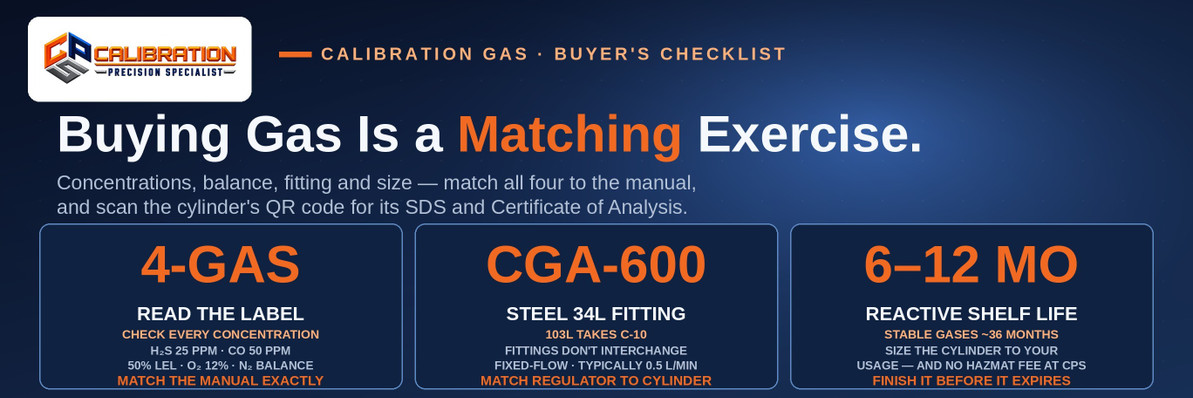
Choosing calibration gas is a matching exercise, not a shopping exercise. The right cylinder is the one whose concentrations match your instrument manual's specified mix exactly, whose balance gas suits the sensor set, whose fitting matches your regulator — steel 34L cylinders take CGA-600, 103L cylinders take C-10 — and whose size you will finish before its shelf life runs out: reactive mixes last 6–12 months, stable gases about 36. Get those matches right and the calibration takes care of itself; get any one wrong and the cylinder is shelf decoration.
This checklist works through the decisions in the order a buyer actually faces them. New to the subject entirely? Start with what calibration gas is, then come back here to buy it properly. CPS sells calibration gas for every major detector brand — the full range is on the store, and our Calibration Gas Finder matches gas to instruments when the manual is nowhere to be found.
Step 1: Start From the Instrument Manual's Specified Mix
Every detector maker specifies the calibration gas its instruments are designed around — the gases, the concentrations, and the balance. That specification, not a catalogue category, is the order. If the manual is lost, the Finder above matches gas to instrument models, and the manufacturer's detector page will state the standard mix. Buying "a 4-gas mix" generically is how fleets end up with cylinders that almost fit: our post on what calibration gas a 4-gas detector needs shows how much the details vary between brands.
Step 2: Match the Concentrations Exactly
Calibration works because the cylinder's concentrations are certified and the instrument is set to them. "Close" is a wrong answer with a confident face: span a detector expecting one concentration with a cylinder certified at another and every subsequent reading is scaled by the difference. Read the label before you order — a standard 4-gas cylinder on our shelf reads H₂S 25 ppm, CO 50 ppm, methane 50% LEL, O₂ 12.0%, balance nitrogen, and the H₂S 25 ppm figure in particular is an industry standard you will see across brands. Our guide to reading a calibration gas label decodes every field, including the certification statement and the expiry date buyers most often miss.
Step 3: Pick the Balance Gas the Sensors Expect
The measured gases in a cylinder are diluted in a balance gas — air or nitrogen — and the choice is not cosmetic. A nitrogen-balance mix contains no oxygen, which affects what the O₂ channel sees during its span; an air-balance mix carries roughly atmospheric oxygen. The instrument manual's specified mix already encodes the right balance for its sensor set, which is why Step 1 comes first. The full reasoning, including when each balance is correct, is in air balance vs. nitrogen balance — and the related two-cylinder workflow is covered in zero gas vs. span gas.
Step 4: Choose the Size by Usage Rate vs. Shelf Life
Cylinder sizes are a race between how fast you use gas and how fast it expires. The sizes are decoded in calibration gas cylinder sizes, and the usage maths — how many calibrations a bottle actually delivers — is in how long a bottle of calibration gas lasts. The deciding fact is shelf life: reactive mixes such as H₂S blends are good for roughly 6–12 months, while stable gases run about 36 months (the full picture is in calibration gas shelf life). A large cylinder is cheaper per litre and a worse bargain the day it expires half full — small fleets and occasional users should size down, high-throughput docks should size up.
Step 5: Match the Fitting — and the Regulator Type
The cylinder has to connect to the regulator, and the regulator has to suit the instrument:
- Fittings. Steel 34L cylinders use the CGA-600 connection; 103L cylinders use C-10. They are not interchangeable, and the wrong pairing simply will not connect — the comparison is laid out in CGA-600 vs. C-10. Check the fitting on the cylinder against the regulator in your kit before the cylinder ships, not at the dock.
- Regulator type. Fixed-flow regulators — typically 0.5 L/min — are the standard for manual calibrations and diffusion instruments; demand-flow regulators feed gas only as a pumped instrument draws it, and pumped units need them. The deciding details are in fixed-flow vs. demand-flow regulators.
Step 6: Check the Expiry on Arrival — and Scan the QR Code
When the cylinder lands, check three things before it goes on the shelf: the expiry date is comfortably ahead of your usage, the concentrations on the label match the order, and the paperwork is retrievable. On CPS cylinders that last step takes seconds: every cylinder carries a QR code that pulls up that cylinder's SDS and Certificate of Analysis — the documents safety audits actually ask for. How the system works is in calibration gas QR codes: SDS and COA on every cylinder, and what the certificate proves — certified concentrations, traceability, stated accuracy — is in what a calibration gas Certificate of Analysis proves. For regulated fleets, NIST-traceable calibration gas explains the traceability chain behind the certificate.
Step 7: Know the Hazmat Reality
Calibration gas ships as hazardous material — the cylinders are pressure vessels and several common components are toxic gases. That has two practical consequences: shipping takes the hazmat route with its paperwork, and many sellers add a hazmat fee at checkout. CPS does not: we charge no hazmat fee on calibration gas — we absorb it, so the price on the product page is the price of the gas. Budget accordingly when comparing quotes, because a cheaper cylinder plus a hazmat surcharge is often the more expensive cylinder.
Step 8: When a Custom or Specialty Mix Is the Answer
Standard mixes cover standard instruments. The checklist ends where the standard shelf ends:
- Unusual gases or concentrations. Instruments measuring less common toxics, or processes with site-specific alarm points, can need concentrations no stock mix carries.
- Five-gas and PID work. Mixes that add a fifth channel — isobutylene at 100 ppm is the familiar one — serve pumped multi-gas and PID instruments.
- One cylinder for a mixed fleet. A blend built around your actual instruments can replace two almost-right stock cylinders.
The options and economics are covered in specialty gas mixes: when standard 4-gas isn't enough. And if the gas is only half the job — instruments due, records to produce, a fleet to bring back into compliance — our calibration services handle the whole programme, ship-in or on-site by written quote.
Frequently Asked Questions
How do I know what calibration gas my detector needs?
From the instrument manual: the maker specifies the gas mix — gases, concentrations, and balance — its detectors are calibrated with. If the manual is lost, use a matching tool such as the CPS Calibration Gas Finder, which pairs gas to instrument models, or check the detector maker's published standard mix for your model.
What happens if I use the wrong concentration of calibration gas?
The instrument is set to the cylinder's certified value while believing it is the specified one (or vice versa), so every reading afterward is scaled wrong by the ratio between the two. The detector passes its calibration routine and then mis-reports real gas — which is why concentrations are matched exactly, never approximately.
What size calibration gas cylinder should I buy?
Size it against your usage rate and the shelf life: reactive mixes expire in roughly 6–12 months, stable gases in about 36. A 34L cylinder suits small fleets and occasional calibration; 103L suits regular dock throughput. The cheapest cylinder is the one you finish before it expires — an expired half-full large cylinder costs more per calibration than small ones.
What fitting does a 34L calibration gas cylinder use?
A steel 34L cylinder uses the CGA-600 connection; the larger 103L uses C-10. The two are not interchangeable, so match the regulator to the cylinder size you are ordering — and if you are switching sizes, budget for the matching regulator at the same time.
Fixed-flow or demand-flow regulator — which do I need?
Fixed-flow (typically 0.5 L/min) for manual calibrations and diffusion instruments — it delivers a steady stream the calibration cap expects. Demand-flow for pumped instruments: it releases gas only as the instrument's pump draws, so the pump is never starved or over-pressured. Using the wrong type produces failed or drifting calibrations.
How long does calibration gas last before it expires?
Reactive mixtures — H₂S blends are the everyday example — carry shelf lives of roughly 6–12 months; stable gases such as methane and CO in nitrogen run about 36 months. The expiry date is printed on the cylinder label, and expired gas must not be used for calibration: its certified concentrations are no longer guaranteed.
Is calibration gas hazmat to ship?
Yes — cylinders are pressurised and several components are toxic, so calibration gas moves as hazardous material with the accompanying paperwork. What varies is the fee: CPS charges no hazmat fee on calibration gas and absorbs the cost, so check for a hazmat surcharge when comparing other sellers' totals.
What is balance gas and why does it matter?
Balance gas is the air or nitrogen the measured gases are diluted in — the bulk of what's in the cylinder. It matters because it decides what the oxygen channel sees during calibration: a nitrogen-balance mix contains no oxygen, an air-balance mix carries about 20.9%. The instrument's specified mix already encodes the correct balance for its sensors.
Can one cylinder calibrate detectors from different brands?
Yes — when the mix matches each instrument's specification. Calibration gas is defined by its certified concentrations, not by the detector brand on the manual, and CPS sells gas for every major detector brand. Fleets running two brands whose manuals specify the same mix can standardise on one cylinder; fleets whose specs differ cannot.
When do I need a custom calibration gas mix?
When no stock mix matches: unusual gases, site-specific concentrations, five-gas blends such as those carrying isobutylene at 100 ppm, or a mixed fleet you want on one cylinder. The instrument specification decides — if the manual's mix is not on the standard shelf, a custom or specialty blend built to it is the correct purchase, not a near miss.
The Bottom Line
Run the checklist in order and calibration gas stops being a guessing game: manual's mix first, concentrations matched exactly, balance gas as specified, size set by usage against a 6–12 month reactive or ~36 month stable shelf life, fitting and regulator matched to the cylinder (CGA-600 on steel 34L, C-10 on 103L), expiry checked on arrival, and the SDS and COA pulled from the cylinder's own QR code when the audit asks. CPS charges no hazmat fee on any of it. If your instruments' spec doesn't match anything on the standard shelf, call us at 865-900-8844 or through Contact Us — custom and specialty mixes are a normal order here, not a special favour.
Need a calibration you can file?
In-house calibration at CPS in Rockwood, Tennessee — $55 for single-gas instruments, $90 for 4- and 5-gas — every channel, as-found and as-left data, full certificate.
See Calibration Servicesor call 865-900-8844
Recent Posts
-
Can You Add a Pump to a SENKO SGT-P or MGT?
Yes — SENKO's SP-Pump101 external sampling pump ($330, part AAA006000) fits the SGT, SGT-P, and MGT, …Nov 12th 2026 -

What Refrigerant Detection Does a Grocery Store Need?
A grocery store needs refrigerant detection in three places: low-mounted carbon dioxide (R-744) sens …Nov 11th 2026 -

What Is LEL and UEL? The Explosive Range, Gas by Gas
The LEL is the lowest concentration of a gas in air that can explode, and the UEL is the highest: me …Nov 10th 2026