
Air Balance vs. Nitrogen Balance: Which Does Your Calibration Gas Need?
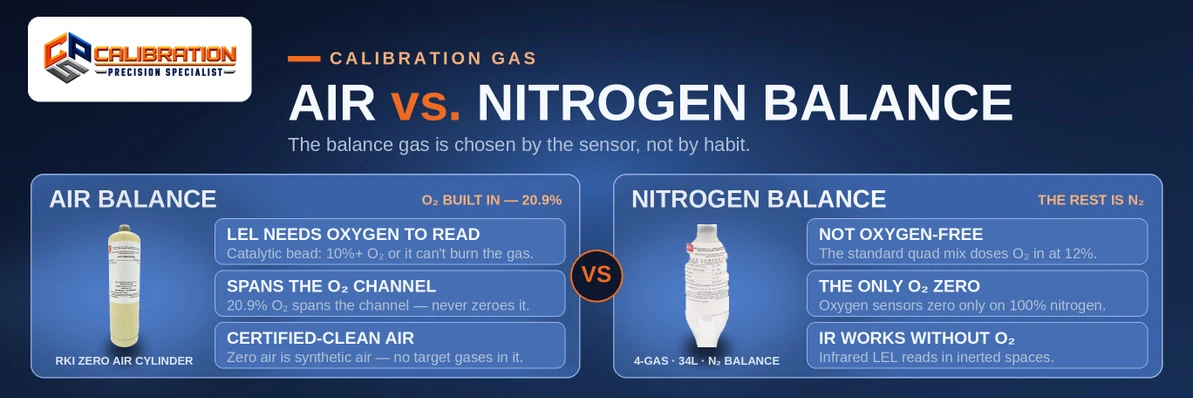
The balance gas is chosen by the sensor, not by habit: standard multi-gas span mixes are nitrogen balance, with the oxygen dosed in as a labeled component — 12% O₂ alongside 50% LEL methane, 50 ppm CO and 25 ppm H₂S in an RKI-equivalent 4-gas mix — while air balance means the oxygen (20.9%) is simply part of the balance itself. Two rules decide most orders: a catalytic-bead LEL sensor needs at least 10% oxygen in the gas to read at all, so its span gas can never be oxygen-free, and an oxygen sensor can only be zeroed with 100% nitrogen, never with an air-balance gas.
Every calibration gas label ends the same way: a list of components, then the words "Nitrogen Balance" or "Air Balance." It is the line buyers guess at most — and the guess matters, because the wrong balance can starve a sensor during calibration, make a zero adjustment impossible, or quietly shorten the life of the mix. This guide settles it sensor by sensor: what the balance gas is, which sensors care, and exactly which one to order for the job in front of you.
One clarification before the details: bottled "air" is synthetic. An air-balance cylinder is blended as 20.9% oxygen with nitrogen making up the rest, certified clean — which is why our zero air cylinder is honestly describable both ways. What actually decides a calibration is not the word on the label. It is whether oxygen is in the mix, and how much.
What Does "Balance Gas" Mean on a Calibration Gas Label?
The balance gas is the bulk remainder of a mixture — everything in the cylinder that is not one of the dosed, certified components. A 4-gas mix is mostly balance gas: the methane, oxygen, carbon monoxide and hydrogen sulfide together make up a minority of the contents — roughly 85% of a quad mix is balance gas — and the balance fills the rest so the mixture can be blended, certified and delivered at a stable concentration.
Two balances cover nearly every cylinder in gas detection:
- Nitrogen balance — the remainder is nitrogen (N₂), an inert gas that does not react with the components. Oxygen appears in the cylinder only if it is dosed in as a labeled component, at a certified concentration.
- Air balance — the remainder is synthetic air: 20.9% oxygen, balance nitrogen, cleaned and certified so it carries none of the gases being measured (sold as zero air when it stands alone). Oxygen is present by definition, whether or not it appears as a labeled component.
Same cylinder, same regulator, same job on paper — but the two are not interchangeable, because different sensor technologies use oxygen in completely different ways.
Does "Nitrogen Balance" Mean There Is No Oxygen in the Bottle?
No — and this is the single most common misunderstanding in calibration gas ordering. "Nitrogen balance" describes what fills the rest of the cylinder; it says nothing about whether oxygen is one of the dosed components.
Look at the standard 4-gas mix. Our RKI-equivalent 4-gas calibration gas is nitrogen balance — and it contains 12% oxygen, dosed and certified alongside 50% LEL methane, 50 ppm carbon monoxide and 25 ppm hydrogen sulfide. RKI's own factory cylinder (part 81-0154RK) is the same recipe; its label lists "OXYGEN 12.0%" and then "NITROGEN — BALANCE." The oxygen has to be there: three of the four channels are calibrated against the mix as a whole, and the LEL channel cannot work without oxygen at all (more on that below).
Why 12% instead of the 20.9% in fresh air? Because in a nitrogen-balance mix the oxygen level is a specification, chosen by the instrument manufacturer — 12%, 18% and 20.9% dosed-oxygen mixes all exist. Air-balance 4-gas mixes exist too, from other blending traditions; in those, the oxygen simply lands at 20.9% because it arrives with the air. Both styles calibrate the same instruments correctly. What you match to your instrument manual is the certified component list — concentrations first, balance second.
The mistake to avoid runs in both directions: assuming a nitrogen-balance mix is oxygen-free (it usually is not, if it is a multi-gas span mix), and assuming any mix is safe for every channel because it worked on a different instrument. When a mix genuinely carries no oxygen — a single toxic gas in nitrogen, for example — that fact is printed in the component list, and it decides which sensors that cylinder can calibrate.
Which Sensors Actually Care About the Balance Gas?
Balance gas is a sensor question before it is a purchasing question. Here is each major technology, and what the balance does to it:
| Sensor type | Needs oxygen in the gas? | Zero reference | What the balance means for calibration |
|---|---|---|---|
| Catalytic bead (pellistor) LEL | Yes — at least 10% O₂ | Clean air / zero air | Span gas must contain oxygen: dosed into a nitrogen-balance mix, or supplied by an air balance. An oxygen-free span gas starves the bead. |
| Galvanic / electrochemical O₂ | It is the oxygen measurement | 100% nitrogen only | Zero point can only be set with oxygen-free gas. Span with air, zero air (20.9% O₂), or a certified O₂ mix. |
| Electrochemical toxics (CO, H₂S, SO₂…) | No | Clean air / zero air | Responds to the target gas in either balance. Balance is a shelf-life question, not a sensor question. |
| Infrared (NDIR) | No | Nitrogen | Works in inert atmospheres; zeroed on nitrogen. Balance matters least here — one reason IR suits inerted spaces. |
| PID (photoionization) | No | Clean air / zero air | Isobutylene span gas is supplied in air balance and in nitrogen balance; either calibrates a PID. Match concentration and manual. |
| Thermal conductivity (TC) | No | Matched background gas | The reading is relative to the background gas itself, so the calibration balance should match the process background. |
Catalytic bead LEL — the one sensor that can be starved. A pellistor works by burning combustible gas on a heated, catalyst-coated bead. No oxygen, no combustion, no signal. Manufacturers put the floor at 10% oxygen: Honeywell's RAE support states plainly that the catalytic bead LEL sensor requires 10% oxygen to function, while the IR sensor will function in an inert atmosphere — and Industrial Scientific does not recommend using catalytic bead sensors below 10% vol. O₂, because incomplete combustion reads low. Calibrate that channel with an oxygen-free mix and the bead under-responds: the instrument either fails calibration or, worse, accepts a span that is set far too low. The standard quad mix avoids the trap by dosing its oxygen in — but a methane-only span cylinder with no oxygen component must be air balance, or the same trap springs.
Oxygen sensors — the one channel air can never zero. A galvanic O₂ sensor produces its signal from the oxygen itself, so its zero point is defined by a gas with no oxygen in it at all: 100% nitrogen. Certified zero gas for oxygen analyzers is nitrogen of at least 99.9% purity; CPS stocks nitrogen at 99.9% and higher grades for exactly this duty. Spanning runs the other way — fresh air, zero air at 20.9%, or a certified oxygen mix. An air-balance gas, at 20.9% oxygen, can span an O₂ channel but can never zero one; there is no setting on the instrument that changes that arithmetic.
Electrochemical toxics — balance-agnostic at the sensor. A CO or H₂S cell reacts with its target gas and produces a current; the reaction does not ask what the rest of the cylinder is made of. Either balance calibrates a toxic channel correctly. The reason toxic span gases are nevertheless blended in nitrogen is stability, covered below: reactive gases keep their certified concentration longer with no oxygen in the cylinder.
Infrared — built for the places oxygen is not. An NDIR sensor measures light absorption, not combustion, so it needs no oxygen and keeps reading in inerted, nitrogen-blanketed spaces where a catalytic bead reads nothing. It is zeroed on pure nitrogen, and its span gas works in either balance — the balance matters less for IR than for any other channel on the instrument.
PID — both balances are on the shelf, and both work. The standard PID span gas, isobutylene, is most commonly supplied in air balance — ISG's published safety data sheet for the product is literally titled "Isobutylene in Air." But it is also blended in nitrogen balance with oxygen dosed in: our isobutylene 100 ppm mix carries 20.9% O₂ in nitrogen, and our 5-gas RKI-equivalent mix puts 100 ppm isobutylene into the nitrogen-balance quad recipe so one cylinder spans all five channels of a PID-equipped monitor, including a GX-6100. A PID ionizes molecules with a lamp; it does not burn them, so the balance does not change the reading — what matters is the certified isobutylene concentration and the correction factor for your target gas.
Thermal conductivity — the background is the measurement. A TC sensor compares how fast the sample gas carries heat away against a reference element in a reference gas, typically air. Change the background gas and you change the reading, because the background's own thermal conductivity is part of the signal. So for percent-volume TC work — the channel that reads combustible gas up to 100% vol. in inerted processes — calibrate with a balance that matches the process background: nitrogen-balance gas for a nitrogen-blanketed process. Calibrating a TC channel against an air background and then reading a nitrogen background is a built-in error no span adjustment fully removes.
When Should You Order Air Balance?
- Zero air duty. When an instrument's fresh-air zero has to be trustworthy and the ambient air is not — near running engines, in process areas, anywhere the background is unknown — a zero air cylinder (20.9% O₂, certified clean) is the reference. It is also the standard fresh-air reference for portable monitors: the zero for the toxic and LEL channels, and the 20.9% span for the O₂ channel.
- A standalone LEL span gas with no oxygen component. If the cylinder's job is to span a catalytic bead and the recipe does not dose oxygen, the oxygen has to arrive with the balance: order it in air.
- PID isobutylene, as commonly supplied. The industry-standard PID cylinder is isobutylene in air; if your manual or your dock expects that product, order it that way — the nitrogen-balance equivalent works too, but consistency with your documented procedure wins.
- Any mix where oxygen must be present but is not a dosed component. If the component list shows no O₂ line and any channel being calibrated burns gas or reads oxygen, the balance must be air.
When Is Nitrogen Balance Required — or Simply the Standard?
- Zeroing an oxygen channel. Non-negotiable: 100% nitrogen. No air-balance gas can set an oxygen zero.
- Standard multi-gas span mixes. The quad and 5-gas recipes the instrument makers specify are nitrogen balance with oxygen dosed in (12% in the RKI-equivalent mixes). Ordering "the standard mix" means ordering that.
- Reactive toxic gases. Hydrogen sulfide, sulfur dioxide, chlorine, nitrogen dioxide and their kin are blended in nitrogen because oxygen in the cylinder shortens their certified life. One major manufacturer's catalog draws the line explicitly: reactive mixtures in nitrogen, non-reactive mixtures in air.
- High-concentration combustible mixes. Percent-volume blends — 40% vol. methane is a real catalog product — are made in nitrogen. With no oxygen in the cylinder, the fuel cannot burn at any concentration; the same fuel blended in air would sit in, or pass through, its flammable range (methane's starts at its 5% LEL) as the cylinder is vented or leaks. Nitrogen balance is what makes a %-volume cylinder a calibration standard instead of a fuel cylinder.
- Inert-atmosphere applications. Percent-volume and IR/TC work in nitrogen-blanketed spaces is calibrated against nitrogen-background gas, matching the background the sensor will actually read.
Which Do You Order? A Sensor-by-Sensor Checklist
- Standard 4-gas portable (catalytic LEL + O₂ + CO + H₂S): the standard quad mix — nitrogen balance, oxygen dosed (our RKI-equivalent 4-gas). One cylinder zeros and spans all four channels.
- 5-gas portable with PID: the 5-gas mix — same nitrogen-balance recipe plus 100 ppm isobutylene — or a standalone isobutylene cylinder in either balance. (If your instrument needs gases beyond the standard recipes entirely, see when standard 4-gas calibration gas is not enough.)
- Setting an oxygen zero: 100% nitrogen, 99.9% or better. Nothing else sets a true zero.
- A fresh-air zero you can trust anywhere: zero air — 20.9% O₂, certified clean.
- Infrared CO₂ or hydrocarbon channels: zero on nitrogen; span in either balance. Balance is not the deciding spec — concentration is.
- Thermal-conductivity % volume in an inerted process: nitrogen-balance span gas, matched to the process background.
- Still unsure: read the component list, not the balance word. If the mix doses oxygen at a certified percentage, it will feed a catalytic bead; if it contains no oxygen at all, it will not — and it is the only kind of cylinder that can zero an O₂ channel.
Does the Balance Gas Affect Shelf Life?
Indirectly, yes — through chemistry, not through the balance itself. Reactive components slowly degrade in the presence of oxygen, which is why blenders put reactive gases in nitrogen: the inert balance protects the certified concentration. You can see the effect on our own shelf. The 4-gas mix, which carries reactive H₂S, is certified for 24 months; the zero air and isobutylene cylinders — non-reactive contents — carry 48 months. The balance gas is never itself the shelf-life spec, though: the expiration printed on the cylinder's certificate is. For the full picture of what sets those dates, see our guide to calibration gas shelf life.
Browse the full calibration gas range, or call us at 865-900-8844 and tell us the instrument — we will match the mix, the balance and the regulator to it. If you would rather hand us the instruments, we calibrate every channel, on the bench or at your site.
Frequently Asked Questions
What does "balance gas" mean on a calibration gas cylinder? The balance gas is the bulk remainder of the mixture — everything in the cylinder that is not a dosed, certified component. If a mix is 50 ppm carbon monoxide with nitrogen balance, the CO is the component and nitrogen makes up essentially all the rest. The two standard balances are nitrogen and air (synthetic air: 20.9% oxygen, balance nitrogen, certified clean).
Does nitrogen balance mean there is no oxygen in the bottle? No. Nitrogen balance means the remainder of the cylinder is nitrogen; oxygen can still be dosed in as a certified component. The standard RKI-equivalent 4-gas mix is nitrogen balance and contains 12% oxygen, alongside 50% LEL methane, 50 ppm CO and 25 ppm H₂S. A mix is oxygen-free only when the component list shows no oxygen at all — as with a single toxic gas blended in nitrogen.
Can I calibrate a 4-gas monitor with a nitrogen balance mix? Yes — that is the standard product for the job. The quad mix (50% LEL methane, 12% O₂, 50 ppm CO, 25 ppm H₂S, nitrogen balance) is blended specifically so one cylinder zeros and spans all four channels of a standard portable monitor. The dosed 12% oxygen is what feeds the catalytic LEL bead and spans the oxygen channel.
How much oxygen does a catalytic bead LEL sensor need? At least 10% oxygen in the gas stream. The bead burns combustible gas on a catalyst, and below roughly 10% O₂ the combustion is incomplete and readings run low — Honeywell states its catalytic LEL sensor requires 10% oxygen to function, and Industrial Scientific recommends against catalytic bead use below 10% vol. O₂. A standard quad mix doses its oxygen at 12% — above that floor, with margin.
What happens if you calibrate an LEL sensor with oxygen-free gas? The bead cannot burn the span gas properly, so the sensor under-responds: the calibration either fails outright or is accepted at a value that makes the instrument read low in the field — the dangerous direction. An oxygen-free cylinder (a toxic gas in pure nitrogen, or a %-volume mix) must never be used to span a catalytic LEL channel. Use a mix with dosed oxygen or an air-balance span gas.
What do you use to zero an oxygen sensor? 100% nitrogen. An oxygen sensor's zero point is defined by a gas containing no oxygen at all, and certified zero gas for oxygen measurement is nitrogen of at least 99.9% purity. Span the channel afterward with fresh air, zero air (20.9% O₂), or a certified oxygen mixture.
Can you zero an oxygen sensor with zero air? No. Zero air is 20.9% oxygen — it is a span reference for the oxygen channel, not a zero. Zeroing an O₂ sensor on zero air would tell the instrument that 20.9% oxygen is "zero," corrupting every reading it takes afterward. Zero air is, however, the right cylinder for a fresh-air zero of the toxic and LEL channels and for spanning O₂.
Is isobutylene calibration gas air balance or nitrogen balance? Both exist, and either calibrates a PID. Isobutylene is most commonly supplied in air balance — ISG's published SDS for the product is "Isobutylene in Air" — but it is also blended in nitrogen balance with oxygen dosed in, including in 5-gas mixes that carry 100 ppm isobutylene alongside the standard four gases. Order the balance your instrument manual or docking-station procedure specifies, at the certified concentration it specifies.
Does the balance gas change how long calibration gas lasts? It changes how long reactive components hold their certified concentration. Reactive gases such as H₂S degrade faster with oxygen in the cylinder, so they are blended in nitrogen; on our shelf the H₂S-bearing 4-gas mix carries a 24-month certified life, while non-reactive zero air and isobutylene cylinders carry 48 months. The date that governs is always the expiration on the cylinder's own certificate.
When should I order air balance instead of nitrogen balance? Order air balance when oxygen must be in the gas but is not a dosed component: a standalone LEL span gas for a catalytic-bead instrument, zero air for a trustworthy fresh-air zero and O₂ span, and PID isobutylene as it is commonly supplied. Order nitrogen balance for standard multi-gas span mixes, for reactive toxics, for percent-volume combustible mixes, and any time you need to zero an oxygen channel.
CPS Calibrations · 109 S. Front Street, Rockwood, TN 37854 · Portable Gas Detection · Calibration Gas · Calibration Services · Contact Us
Recent Posts
-
Flame Detector vs. Gas Detector: What's the Difference — and Do You Need Both?
A gas detector and a flame detector guard opposite ends of the same incident: a gas detector reads l …Oct 21st 2026 -

How Do You Test a Flame Detector? Self-Tests, Test Lamps, and NFPA 72
You test a flame detector with light, not gas — there is no span gas, no zero gas, and never an open …Oct 21st 2026 -

Why Does a Flame Detector False Alarm — and Which Type Won't?
A flame detector false alarms because something that is not a fire is producing the signal it watche …Oct 21st 2026