
When Is Standard 4-Gas Calibration Gas Not Enough?
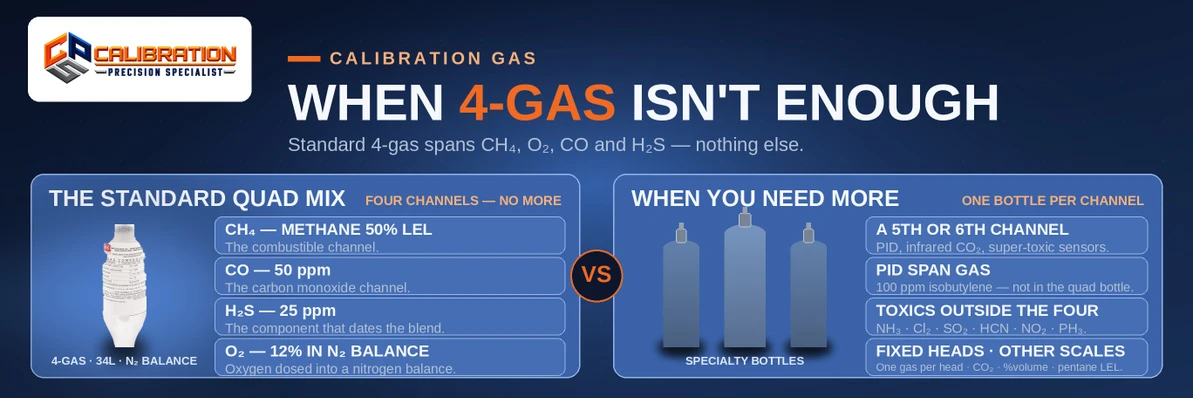
Standard 4-gas calibration gas — methane at 50% LEL, oxygen, carbon monoxide at 50 ppm, and hydrogen sulfide at 25 ppm — stops being enough the moment an instrument carries any channel beyond those four: a PID channel, a fifth or sixth sensor, a toxic gas such as ammonia, chlorine, sulfur dioxide, or nitrogen dioxide, a non-methane combustible, a CO₂ or %volume scale, or a fixed toxic-gas head. Each of those channels needs a specialty gas mix — a bottle matched to that channel's gas, range, and span point — because a channel that is zeroed but never spanned is never actually calibrated.
You Need a Specialty Mix When…
- Your instrument has a fifth or sixth channel — a PID, an infrared CO₂ sensor, or a super-toxic sensor alongside the standard four.
- You run a PID or VOC channel — a PID spans on 100 ppm isobutylene, which is not in the 4-gas bottle.
- Your hazard list includes a toxic gas outside the four — ammonia (NH₃), chlorine (Cl₂), sulfur dioxide (SO₂), hydrogen cyanide (HCN), nitrogen dioxide (NO₂), or phosphine (PH₃).
- Your combustible hazard isn't methane — pentane, propane, or solvent vapors — or you measure on a different scale entirely, like infrared CO₂ or %volume hydrocarbons.
- You maintain fixed detection — one head, one target gas, one bottle per head.
If none of those describe your fleet, standard 4-gas is genuinely enough — it's the right bottle for standard 4-gas instruments. The rest of this post walks through each trigger, and how to spec the bottle that covers it.
What Does "Not Enough" Actually Look Like?
A calibration has two halves: zero and span. Zeroing sets the instrument's baseline in clean air. Spanning teaches it what a known concentration of the target gas reads like. Standard 4-gas can zero almost anything — and span exactly four things.
When a channel gets zeroed but never spanned, it looks calibrated. The paperwork says calibrated. But sensor drift on that channel — the slow loss of sensitivity every electrochemical, catalytic, infrared, and PID sensor experiences — stays invisible, because nothing ever challenged the sensor with the gas it's supposed to measure. That's the real cost of stretching a 4-gas bottle too far: not a failed calibration, but a false one.
Standard 4-Gas vs. Specialty Gas: What Each Bottle Actually Spans
The standard 4-gas mix is the workhorse of gas detection for a good reason. One bottle spans every channel on the most common personal monitors in the field, including the RKI GX-3R and the SENKO SP-MGT. One bottle, one regulator, one procedure. But "standard" describes a specific fleet, not every fleet — here's the head-to-head:
| Standard 4-gas | Specialty gas | |
|---|---|---|
| Channels spanned | CH₄ (LEL), O₂, CO, H₂S — four, no more | Any channel outside the four: PID, NH₃, Cl₂, SO₂, HCN, NO₂, PH₃, CO₂, %volume, non-methane LEL |
| Typical contents | Methane 50% LEL, O₂, CO 50 ppm, H₂S 25 ppm in one bottle | One bottle per extra channel, blended to that channel's span point (e.g., 100 ppm isobutylene, 10 ppm Cl₂, pentane 25% LEL) |
| Shelf life | Long for a stable mix; the blend is dated by its H₂S component | Reactive toxics run roughly 6–12 months |
| Best for | Standard 4-gas portable fleets | 5- and 6-gas instruments, PID work, toxic-specific hazards, fixed heads |
Does Your Instrument Have a Fifth or Sixth Channel?
Six-gas instruments exist because some jobs monitor more than the standard four. The RKI GX-6000, for example, can carry up to six gases at once — the standard four plus combinations of PID, infrared, and super-toxic sensors. Every one of those extra channels needs its own span gas, and none of them are in the 4-gas bottle.
The rule is simple: count the channels, then count the gases in your bottle. If the numbers don't match, something isn't getting spanned. A 5- or 6-gas instrument usually travels with a small library of bottles — the 4-gas mix for the core channels, plus one specialty bottle per extra channel.
What Gas Calibrates a PID Channel?
A photoionization detector (PID) doesn't measure one gas — it responds to hundreds of volatile organic compounds, each with its own response relative to a reference gas. That reference is isobutylene, almost always 100 ppm. You span the PID on isobutylene, then apply the manufacturer's correction factor for the specific vapor you're hunting — benzene, solvents, fuels — to convert the reading.
Skip the isobutylene and the PID channel is decoration: it will beep at something, but the number on the screen has no defensible meaning. If your work involves VOC screening, tank entry around solvents, or hazmat response, isobutylene isn't specialty in the sense of optional — it's the bottle that makes the channel real. (For dedicated benzene work, ask us about benzene-specific span options and correction-factor discipline — the PID alone doesn't speciate.)
Which Toxic Gases Aren't in a 4-Gas Bottle?
This is the most common trigger, and it follows the hazards of specific industries:
- Ammonia (NH₃) — refrigeration plants, food and beverage processing, fertilizer and agricultural operations. Span points vary widely by sensor range, which is why ammonia gas comes in everything from 25 ppm up through 500 ppm.
- Chlorine (Cl₂) — water and wastewater treatment, chemical processing, pulp and paper. Low ranges rule here; 10 ppm is a typical span point.
- Sulfur dioxide (SO₂) — power generation, pulp mills, diesel and combustion sources. 10 ppm SO₂ covers common portable and fixed ranges.
- Hydrogen cyanide (HCN) — plastics, mining, electroplating, and fire-service overhaul work. 10 ppm HCN is the standard span.
- Nitrogen dioxide (NO₂) — diesel exhaust in mining, warehousing, and tunnels. 10 ppm NO₂.
- Phosphine (PH₃) — grain fumigation and semiconductor work. 5 ppm PH₃.
None of these are exotic. They're everyday gases in everyday industries — they're just not in the standard bottle, so each one needs its own. Browse the full range under single-gas calibration gas.
What If Your Combustible Gas Isn't Methane?
The LEL channel in a 4-gas mix is spanned on methane. That's correct when methane is what you're monitoring. But catalytic and infrared LEL sensors respond differently to different combustible gases: a sensor spanned on methane reads pentane, propane, and solvent vapors through a correction factor — and if your actual hazard is a solvent, spanning directly on that gas is the more honest calibration. That's what a pentane 25% LEL mix is for. Refineries, paint and coatings operations, and solvent handling plants are the usual customers.
Scale matters too. Infrared CO₂ channels and %volume hydrocarbon channels work on completely different ranges than a ppm toxic sensor — a CO₂ 5.0% mix spans what a 4-gas bottle can't touch. And don't forget the plainest specialty bottle of all: zero air (20.9% O₂ in nitrogen), the certified-clean baseline for zeroing when shop air can't be trusted to be clean.
How Do Fixed Gas Detectors Get Calibrated?
Fixed detection is specialty gas territory by design. A sample-draw transmitter like the RKI GD-70D is built around one target gas per head — arsine in a fab, ammonia in a cold-storage plant, chlorine at a water plant, H₂S somewhere else in the same facility. A single plant can run half a dozen different fixed target gases, and each head calibrates with its own gas at its own span point. There is no fleet bottle for fixed systems; there's a shelf, labeled, one bottle per gas.
What Makes or Breaks a Specialty Calibration?
Balance gas is part of the recipe. Bottles are blended in nitrogen or in air, and it isn't filler trivia. Catalytic LEL sensors need oxygen present to respond, which is why combustible mixes are often blended with an oxygen component. An oxygen channel obviously can't be spanned with a nitrogen-balance bottle that contains no oxygen. When you order, the balance on the label has to suit the sensor doing the reading.
Reactive specialty gases live fast. Most of the toxics above — NH₃, Cl₂, SO₂, HCN, NO₂, PH₃ — are reactive gases, with certified shelf lives of roughly 6–12 months (see our post on calibration gas shelf life). They also want stainless regulators rather than brass. Buy specialty bottles in the size you'll finish inside the date, and treat the expiration as part of the spec, not fine print.
How Do You Spec a Specialty Gas Bottle?
Getting the right gas the first time takes four pieces of information:
- Every channel on the instrument — not just the odd one. List all sensors and their ranges.
- The span point for each range — typically near the middle of the sensor's range; the instrument manual states it. A 0–300 ppm ammonia sensor and a 0–1,000 ppm ammonia sensor do not share a span bottle.
- Single-gas or blended — one reactive toxic per bottle is the norm; blending reactive gases together shortens everyone's shelf life.
- How often you'll use it — which sets the cylinder size against that 6–12 month reactive clock.
Bring us that list — or just the instrument model and sensor configuration — and we'll match bottles to channels before you spend anything. Call 865-900-8844.
The Calibration Angle
On our benches, this is daily work: an instrument arrives, we read its full sensor configuration, and every channel gets challenged with its own correct gas — the 4-gas mix where it applies, specialty bottles where it doesn't. Gas detection and process instruments alike — temperature, flow, pressure, and gas — leave with a certificate that shows the gas lot behind each channel. We calibrate every channel, and we prove it on paper. If your fleet has outgrown the standard bottle, ship your instruments to our lab or have us come to your facility — and send the sensor list ahead so the right gas is on the bench when they arrive.
The Bottom Line
Standard 4-gas spans methane, oxygen, CO, and H₂S — nothing else. A fifth or sixth channel, a PID, a toxic gas outside the four, a non-methane combustible, a CO₂ or %volume scale, or any fixed toxic head each need specialty gas matched to that channel's gas, range, and span point. The failure mode isn't dramatic — it's a channel that gets zeroed, documented, and trusted without ever being spanned. Count your channels, count your gases, and make the numbers match.
Stocking up? Browse calibration gas — multi-gas mixes for standard fleets and single-gas bottles for everything beyond them.
Need your fleet verified? Ship your instruments to our lab or have us come to your facility — gas detection and process instruments alike.
Frequently Asked Questions
Can I calibrate a 5- or 6-gas instrument with a standard 4-gas bottle?
Only four of its channels. The 4-gas mix spans the LEL, O₂, CO, and H₂S channels; any additional channel — PID, CO₂, NH₃, Cl₂, SO₂, or another toxic — needs its own span gas. Calibrating with 4-gas alone leaves the extra channels zeroed but never spanned, so their drift goes undetected.
What gas do I use to calibrate a PID?
Isobutylene, typically 100 ppm, is the universal PID span gas. The PID is calibrated on isobutylene and then applies a manufacturer-published correction factor for the specific vapor being measured. Without an isobutylene span, PID readings aren't tied to any reference and can't be relied on quantitatively.
Why can't ammonia or chlorine just be added to a 4-gas mix?
Reactive gases are blended one to a bottle for good reasons: they react with cylinder walls, moisture, and potentially each other, and blending them shortens shelf life for the whole mix. They also need different span concentrations for different sensor ranges. Single-gas bottles keep each reactive gas stable, correctly concentrated, and dated on its own clock.
Does the balance gas (nitrogen vs. air) matter?
Yes. Catalytic LEL sensors require oxygen to respond, so combustible-gas mixes are often blended with an oxygen component; an oxygen sensor can't be spanned from a bottle with no oxygen in it. Check the balance on the label against the sensor you're calibrating — it's part of the specification.
How do I choose the right concentration for a specialty bottle?
Match the manufacturer's specified span point for that sensor, which is typically near the middle of its measuring range. A 0–100 ppm chlorine sensor and a 0–300 ppm ammonia sensor take different bottles. If you're unsure, send us the instrument model and sensor ranges at 865-900-8844 and we'll spec it.
Do specialty gases expire faster than standard 4-gas?
Usually, yes. Most specialty toxics are reactive gases with certified shelf lives around 6–12 months, versus roughly 36 months for stable gases — and a 4-gas mix itself is dated by its H₂S component. Buy the cylinder size you'll finish within the certified life.
CPS Calibrations · 109 S. Front Street, Rockwood, TN 37854 · Portable Gas Detection · Calibration Gas · Calibration Services · Contact Us
Recent Posts
-

What Does SIL Mean for Gas Detection?
SIL — Safety Integrity Level — is a rating of a safety function, not of a single detector: under IEC …Oct 21st 2026 -

What Is an Ultrasonic Gas Leak Detector?
An ultrasonic gas leak detector is a fixed detector that finds leaks by listening instead of samplin …Oct 21st 2026 -

Open-Path vs. Point Gas Detectors: What's the Difference?
The difference between an open-path and a point gas detector is what each one measures: an open-path …Oct 21st 2026