
Calibration Gas Cylinder Sizes: What Sizes Does Calibration Gas Come In?
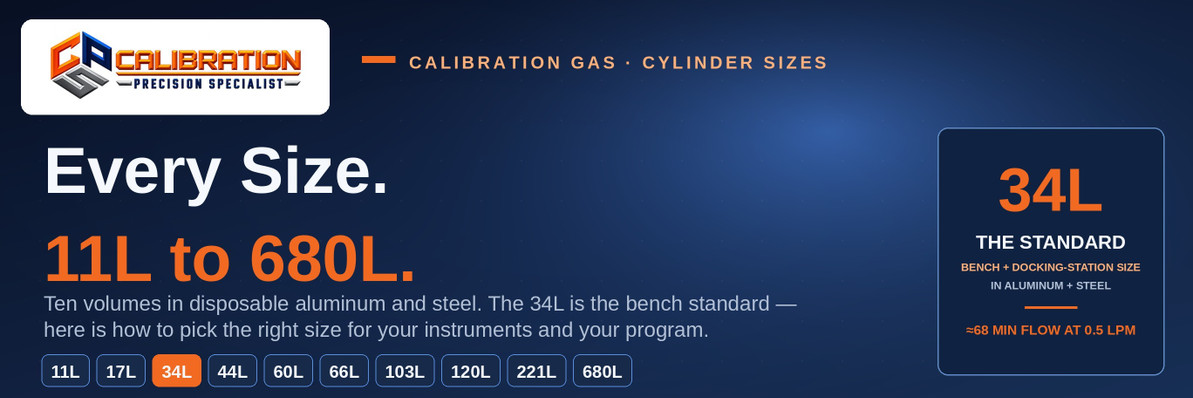
Calibration gas comes in disposable aluminum cylinders of 11L, 34L, 44L, 60L, 66L, and 120L, and steel cylinders of 17L, 34L, 103L, 221L, and 680L — ten volumes in all, from 11L to 680L, with the 34L made in both materials. The 34L is the most common size — it is the standard cylinder for bench calibrations and docking stations — while 11L is the smallest size (sold in minimum quantities of 6) and steel cylinders of 103L and up are made for high-volume calibration programs.
Most buyers meet cylinder sizes as a wall of near-identical product listings and pick one at random. Size is not a detail, though: it decides how often you swap cylinders mid-job, whether your regulator connection matches, and — for reactive gases — how much gas you throw away expired. If you're new to the product itself, what calibration gas is covers what the mixes are and why the concentrations matter. This post is about the container decision: the full size range, what each size is for, and how to pick the one that fits your burn rate, your regulator, and your shelf.
What Sizes Does Calibration Gas Come In?
| Cylinder size | Material | Flow time at 0.5 LPM* | Connection | Typical role |
|---|---|---|---|---|
| 11L | Aluminum (disposable) | ~22 minutes | Varies — check the listing | Smallest size; single-gas bump testing (minimum order of 6) |
| 17L | Steel | ~34 minutes | Varies — check the listing | Compact steel cylinder for personal bump kits and light use |
| 34L | Aluminum or steel | ~68 minutes | Steel: CGA-600 | The standard bench and docking-station size |
| 44L | Aluminum (disposable) | ~88 minutes | Varies — check the listing | Step up from 34L — fewer cylinder changes |
| 60L | Aluminum (disposable) | ~120 minutes | Varies — check the listing | Busy benches and docking stations |
| 66L | Aluminum (disposable) | ~132 minutes | Varies — check the listing | Busy benches and docking stations |
| 103L | Steel | ~206 minutes | C-10 | High-volume calibration programs |
| 120L | Aluminum (disposable) | ~240 minutes | Varies — check the listing | Largest disposable aluminum size |
| 221L | Steel | ~442 minutes | Varies — check the listing | High-volume programs, multi-crew shops |
| 680L | Steel | ~1,360 minutes | Varies — check the listing | The largest size — fixed, high-throughput programs |
*Flow time is the cylinder's gas volume divided by a fixed-flow regulator's standard 0.5 LPM rate. It is a comparison measure, not a promise — a bump test flows gas for seconds, and a full calibration for a minute or two, so real-world life is measured in months, not minutes. Browse the full range in our calibration gas catalog, split into single-gas and multi-gas mixes.
What Does the Liter Number on a Calibration Gas Cylinder Mean?
The liters describe how much gas comes out, measured as the volume the gas would occupy at atmospheric pressure — not the physical size of the bottle. The gas inside is stored compressed at high pressure, which is how a 34L cylinder (the label reads "1.2 Cu. Ft., 34 Liters") fits in a kit case.
That distinction matters twice over. First, don't shop by how big the bottle looks; shop by liters against your usage. Second, the same mix at the same concentrations is available across the size range — going from 34L to 103L changes how often you swap cylinders, not what your instrument drinks.
How Long Does a Cylinder Actually Last?
Run the math on the standard size. A 34L cylinder at 0.5 LPM delivers about 68 minutes of flow. A bump test flows gas for roughly 15–30 seconds; a full calibration, a minute or two including stabilization. On flow time alone, one 34L cylinder is on the order of 130–270 bump tests — which is why a 34L typically lasts a small fleet through many months of bump tests and calibrations. The full per-size math is in how long does a bottle of calibration gas last?
The catch: cylinders rarely die empty. They die expired. Every mix has a shelf life, printed on its product page, and reactive gases have shorter lives than stable ones. A cylinder that outlives its shelf life can drift out of tolerance and start failing bump tests — so the right size is the one you will finish before it expires, not the biggest one on the shelf.
Steel or Aluminum: What Actually Changes?
The gas doesn't care what it's stored in. The differences are about weight, handling, and habit:
- Aluminum is lighter. When the cylinder rides in a bump kit that gets carried to the work all day, the shell weight is the weight you're lifting. Aluminum is the natural pick for the portable end of the range.
- Steel is the workhorse. Steel cylinders are the traditional shop bottles — they live on benches, in cabinets, and on trucks, and they shrug off the knocks of shop life. The big volumes — 103L, 221L, and 680L — are steel.
- The fitting decides compatibility, not the shell. Whatever the material, your regulator has to match the cylinder's CGA connection. Buy the regulator for the fitting, not the metal — and confirm the fitting on the product listing for the exact cylinder you're ordering.
Why Does the Fitting Matter More Than the Size?
Because a mismatch stops work completely. A steel 34L cylinder takes a CGA-600 connection; a steel 103L takes C-10. They are different fittings, and a regulator built for one will not seal on the other — you get no flow, or worse, a leak you can hear.
When you order, match three things in order: the mix (concentrations your instruments are set for), the size (your burn rate), and the fitting (your regulator). If you're moving up from 34L to 103L, budget for the C-10 regulator as part of the move. The full fitting story — what CGA-600 and C-10 are and why both exist — is in CGA-600 vs. C-10 regulators. And match the regulator type to the instrument: fixed-flow (typically 0.5 LPM) for docking stations and manual calibrations with a cap, demand-flow for instruments with an internal pump — our guide to fixed-flow vs. demand-flow regulators explains how to tell which you need.
Which Size Should You Buy?
- One monitor, one tech: 17L or 34L. The gas stays fresh, the kit stays light, and a 34L still holds hundreds of bump tests. For a single-gas instrument used occasionally, 11L cylinders (minimum order of 6) are the low-cost route.
- A bench calibrating a small fleet: 34L to 66L. Step up to 44L, 60L, or 66L aluminum when cylinder swaps interrupt work; the gas costs less per liter as sizes grow.
- A docking station: 34L is the standard fit. Stations consume gas on every automatic bump and calibration, so high-throughput stations justify 60L and up.
- High-volume programs and multi-crew shops: steel, 103L and up. Steel cylinders carry the big volumes — 103L, 221L, and 680L — for programs calibrating daily.
- Reactive or exotic mixes: buy the size you will use up. A smaller cylinder of a short-shelf-life mix beats a large one thrown away half full.
- Occasional use — a couple of calibrations a quarter: stay small. Shelf life, not capacity, is your constraint; a fresh 17L beats a stale 103L every time.
Not sure which mix your instrument needs in the first place? The Calibration Gas Finder matches your instrument's brand and model to the exact mix and cylinder — start there, then pick the size. And if you would rather not keep gas on hand at all, our in-house calibration service includes the gas — cylinders are for your own bench.
How Does Shelf Life Change the Size Decision?
Reactive mixes keep about 6 to 12 months; stable gases around 36 months, and the expiry date is printed on every cylinder. Size and shelf life are the same decision: the bigger the bottle, the faster you must burn it. A 103L of a reactive mix feeding one monitor is gas you'll throw away; the same bottle feeding a docking station is the cheapest way to run the program. Match the cylinder to the consumption rate first and the storage shelf second — the full picture is in calibration gas shelf life.
What Should You Check When a Cylinder Arrives?
Three checks, two minutes:
- Scan the QR code on the cylinder. Every CPS calibration gas cylinder carries one, and it pulls up that cylinder's SDS and Certificate of Analysis — the concentrations, the lot, the paperwork your safety file needs, tied to the exact bottle in your hand.
- Confirm the label against your order. Mix and concentrations match what your instruments expect, and note the printed expiry — that's the date your size decision gets graded against.
- Look at the valve and cap. Damage in transit is rare, but a bent valve or missing cap is a return-now problem, not a discover-it-during-calibration problem.
One cost note while you're comparing suppliers: CPS charges no hazmat fee on calibration gas — the price of the bottle is the price. If you're weighing a one-time bottle against a refillable program, disposable vs. refillable calibration gas cylinders works through that cost question directly.
Storing Cylinders, and Retiring Them
Store cylinders upright, capped, secured, and out of heat and direct sun — the details are in how to store calibration gas. When a cylinder is truly empty and fully depressurized, the shell is recyclable steel or aluminum; how to dispose of calibration gas cylinders covers the safe end-of-life routine. "Empty" means empty — never treat a cylinder that still holds pressure as scrap.
Frequently Asked Questions
What sizes does calibration gas come in? Ten volumes: disposable aluminum cylinders of 11L, 34L, 44L, 60L, 66L, and 120L, and steel cylinders of 17L, 34L, 103L, 221L, and 680L. The 34L is made in both materials.
What is the most common calibration gas cylinder size? The 34L. It is the standard bench and docking-station size, stocked in the widest range of mixes, and at a fixed-flow regulator's 0.5 LPM it delivers about 68 minutes of flow — enough for months of bump tests and calibrations in a small fleet. In steel it uses the common CGA-600 fitting.
How long does a 34L calibration gas cylinder last? On flow time, about 68 minutes at 0.5 LPM — on the order of 130–270 bump tests, since each flows gas for only 15–30 seconds. In practice a 34L lasts a small fleet many months; most cylinders are retired for shelf-life expiry before they run empty.
What is the smallest calibration gas cylinder? The 11L disposable aluminum cylinder. It is sold in minimum quantities of 6 and suits occasional single-gas bump testing.
What is the largest calibration gas cylinder? The 680L steel cylinder, made for fixed, high-throughput calibration programs. The largest disposable aluminum size is 120L.
Are calibration gas cylinders refillable? The cylinders in these sizes are disposable — when one runs empty or passes its shelf-life date, it is replaced, not refilled.
Does cylinder size change which regulator I need? The regulator is set by the cylinder's connection, not its volume class: a steel 34L takes CGA-600, a steel 103L takes C-10, and other sizes vary — check the fitting on the cylinder's product listing and match the regulator to it. Fixed-flow vs. demand-flow is chosen by the instrument, not the cylinder.
Which cylinder size should I buy for a docking station? The 34L is the standard station cylinder. High-throughput stations that burn gas on constant automatic bumps and calibrations step up to 60L or 66L aluminum, or 103L steel — and if you move to the steel 103L, plan on its C-10 regulator as part of the change.
Does calibration gas expire? Yes. Reactive mixes keep about 6 to 12 months and stable gases around 36 months; the expiry date is printed on every cylinder. Expired gas can drift out of tolerance and cause failed bump tests and calibrations — check the date before relying on a cylinder, and size your purchase so you finish the gas before it expires.
Can calibration gas cylinders be shipped? Yes, as regulated hazmat — UN 1956, Compressed Gas, n.o.s., Class 2.2 — by UPS Ground within the United States. They cannot ship by air. CPS charges no hazmat fee on calibration gas.
The Bottom Line
Ten sizes, one decision rule: buy the cylinder your program empties before the gas expires — 17L or 34L for a personal kit and bench, 44L to 66L when swaps interrupt work, 103L and up in steel for high-volume programs. Confirm the mix first, the fitting second, and let your burn rate pick the size. Browse the range under calibration gas, find the mix for a specific instrument in the Calibration Gas Finder, and check what calibration gas do you need for a 4-gas detector? if the mix itself is the open question. Every CPS cylinder's QR code scans to its SDS and Certificate of Analysis, and we charge no hazmat fee. Not sure which size your fleet burns through? Call CPS Calibrations at 865-900-8844 or reach us through Contact Us.
Need a calibration you can file?
In-house calibration at CPS in Rockwood, Tennessee — $55 for single-gas instruments, $90 for 4- and 5-gas — every channel, as-found and as-left data, full certificate.
See Calibration Servicesor call 865-900-8844
Recent Posts
-

Can You Add a Pump to a SENKO SGT-P or MGT?
Yes — SENKO's SP-Pump101 external sampling pump ($330, part AAA006000) fits the SGT, SGT-P, and MGT, …Nov 12th 2026 -

What Refrigerant Detection Does a Grocery Store Need?
A grocery store needs refrigerant detection in three places: low-mounted carbon dioxide (R-744) sens …Nov 11th 2026 -

What Is LEL and UEL? The Explosive Range, Gas by Gas
The LEL is the lowest concentration of a gas in air that can explode, and the UEL is the highest: me …Nov 10th 2026