
What Calibration Gas Do You Need for a 4-Gas Detector?
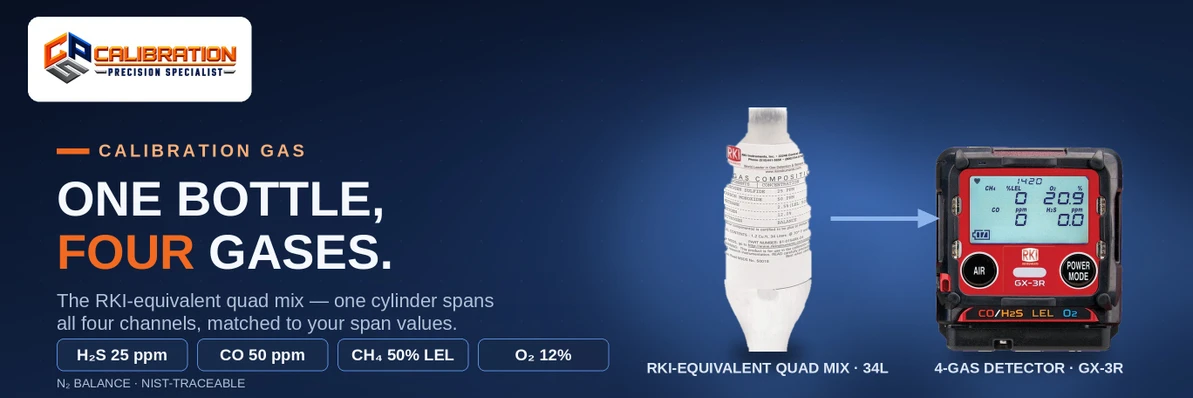
A 4-gas detector needs a quad calibration gas containing all four gases it measures. The most common blend — the RKI-equivalent mix — is hydrogen sulfide (H2S) 25 ppm, carbon monoxide (CO) 50 ppm, methane (CH4) at 50% LEL, and oxygen (O2) 12%, balanced in nitrogen. Blends are not interchangeable between brands: match the mix to your instrument's sensor set and span values, or the calibration will fail or be set wrong.
Why the mix has to match your instrument
A calibration does two things: it checks that each sensor responds, and it sets each channel's span against a known concentration. The instrument expects the concentration printed in its calibration settings — feed it a different blend and one of two things happens: the calibration fails outright, or worse, it "passes" with a span set against the wrong value and every reading afterward is off by that difference.
That is why there is no universal 4-gas cylinder. The gases are always the same four — LEL, O2, CO, H2S — but the concentrations differ by manufacturer:
- RKI-equivalent: H2S 25 ppm / CO 50 ppm / CH4 50% LEL / O2 12%
- MSA-equivalent: H2S 20 ppm / CO 60 ppm / pentane-simulated LEL / O2 15%
Note the LEL difference too: some blends carry methane as the LEL component, others carry pentane (or a pentane-equivalent) because that is what the instrument's LEL sensor is set to respond to. Methane in a pentane-set instrument — or the reverse — reads wrong even when the percentages look similar.
What about a fifth channel or a PID?
If your instrument reads a fifth gas — a toxic sensor, or a PID for volatile organic compounds — a quad mix will never calibrate that channel, because the fifth gas simply isn't in the cylinder. Five-gas instruments need a 5-gas blend that adds the fifth component (isobutylene 100 ppm is the standard PID span gas). We covered how those mixes are built in Specialty Gas Mixes: When a Standard 4-Gas Blend Isn't Enough.
Choosing a cylinder size
- 11L — pocket-size for occasional bump tests (minimum order of 6).
- 34L — the standard bench and docking-station cylinder; the RKI-equivalent quad mix is $184 in a 34L aluminum cylinder.
- 58L–120L — for fleets and stations that calibrate weekly.
- Steel cylinders (103L and up) — high-volume programs.
A 34L cylinder lasts a small fleet many months of bump tests and calibrations. In practice, cylinders are replaced because they reach their shelf-life date, not because they run empty — which is why buying the biggest cylinder is not always the saving it looks like.
The regulator matters as much as the gas
Docking stations and manual calibrations through a calibration cap use a fixed-flow regulator (typically 0.5 LPM). Instruments with an internal pump draw the gas themselves and need a demand-flow regulator. The wrong regulator is one of the most common causes of a failed calibration — we explained the difference in Fixed-Flow vs. Demand-Flow Regulators. Match the connection to the cylinder as well: C-10 or CGA-600, as listed on the cylinder's product page.
Shelf life: the quiet failure
Calibration gas expires. Every mix has a shelf life — listed on each product page in our calibration gas catalog — and reactive gases age faster than stable ones. Gas past its date can drift out of tolerance, and a cylinder that has drifted will fail good instruments or pass bad ones. If your bump tests have started failing for no obvious reason, check the cylinder's date before you blame the sensor — we see it constantly, and it's one of the causes in Why Bump Tests Fail.
Shipping and documentation
Calibration gas ships as regulated hazmat — UN 1956, Compressed Gas, n.o.s., Class 2.2 — by UPS Ground within the United States; it cannot ship by air. Every cylinder CPS sells is NIST-traceable, and the QR codes on the cylinder pull up its Safety Data Sheet and the Certificate of Analysis for that specific cylinder.
If you'd rather not keep gas on the shelf at all, our in-house calibration service uses our gas, not yours — $90 flat for a 4- or 5-gas instrument, 3–5 business-day turnaround.
Frequently Asked Questions
What is in a standard 4-gas calibration cylinder? The most common blend (the RKI-equivalent) is H2S 25 ppm, CO 50 ppm, methane at 50% LEL, and O2 12%, balanced in nitrogen. Other brands specify different concentrations — the MSA-equivalent blend is H2S 20 ppm, CO 60 ppm, pentane-simulated LEL, O2 15% — so match the cylinder to your instrument, not just to the words "4-gas."
Can I use any 4-gas cylinder on any 4-gas detector? No. The instrument's span is set against specific concentrations, and the LEL component may be methane or pentane-based depending on the brand. The wrong blend fails the calibration or sets the span wrong. Check your instrument's calibration settings and buy the matching mix.
How long does a 34L calibration gas cylinder last? In use, a long time — a 34L cylinder typically serves a small fleet through many months of bump tests and calibrations. Most cylinders are retired at their shelf-life date rather than emptied, which is why mid-size cylinders are usually the economical choice.
Does calibration gas expire? Yes. Every mix has a shelf life, printed on the cylinder and listed on its product page. Expired or drifted gas can fail good instruments and pass bad ones, so check the date when a calibration starts behaving strangely.
What size calibration gas cylinder should I buy? 34L is the standard for benches and docking stations. Choose 11L (minimum order of 6) for occasional bump testing, 58L–120L for fleets calibrating weekly, and steel 103L+ cylinders for high-volume programs.
Do I need a regulator, and which kind? Yes — gas doesn't flow without one. Fixed-flow (typically 0.5 LPM) for docking stations and calibration caps; demand-flow for pumped instruments that draw gas themselves. The connection (C-10 or CGA-600) must match the cylinder.
Can calibration gas be shipped? Yes, within the United States by UPS Ground. It is regulated hazmat (UN 1956, Class 2.2) and cannot ship by air or outside the US.
What calibration gas does a 5-gas detector need? A 5-gas blend that adds the fifth channel's gas to the quad mix — isobutylene 100 ppm for PID instruments, or the specific toxic gas for a fifth toxic sensor. A quad cylinder cannot calibrate a fifth channel.
Is your calibration gas NIST-traceable? Yes — every cylinder is NIST-traceable, and the QR codes on the cylinder open its Safety Data Sheet and its own Certificate of Analysis.
How much does 4-gas calibration gas cost? The RKI-equivalent quad mix is $184 in a 34L aluminum cylinder at CPS Calibrations; prices rise with cylinder size and vary by blend. Single-gas cylinders start lower; specialty 5-gas blends cost more than the standard quad mix.
CPS Calibrations sells calibration gas for the instruments it services — and calibrates those instruments in-house for $90 flat (4- or 5-gas). Questions about matching a mix to your instrument: 865-900-8844.
Recent Posts
-

What Is a Confined Space? OSHA's Definition, the 3 Tests, and When It Becomes Permit-Required
A confined space is a space that passes all three of OSHA's tests at the same time: it is large enou …Oct 21st 2026 -

PID vs. LEL for VOC Detection: Which Sensor Do You Actually Need?
Use a PID to detect VOCs and an LEL sensor to detect explosive atmospheres — they measure different …Oct 21st 2026 -

Semiconductor (MOS) Gas Sensors: Where They Work and Where They Lie
A semiconductor (MOS) gas sensor measures gas with a heated film of metal oxide — usually tin dioxid …Oct 21st 2026