
Zero Gas vs Span Gas: The Two Cylinders Every Calibration Needs
Zero gas and span gas do opposite halves of the same job. Zero gas tells the detector what "nothing" looks like — a clean, certified gas with none of the target gases in it — and span gas tells it what a known concentration looks like, so the instrument can scale every reading in between. Skip the zero and the baseline is wrong; span on top of a bad zero and the detector faithfully locks in the error. A real calibration needs both cylinders, zero first, span second.
Every calibration procedure in every detector manual is built on those two reference points. This post explains what each gas actually is, why the oxygen channel plays by different rules, and what goes wrong — quietly — when one of the two cylinders never comes out of the case. If you are still matching gas to instruments, our Calibration Gas Finder pairs gases to specific detectors, and the full calibration gas range is on the store.
What Is Zero Gas?
Zero gas is a certified gas that contains none of the gases the instrument measures — or, for the oxygen channel, a deliberate and known oxygen content. Its job is to give the detector a trustworthy baseline: "when you see this, display zero." It comes in two forms:
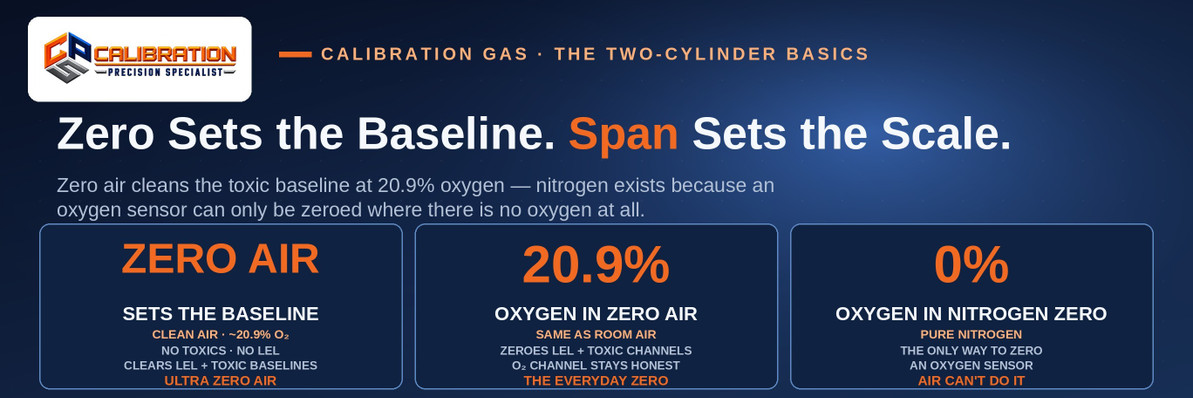
- Zero air. Clean, contaminant-free air — hydrocarbons, CO, H₂S and other target gases removed — carrying the normal atmospheric oxygen content of about 20.9%. It is the zero gas for LEL, CO, H₂S and PID channels, precisely because it cleans the toxics baseline without lying to the oxygen sensor: the O₂ channel sees the same 20.9% it sees in the real world. Zero air is a standard product line at CPS — see what calibration gas is for how the grades are built.
- Nitrogen zero. Pure nitrogen with no oxygen in it at all. It exists for one main reason: the oxygen sensor, covered next.
Why Can't You Zero an Oxygen Sensor in Air?
Because there is nothing to zero against. An oxygen sensor measures oxygen, and ordinary air is 20.9% oxygen — holding the sensor in air and pressing "zero" would teach it that 20.9% oxygen means "no oxygen," corrupting every reading below that point, including the low-oxygen alarms that protect people entering confined spaces. To set the oxygen channel's zero, the gas around the sensor has to contain no oxygen — which is what a nitrogen cylinder provides.
Nitrogen zero also shows up in inert-atmosphere work — tank blanketing, purged enclosures, oxygen-free processes — where instruments are verified against an oxygen-free baseline because that is the atmosphere they actually guard. One handling note that matters: a nitrogen cylinder is itself an oxygen-displacement hazard. Use it in ventilated areas, never breathe from it, and treat it with the same respect as the spaces it helps you enter.
What Is Span Gas?
Span gas is a certified mixture at known concentrations, chosen to sit near the levels the instrument alarms at. Where zero gas sets the bottom of the scale, span gas sets the slope: "when you see this much gas, this is the number you display." The familiar H₂S span standard is 25 ppm; a typical 4-gas span cylinder carries the LEL, O₂, CO and H₂S channels in a single mix (our post on what calibration gas a 4-gas detector needs walks through those mixes), and 5-gas mixes add a fifth channel such as isobutylene at 100 ppm.
Inside every span mix there is also a third player: the balance gas — the air or nitrogen the measured gases are diluted in. Balance changes what the oxygen channel sees during calibration, which is why the mix has to match the instrument maker's specification rather than coming close. That distinction has its own post: air balance vs. nitrogen balance. The concentrations in a given cylinder are printed on its label and certified in its paperwork — on CPS cylinders, a QR code on the cylinder pulls up that cylinder's SDS and Certificate of Analysis.
Zero Gas vs. Span Gas, Side by Side
| Zero gas | Span gas | |
|---|---|---|
| Job in the calibration | Sets the baseline — what the detector displays when no target gas is present | Sets the scale — what the detector displays at a known concentration |
| What's in the cylinder | Zero air (clean air, ~20.9% O₂, no toxics/LEL) or nitrogen (no O₂ at all) | Certified mix at specified concentrations (e.g., H₂S at 25 ppm) in an air or nitrogen balance |
| Used when | First step of a calibration; also to clear a drifting or suspect baseline | Immediately after the zero, while the detector is in calibration mode |
| What goes wrong without it | Every reading carries the baseline error — the detector reads high or low everywhere, all shift | The detector responds but reports the wrong amount — it passes a casual glance and fails at the alarm point |
| Paperwork | Certified contaminant-free grade; SDS and COA by QR code on CPS cylinders | Certified concentrations with stated accuracy; SDS and COA by QR code on CPS cylinders |
What Happens If You Skip the Zero?
Sensor baselines drift — with age, temperature swings, humidity, and exposure history. Zeroing is what absorbs that drift. Skip it, or do it badly, and the error rides along under every reading:
- Zeroing in dirty air is worse than not zeroing. A "fresh-air zero" done beside a running forklift, a solvent cabinet, or idling trucks teaches the detector that contaminated air is clean air. From then on it under-reports — a detector zeroed in 15 ppm of background CO will show roughly 15 ppm less than reality until it is re-zeroed properly. This is the honest argument for certified zero air over "stepping outside": the cylinder is guaranteed clean, the parking lot is not.
- A bad zero poisons the span that follows. The span step assumes the baseline is true. Span a detector whose zero is off and you have built the baseline error into the scale itself — the instrument now passes its calibration record while reading wrong at both ends.
- Negative drift hides. A sensor whose baseline has drifted below zero can sit at a displayed 0 while real gas is already present. A proper zero with clean gas exposes and corrects that instead of masking it.
What Happens If You Skip the Span?
The mirror-image failure: the detector powers on, responds to gas, and reports the wrong amount. Sensors lose sensitivity as they age — span calibration is what measures that loss and corrects the scale factor. Without it, a detector can respond reassuringly to a bump test (which only proves it reacts, not that it reads accurately — the difference is spelled out in bump test vs. calibration) while under-reporting the concentration at the moment the alarm decision matters. Zero without span is a detector that is honest about nothing and vague about everything else.
Which Instruments and Procedures Need Which?
- Multi-gas portables (LEL/O₂/CO/H₂S and up). Both: zero air (or verified clean air, per the manual) for the toxic and LEL baselines, then the matching span mix. Docking stations automate the sequence — zero first, span second — which is why station calibrations are consistent.
- The oxygen channel specifically. Full calibration procedures that zero the O₂ sensor call for nitrogen. Many portable routines instead set the O₂ span in fresh air at 20.9% and never user-zero the channel — follow your manual; the point is that the O₂ zero, when it is done, is done in nitrogen, never in air.
- PID instruments. Zero air matters more, not less: a PID zeroed in solvent-laden air starts its day with a false baseline on the channel most sensitive to background vapours, and span gas (typically isobutylene) sets its scale.
- Fixed systems. The same two-step logic applies at the detector head, which is one reason fixed-detector calibrations are scheduled service rather than a dock-side routine — our calibration services cover both routes.
Frequently Asked Questions
What is zero gas in gas detector calibration?
Zero gas is a certified gas containing none of the gases the instrument measures, used to set the detector's baseline — the reading it shows when no target gas is present. It comes as zero air (clean air at about 20.9% oxygen) for toxic and LEL channels, or nitrogen (no oxygen) for zeroing the oxygen sensor.
What is span gas?
Span gas is a certified mixture at known concentrations — H₂S at 25 ppm is the common standard — used to set the detector's scale, so a given amount of gas produces the correct displayed reading. It is applied immediately after the zero step in a calibration.
Can I zero my gas detector in fresh air instead of zero air?
Only if the air is genuinely clean, and that is the catch: air beside vehicles, solvents, or exhaust carries background gas that the detector will learn as "zero," and it will under-report by roughly that amount until re-zeroed. Manufacturers allow fresh-air zeroing in verified clean air; certified zero air removes the guesswork.
Why do I need nitrogen to zero an oxygen sensor?
An oxygen sensor can only be zeroed in gas that contains no oxygen. Air is 20.9% oxygen, so zeroing in air would teach the sensor that 20.9% means zero and corrupt every reading below it — including low-oxygen alarms. Nitrogen provides the oxygen-free reference the zero requires.
Do I need both zero gas and span gas for a 4-gas monitor?
Yes, for a full calibration: zero air (or verified clean air, as the manual allows) sets the baselines, and the 4-gas span mix sets the scale for the LEL, O₂, CO and H₂S channels. A bump test uses only span gas, because it checks response, not the baseline.
What happens if I calibrate without zeroing first?
The span step builds whatever baseline error exists into the instrument's scale. The detector completes its calibration, generates a passing record, and then reads wrong at every concentration — the failure is invisible until the readings are compared against a known atmosphere.
Is zero air the same as compressed air from a shop compressor?
No. Shop compressor air can carry oil mist, moisture, and carbon monoxide generated by the compressor itself — exactly the contaminants a zero gas must not contain. Zero air is a certified, contaminant-free grade produced for calibration, with its contents documented on the cylinder's certificate.
Can I use nitrogen zero gas for every sensor?
No. Nitrogen is for zeroing the oxygen channel and for specific inert-atmosphere procedures. Zeroing toxic and LEL channels in nitrogen also starves the oxygen channel during the procedure, and most portable manuals specify zero air or clean air for those channels. Match the zero gas to the channel, per the manual.
How long does a cylinder of zero gas last?
It depends on cylinder size and regulator flow. Through a typical fixed-flow regulator at 0.5 L/min, a 34L cylinder delivers about 68 minutes of flow — many dozens of calibrations, since each zero step uses seconds to a minute or two of gas. Shelf life matters too: check the expiry on the label, and see how long bottles really last.
Does a bump test need zero gas or span gas?
Span gas only. A bump test exposes the sensors to a known concentration to confirm they respond and alarm; it does not set the baseline. The zero gas comes out for the full calibration, where accuracy — not just response — is established. A docking station typically runs both steps in sequence.
The Bottom Line
Zero gas and span gas are not two brands of the same thing — they are the two reference points every honest reading hangs from. Zero air keeps the toxic and LEL baselines clean without lying to the oxygen channel; nitrogen exists because an oxygen sensor can only be zeroed where there is no oxygen; and span gas sets the scale that turns a response into a number. Keep both cylinders in the kit, use them in that order, and scan the QR code on any CPS cylinder to pull its SDS and Certificate of Analysis when the paperwork is questioned. Not sure which gases your instruments take? Call CPS at 865-900-8844 or reach us through Contact Us — we sell calibration gas for every major detector brand, and we will match the cylinders to your fleet.
Need a calibration you can file?
In-house calibration at CPS in Rockwood, Tennessee — $55 for single-gas instruments, $90 for 4- and 5-gas — every channel, as-found and as-left data, full certificate.
See Calibration Servicesor call 865-900-8844
Recent Posts
-

Can You Add a Pump to a SENKO SGT-P or MGT?
Yes — SENKO's SP-Pump101 external sampling pump ($330, part AAA006000) fits the SGT, SGT-P, and MGT, …Nov 12th 2026 -

What Refrigerant Detection Does a Grocery Store Need?
A grocery store needs refrigerant detection in three places: low-mounted carbon dioxide (R-744) sens …Nov 11th 2026 -

What Is LEL and UEL? The Explosive Range, Gas by Gas
The LEL is the lowest concentration of a gas in air that can explode, and the UEL is the highest: me …Nov 10th 2026