
How Do You Dispose of Calibration Gas Cylinders?
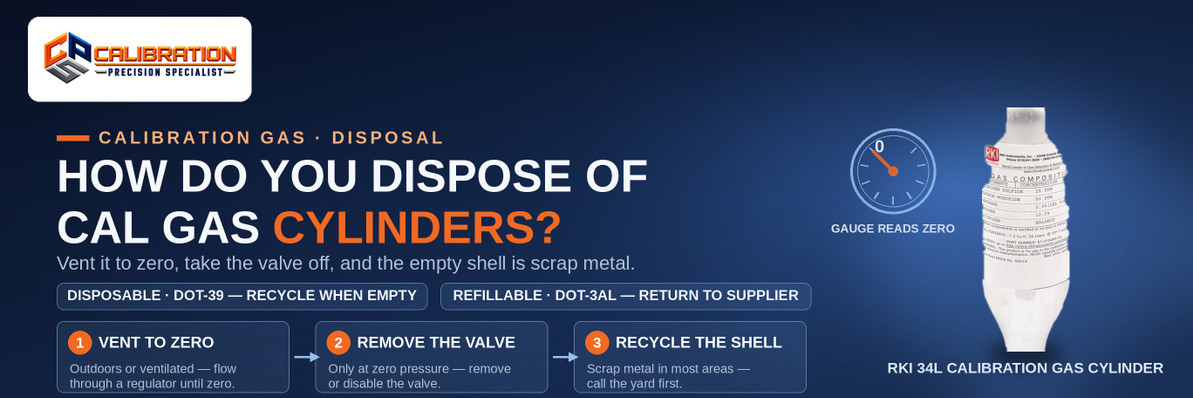
To dispose of an empty disposable calibration gas cylinder, vent the last of the gas out through a regulator in a safe, ventilated area until the gauge reads zero, then remove or disable the valve — at zero pressure with the valve off, the shell is scrap metal and is accepted for recycling in most areas. Never put a cylinder that still holds pressure in the trash, and never treat a partially full cylinder — especially a toxic gas like hydrogen sulfide, chlorine, or ammonia — as an empty: use the gas up, or route it through your supplier or a local hazardous-waste program. Refillable DOT-3AL cylinders aren't disposed of at all — they go back to the supplier for refill.
That's the whole answer. The rest of this post is the details that keep each step safe and legal: how to tell which kind of cylinder you're holding, the step-by-step for empties, the separate routes for partial and toxic cylinders, and the short list of things to never do. We get asked this question constantly — usually by someone staring at a shelf of dead bottles that accumulated because disposal felt like a gray area. It doesn't have to be.
First: Which Kind of Cylinder Are You Holding?
Disposal starts with identification, because the two cylinder families in this business have opposite endings:
- Disposable (DOT-39). Built to the DOT-39 specification and legally non-refillable — the 17L, 34L, 58L, and 103L bottles most fleets bump and calibrate with. When one is empty, its life is over, and this post's recycling steps apply. (The disposable-vs-refillable economics are covered in our post on disposable vs. refillable calibration gas cylinders.)
- Refillable (DOT-3AL). Built for the round trip — thicker walls, a service valve, periodic hydrostatic retesting. These are return assets, not disposables. Many are marked right on the label: the ecosmart refillable in our hero photo says "REFILLABLE CYLINDER — DO NOT DISCARD" and "RETURN." If yours says anything like that, skip to the refillable section below — it goes back, not out.
If a cylinder's label is missing or unreadable and you don't know what gas is in it, stop there. An unidentified cylinder doesn't get the vent-and-recycle treatment; it goes to a hazardous-waste professional who can identify and handle it. More on that below.
How Do You Dispose of an Empty Disposable Cylinder? Step by Step
For a standard disposable cylinder that has genuinely run out, the process is short:
- Prove it's empty. Thread on a regulator and check the gauge, then open the valve. A bottle that "feels dead" can still hold meaningful pressure — enough to matter in a trash compactor. The gauge, not the heft, decides.
- Vent it fully through the regulator. Outdoors or in a well-ventilated area, away from people and — for combustible mixes — away from ignition sources, open the valve and let the remaining gas flow out through the regulator until the gauge reads zero and flow stops. Then leave the valve open for a while so the last residual pressure equalizes. Use the regulator rather than cracking the bare valve: it controls the release and keeps dirt out of the valve.
- Remove or disable the valve. Once the cylinder is verified at zero pressure, remove the valve (or disable it per the cylinder maker's instructions). This is the step that converts "a cylinder" into "a piece of metal" in the eyes of recyclers and waste handlers — it proves the shell can't hold pressure and can't be refilled by accident.
- Recycle the shell as scrap metal. A fully depressurized cylinder with the valve removed is, in most areas, accepted as scrap metal — steel or aluminum depending on the bottle. Call the scrap yard or recycling center first and tell them exactly what you have; acceptance and prep requirements vary by state and municipality, and some want the cylinder marked "EMPTY."
- Ask about supplier take-back. Some gas suppliers will take back their own empty disposables, or accept them when your next order delivers. It's worth one question before you haul shells anywhere — the answer is often yes, and it's the simplest route of all.
Done this way, an empty disposable is a non-event: no hazard, no special paperwork for a truly empty, depressurized shell in most jurisdictions — and no growing pile in the corner.
What If the Cylinder Isn't Empty?
This is where disposal goes wrong in the real world, because "mostly empty" and "expired" cylinders get treated like empties. They aren't. Work them in this order:
- Still in date, still usable? Use it up. The cleanest disposal is consumption. A partial bottle of in-date gas can finish its life doing bump tests and calibrations on the job it was bought for. This is also why right-sizing matters — the storage habits in our post on how to store calibration gas (rotate oldest first, buy the size you'll finish) are what keep partial cylinders from becoming a disposal problem in the first place.
- Expired or unusable? Don't use it, don't rush to vent it. Gas past its certified shelf life shouldn't be used for calibration — the concentration is no longer guaranteed (the full breakdown is in our post on calibration gas shelf life). But an expired bottle with real pressure in it is also not a vent-and-recycle candidate, especially if it's a toxic or flammable mix. Deliberately venting a meaningful quantity of toxic gas to "empty" a bottle just moves the hazard from the cylinder to the air around you.
- Route it out: supplier first, hazardous waste second. Ask the supplier who sold it — many gas suppliers take back their own cylinders, partial or expired, because they have the equipment and permits to handle the contents. If they won't, your local hazardous-waste program (the same authority that runs household hazardous-waste collection, and its commercial equivalent) is the correct destination. Tell them the gas and concentration from the label; that's what determines how they'll take it.
The rule that ties it together: the fuller and more hazardous the contents, the less this is a do-it-yourself job.
Why Do Toxic and Reactive Gases Get Extra Caution?
A 4-gas bottle and a bottle of chlorine are both "calibration gas," but they don't get the same ending. Toxic and reactive gases — hydrogen sulfide (H₂S), chlorine (Cl₂), ammonia (NH₃), sulfur dioxide (SO₂), hydrogen cyanide (HCN) — deserve a slower hand, for two reasons:
- "Empty" isn't empty. A toxic-gas cylinder at atmospheric pressure still holds a full cylinder's volume of the gas at low pressure, and residues adsorb onto the walls of reactive-gas bottles. Venting the last of a toxic cylinder should happen outdoors or with real ventilation, upwind, away from air intakes, occupied areas, and anyone downstream — never into a closed shop, a vehicle, or a drain.
- The SDS and local rules govern, not habit. Every mix ships with a safety data sheet that covers handling and disposal for that specific gas, and disposal acceptance for pressurized or toxic-gas cylinders varies by state and municipality. When the SDS and a general rule of thumb disagree, the SDS wins. When a toxic cylinder is damaged, corroded, leaking, or still pressurized with no way to use the contents, that's a hazardous-waste or supplier job — not the scrap-metal steps above.
Flammable mixes (methane, pentane, and other LEL blends) carry the mirror-image rule: venting happens away from sparks, flames, pilot lights, and running engines, full stop.
Refillable Cylinders Aren't Disposed Of — They're Returned
A refillable DOT-3AL cylinder never reaches the vent-and-recycle steps, because it was never a one-way product. It's a deposit-and-return asset: you bought the gas and the use of the shell, and the shell goes back to the gas house for refill, over and over, through periodic hydrostatic retests.
Even at the very end of a refillable's life, the ending isn't yours to improvise. When a shell fails retesting or is damaged, the supplier or gas house retires it through their own process — they control the depressurization and the scrapping. Send it back and let the return loop finish the job. Scrapping a refillable yourself throws away the deposit value and skips the people equipped to retire it properly. (How the round-trip economics work is covered in the disposable vs. refillable post.)
Never Do This
- Never put a pressurized cylinder in the trash or a dumpster. A cylinder with pressure in it can rupture under compaction or in a waste truck — a genuine injury hazard to waste workers, and the reason "just throw it away" is never the answer.
- Never puncture, crush, cut, or drill a cylinder that hasn't been verified fully depressurized with the valve removed. The verification comes first; the scrap prep comes second.
- Never remove the valve from a cylinder that still shows pressure. Zero on the gauge, no flow, valve open and equalized — then, and only then, does the valve come off.
- Never refill a disposable. DOT-39 cylinders are non-refillable by law and by construction — thinner walls and a single-use valve that aren't rated for a second pressurization. No legitimate gas house will fill one.
- Never vent toxic gas indoors or near people, air intakes, or occupied spaces just to empty a bottle faster.
- Never guess at an unlabeled cylinder. Unknown contents go to a hazardous-waste professional, not to the vent-and-recycle steps.
The Calibration Angle
Here's the pattern we see from the bench: disposal problems are usually rotation problems that had a few months to grow. Gas that gets stored right, rotated oldest-first, and bought in sizes matched to the fleet mostly gets used — and used gas never needs disposing. It's the forgotten bottle in the back, two years past its date and half full of H₂S, that becomes the headache. Our posts on calibration gas shelf life and storing calibration gas are the prevention side of this one.
And if you're staring at a shelf of empties and partials right now and you're not sure which route each bottle takes? Call us at 865-900-8844 and describe what you have — the gas, the size, whether it's disposable or refillable, and how much is left. We'll tell you your options, including whether your supplier is likely to take them back. When your detectors come in for service — shipped to our Rockwood lab or on-site at your facility — we're happy to look at the cylinder shelf while we're at it: we calibrate every channel, and a fleet's gas inventory is part of doing that right. Fresh stock is on the calibration gas page, including our standard 4-gas mix.
The Bottom Line
Disposing of calibration gas cylinders comes down to matching the route to the bottle. Empty disposable: vent it to zero through a regulator in a ventilated area, remove the valve, and recycle the shell as scrap metal where accepted — or hand it back to your supplier. Partial, expired, damaged, or toxic: use the gas up if you legitimately can, and otherwise let the supplier or a hazardous-waste program take it. Refillable: it goes back, every time, including at end of life. The only true never on the list is the one that matters most — a cylinder that still holds pressure never goes in the trash.
Frequently Asked Questions
Can you throw an empty calibration gas cylinder in the trash? Not while it holds any pressure — a pressurized cylinder in the trash is a rupture hazard for waste workers and is the one route that's never acceptable. A cylinder that has been fully vented to zero and had its valve removed is scrap metal, and in most areas it belongs in metal recycling rather than the trash; some local programs do accept prepared empties as regular waste, but rules vary by state and municipality, so check before you toss. When in doubt, recycle it or hand it to your supplier.
How do you know a calibration gas cylinder is really empty? Don't go by weight or feel. Thread on a regulator and read the gauge: zero pressure, and no flow or hiss when the valve is opened through the regulator, means empty. Leave the valve open for a bit afterward so any residual pressure equalizes before you remove the valve. If the gauge shows anything at all, the cylinder still has contents to deal with — treat it as partially full.
Can a disposable calibration gas cylinder be refilled instead of thrown away? No. Disposable cylinders are built to the DOT-39 specification, which is legally and mechanically non-refillable — thinner walls and a single-use valve not rated for repeated pressurization. No legitimate gas supplier will refill one. When it's empty, vent it, remove the valve, and recycle the shell; if you want a cylinder that comes back, that's the refillable DOT-3AL side of the disposable vs. refillable choice.
What should you do with an expired cylinder that's still half full? Don't calibrate with it — past its certified date, the concentration is no longer guaranteed. Don't vent a meaningful amount of it either, particularly a toxic or flammable mix. Ask the supplier who sold it about take-back first; many take their own cylinders back. Otherwise, route it through a local hazardous-waste program, and tell them the gas and concentration from the label.
Will a scrap yard take calibration gas cylinders? In most areas, yes — once the cylinder is fully depressurized and the valve has been removed, the shell is simply steel or aluminum scrap. Call ahead, describe exactly what you have, and ask about their prep requirements (some want cylinders marked "EMPTY"), because acceptance varies locally. A cylinder that still holds pressure, or still has its valve, is a different conversation — finish the venting steps first.
What happens to a refillable cylinder at the end of its life? It goes back through the return loop. Refillables are retired by the supplier or gas house when they fail hydrostatic retesting or are damaged — they handle the depressurization and scrapping. Don't scrap a refillable yourself: you'd lose the deposit value and skip the people equipped to retire it.
What if a cylinder is damaged, leaking, or you don't know what's in it? Don't vent it, don't move it more than you have to, and don't guess. Move people away if it's actively leaking, ventilate the area if you can do so safely, and call your supplier or your local hazardous-waste authority for instructions. Unlabeled or unknown cylinders are identified and handled by hazardous-waste professionals — they never get the standard vent-and-recycle steps.
CPS Calibrations · 109 S. Front Street, Rockwood, TN 37854 · Portable Gas Detection · Calibration Gas · Calibration Services · Contact Us
Recent Posts
-

Why Does Gas Detector Data Logging Matter? The Paper Trail Your Incidents Need
Gas detector data logging matters because it is the only objective record of an incident: a data-log …Oct 22nd 2026 -

What Is a Confined Space? OSHA's Definition, the 3 Tests, and When It Becomes Permit-Required
A confined space is a space that passes all three of OSHA's tests at the same time: it is large enou …Oct 21st 2026 -

PID vs. LEL for VOC Detection: Which Sensor Do You Actually Need?
Use a PID to detect VOCs and an LEL sensor to detect explosive atmospheres — they measure different …Oct 21st 2026