
Disposable vs. Refillable Calibration Gas Cylinders: Which Costs Less?
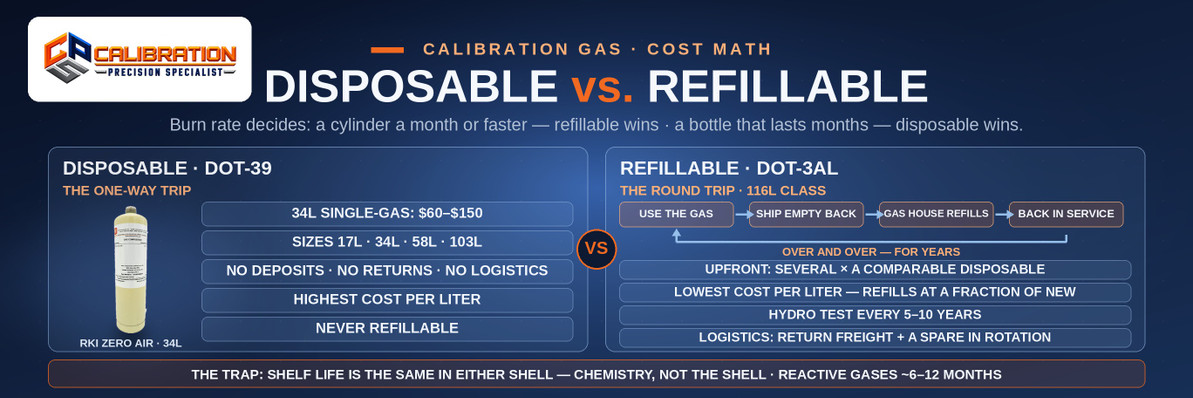
Neither wins for everyone: disposable (DOT-39) calibration gas cylinders are cheaper to buy — a 34L single-gas bottle typically runs $60–$150 — but carry the highest cost per liter, while refillable (DOT-3AL) cylinders cost several times more up front and then refill at a fraction of a new cylinder's price. Burn rate decides it: if you go through a cylinder a month or faster, refillables usually cost less; if a bottle lasts you months, disposables do.
Set a disposable 58L cylinder next to a refillable one and they look like the same product in the same size. They aren't. One is a one-way trip: buy it, use it, vent it empty, and dispose of the shell. The other is a round trip: buy the cylinder once, then ship it back to the gas house for refills at a fraction of the new-cylinder price, over and over, for years.
Most shops default to disposables because they're sitting on the shelf and the invoice is simple. That's fine — until your gas bill grows past the point where the round-trip cylinder would have been cheaper. Here's how the two actually compare, and the simple burn-rate math that decides it.
Disposable vs. Refillable at a Glance
| Disposable (DOT-39) | Refillable (DOT-3AL / ISO 7866) | |
|---|---|---|
| Common sizes | 17L, 34L, 58L, 103L | 116L class (ecosmart, 6D/7D-class programs) |
| Upfront cost | Low — 34L single-gas typically $60–$150 | High — often several times a comparable disposable |
| Cost per liter | Highest — a new cylinder is built into every price | Lowest over time — refills at a fraction of a new cylinder |
| Shelf life | Set by the gas — reactive gases ~6–12 months | Identical — chemistry, not the shell |
| Refills | Never — legally non-refillable | Repeated, within service life; hydrostatic retest every 5–10 years |
| Logistics | None — buy, use, vent, dispose of the shell | Return freight, a spare in rotation, retest dates to track |
| Best for | Small fleets, rare gases, low burn rate | High-volume fleets, daily calibration, workhorse mixes |
Disposable Cylinders: The One-Way Trip
A disposable calibration gas cylinder is built to DOT-39 specification — a non-refillable standard, in aluminum for reactive gases (H₂S, Cl₂, NH₃, HCl) or steel for non-reactive mixes. Common portable sizes run 17L, 34L, 58L, and 103L, most with a C-10 valve connection that threads straight onto your fixed-flow or demand-flow regulator.
The selling points are all about simplicity:
No deposits, no returns, no logistics. You buy the cylinder, it arrives ready to use, and when it's empty you vent it fully, handle the shell per your local disposal rules, and order another. There's no cylinder inventory to track, no empties staging in the shop, no return freight to schedule.
Low upfront cost. A 34L single-gas disposable typically lands in the $60–$150 range depending on the gas; a 103L multi-gas cylinder runs a few hundred dollars. Easy to budget, easy to approve.
The right size for small fleets. If you're bump-testing a handful of monitors a few times a week, a 34L or 58L disposable can last months — and for reactive gases with 6–12 month shelf lives, "lasts until it expires" is exactly the cylinder you want (see our post on calibration gas shelf life).
The downsides are equally real: you're paying the highest price per liter of gas in the industry — every disposable includes a brand-new cylinder in the price — and you're generating a steady stream of empty shells to dispose of. For a plant bumping twenty monitors every morning, disposables become a treadmill of orders, deliveries, and dead cylinders.
And one hard rule: DOT-39 means non-refillable, full stop. The thinner walls and single-use valve aren't rated for repeated pressurization, and no legitimate gas house will refill one. Attempting it isn't a shortcut — it's a safety and legal problem.
Refillable Cylinders: The Round Trip
A refillable calibration gas cylinder — built to DOT-3AL or ISO 7866, with refillable product lines like the ecosmart 116L series, Calgaz's refillable 6D/7D sizes, or SpecAir's Enviro-Cyl — is engineered for the round trip. Thicker walls, a service valve designed for repeated connections, and a DOT retest stamp that keeps it legal through periodic hydrostatic testing (typically on a 5- or 10-year cycle).
The deal works like this: you buy the cylinder once (a real upfront cost — often several times the price of a comparable disposable), then when it runs low you ship the empty back to the gas house. They refill it — usually with the same certified mix — and send it back at a refill price that's typically a fraction of a new disposable. Some programs even credit you for returning cylinders, aluminum shells included.
The math is all about burn rate. A refillable doesn't save you a dime sitting half-full. It saves you money on the tenth refill, the twentieth, the fiftieth. High-volume users — plants with big fleets, service companies calibrating daily, anyone running bump-test stations around the clock — cross the break-even point fast. A shop that burns through a cylinder a month will pay for the refillable cylinder itself in the first year or two, then keep the per-refill savings for as long as the shell stays in service.
The catch is logistics. You now own a cylinder fleet: empties to stage, return freight to arrange, turnaround time to plan around (keep a spare in rotation or the refill cycle becomes your downtime), and retest dates to track. None of this is hard — it's just work that disposables never asked you to do.
Does Gas Last Longer in a Refillable Cylinder? The Shelf-Life Trap
No — and here's the trap that catches smart buyers: a refillable cylinder does not make the gas last longer. Shelf life is chemistry, not metallurgy. That 116L refillable of hydrogen sulfide still expires on the H₂S clock — roughly 12 months — just like the disposable would. If your fleet is two monitors and a quarterly calibration schedule, a giant refillable of a reactive gas will expire mostly full, and every refill is wasted money.
Rule of thumb: size the cylinder — disposable or refillable — to what you'll actually consume before the shortest-lived component expires. For reactive gases, that's usually the 34L–58L range for small shops. Refillables pay off when you're burning through that same gas fast enough that shelf life never gets a vote.
Which One Costs Less? Do the Burn-Rate Math
Per liter, disposables are the most expensive way to buy calibration gas — but cost per liter isn't the whole bill, and it isn't what decides this. Forget brand loyalty and shelf availability. The decision is three inputs:
- Your burn rate. How many liters per year? Multiply your bump tests and calibrations by the gas each one consumes (a bump test at 0.5 LPM for a minute is half a liter; full calibrations use more). Low burn rate → disposable. High burn rate → start pricing refillables.
- Your gas mix. Reactive gases (H₂S, Cl₂, NH₃, HCl, SO₂) favor smaller cylinders you'll finish before expiration — often disposables. Stable gases (methane, CO, pentane, O₂) in high volume are the sweet spot for refillables.
- Your logistics appetite. If nobody in the shop will manage cylinder returns, a refillable program dies in the corner with three empties. Be honest about it.
Use disposables when:
- Your fleet is a handful of monitors, bumped a few times a week
- The gas is exotic or rarely used — a bottle you touch quarterly, not daily
- The gas is reactive and a small bottle gets finished before it expires anyway
- Nobody in the shop will own cylinder returns and retest tracking
Use refillables when:
- You burn through a cylinder a month or faster
- The gas is a stable, high-volume workhorse mix used every day
- You run bump-test stations, a big fleet, or daily calibrations
- You can keep a spare in rotation so turnaround time never becomes downtime
A practical pattern we see in well-run shops: disposables for the exotic stuff (the chlorine 2 ppm bottle you touch quarterly, the ammonia 10 ppm for the one fixed head in the corner) and refillables for the workhorse gas — the 4-gas mix your RKI GX-3R and SENKO SP-MGT fleets drink every day. One cylinder type doesn't have to win everywhere.
The Calibration Angle
Here's where this connects to our benches: whether your fleet runs disposables, refillables, or a mix of both, we calibrate every channel with fresh, NIST-traceable gas — and we check the date on our own bottles like it's our job, because it is. Every detector that comes through our lab — gas detection and process instruments alike, temperature, flow, pressure, and gas — gets challenged with gas inside its certified life, and the certificate shows the gas lot behind the work. We calibrate every channel, and we prove it on paper.
Not sure your cylinders are sized to your fleet? Call us at 865-900-8844 — we'll help you match cylinder sizes and types to your actual burn rate before you spend a dollar. Ship your detectors to our lab or have us come to your facility.
The Bottom Line
Disposables (DOT-39) win on simplicity: low upfront cost, no logistics, no returns — but the highest cost per liter and a stream of empty shells. Refillables (DOT-3AL) win on economics above a break-even burn rate: buy the cylinder once, refill at a fraction of the cost — but only if you're burning gas fast enough to get there, and only with a logistics plan for returns. Either way, size the cylinder to what you'll consume before the gas expires — shelf life doesn't care which shell it's in.
Stocking up? Browse calibration gas — single-gas bottles (pentane, isobutylene, H₂S, NH₃, Cl₂ and more) and multi-gas mixes — and check the date on the bottles you already own. Need your fleet verified? Ship your detectors to our lab or have us come to your facility — gas detection and process instruments alike.
Frequently Asked Questions
Can I refill a disposable calibration gas cylinder? No. Disposable cylinders are built to DOT-39 specification, which is legally and mechanically non-refillable — thinner walls and a single-use valve that isn't rated for repeated pressurization. No legitimate gas supplier will refill one, and attempting it is a safety and legal problem. When it's empty, vent it fully and dispose of the shell per your local rules.
How many times can a refillable cylinder be refilled? Essentially unlimited within the cylinder's service life. Refillables (DOT-3AL / ISO 7866) are built for repeated filling, but they must pass periodic hydrostatic retesting — typically every 5 or 10 years — to stay in service. The retest stamp on the shoulder is the proof; an out-of-date cylinder won't be filled.
Does calibration gas last longer in a refillable cylinder? No. Shelf life is determined by the gas chemistry — reactive gases like H₂S and Cl₂ drift in 6–12 months regardless of the shell. A refillable only saves money if you consume the gas before it expires. Oversized refillables of reactive gas are one of the most expensive mistakes in calibration gas buying.
Are refillable cylinders always cheaper than disposables? Only above a break-even burn rate. A refillable costs several times more upfront, then refills at a fraction of a new disposable's price. Low-volume users may never reach the crossover point — and they avoid the return logistics entirely. High-volume users (plants, service companies, bump-test stations) cross it quickly and save on every refill after.
What do I do with empty disposable cylinders? Vent the cylinder completely through a regulator in a safe area, remove or disable the valve per local regulations, and recycle the steel or aluminum shell. Rules vary by state and municipality, so check your local hazardous-waste guidance — and never put a pressurized cylinder in general trash.
Do disposable and refillable cylinders use the same regulator? Most portable cylinders — disposable and refillable — in the 34L–116L range use the same C-10 valve connection, so your fixed-flow regulator or demand-flow regulator threads onto both. Larger refillable cylinders may use different CGA connections (e.g., CGA-590 or 600), so confirm the valve before ordering.
CPS Calibrations · 109 S. Front Street, Rockwood, TN 37854 · Portable Gas Detection · Calibration Gas · Calibration Services · Contact Us
Recent Posts
-

Why Does Gas Detector Data Logging Matter? The Paper Trail Your Incidents Need
Gas detector data logging matters because it is the only objective record of an incident: a data-log …Oct 22nd 2026 -

What Is a Confined Space? OSHA's Definition, the 3 Tests, and When It Becomes Permit-Required
A confined space is a space that passes all three of OSHA's tests at the same time: it is large enou …Oct 21st 2026 -

PID vs. LEL for VOC Detection: Which Sensor Do You Actually Need?
Use a PID to detect VOCs and an LEL sensor to detect explosive atmospheres — they measure different …Oct 21st 2026