
Gas Detection in the Refrigeration Machinery Room: What ASHRAE 15 Requires
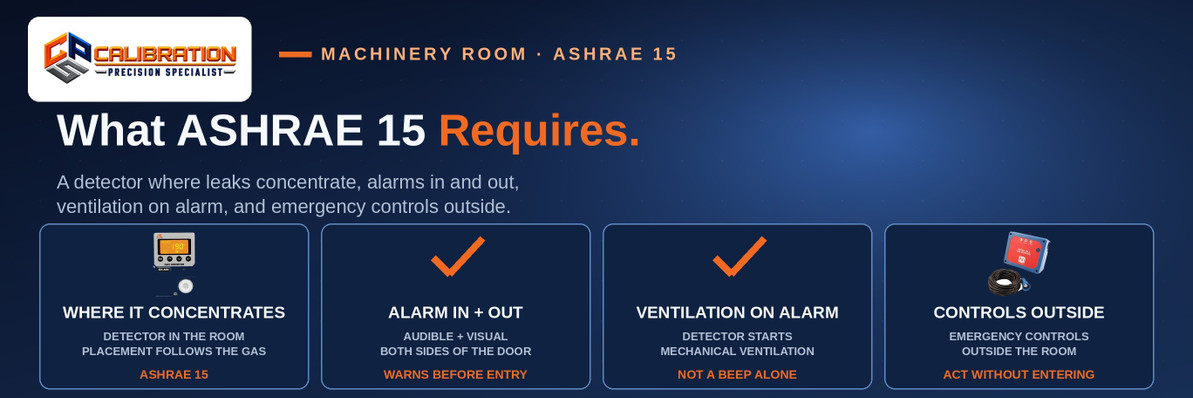
ASHRAE Standard 15 requires a refrigeration machinery room to contain a refrigerant detector located where a refrigerant leak would concentrate, and that detector must trigger an audible and visual alarm both inside and outside the room, activate the room's mechanical ventilation, with emergency controls located outside the room. Detection that only sounds a local beep — no outside alarm, no ventilation — does not meet the standard.
Of all the rooms in a cold storage plant, the machinery room is the one with a named standard written around it. ASHRAE 15 is the safety standard for refrigeration systems, and its machinery-room detection provisions are short, specific, and functional: they describe what the system must do, not just what must be mounted. This post states each requirement in plain language and explains why it is written that way. It is a summary in substance, not the controlling text — for a compliance determination, work from the current edition of the standard and your authority having jurisdiction. The rest of the cold storage series covers where ammonia leaks hide, halocarbon pooling, and the detectors workers carry.
What Does ASHRAE 15 Require, Requirement by Requirement?
| Requirement | What it means in the room |
|---|---|
| A refrigerant detector in the machinery room | Continuous refrigerant detection in the room itself — not a portable, not a detector in an adjacent space |
| Located where a refrigerant leak would concentrate | Placement follows the gas: above likely leak points and covering the occupied zone for ammonia (vapor rises; cold aerosol releases can behave differently); low, at pits and low corners, for heavier-than-air halocarbons |
| Audible and visual alarm inside the room | A worker in the room — over compressor noise, in a bright or dark space — gets the warning in two senses |
| Audible and visual alarm outside the room | The warning reaches a technician before he opens the door and enters the leak |
| The detector activates mechanical ventilation | On alarm, the room's ventilation starts automatically and begins diluting the refrigerant — detection and mitigation are one system |
| Emergency controls outside the room | The controls needed in an emergency can be reached and operated without entering the hazardous room |
Why Does Placement Say "Where a Leak Would Concentrate"?
Because ASHRAE 15 is written around the physics, and the physics differ by refrigerant. The standard does not stamp one mounting height because one height is wrong for half the industry:
- Ammonia vapor is lighter than air and rises, so detectors belong above likely leak points — valve groups, compressors, vessels — with coverage of the occupied zone, because a cold aerosol release can initially slump and travel at working height before it warms and rises. The exposure stakes are toxic: OSHA PEL 50 ppm, NIOSH IDLH 300 ppm.
- Halocarbons such as R-404A, R-449A, and R-134a are heavier than air and pool low, so "where it concentrates" is the pit, the trench, and the low corner — and the consequence to guard is oxygen displacement, air falling below 19.5% oxygen from its normal 20.9%.
A detector mounted for conduit convenience instead of concentration fails the requirement in substance even if a detector is technically "in the room."
Why Must the Alarm Be Inside AND Outside?
The outside alarm is the one that saves the entry. A machinery-room leak's most likely victim is not the person already inside when it starts — it is the technician who arrives on a fault call, pulls the door open, and steps into a room that has been filling, unwatched, for an hour. An alarm that sounds only inside that room warns him at the moment he is already in the hazard. The outside audible and visual alarm moves the warning to the one place it can change the outcome: the doorway, in clean air, before entry. The inside alarm protects the occupant; the outside alarm protects the entrant. ASHRAE 15 requires both because the two people are in two different kinds of danger.
Why Must the Detector Activate Ventilation?
Because detection without mitigation only documents the emergency. When the detector starts the room's mechanical ventilation automatically, three things happen without waiting for a human decision: the refrigerant concentration is diluted toward safe levels, the room a responder eventually enters is a better room than the one that alarmed, and the system behaves the same way at 2 a.m. as it does during a staffed shift. A detector whose only output is a sound depends entirely on someone hearing it, responding correctly, and starting ventilation by hand — in an unstaffed room, that chain has no first link. Tying the detector's relay to ventilation is what makes the installation a system rather than an accessory; it is also a core part of what our fixed system installation work wires and tests.
What Do Emergency Controls Outside the Room Cover?
The principle is reach: in an emergency, the controls for the refrigeration system must be operable from outside the machinery room, so nobody has to enter a room in alarm conditions to shut down equipment or act on the system. It is the same logic as the outside alarm, applied to action instead of warning — the doorway, not the hazard, is where the human stands. In an audit, this is a walk-the-room check: stand outside the door and ask what you can see (the outside alarm), what starts by itself (ventilation), and what you can operate (the emergency controls) without crossing the threshold.
What Does Meeting ASHRAE 15 Cost, and What Keeps It Met?
The detection hardware for a single machinery room starts at stand-alone scale — a stand-alone oxygen point such as the RKI OX-600 is $785, and a combustible point such as the RKI PS 2 is $450 — and rises with refrigerant-specific points, controller integration, and the ventilation and alarm wiring the standard's functional requirements demand. The honest total is a per-room figure that depends on the room; anyone quoting it without seeing the room is guessing.
Staying met is the second half: a detector that has drifted out of calibration satisfies the paperwork and fails the purpose. Every machinery-room point goes on a written calibration schedule based on its manual — we calibrate every channel an instrument carries, through calibration services and the CPS Calibration Program. In-house calibration is $55 single-gas / $90 for 4- & 5-gas instruments; on-site work on installed systems is quoted in writing and costs more than bench work — we never present in-house rates as on-site rates.
Frequently Asked Questions
What does ASHRAE 15 require for gas detection in a refrigeration machinery room?
ASHRAE Standard 15 requires each refrigeration machinery room to contain a refrigerant detector located where a refrigerant leak would concentrate. The detector must trigger an audible and visual alarm both inside and outside the room, and it must activate the room's mechanical ventilation. Emergency controls for the refrigeration system are located outside the room. All four elements — placement, two-sided alarming, ventilation activation, and outside controls — are part of the requirement, not a menu.
Does ASHRAE 15 require a detector in every refrigeration machinery room?
Yes, in substance: the requirement attaches to the machinery room itself — each refrigeration machinery room shall contain a detector. A portable monitor carried by a technician, or a detector in an adjacent space, does not substitute for a detector in the room, because the room's leaks occur around the clock, including when no technician is present. The detector's location within the room is governed by where a leak of that room's refrigerant would concentrate.
Where must the machinery room refrigerant detector be located?
Where a refrigerant leak would concentrate — placement follows the gas. For ammonia, whose vapor is lighter than air and rises, that means above likely leak points such as valve groups and compressors, with coverage of the occupied zone as well, since a cold aerosol release can behave differently at first. For heavier-than-air halocarbons such as R-404A, R-449A, and R-134a, it means low — pits, trenches, and low corners. A location chosen for wiring convenience rather than concentration does not meet the requirement in substance.
Why does ASHRAE 15 require an alarm outside the machinery room?
To warn the entrant before entry. The person most at risk from a machinery-room leak is often the technician arriving later who opens the door into a room that has been filling unwatched. An alarm sounding only inside warns him once he is already in the hazard; the audible and visual alarm outside the room warns him at the doorway, in clean air, where the warning can still change what he does next. The inside alarm protects occupants; the outside alarm protects entrants.
Does the detector have to start the ventilation, or is an alarm enough?
An alarm alone is not enough — the detector must activate the room's mechanical ventilation. Automatic ventilation dilutes the refrigerant concentration without waiting for a person to hear the alarm, respond, and start fans by hand, and it works identically on an unstaffed night shift. Detection and mitigation are one system under ASHRAE 15: a detector wired only to a sounder meets neither the letter's intent nor the room's actual need in an emergency.
Where must emergency controls be located under ASHRAE 15?
Outside the machinery room. The principle is reach: the controls needed to act on the refrigeration system in an emergency must be operable without entering a room that may be in alarm conditions. It pairs with the outside alarm — from the doorway, a responder can see the warning, ventilation is already running, and the controls are at hand — instead of having to cross into the hazard to begin responding to it.
Does ASHRAE 15 apply to ammonia and halocarbon systems alike?
Yes — ASHRAE 15 is the safety standard for refrigeration systems generally, and its machinery-room detection requirements are framed around "refrigerant," not one named gas. What changes between an ammonia room and a halocarbon room is the application: detector placement (above leak points and the occupied zone for rising ammonia vapor; low for pooling halocarbons), the sensing technology, and the hazard being tracked — ammonia toxicity (OSHA PEL 50 ppm) in one case, oxygen displacement in the other.
What happens if a machinery room detector alarms but ventilation does not start?
In substance, the installation is not meeting ASHRAE 15, even though a detector is present and alarming. The ventilation activation is a functional requirement of the detector system, not an enhancement — which is why commissioning and periodic testing should prove the whole chain, detector to alarm to fan, not just the sensor's reading. A system that has never been tested end-to-end is an assumption, and machinery rooms are a poor place for assumptions.
How often must machinery room gas detectors be calibrated to stay compliant?
ASHRAE 15 requires the detection to work; the calibration interval itself comes from each detector's manufacturer, and no single interval honestly covers every model. The compliance risk is a detector that is present, powered, and reading low because it has drifted — it satisfies a walk-by inspection and fails its purpose. Put every machinery-room point on a written calibration schedule based on its manual, keep the records, and test the alarm-and-ventilation chain on the same visits.
Who can check whether my machinery room meets ASHRAE 15?
Start with the walk-the-room test in this post — detector where the refrigerant concentrates, audible and visual alarms inside and outside, ventilation that starts on alarm, emergency controls outside — then confirm against the current edition of ASHRAE 15 and your authority having jurisdiction, whose reading controls. CPS Calibrations designs, installs, and calibrates machinery-room detection — call 865-900-8844 — and this summary is guidance in plain language, not a substitute for the standard's text or a formal compliance review.
The Bottom Line
ASHRAE 15's machinery-room rule is four working parts, not one device: a refrigerant detector where a leak would concentrate, audible and visual alarms inside and outside the room, ventilation the detector itself activates, and emergency controls outside the door. A room with a beeping box and none of the rest has detection equipment — it does not yet have what the standard requires.
Auditing a machinery room against ASHRAE 15, or bringing one up to it? Call CPS Calibrations at 865-900-8844 — we design, install, and calibrate the full chain, detector to alarm to ventilation, from Rockwood, Tennessee.
CPS Calibrations · 109 S. Front Street, Rockwood, TN 37854 · Calibration Services · The CPS Calibration Program
Need a calibration you can file?
In-house calibration at CPS in Rockwood, Tennessee — $55 for single-gas instruments, $90 for 4- and 5-gas — every channel, as-found and as-left data, full certificate.
See Calibration Servicesor call 865-900-8844
Recent Posts
-

Can You Add a Pump to a SENKO SGT-P or MGT?
Yes — SENKO's SP-Pump101 external sampling pump ($330, part AAA006000) fits the SGT, SGT-P, and MGT, …Nov 12th 2026 -

What Refrigerant Detection Does a Grocery Store Need?
A grocery store needs refrigerant detection in three places: low-mounted carbon dioxide (R-744) sens …Nov 11th 2026 -

What Is LEL and UEL? The Explosive Range, Gas by Gas
The LEL is the lowest concentration of a gas in air that can explode, and the UEL is the highest: me …Nov 10th 2026