
What Gas Detectors Do Cold Storage Workers Need?
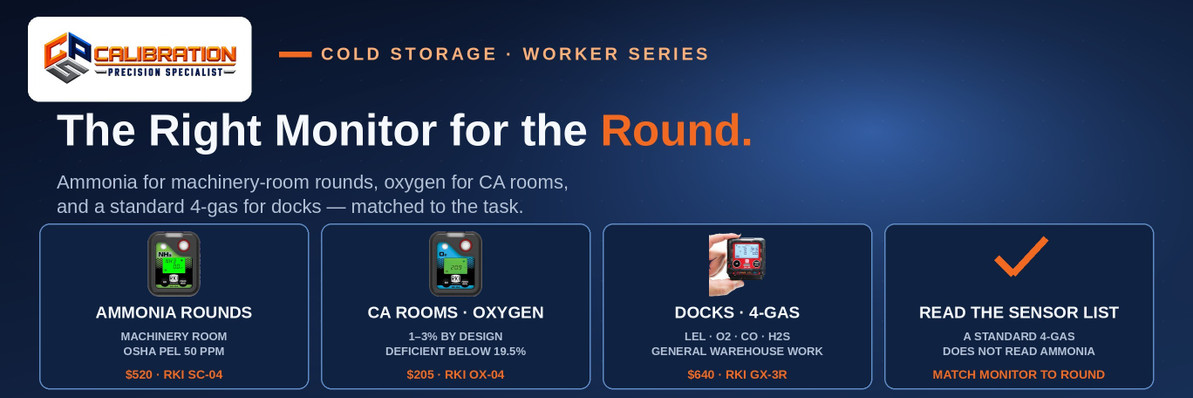
Cold storage workers need portable gas detectors matched to the task, not one monitor for the whole plant: a personal ammonia monitor for machinery-room rounds (ammonia's OSHA limit is 50 ppm, and a standard 4-gas monitor does not read ammonia), an oxygen monitor for anyone working around controlled-atmosphere rooms (air below 19.5% oxygen is deficient, and those rooms run at 1–3% oxygen by design), and a standard 4-gas monitor — LEL, oxygen, CO, H2S — for dock, engine, and general warehouse work.
Ask a cold storage plant what its people carry and the common answer is "4-gas monitors" — as if refrigeration work were confined-space work with a coat on. It is not. A cold storage plant holds at least three distinct gas jobs, and only one of them is the job a standard 4-gas was built for. This post sorts them by the round a worker actually walks. For the fixed side of the same plant, start with ammonia detection in cold storage; for the rooms that are dangerous by design, see controlled-atmosphere storage.
Who Needs a Personal Ammonia Monitor?
Anyone whose round enters the machinery room or works on the refrigeration system: refrigeration technicians, maintenance mechanics, and the operator who checks the plant. Their gas is ammonia, its OSHA permissible exposure limit is 50 ppm as an 8-hour average, and its NIOSH immediately-dangerous level is 300 ppm.
The honest problem: a standard 4-gas monitor does not read ammonia. Its four channels are combustible gas, oxygen, carbon monoxide, and hydrogen sulfide. A tech can walk a machinery-room round wearing a perfectly good, freshly calibrated 4-gas and have no ammonia reading at all. The fix is a dedicated personal ammonia monitor — the RKI SC-04 Ammonia single-gas monitor ($520) is built to exactly this scale — or a configured multi-gas instrument that carries an ammonia channel as an added sensor. Either is defensible; assuming the standard 4-gas covers it is not. Browse the single-gas monitors range for the single-gas options.
Who Needs an Oxygen Monitor?
Anyone whose work takes them to a controlled-atmosphere (CA) room door — produce warehouse crews, forklift drivers staging at CA rooms, and maintenance staff who service them. A CA room holds oxygen at 1–3% by design to slow ripening; normal air is 20.9%, and OSHA defines anything below 19.5% as oxygen-deficient. There is no smell, no color, and no reliable bodily warning that separates 20.9% from a room that will drop a worker in a breath or two.
The personal layer is a single-gas oxygen monitor — the RKI OX-04 Oxygen monitor ($205) — worn by anyone who opens, stages at, or works beside a CA room, backed by the fixed oxygen point and door discipline covered in the controlled-atmosphere post. The same oxygen channel is why dock crews near halocarbon-charged equipment also need oxygen awareness: halocarbon refrigerants pool low and displace oxygen.
Who Actually Needs the Standard 4-Gas?
Dock crews, yard and engine-space workers, and general maintenance — the workers whose hazards really are the classic four. Diesel and propane equipment on docks and in trailers brings carbon monoxide and combustible vapor; enclosed dock pits, battery charging, and general plant work round out a genuine LEL / O2 / CO / H2S profile. For that round the standard instrument is right: the RKI GX-3R 4-gas monitor ($640) covers all four channels in one unit. The point of this post is not that 4-gas monitors are wrong — it is that they are right for one of the plant's three jobs and silent on the other two.
How Do the Three Rounds Compare?
| The round | The gas that matters | The monitor | Why not the standard 4-gas alone? |
|---|---|---|---|
| Machinery-room rounds, refrigeration maintenance | Ammonia (NH3) — PEL 50 ppm, IDLH 300 ppm | Personal ammonia monitor (e.g. RKI SC-04, $520) or multi-gas with an NH3 channel | Ammonia is not one of the standard four channels |
| CA room doors, produce warehouse work | Oxygen (O2) — deficient below 19.5%; CA rooms at 1–3% | Personal oxygen monitor (e.g. RKI OX-04, $205) plus fixed point + door discipline | A 4-gas does read O2 — but CA work needs O2 on every person at the door, not shared units |
| Docks, engines, general warehouse | LEL, O2, CO, H2S | Standard 4-gas (e.g. RKI GX-3R, $640) | It is the right tool here — this is the job it was built for |
Calibration note, honestly stated: every one of these instruments drifts and needs bump testing and calibration on its manufacturer's schedule. We calibrate every channel an instrument carries — a 5-channel unit gets five channels calibrated, not four — through our calibration services and the CPS Calibration Program. In-house rates are $55 single-gas / $90 for 4- & 5-gas instruments; on-site work is quoted in writing and costs more than bench work.
Frequently Asked Questions
What gas detectors do cold storage workers need?
It depends on the round. Refrigeration and machinery-room workers need a personal ammonia monitor, because ammonia (OSHA limit 50 ppm) is not a channel on a standard 4-gas monitor. Workers around controlled-atmosphere rooms need a personal oxygen monitor — CA rooms run at 1–3% oxygen and air below 19.5% is deficient. Dock, engine, and general warehouse crews need the standard 4-gas: LEL, oxygen, carbon monoxide, and hydrogen sulfide.
Does a 4-gas monitor detect ammonia?
No — a standard 4-gas monitor reads combustible gas (%LEL), oxygen, carbon monoxide, and hydrogen sulfide, and ammonia is not among them. A worker wearing one in an ammonia machinery room has no ammonia reading. The options are a dedicated single-gas ammonia monitor such as the RKI SC-04 ($520) or a configured multi-gas instrument with an ammonia sensor added as an extra channel. Check the sensor list, not the instrument's marketing name.
Why do cold storage workers need oxygen monitors?
Because of controlled-atmosphere rooms. CA produce rooms are held at 1–3% oxygen by design to slow ripening, against 20.9% in normal air, and OSHA defines below 19.5% as an oxygen-deficient atmosphere. Oxygen deficiency gives no smell, color, or reliable warning feeling. A personal oxygen monitor such as the RKI OX-04 ($205) on every worker who opens or stages at a CA room door is the layer that speaks before entry.
What is the exposure limit for ammonia for refrigeration workers?
The OSHA permissible exposure limit for ammonia is 50 ppm as an 8-hour time-weighted average, and the NIOSH immediately dangerous to life or health level is 300 ppm. That is why the machinery-room monitor is a ppm-range toxic instrument: it has to track exposure meaningfully around the 50 ppm working limit and alarm with time to act, long before 300 ppm conditions.
Do forklift drivers in a cold storage warehouse need gas detectors?
Drivers who work the general warehouse and docks are covered by the plant's dock program — the standard 4-gas hazards from engines and equipment. A driver whose route includes staging at or opening controlled-atmosphere rooms needs a personal oxygen monitor for that part of the job, because the CA room hazard is oxygen, it sits behind a specific door, and a shared monitor left on a charger protects nobody at that door.
What gas detector should a refrigeration technician carry?
A personal ammonia monitor first — the machinery room is his workplace and ammonia is its gas, at an OSHA limit of 50 ppm. Many technicians pair it with, or step up to, a configured multi-gas instrument that adds an ammonia channel to the standard four, so one unit covers both the machinery room and general plant work. What he should not do is rely on a standard 4-gas alone and assume ammonia is covered; it is not one of the four.
How much do cold storage gas detectors cost?
At live CPS list prices: a personal ammonia monitor (RKI SC-04) is $520, a personal oxygen monitor (RKI OX-04) is $205, and a standard 4-gas monitor (RKI GX-3R) is $640. Single-gas instruments cost less per worker, which is what makes it practical to put the right single gas on every person who needs it instead of sharing one multi-gas unit across a crew. Calibration is the recurring cost on top: $55 per single-gas instrument and $90 per 4- or 5-gas instrument in-house at CPS.
Can one multi-gas monitor cover ammonia, oxygen, and the standard four gases?
A configured multi-gas instrument can — instruments in that class accept an ammonia sensor as an added channel alongside LEL, oxygen, CO, and H2S. That is a legitimate one-unit answer for a refrigeration technician who works everywhere in the plant. The honest caveats are cost per worker and discipline: a shared configured unit only protects the person wearing it, and every channel it carries still needs calibration on schedule.
Do cold storage workers need refrigerant leak detectors?
Maintenance technicians do, for a different job: finding the leak. A handheld refrigerant leak detector — see the refrigerant leak detectors range — pinpoints a halocarbon leak at a coil or fitting after an alarm or a charge loss points to the system. It is a search tool, not a personal safety monitor: it does not replace the ammonia or oxygen monitor a worker wears for exposure protection.
How often do personal gas detectors in cold storage need calibration?
On the interval the manufacturer specifies for that instrument, with a bump test before use as the manufacturer directs — there is no single honest number for every model. Cold, damp work is hard on sensors, so treat the manual's interval as a maximum, not a target. CPS calibrates single-gas instruments in-house for $55 and 4- and 5-gas instruments for $90, and we calibrate every channel the instrument carries.
The Bottom Line
Cold storage has three portable-detection jobs, not one: ammonia for the machinery-room round, oxygen for the controlled-atmosphere door, and the standard four gases for docks and general work. The most common failure is also the quietest — a good 4-gas monitor, freshly calibrated, that simply has no ammonia channel on it.
Sorting out who in your plant should carry what? Call CPS Calibrations at 865-900-8844 — we will match monitors to rounds, and keep every channel calibrated under the CPS Calibration Program.
CPS Calibrations · 109 S. Front Street, Rockwood, TN 37854 · Calibration Services · The CPS Calibration Program
Need a calibration you can file?
In-house calibration at CPS in Rockwood, Tennessee — $55 for single-gas instruments, $90 for 4- and 5-gas — every channel, as-found and as-left data, full certificate.
See Calibration Servicesor call 865-900-8844
Recent Posts
-

Can You Add a Pump to a SENKO SGT-P or MGT?
Yes — SENKO's SP-Pump101 external sampling pump ($330, part AAA006000) fits the SGT, SGT-P, and MGT, …Nov 12th 2026 -

What Refrigerant Detection Does a Grocery Store Need?
A grocery store needs refrigerant detection in three places: low-mounted carbon dioxide (R-744) sens …Nov 11th 2026 -

What Is LEL and UEL? The Explosive Range, Gas by Gas
The LEL is the lowest concentration of a gas in air that can explode, and the UEL is the highest: me …Nov 10th 2026