
Controlled Atmosphere Storage: The Oxygen Hazard in Produce Warehouses
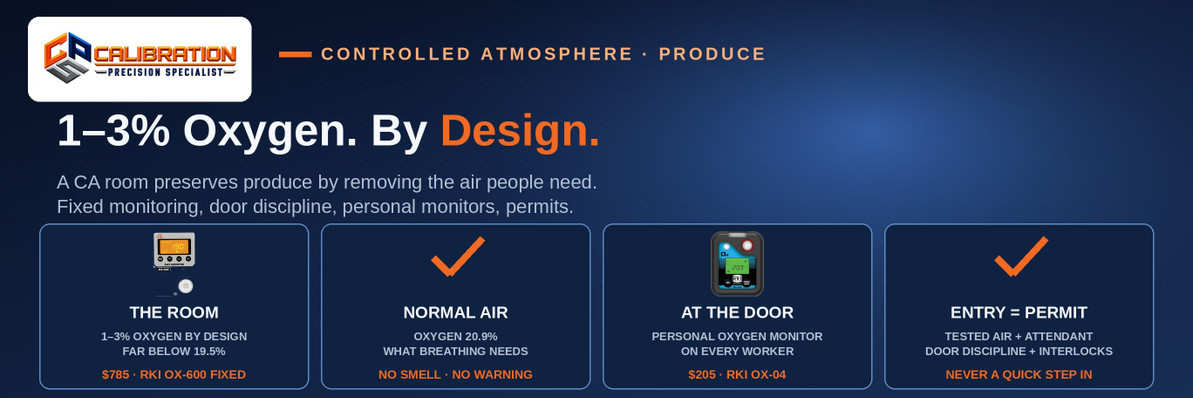
A controlled-atmosphere (CA) produce room is an oxygen hazard by design: it holds oxygen at 1–3% to slow ripening, against 20.9% in normal air and an OSHA oxygen-deficient line of 19.5% — so entry without testing, door discipline, and interlocks can be immediately fatal. The protection is layered: a fixed oxygen monitor at the room, controlled and interlocked doors, a personal oxygen monitor on every worker at the door, and permit discipline for any entry.
Most gas hazards are failures — a leak, a spill, a broken seal. A controlled-atmosphere room is different, and that difference is what makes it dangerous. The low oxygen is the process. The room is sealed, flushed, and held at 1–3% oxygen on purpose, day after day, and it works perfectly. The hazard arrives when a person treats that room like any other cold room: a door opened out of habit, a quick step inside to grab a pallet or check a label. This post covers how CA storage creates the hazard and the layered controls that manage it. It sits in the cold storage series alongside what detectors cold storage workers need and ammonia detection in cold storage.
Why Is a Controlled-Atmosphere Room So Dangerous If Nothing Is Broken?
Because the numbers leave no margin and the body gives no warning. Set them side by side:
| Air | Oxygen |
|---|---|
| Normal air | 20.9% |
| OSHA oxygen-deficient line (29 CFR 1910.146) | Below 19.5% |
| A controlled-atmosphere produce room, by design | 1–3% |
A CA room is not slightly below the deficient line — it is roughly ten times below it. And oxygen deficiency defeats human warning systems completely: no odor, no color, no taste, and the early effect of low oxygen is impaired judgment, which removes the victim's ability to recognize the problem and self-rescue. A worker who steps into 1–3% oxygen does not get a minute to reconsider. Entry without testing and controls can be immediately fatal — that is not a figure of speech, it is the arithmetic of the two numbers above.
What Fixed Monitoring Does a CA Room Need?
A fixed oxygen monitor that reads the room continuously — not a portable brought out when someone remembers. The stand-alone RKI OX-600 oxygen monitor (0–25%, $785) is built to this scale: one unit watching the room and alarming at the door, so the state of the air is known before anyone reaches for a handle.
Fixed monitoring earns its place three ways:
- It is always there. CA conditions persist around the clock, including nights, weekends, and shift changes when no entry is planned and a door gets opened out of routine.
- It alarms outside the hazard. The warning belongs at the doorway, in breathable air, where it can stop an entry — not only inside the room, where the person who needs it is already in the hazard.
- It catches the second problem too. A room being returned to breathable air, or a sealing or flushing fault that changes conditions in adjacent low spaces, shows up on a continuous reading. A spot check shows one moment; a fixed point shows the trend.
If the fixed system needs designing and installing, that is a defined service: see fixed system installation.
What Do Door Discipline and Interlocks Actually Do?
They turn opening the room from a reflex into a decision. In practice:
- The door is signed, locked or controlled, and treated as a boundary, not a shortcut. Nobody opens a CA door to save thirty steps.
- Interlocks and alarms tie the door to the monitor where the system is so equipped: open the door on a room at CA conditions and the alarm states what the worker cannot sense.
- Entry is a permit act. Testing the air, a named attendant outside, a retrieval plan, and a reason — the same permit discipline used for any permit-required space, applied to a room that looks like a refrigerator. The full entry framework for produce operations belongs in the site's confined-space program; this post's point is narrower: a CA room must be inside that program, not beside it because it is "just storage."
Why Does Every Worker at the Door Need a Personal Monitor Too?
Because fixed monitoring guards a place and people move. The personal layer — a single-gas oxygen monitor such as the RKI OX-04 ($205) — travels with the worker to the door, into adjacent low areas where displaced air can collect, and onto the maintenance tech servicing the room's equipment. The two layers cover each other's gaps: the fixed point never leaves its post but cannot follow a worker; the personal monitor follows the worker but only protects the one wearing it. CA work needs both, for the same reason machinery-room ammonia work needs a fixed point and a personal monitor — see what gas detectors cold storage workers need.
Calibration, honestly: oxygen sensors work continuously and drift like any other sensor. Both the fixed point and the personal monitors go on a written calibration schedule based on their manuals — we calibrate every channel an instrument carries, through calibration services and the CPS Calibration Program.
Frequently Asked Questions
What is controlled-atmosphere storage?
Controlled-atmosphere (CA) storage holds produce in a sealed room whose air is deliberately altered — in particular, oxygen is reduced to 1–3%, compared with 20.9% in normal air — to slow ripening and extend storage life. It is standard, effective produce practice. The same reduction that preserves the fruit makes the room's air immediately dangerous to people, which is why CA rooms require oxygen monitoring and strict entry control.
How low is the oxygen in a controlled-atmosphere room?
Between 1% and 3% oxygen by design. For scale: normal air is 20.9% oxygen, and OSHA defines an atmosphere below 19.5% oxygen as oxygen-deficient under 29 CFR 1910.146. A CA room therefore sits far below the deficient line — roughly ten times lower — not marginally under it. There is no "slightly low" CA room; every CA room at operating conditions is an immediately dangerous atmosphere for an unprotected entrant.
Can you survive entering a controlled-atmosphere room?
Entry into a CA room at 1–3% oxygen without testing, respiratory protection, and a permit-controlled entry plan can be immediately fatal. Oxygen that low cannot sustain consciousness for more than a very short time, and low oxygen impairs judgment first, so self-rescue is unreliable. Do not treat any figure you have heard about "holding your breath and ducking in" as a plan — that is exactly the entry pattern this hazard kills with.
What are the warning signs of low oxygen in a CA room?
There are effectively none a person can rely on. Low oxygen has no odor, color, or taste, and its early effects — impaired judgment, poor coordination — disable the victim's ability to recognize and escape the hazard. That absence of warning is the core of the CA problem and the reason detection is instrumental, not sensory: a fixed oxygen monitor at the room and a personal monitor on the worker are the warning system.
What oxygen monitoring does a controlled-atmosphere room need?
Two layers. A fixed oxygen monitor — a stand-alone unit such as the RKI OX-600 (0–25%, $785) — reads the room continuously and alarms at the doorway, in breathable air, before entry. A personal oxygen monitor such as the RKI OX-04 ($205) goes on every worker who opens, stages at, or services the room. The fixed point guards the place around the clock; the personal monitor follows the person. Either layer alone leaves a gap the other is meant to close.
What is door discipline for a controlled-atmosphere room?
Treating the CA door as a controlled boundary rather than a routine warehouse door: the room is signed and its doors kept closed and controlled, opening is a deliberate act tied to the oxygen monitor's reading, interlocks or alarms where fitted state the hazard when the door opens, and any actual entry runs under permit discipline — tested air, an attendant outside, and a retrieval plan. The goal is that nobody opens a CA room out of habit or as a shortcut.
Is a controlled-atmosphere room a confined space?
Functionally, a CA room presents the defining problem of one: an atmosphere that is immediately dangerous to life, in an enclosed room people can physically enter. Whether a given room is formally classed as a permit-required confined space is a determination the site's own safety program makes under the confined-space standard — but the safe course, and the one this post recommends, is to run CA room entry with permit discipline (testing, attendant, plan) rather than argue the room out of the program because it is "just storage."
What happens when a CA room is opened for loading or unloading?
The room must first be returned to breathable air — ventilated and purged back toward normal 20.9% oxygen — and that return must be verified by instrument reading, not by elapsed time or by how the air feels. A fixed oxygen monitor showing the room back in the normal range, confirmed before the door becomes a routine working door, is the control. Timer-based re-entry guesses at the one number that has to be measured.
Who in a produce warehouse needs a personal oxygen monitor?
Every worker whose job takes them to a CA room door: warehouse crews staging or retrieving product, forklift drivers working CA doors, maintenance staff servicing CA rooms and their equipment, and supervisors who check the rooms. A personal oxygen monitor such as the RKI OX-04 costs $205 — priced so the monitor can be issued per person rather than shared, because a shared monitor on a charger protects nobody standing at the door.
How often do CA room oxygen monitors need calibration?
On the interval the manufacturer specifies for that monitor — fixed and personal oxygen sensors work continuously and drift, and no single interval honestly covers every model. Put both layers on a written calibration schedule based on their manuals and keep the records with the CA room's entry documentation. CPS calibrates oxygen monitors in-house — single-gas instruments at $55 — and we calibrate every channel an instrument carries.
The Bottom Line
A controlled-atmosphere room is not a cold room with a quirk — it is a room held at 1–3% oxygen on purpose, ten times below the line where air becomes deficient, with no warning a human sense can catch. Fixed oxygen monitoring at the door, door discipline and interlocks, a personal monitor on every worker, and permit discipline for entry are not four options; they are one system.
Reviewing a produce warehouse's CA controls, or adding the monitoring layer? Call CPS Calibrations at 865-900-8844 — we supply and calibrate the fixed and personal oxygen instruments, and install fixed systems, from Rockwood, Tennessee.
CPS Calibrations · 109 S. Front Street, Rockwood, TN 37854 · Calibration Services · The CPS Calibration Program
Need a calibration you can file?
In-house calibration at CPS in Rockwood, Tennessee — $55 for single-gas instruments, $90 for 4- and 5-gas — every channel, as-found and as-left data, full certificate.
See Calibration Servicesor call 865-900-8844
Recent Posts
-

Can You Add a Pump to a SENKO SGT-P or MGT?
Yes — SENKO's SP-Pump101 external sampling pump ($330, part AAA006000) fits the SGT, SGT-P, and MGT, …Nov 12th 2026 -

What Refrigerant Detection Does a Grocery Store Need?
A grocery store needs refrigerant detection in three places: low-mounted carbon dioxide (R-744) sens …Nov 11th 2026 -

What Is LEL and UEL? The Explosive Range, Gas by Gas
The LEL is the lowest concentration of a gas in air that can explode, and the UEL is the highest: me …Nov 10th 2026