
Freon and Halocarbon Refrigerant Leaks in Cold Storage: The Gas That Pools Low and Displaces Oxygen
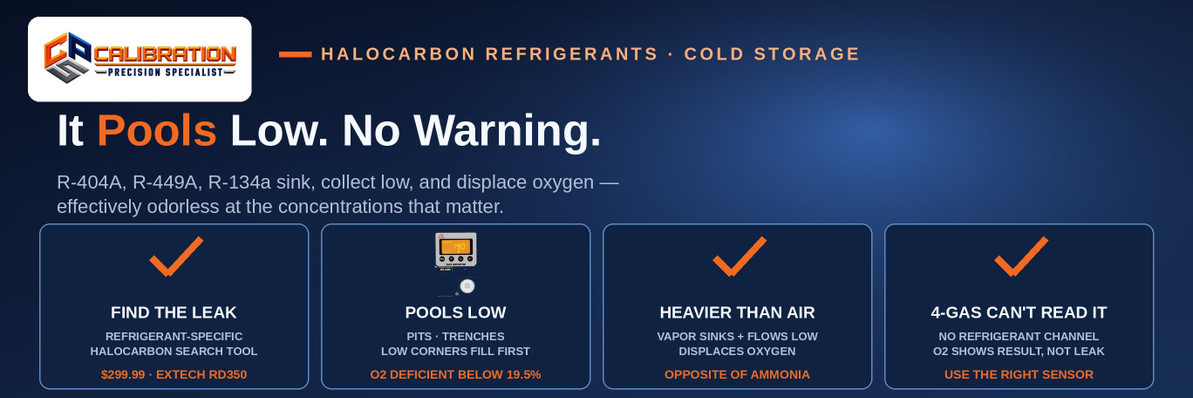
Halocarbon refrigerants — R-404A, R-449A, R-134a and their relatives, sold for decades under the Freon name — are heavier than air, so a leak pools low in pits, trenches, and low corners, displaces oxygen, and is effectively odorless at dangerous concentrations. Detecting one takes a refrigerant-specific instrument (infrared or semiconductor): a standard 4-gas monitor does not read refrigerant concentration at all, and its oxygen channel only shows the displacement after the gas has already pooled.
Cold storage runs on two refrigerant families with opposite personalities. Ammonia — covered in ammonia detection in cold storage — is toxic, pungent, and rises. The halocarbons in split systems, display cases, condensing units, and smaller plants are none of those things: mildly toxic at ordinary levels, effectively odorless where it matters, and heavy. A halocarbon leak is a quiet, floor-hugging event, and every control for it follows from those two facts: it pools low, and nobody smells it coming.
Why Does Halocarbon Refrigerant Pool Low?
Because the vapor is heavier than air. Released refrigerant does not mix evenly through a room and wait to be noticed — it sinks, flows along the floor like a slow liquid, and accumulates in the lowest available volume:
- Pits, trenches, and below-grade spaces fill first and clear last.
- Low corners and the floor layer of the machinery room hold concentrations the breathing zone above them does not — until the pool deepens.
- Inside cases, cabinets, and enclosed unit housings, where a small leak concentrates in a small volume.
This is the placement lesson in one sentence: for halocarbons, the sensor belongs low — at the pit, the trench, and the low corner — which is the opposite end of the wall from ammonia practice and one more reason a single generic detector location serves neither gas. It is also what ASHRAE 15 means by a detector located where a refrigerant leak would concentrate; the machinery-room requirements are laid out in what ASHRAE 15 requires.
How Does a Refrigerant Leak Become an Oxygen Hazard?
By displacement. Pooled refrigerant occupies volume that held air. As the pool deepens in a pit or a tight machinery room, the oxygen fraction in that layer falls — from the normal 20.9% toward and below the 19.5% line where OSHA defines the atmosphere as oxygen-deficient. The worker at risk is the one who steps down into the pit, kneels at a low fitting, or leans into a case — head in the pooled layer, in a room whose standing-height air still reads normal.
That geometry is why two instruments do two different jobs here:
| Job | Instrument | What it tells you |
|---|---|---|
| Warn that air has been displaced | Fixed oxygen point, mounted low — e.g. RKI OX-600 ($785) | That the pooled layer has pushed oxygen down — the life-safety alarm |
| Find the leak itself | Refrigerant-specific detector — fixed infrared/semiconductor point, or a handheld such as the Extech RD350 ($299.99) | Where the refrigerant is escaping, in refrigerant concentration — the repair tool |
Why Can't a Standard 4-Gas Monitor Detect a Refrigerant Leak?
Because none of its four channels measures refrigerant. A standard 4-gas reads combustible gas (%LEL), oxygen, carbon monoxide, and hydrogen sulfide. Point it at an R-449A leak and three channels have nothing to say; the fourth — oxygen — responds only when the pooled refrigerant has displaced enough air to move the oxygen reading, which is a warning about the result of the leak, not a measurement of the leak. It also cannot find anything: leak-finding means walking a refrigerant-specific sensor along fittings, coils, and joints and watching refrigerant concentration respond, which is a different instrument class entirely — infrared or semiconductor, tuned to refrigerants. The handheld side of that class lives in the refrigerant leak detectors range.
None of this makes the 4-gas useless in cold storage — for dock, engine, and general work it is the right instrument, as what gas detectors cold storage workers need lays out. It makes it the wrong answer to the specific question "is refrigerant leaking, and where?"
What Should a Halocarbon Detection Setup Include?
- Fixed refrigerant detection low in the machinery room — at the points where a leak would concentrate: pits, trenches, low corners, and below the equipment — alarming inside and outside the room and activating ventilation, the ASHRAE 15 pattern.
- An oxygen point where people can enter the pooled layer — pits and tight rooms — because displacement is the life-safety consequence.
- A handheld refrigerant leak detector in the maintenance kit, so an alarm or a charge loss becomes a located, repairable leak instead of a recharge-and-hope cycle.
- Calibration and bump discipline for every point, on each manufacturer's schedule — we calibrate every channel an instrument carries, through calibration services. Fixed installations that need designing are covered under fixed system installation.
Frequently Asked Questions
Is Freon dangerous in a cold storage facility?
The halocarbon refrigerants sold under the Freon name and their modern successors — R-404A, R-449A, R-134a — are dangerous mainly by displacement and pooling. They are heavier than air, collect in pits and low areas, and push oxygen out of that layer; air below 19.5% oxygen is oxygen-deficient, against a normal of 20.9%. They are also effectively odorless at dangerous concentrations, so a significant leak gives no smell warning. The hazard is real but specific: low, pooled, and silent.
Does refrigerant gas rise or sink?
Halocarbon refrigerant vapor sinks. R-404A, R-449A, and R-134a are all heavier than air, so leaked vapor flows down and pools in the lowest available space — pits, trenches, low corners, and the floor layer of a machinery room. That is the opposite behavior from ammonia vapor, which is lighter than air and rises, and it is why halocarbon detectors are mounted low while ammonia placement starts above the leak points.
Can a 4-gas monitor detect a Freon leak?
No. A standard 4-gas monitor reads combustible gas, oxygen, carbon monoxide, and hydrogen sulfide — it has no refrigerant channel and does not read refrigerant concentration. Its oxygen channel can warn that pooled refrigerant has displaced air, which is a life-safety warning about the leak's result, but it cannot detect the leak itself or find it. Leak detection requires a refrigerant-specific instrument using infrared or semiconductor sensing.
How do you find a halocarbon refrigerant leak?
With a refrigerant-specific leak detector walked along the system: fittings, joints, coils, valve stems, and service ports, watching the instrument respond to refrigerant concentration. A handheld such as the Extech RD350 ($299.99) is built for that search. Fixed refrigerant detectors in the machinery room do the warning job — alarming when a leak concentrates — and the handheld then does the finding job. Soap solution and electronic detection are complementary on small joints, but the electronic instrument is what searches a whole system.
Why is refrigerant pooled in a pit an oxygen hazard?
Because pooled refrigerant displaces the air that was in the pit. The pit's volume fills with refrigerant vapor from the bottom up, and the oxygen fraction in that layer falls from the normal 20.9% toward and below 19.5%, the level OSHA defines as oxygen-deficient. A worker who steps or kneels down into the pit puts his head and chest in that depleted layer while the room above still reads — and feels — normal.
Can you smell a halocarbon refrigerant leak?
Not reliably, and not at the concentrations that matter. R-404A, R-449A, and R-134a are effectively odorless at dangerous concentrations: a leak large enough to pool and displace oxygen in a low area can be present with no smell a worker would act on. Treat odor as no detection at all for halocarbons — the detection has to be instrumental, fixed points low in the room for warning and refrigerant-specific handhelds for finding.
Where should refrigerant detectors be mounted?
Low — where the gas pools. For halocarbon systems that means at pits, trenches, and low corners, below and beside the equipment in the machinery room, in the layer a leak actually fills. This is what ASHRAE 15 requires in substance: a detector located where a refrigerant leak would concentrate. A halocarbon sensor mounted at ceiling height repeats the classic placement error in reverse — it watches the last place the gas will reach.
What refrigerants are used in cold storage besides ammonia?
The halocarbon family: R-404A has been a cold storage staple, R-449A is a common lower-global-warming successor in similar duty, and R-134a serves medium-temperature and smaller systems, alongside other halocarbon blends in specific equipment. All share the behavior this post is about — heavier than air, pooling low, displacing oxygen, and effectively odorless at dangerous concentrations — so the detection approach is the same across the family even as the specific refrigerant in a plant changes.
Does ASHRAE 15 apply to halocarbon systems, or only ammonia?
ASHRAE 15's machinery-room detection requirements are written for refrigeration machinery rooms generally, not for ammonia alone: a refrigerant detector where a leak would concentrate, audible and visual alarm inside and outside the room, activation of mechanical ventilation, and emergency controls outside the room. A halocarbon plant room is squarely in that scope — the compliance detail, requirement by requirement, is in our ASHRAE 15 machinery-room post.
How much does refrigerant leak detection cost?
The handheld finding tool is the inexpensive end: the Extech RD350 refrigerant leak detector is $299.99 at CPS list. The warning layer is fixed: a stand-alone oxygen point such as the RKI OX-600 is $785, and fixed refrigerant-specific points and multi-point systems are priced by the room and the point count. Every detector in the setup also carries a recurring calibration cost on its manufacturer's schedule, which belongs in the budget from the start.
The Bottom Line
Halocarbon refrigerant is the quiet half of cold storage risk: heavier than air, pooled in pits and low corners, displacing oxygen, and effectively odorless while it does it. Detect it where it pools, with instruments that actually read refrigerant — and let the oxygen channel do the life-safety warning it is good at, instead of asking a 4-gas to do a job none of its channels can perform.
Auditing refrigerant detection in a cold storage plant, or adding the low points a machinery room is missing? Call CPS Calibrations at 865-900-8844 — we supply, install, and calibrate fixed and portable detection from Rockwood, Tennessee.
CPS Calibrations · 109 S. Front Street, Rockwood, TN 37854 · Calibration Services · The CPS Calibration Program
Need a calibration you can file?
In-house calibration at CPS in Rockwood, Tennessee — $55 for single-gas instruments, $90 for 4- and 5-gas — every channel, as-found and as-left data, full certificate.
See Calibration Servicesor call 865-900-8844
Recent Posts
-

Can You Add a Pump to a SENKO SGT-P or MGT?
Yes — SENKO's SP-Pump101 external sampling pump ($330, part AAA006000) fits the SGT, SGT-P, and MGT, …Nov 12th 2026 -

What Refrigerant Detection Does a Grocery Store Need?
A grocery store needs refrigerant detection in three places: low-mounted carbon dioxide (R-744) sens …Nov 11th 2026 -

What Is LEL and UEL? The Explosive Range, Gas by Gas
The LEL is the lowest concentration of a gas in air that can explode, and the UEL is the highest: me …Nov 10th 2026