
Refrigerant Leak Detection in Data Centers: Chillers, CRAC Units, and the New A2L Refrigerants
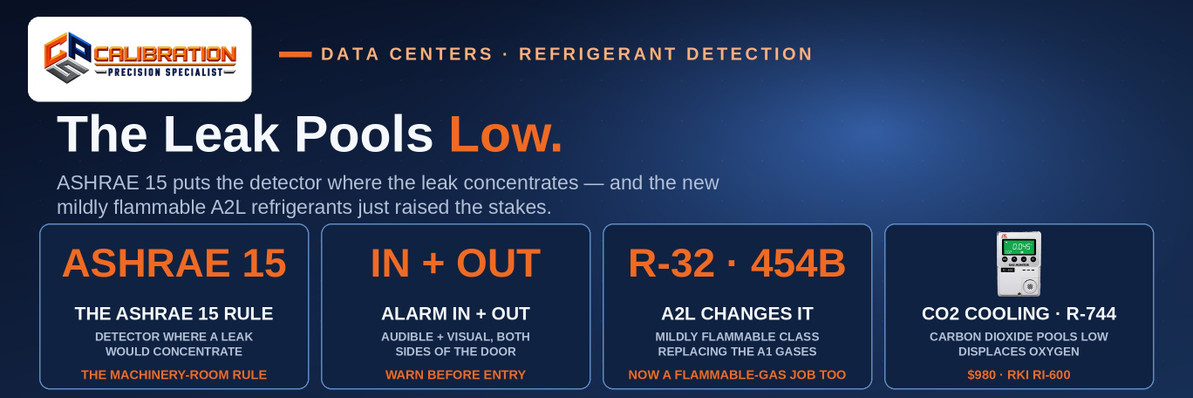
Data center refrigerant leak detection is governed by ASHRAE Standard 15: every refrigeration machinery room needs a detector located where a leak would concentrate, triggering an audible and visual alarm inside and outside the room and activating mechanical ventilation — and the shift to mildly flammable A2L refrigerants (R-32, R-454B) adds a flammability hazard the older A1 refrigerants never had.
A data center's cooling plant is the hardest-working room nobody tours. Chillers, computer room air conditioners (CRAC) and air handlers (CRAH), pumps, and refrigerant piping move the heat out of the halls around the clock — and every joint, seal, and service valve in that plant is a place refrigerant can leave. Leaks are a when, not an if, over a plant's life. What the leak does next depends on the gas, the room, and whether anything in that room is watching. This post covers the watching: the standard that requires it, where the sensors belong, and why the new refrigerants changed the design. For the facility-wide picture, see the cluster hub, what gas detection does a data center need?
Why Is a Refrigerant Leak Dangerous in a Machinery Room?
Three properties combine to make a machinery-room leak a people problem, not just a repair bill:
- Most refrigerants are heavier than air. Released gas sinks and pools — low in the room, in pits, trenches, and below-grade corners — instead of dispersing.
- They displace oxygen as they build. A pool of refrigerant is a pool of air that is no longer air. OSHA defines an atmosphere below 19.5% oxygen as oxygen-deficient; a technician working low in a flooded machinery room can be in deficient air while standing in a room that looks entirely normal.
- There is no reliable human warning. Refrigerants are effectively odorless at dangerous concentrations. Nothing about the room announces the leak to the person walking into it.
Add the repair economics — a slow leak is lost charge, lost efficiency, and a compressor working harder — and the case for fixed detection makes itself. But in this room, detection is not just a good idea. It is a written requirement.
What Does ASHRAE 15 Require for Refrigerant Detection?
ASHRAE Standard 15 requires each refrigeration machinery room to contain a detector, located where a refrigerant leak would concentrate, that triggers an audible and visual alarm both inside and outside the room and activates mechanical ventilation. Each clause of that sentence does specific work:
- "Where a leak would concentrate" — placement follows the gas, not the conduit run. Heavy refrigerants concentrate low and in pits and trenches; the sensor belongs there, at the equipment most likely to leak.
- "Audible and visual, inside and outside" — the outside alarm is the one that saves people. It warns the technician before he opens the door, not after he is already standing in the leak.
- "Activates mechanical ventilation" — detection that only beeps is half a system. The detector's relay starts diluting the room automatically, whether or not anyone is present to hear it.
A machinery room that has a sensor wired to nothing — no outside alarm, no ventilation start — does not meet the intent of the standard even if a detector is technically on the wall. When CPS surveys a cooling plant, those three functions are the checklist. If the system needs designing and installing rather than just supplying, see fixed system installation.
Where Do Chillers, CRAC, and CRAH Units Leak?
Anywhere refrigerant is contained, moved, or serviced:
- Chillers — the largest charges in the plant, concentrated in the machinery room ASHRAE 15 is written for. Compressor seals, relief valves, and service connections are the usual sources.
- CRAC and CRAH refrigerant circuits — distributed equipment brings refrigerant piping closer to (and sometimes into) the halls it cools, which spreads the placement question beyond one machinery room.
- Condensing units and piping runs — joints, flare connections, and vibration-worn lines anywhere along the run.
- CO2 (R-744) systems — a growing data center choice, with a different gas behavior to design for: carbon dioxide pools low and displaces oxygen as it builds, which is why a stand-alone CO2 point such as the RKI RI-600 ($980) is the machinery-room instrument for that refrigerant.
The fixed detector's job is to stand watch over all of it continuously. The technician's job — finding the exact joint once the room alarm has spoken — belongs to a handheld refrigerant leak detector, a different instrument for a different task. Warning and pinpointing are both necessary; neither does the other's work.
What Changes with A2L Refrigerants Like R-32 and R-454B?
Flammability joins the hazard list. The industry is shifting from A1 refrigerants such as R-410A and R-134a to lower-global-warming-potential A2L refrigerants such as R-32 and R-454B. The "2L" classification means lower flammability — these gases are mildly flammable, a property the A1 class does not have.
That one property rewrites the leak conversation:
- A leak is no longer only an asphyxiation and cost problem. Pooled A2L refrigerant near an ignition source is a combustible-gas problem as well.
- Detection becomes part of the installation standard, not an option. Current standards build leak detection, alarming, and ventilation mitigation into A2L installations rather than treating detection as an add-on.
- A conversion is a detection project. If your plant is planning an A2L changeover, the detection design belongs in the conversion scope — sensor selection for a mildly flammable gas, placement, alarm and ventilation functions — not in a retrofit after the new chillers arrive.
This post states no A2L alarm setpoint and no flammability figure for any named refrigerant: those numbers come from the specific refrigerant's data and the system's listed design, and a general post quoting them out of context would mislead more than it helped.
Stand-Alone Points or a Controller-Based System?
The machinery room decides by its size. A single chiller room is often covered by stand-alone monitors from the stand-alone detectors range — each with its own display, alarm, and the relay ASHRAE 15 expects to start ventilation. A multi-room plant, or one reporting to a building management system, belongs on detector heads wired to a controller in the fixed systems range, with a stand-alone transmitter such as the RKI M2A-XL ($1,270 non-explosion-proof / $1,320 explosion-proof) as the per-point building block. Either way, contrast this room with its neighbors in this cluster: the generator room, where the gas is carbon monoxide, and the battery room, where a lithium-ion UPS fails by venting off-gas — three rooms, three gases, three different detection designs.
And whichever shape you choose, it needs calibration. A fixed refrigerant or CO2 point drifts silently; nobody wears it, so nobody notices a sluggish sensor. Fixed points go on a written calibration schedule under calibration services, tracked the way the CPS Calibration Program tracks them — we calibrate every channel on the schedule its manual sets.
Frequently Asked Questions
Does a data center need refrigerant leak detectors?
Yes, in the refrigeration machinery room — ASHRAE Standard 15 requires it. Each machinery room must contain a detector located where a refrigerant leak would concentrate, triggering an audible and visual alarm inside and outside the room and activating mechanical ventilation. Data center chillers live in exactly that kind of room. Outside the machinery room, distributed CRAC/CRAH refrigerant circuits spread the question across the plant, and the placement follows the same logic: where the gas would go, at the equipment most likely to leak.
What does ASHRAE 15 require for refrigerant leak detection?
A detector in each refrigeration machinery room, located where a leak would concentrate, that does three things on alarm: sounds an audible alarm, shows a visual alarm — both inside and outside the room — and activates mechanical ventilation. The outside alarm warns a technician before he opens the door; the ventilation start dilutes the room automatically. A sensor on the wall wired to neither function does not meet the intent of the standard.
Where should refrigerant detectors be placed in a chiller room?
Where a leak would concentrate — for most refrigerants, low. Heavier-than-air refrigerants sink and pool in low spots, pits, and trenches, and at the equipment most likely to leak: chiller compressor seals, relief valves, and service connections. Placement follows the gas and the equipment, not the convenience of the conduit run. A detector mounted high in a room full of a low-pooling refrigerant can read clean air over a dangerous pool.
What is an A2L refrigerant, and why does it change leak detection?
A2L is a refrigerant safety classification: the "2L" means lower flammability — mildly flammable. R-32 and R-454B are the A2L refrigerants replacing A1 gases such as R-410A and R-134a as the industry moves to lower global-warming-potential refrigerants. The change for detection is that a leak is now a flammable-gas hazard as well as an oxygen-displacement hazard, and current standards build leak detection, alarming, and ventilation mitigation into A2L installations instead of treating detection as optional.
Are R-32 and R-454B flammable?
They are classed as mildly flammable — the A2L "lower flammability" classification — unlike the A1 refrigerants (R-410A, R-134a) they replace, which are not classed as flammable. "Mildly" is a classification, not a dismissal: pooled A2L refrigerant near an ignition source is a genuine combustible-gas hazard, which is precisely why detection and ventilation mitigation are built into the standards for A2L installations. This post does not quote a flammability limit figure for either gas; that number belongs to the refrigerant's own data and the system design.
Why is a refrigerant leak dangerous if you can't smell it?
Because the danger has no warning your senses can use. Most refrigerants are effectively odorless at dangerous concentrations, heavier than air, and displace oxygen as they pool low — below 19.5% oxygen, OSHA defines the atmosphere as oxygen-deficient. A technician can walk into a machinery room that looks, sounds, and smells normal and be standing in air that will not support him. The fixed detector, and especially its alarm outside the door, is the warning the room itself does not give.
What's the difference between a fixed refrigerant detector and a handheld leak detector?
They do opposite halves of the job. A fixed detector stands continuous watch over a room — it warns that a leak exists, alarms inside and outside, and starts ventilation, but it does not tell you which joint is leaking. A handheld refrigerant leak detector is the technician's pinpointing tool, carried to the equipment after the room is safe to find the exact source. A plant needs the warning layer installed and the finding tool in the technician's kit; neither substitutes for the other.
Do CO2 (R-744) data center cooling systems need gas detection?
Yes — carbon dioxide is itself the hazard gas in an R-744 plant. CO2 pools low and displaces oxygen as it builds, in a machinery room or anywhere a charge can collect. A stand-alone CO2 monitor such as the RKI RI-600 ($980) is built to exactly that scale: a continuous point reading in the room where the charge lives, alarming before the pool becomes an oxygen problem for the person working in it.
At what ppm does a refrigerant detector alarm?
This post does not state one, deliberately. Alarm setpoints for refrigerant detection come from the specific refrigerant, the detector's listing, and the requirements applied to that machinery room — there is no single ppm figure that is correct across halocarbon, A2L, and CO2 installations, and quoting one out of context would be inventing precision. The detector's documentation and the system design are where the number lives; ask for both when a system is quoted to you.
How often do refrigerant detectors need calibration?
On the interval the manufacturer specifies for that detector — the honest answer, because no single code number covers every sensor technology in a cooling plant. What is universal is the failure mode: a fixed sensor drifts silently, with no user wearing it to notice, so an uncalibrated point can read low for months while reporting the room is safe. Put every fixed point on a written calibration schedule based on its manual, and keep the records with the facility's life-safety documentation.
The Bottom Line
Refrigerant detection in a data center is a standards job, not a shopping job: ASHRAE 15 puts a detector where a leak concentrates in every machinery room, alarms inside and outside the door, and starts the ventilation — and the A2L shift to R-32 and R-454B adds mild flammability to a leak that was already an oxygen hazard.
Surveying a cooling plant, or scoping an A2L conversion? Start with the fixed systems range, or call CPS Calibrations at 865-900-8844 — and keep the whole facility in view with the cluster hub, what gas detection does a data center need?
CPS Calibrations · 109 S. Front Street, Rockwood, TN 37854 · Calibration Services · The CPS Calibration Program
Need a calibration you can file?
In-house calibration at CPS in Rockwood, Tennessee — $55 for single-gas instruments, $90 for 4- and 5-gas — every channel, as-found and as-left data, full certificate.
See Calibration Servicesor call 865-900-8844
Recent Posts
-

Can You Add a Pump to a SENKO SGT-P or MGT?
Yes — SENKO's SP-Pump101 external sampling pump ($330, part AAA006000) fits the SGT, SGT-P, and MGT, …Nov 12th 2026 -

What Refrigerant Detection Does a Grocery Store Need?
A grocery store needs refrigerant detection in three places: low-mounted carbon dioxide (R-744) sens …Nov 11th 2026 -

What Is LEL and UEL? The Explosive Range, Gas by Gas
The LEL is the lowest concentration of a gas in air that can explode, and the UEL is the highest: me …Nov 10th 2026