
What Gas Detection Does a Data Center Need?
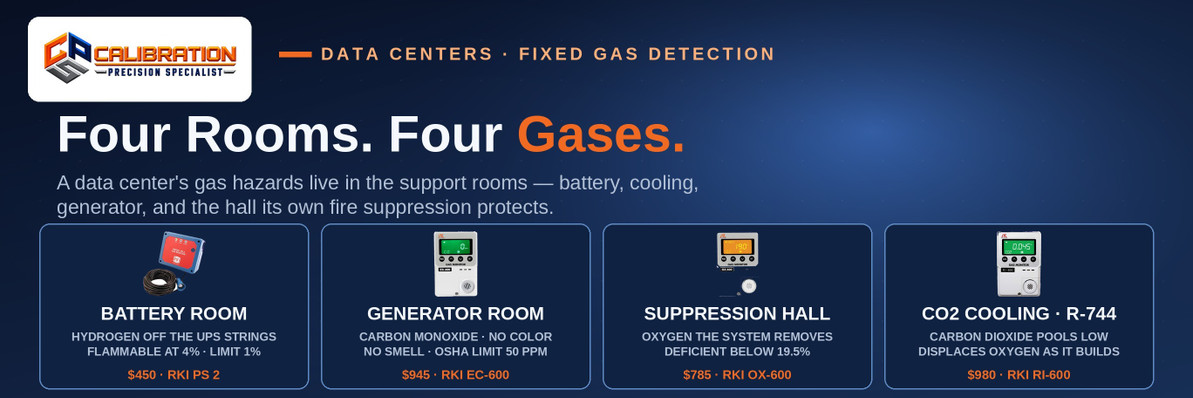
A data center needs fixed gas detection in the rooms around the servers, not just in the data hall: hydrogen detection high in the battery room (hydrogen is flammable at 4% by volume, and fire codes design ventilation to hold it to 1%), refrigerant detection in the cooling plant machinery room as ASHRAE 15 requires, carbon monoxide detection at the generators (OSHA limit 50 ppm), and oxygen monitoring anywhere inert-gas fire suppression can displace breathable air (oxygen-deficient below 19.5%).
Ask a room of data center operators what their gas detection covers and most will point at the smoke detectors over the racks. Smoke detection protects the equipment. Gas detection protects the people who work in the support rooms — and a modern data center is mostly support rooms: a battery room full of charging lead-acid (or a lithium-ion UPS lineup), a cooling plant full of refrigerant, a generator room or yard full of diesel exhaust, and, in many halls, a clean-agent suppression system that works by taking oxygen away. Each of those rooms has a different gas, a different place the gas goes, and a different job for the detector. This post is the map, zone by zone.
What Is the Gas Hazard Map for a Data Center?
| Zone | Gas to monitor | Why it is there | Where the sensor goes | What the alarm must do |
|---|---|---|---|---|
| Battery room (lead-acid UPS) | Hydrogen (H2) | Charging batteries give off hydrogen | High — hydrogen rises | Alarm early, start or boost ventilation |
| Battery room (lithium-ion UPS) | Battery off-gas | A failing cell vents gas before smoke or flame | At the racks / room level per the system design | Alarm at the earliest stage, before thermal runaway spreads |
| Cooling plant / chiller room | Refrigerant | Leaks from chillers, CRAC/CRAH refrigerant circuits | Where a leak would concentrate — most refrigerants pool low | Audible + visual alarm inside and outside the room, start ventilation (ASHRAE 15) |
| Generator room / yard | Carbon monoxide (CO), diesel vapor | Engine exhaust, day tanks and fuel fill points | Breathing zone for CO; at tank and fill points for fuel vapor | Alarm before the room is occupied or entered |
| Data hall with inert-gas or CO2 suppression | Oxygen (O2) | A discharge displaces oxygen by design | At occupied height, and at the door | Warn before entry after a discharge; hold re-entry until oxygen is verified back |
| Fuel storage | Combustible vapor (%LEL) | Diesel day tanks, fill and vent points | At the tank, fill point, and low spots | Alarm at a fraction of the LEL, before vapor can find an ignition source |
Four of those zones can be covered by a single stand-alone monitor each. The larger sites tie every point into a controller so one alarm reaches a staffed desk. Both shapes are covered below.
Why Do Battery Rooms Need Hydrogen Detection?
Because a charging lead-acid battery is a small, continuous hydrogen generator. Every flooded and valve-regulated lead-acid string in a UPS room releases hydrogen as it charges, most of it near the end of the charge cycle — and hydrogen is flammable at just 4% by volume in air, the lowest flammable limit of any common fuel gas. Fire codes take that seriously: battery-room ventilation is designed to limit hydrogen to 25% of that limit — 1% by volume — during the worst case, every battery boost-charging at once.
Ventilation is the control, but ventilation fails quietly. A louver sticks, a fan belt goes, a damper gets closed for winter — and the room has no way to say so. That is what the detector is for:
- The sensor goes high. Hydrogen is much lighter than air and rises. A hydrogen detector mounted at breathing height under a ceiling pocket of hydrogen reads clean air while the hazard collects over its head. Mount it high, above the battery racks.
- The first alarm comes early. Monitor first alarms are commonly set at 10% of the LEL — 0.4% hydrogen — which is the signal to start or boost ventilation and investigate, long before the 1% design limit, and nowhere near the 4% flammable limit.
- The alarm has to reach someone. A battery room is unstaffed most of the day. The detector's relay should start the exhaust fan and report to a point that is actually watched — a controller, the building system, or a staffed desk.
A stand-alone combustible point monitor built for exactly this duty is the RKI PS 2 at $450; larger rooms and multi-point systems use detector heads on a controller from the fixed systems range.
The lithium-ion exception: lithium-ion UPS batteries do not off-gas hydrogen in normal charging. Their hazard is different — a failing cell vents flammable, toxic off-gas before it smokes or flames, which is the earliest warning a thermal runaway gives. Smoke detection alone hears about a lithium-ion failure late; off-gas detection is the layer that hears about it first. If your UPS is lithium, hydrogen detection is the wrong purchase and off-gas detection is the right conversation.
What Refrigerant Detection Does the Cooling Plant Need?
A data center moves its heat out with refrigerant — in chillers, in computer room air handlers, in condensing units — and refrigerant leaks are a when, not an if, over a plant's life. Most refrigerants are heavier than air, effectively odorless at dangerous concentrations, and displace oxygen as they pool low in a machinery room. A technician can walk into a room that looks, sounds, and smells normal and be standing in air that will not support him.
This is the one data center gas job with a named standard behind it. ASHRAE Standard 15 requires each refrigeration machinery room to contain a detector, located where a refrigerant leak would concentrate, that triggers an audible and visual alarm both inside and outside the room and activates mechanical ventilation. Three details in that sentence do the real work:
- "Where a leak would concentrate" — placement follows the gas, not the convenience of the conduit run. Heavy refrigerants concentrate low and in pits and trenches; the sensor belongs there.
- "Inside and outside" — the outside alarm is the one that matters. It warns the technician before he opens the door, not after he is already standing in the leak.
- "Activates ventilation" — detection that only beeps is half a system. The detector's job is to start diluting the room automatically.
The A2L change: the industry is shifting from A1 refrigerants such as R-410A and R-134a to lower-global-warming A2L refrigerants such as R-32 and R-454B. The "2L" means mildly flammable — a property the old refrigerants did not have. A leak that used to be only an asphyxiation and cost problem is now also a flammable-gas problem, which is why new A2L installations come with leak detection and mitigation built into the standard rather than added as an option. If your plant is planning an A2L conversion, the detection design belongs in the conversion scope, not after it. Handheld refrigerant leak detectors are the technician's tool for finding the leak once the room alarm has done its job — finding it is a different job from being warned about it.
Do Data Center Generators Need Gas Detection?
Yes — carbon monoxide first. A generator that runs for its weekly exercise, a load test, or a real outage fills its room and its exhaust path with CO, and CO is colorless and odorless with an OSHA permissible exposure limit of 50 ppm as an 8-hour average. Exhaust leaks at manifolds, flanges, and door seals do not announce themselves; the room a technician enters to check a fault alarm can already be over the limit. A fixed CO point in the generator room — the stand-alone RKI EC-600, 0–150 ppm, $945, is built to exactly this scale — turns an invisible exposure into a number on the wall and an alarm before entry.
Fuel is the second generator-room job. Diesel day tanks, fill points, and vent lines get a combustible (%LEL) point where vapor would collect, so a spill or an overfill alarms as a vapor problem before it becomes a fire problem. Enclosed generator rooms need both points; an outdoor yard needs the fuel point and a portable monitor on the technician doing the fueling.
Why Does the Data Hall Itself Need Oxygen Monitoring?
Because in a hall protected by inert-gas suppression, the fire system and the breathing hazard are the same system. IG-541 and similar inert blends — and CO2 suppression, where it is used — extinguish fire by reducing the oxygen concentration in the protected space. That is safe engineering for servers and a genuine hazard for the person inside when it discharges, or who walks in afterward while the room is still depleted.
OSHA draws the line plainly: an atmosphere below 19.5% oxygen is oxygen-deficient, and above 23.5% is oxygen-enriched (normal air is about 20.9%). The controls that make the suppression hazard manageable are simple and specific:
- A stand-alone oxygen monitor at the hall — the RKI OX-600, 0–25%, $785 — reads the room continuously, not just during an event, and catches slow leaks from suppression cylinder storage as well as discharges.
- Alarm at the door and a re-entry rule: nobody re-enters after a discharge until the monitor — not a guess, not a timer — shows oxygen back in the normal range.
- The same monitor covers the other inert gases a data center uses: nitrogen for purging and pressurization, and any below-grade or sealed space where a leaking refrigerant charge can also push oxygen down. One oxygen point is cheap insurance against three different gases arriving at the same result.
Stand-Alone Monitors or a Full Fixed System?
Both shapes are legitimate; the room count decides.
Stand-alone monitors — one unit per room, its own display, alarm, and relay — fit most small and mid-size sites. The data center set is four units: the RKI PS 2 combustible monitor ($450) for the battery room, the RKI EC-600 CO monitor ($945) for the generator room, the RKI OX-600 oxygen monitor ($785) for the suppression hall, and the RKI RI-600 CO2 monitor ($980) where CO2 — as an R-744 refrigerant or a suppression agent — is the gas that pools low and displaces oxygen. Browse the full stand-alone detectors range.
A controller-based system fits a large or multi-building site: individual detector heads at each point wired (or wireless) back to a controller that logs every alarm, drives ventilation and shutdown relays, and reports to the building management system. A stand-alone transmitter such as the RKI M2A-XL ($1,270 non-explosion-proof / $1,320 explosion-proof) is the middle step — a full transmitter with its own relays at the point, ready to join a controller later. If the system needs designing and installing rather than just supplying, that is a defined service: see fixed system installation.
Whichever shape you choose, it needs calibration. A fixed head drifts silently — there is no worker wearing it to notice a sluggish response — so fixed points go on a calibration schedule with the same discipline as portable instruments. That is routine work for our calibration services, in-house in Rockwood, Tennessee and on-site for installed systems.
Frequently Asked Questions
What gases should a data center monitor?
Four, in four places: hydrogen in the battery room (lead-acid UPS batteries give it off while charging, and it is flammable at 4% by volume), refrigerant in the cooling plant machinery room, carbon monoxide in the generator room (OSHA limit 50 ppm as an 8-hour average), and oxygen in any hall where inert-gas or CO2 fire suppression can displace breathable air. Lithium-ion UPS rooms add a fifth job: battery off-gas detection, because a failing cell vents gas before it smokes.
Do data center battery rooms need hydrogen detection?
Lead-acid battery rooms do, yes. Charging flooded and valve-regulated lead-acid batteries release hydrogen continuously, hydrogen is flammable at 4% by volume, and fire codes design battery-room ventilation to hold it to 1% — 25% of the flammable limit — even when every battery is boost-charging at once. Ventilation alone cannot report its own failure; a hydrogen detector mounted high in the room, alarming early (commonly 10% of the LEL, 0.4% hydrogen) and starting the exhaust fan, is what proves the ventilation is working. Lithium-ion UPS batteries do not release hydrogen in normal operation — their rooms need off-gas detection instead.
Where should a hydrogen detector be installed in a battery room?
High — above the battery racks, near the ceiling. Hydrogen is much lighter than air and rises, so it collects in the highest pockets of the room first. A detector mounted at breathing height can read clean air while a flammable layer builds overhead. Place the sensor where the gas goes, keep it clear of direct supply-air streams that would dilute the sample, and wire its relay to start or boost the room ventilation on the first alarm.
How much hydrogen in a battery room is dangerous?
Hydrogen becomes flammable at 4% by volume in air — that is its lower flammable limit, 100% LEL. Nobody designs to that number: fire codes limit battery-room ventilation design to 25% of the limit, 1% hydrogen, under worst-case charging, and monitor first alarms are commonly set at 10% of the LEL, 0.4% hydrogen, so the room gets ventilated and investigated with a wide margin still in hand. The gap between the 0.4% alarm and the 4% flammable limit is the entire point of detecting it.
Does ASHRAE 15 require refrigerant leak detectors in a data center?
ASHRAE Standard 15 requires a refrigerant detector in each refrigeration machinery room — which is where a data center's chillers live. The detector must be located where a refrigerant leak would concentrate, and it must trigger an audible and visual alarm both inside and outside the room and activate mechanical ventilation. Most refrigerants are heavier than air and pool low, so machinery-room sensors belong low and in pits or trenches, and the outside-the-door alarm is what protects a technician before he enters.
What changes with A2L refrigerants like R-32 and R-454B?
Flammability joins the problem. A2L refrigerants are classed "2L" for lower flammability — mildly flammable, unlike the A1 refrigerants (R-410A, R-134a) they replace as the industry moves to lower global-warming-potential gases. A machinery-room leak is still an oxygen-displacement hazard, but it is now also a combustible-gas hazard, and current standards build leak detection, alarming, and ventilation mitigation into A2L installations instead of treating detection as optional. A plant converting to A2L should design the detection in the same project, not retrofit it afterward.
Why monitor oxygen in a data hall with inert-gas suppression?
Because the suppression system works by taking oxygen away. An IG-541 or similar inert-gas discharge — or a CO2 system discharge — reduces the oxygen concentration in the protected hall to a level that will not support fire, and that same air will not properly support a person. OSHA defines below 19.5% oxygen as an oxygen-deficient atmosphere. A continuous oxygen monitor (a stand-alone unit such as the RKI OX-600, 0–25%, $785) alarms at the door, and re-entry after a discharge waits until the monitor shows oxygen back at normal, about 20.9% — verified by an instrument, not estimated by a timer.
Do data center generators need carbon monoxide detectors?
Yes, in any enclosed generator room. Generator exhaust is rich in carbon monoxide, CO is colorless and odorless, and leaks at exhaust manifolds, flanges, and seals give no warning a person can sense. The OSHA permissible exposure limit for CO is 50 ppm as an 8-hour time-weighted average. A fixed CO monitor in the room — the RKI EC-600 reads 0–150 ppm and costs $945 — alarms before a technician entering on a fault call walks into an over-limit room. Day tanks and fuel fill points in the same room also warrant a combustible (%LEL) point for diesel vapor.
How much does gas detection for a data center cost?
For a small or mid-size site, the stand-alone route prices by the room, at live CPS list prices: a combustible point for the battery room (RKI PS 2) is $450, an oxygen monitor for a suppression hall (RKI OX-600) is $785, a CO monitor for the generator room (RKI EC-600) is $945, and a CO2 monitor (RKI RI-600) is $980 — one unit per room, each with its own display, alarm, and relay. Larger sites move to detector heads on a multi-channel controller, priced by the point count and the installation; a stand-alone transmitter such as the RKI M2A-XL runs $1,270–$1,320 depending on the housing. Every one of those instruments also carries a recurring calibration cost, which belongs in the budget from day one.
How often do fixed gas detectors in a data center need calibration?
On the interval the manufacturer specifies for that detector — there is no single code number that covers every head, and any answer that gives you one is guessing. What is universal is the failure mode: a fixed sensor drifts silently, with no user wearing it to notice, so an uncalibrated fixed point can read low for months while reporting that the room is safe. Put every fixed point on a written calibration schedule based on its manual, shorten the interval for hot, dirty, or corrosive rooms, and keep the records with the rest of the facility's life-safety documentation.
The Bottom Line
A data center's gas detection is a map, not a monitor: hydrogen high in the battery room, refrigerant detection where a leak concentrates in the cooling plant with alarms inside and outside the door, CO at the generators, and oxygen at the suppression hall — each gas in its own room, each sensor where that gas actually goes.
Working through that map for a new build or an audit finding? Start with the fixed systems range, or call CPS Calibrations in Rockwood, Tennessee — the same bench that calibrates portable instruments designs, supplies, installs, and calibrates the fixed side too.
CPS Calibrations · 109 S. Front Street, Rockwood, TN 37854 · Fixed Systems · Fixed System Installation · Calibration Services
Need a calibration you can file?
In-house calibration at CPS in Rockwood, Tennessee — $55 for single-gas instruments, $90 for 4- and 5-gas — every channel, as-found and as-left data, full certificate.
See Calibration Servicesor call 865-900-8844
Recent Posts
-

Can You Add a Pump to a SENKO SGT-P or MGT?
Yes — SENKO's SP-Pump101 external sampling pump ($330, part AAA006000) fits the SGT, SGT-P, and MGT, …Nov 12th 2026 -

What Refrigerant Detection Does a Grocery Store Need?
A grocery store needs refrigerant detection in three places: low-mounted carbon dioxide (R-744) sens …Nov 11th 2026 -

What Is LEL and UEL? The Explosive Range, Gas by Gas
The LEL is the lowest concentration of a gas in air that can explode, and the UEL is the highest: me …Nov 10th 2026