
Thermal Runaway in Data Center Battery Rooms: Off-Gas Detection for Lithium-Ion UPS
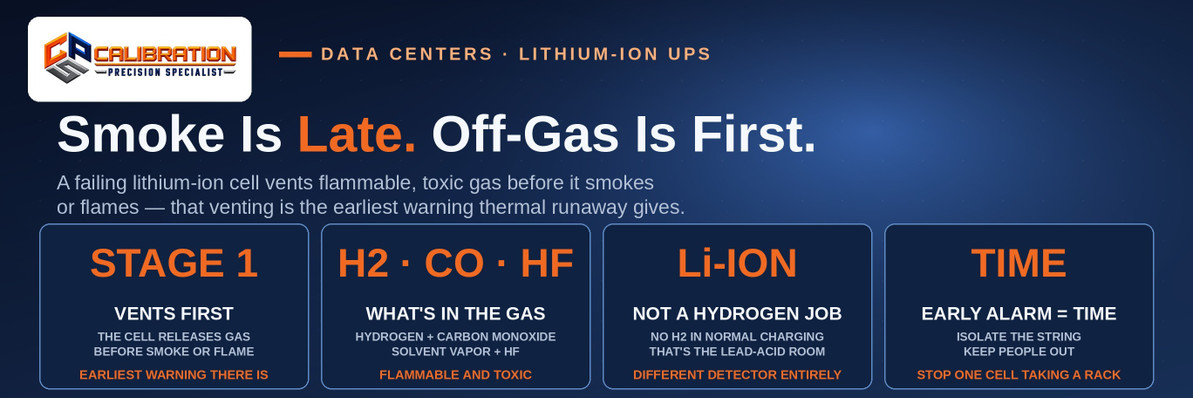
A failing lithium-ion UPS cell vents flammable, toxic off-gas — hydrogen, carbon monoxide, electrolyte solvent vapor, and hydrogen fluoride — before it produces smoke or flame, so off-gas detection is the earliest warning of thermal runaway in a data center battery room; smoke detection alone only reports the event after it is already well advanced.
The battery room used to be the best-understood gas problem in a data center. Lead-acid strings give off hydrogen as they charge, hydrogen is flammable at 4% by volume, and the answer — ventilation designed to hold it to 1%, with a detector mounted high — is settled practice. Lithium-ion UPS changed the room. A lithium battery does not gas in normal operation at all. Its hazard arrives all at once, from a single failing cell, and it announces itself as gas before it announces itself as fire. This post is about that announcement — what it is, why the detector over the door misses it, and what catches it. For the whole-facility map this room sits in, start with what gas detection a data center needs.
What Is Thermal Runaway in a Lithium-Ion UPS Battery?
Thermal runaway is a self-feeding failure inside a single cell. Something goes wrong — an internal defect, damage, a charging fault, overheating — and the cell begins generating heat faster than it can shed it. The rising temperature drives more chemical reaction, which generates more heat. Once that loop starts, it does not need anything from outside the cell to keep going, and it can spread to the cells beside it.
The sequence matters more than the chemistry, because detection lives in the sequence:
- The cell vents. Pressure from the failing cell's reactions is released as off-gas — before there is smoke, and before there is flame.
- Heat and visible failure follow. The cell smokes, may ignite its own vented gas, and drives its neighbors toward failing the same way.
- The event becomes a fire problem — the stage conventional detection was designed for.
Every stage after the first is a worse place to learn about the event. The venting stage is the one with options in it: isolate the string, alert the room, keep the failure to one cell or one module instead of a rack.
What Is Battery Off-Gas, and What Is in It?
Off-gas is the mixture a failing lithium-ion cell releases when it vents. Based on the cluster research behind this series, it includes:
- Hydrogen (H2) — flammable, and released here as part of a failure event, not as a normal charging product.
- Carbon monoxide (CO) — toxic, and already familiar to any facility that runs generators.
- Electrolyte solvent vapor — the flammable liquid electrolyte inside the cell, released as vapor.
- Hydrogen fluoride (HF) — a toxic, corrosive gas formed from the electrolyte's fluorine compounds.
Two honest qualifications belong with that list. First, the exact mix varies with cell chemistry and how far the failure has progressed — any list, including this one, is the family of what can be present, not a recipe for a specific battery. Second, this post deliberately states no alarm threshold in ppm or percent for off-gas — detection setpoints belong to the specific listed detection system and the battery manufacturer's design, and a universal number quoted without that context would be invented, not informative.
Why Are Smoke Detectors Too Late for Lithium-Ion UPS Fires?
Because smoke is a late product of the event. A smoke detector — however sensitive — responds to particles from a cell that is already breaking down visibly. The off-gas stage comes first: the cell vents gas while it still looks, from across the room, like every other cell in the string.
That ordering is the entire argument:
- Off-gas detection responds to stage one — the venting — which is the only stage where intervention can still change the outcome for the rest of the string.
- Smoke detection responds to stage two or later — valuable, code-required, and absolutely still necessary, but it reports an event in progress rather than an event beginning.
- Neither replaces the other. Off-gas detection is an added earlier layer in front of the smoke and fire systems the room already has, not a substitute for them.
Is This the Same Problem as Hydrogen in a Lead-Acid Battery Room?
No — and confusing the two leads to buying the wrong detector. The contrast:
| Lead-acid UPS room | Lithium-ion UPS room | |
|---|---|---|
| Gas in normal operation | Hydrogen, released continuously while charging | None — no normal off-gassing |
| The hazard pattern | A slow build toward a flammable concentration if ventilation fails | A sudden venting event from one failing cell |
| Key numbers | Hydrogen flammable at 4% by volume; ventilation designed to hold 1%; first alarm commonly 10% LEL (0.4%) | No universal alarm number — setpoints come from the listed system design |
| Detection job | Prove the ventilation is working, alarm early, start the fan | Catch the venting stage, before smoke, flame, or spread |
| Sensor placement logic | High — hydrogen rises and collects at the ceiling | At the racks / room level per the off-gas system design |
Lead-acid hydrogen monitoring is covered in depth in our guide to hydrogen monitoring in battery rooms — including the stand-alone combustible monitor that fits that duty. Do not carry that purchase into a lithium-ion room: a hydrogen point monitor is not an off-gas detection system, and this post names no off-gas product because the right system is selected against the specific battery installation, not off a shelf page.
Where Does Off-Gas Detection Belong in a Battery Room?
Where the design of the specific system puts it — and that answer is a feature, not an evasion. Off-gas sensing is engineered detection: sensor placement follows the battery rack layout, the room's airflow, and the listed system's own instructions, because the gas has to be intercepted between the venting cell and the rest of the room. The design questions that have to be answered for any installation:
- At the rack or at the room? Rack-level sensing sits closest to the venting cell; room-level sensing covers more area with fewer points. The battery and system manufacturers' guidance decides.
- What does the alarm do? An off-gas alarm that only sounds locally wastes the warning it bought. The signal belongs at a staffed point and, where the design calls for it, tied to isolating the affected string.
- Who responds, and how fast? The value of early warning is measured in what your team does with it — the response procedure is part of the detection design, written before the event, not during it.
If a fixed system needs designing and installing rather than just supplying, that is a defined service: see fixed system installation.
What Should You Do If Your UPS Is Lead-Acid Instead?
Stay with the settled answer. Hydrogen detection high in the room, ventilation designed to the 1% limit, a first alarm well below it, and the detector's relay proving the fan runs. The hub post for this cluster walks that room alongside the rest of the facility: what gas detection does a data center need? And whichever chemistry is in the room, every fixed point in it drifts silently over time — fixed detection belongs on a calibration schedule through calibration services, with records kept the way the CPS Calibration Program keeps them.
Frequently Asked Questions
What is thermal runaway in a data center battery room?
Thermal runaway is a self-feeding failure inside a single lithium-ion cell: the cell generates heat faster than it can shed it, the heat drives more reaction, and the failure can spread to neighboring cells. In a UPS battery room it matters because the first outward sign is not fire — the failing cell vents flammable, toxic off-gas before it smokes or flames, and that venting stage is the earliest point where detection can still change the outcome.
What gas comes out of a failing lithium-ion battery?
A venting lithium-ion cell releases a mixture that includes hydrogen, carbon monoxide, electrolyte solvent vapor, and hydrogen fluoride — a blend that is both flammable and toxic. The exact mix varies with the cell chemistry and how far the failure has progressed. That gas, released before smoke or flame, is called battery off-gas, and it is what off-gas detection systems are built to sense.
Why is smoke detection not enough for lithium-ion UPS batteries?
Because smoke is a late product of the failure. A lithium-ion cell vents off-gas first — while it still looks normal from across the room — and only smokes after the breakdown is visibly advanced. A smoke detector, however sensitive, can only respond at that later stage. Off-gas detection responds to the earlier venting stage, which is the only stage where isolating the string or keeping people out can still change the outcome. Both layers belong in the room; neither replaces the other.
Do lithium-ion battery rooms need hydrogen detectors?
Not for normal operation — lithium-ion UPS batteries do not release hydrogen while charging the way lead-acid batteries do, so the standing hydrogen-monitoring design for lead-acid rooms (detector mounted high, first alarm commonly at 10% LEL, ventilation held to 1% hydrogen) does not transfer. Hydrogen is one component of the off-gas a failing lithium cell vents, but sensing that venting event is a different job, done by an off-gas detection system selected for the specific battery installation.
At what level does an off-gas detector alarm?
There is no universal number, and this post will not invent one. Off-gas alarm setpoints come from the specific listed detection system and the battery manufacturer's design for that installation — they are not a single ppm or percent figure that applies across chemistries, racks, and rooms. Any source that quotes you one threshold for all lithium-ion UPS rooms, without naming the system and its listing, is guessing. Ask the system designer for the setpoint and the document it comes from.
Where should off-gas sensors be placed in a UPS room?
Placement follows the specific system's design: the battery rack layout, the room's airflow, and the listed manufacturer's instructions. Rack-level sensing sits closest to a venting cell; room-level sensing covers more area with fewer points. Unlike hydrogen in a lead-acid room — where the rule is simply "high, because hydrogen rises" — off-gas placement is engineered per installation, and copying a placement from another site is not a design.
Can off-gas detection prevent thermal runaway?
No — and any claim otherwise overstates what detection does. Detection cannot stop the chemistry inside a failing cell. What early off-gas detection does is buy time at the only stage where time helps: alerting staff, keeping people out of the room, and isolating the affected string so one cell's failure is less likely to become a rack's or a room's. Prevention lives in battery quality, charging control, and maintenance; detection limits how far a failure travels.
What is the difference between off-gas detection and hydrogen detection?
Hydrogen detection watches for one gas building up slowly during normal lead-acid charging — hydrogen is flammable at 4% by volume, ventilation is designed to hold it to 1%, and the detector proves the ventilation works. Off-gas detection watches for a sudden venting event from a failing lithium-ion cell, sensing the mixture that cell releases before smoke or flame. Same room, different chemistry, different failure pattern, different instrument — the two are not interchangeable.
Do lithium-ion UPS rooms still need smoke detectors?
Yes. Off-gas detection is an earlier layer added in front of the room's smoke and fire detection, not a replacement for it. Smoke detection remains part of the fire protection the room is built with, and it responds at the stage where the event has become a fire problem. The argument for off-gas detection is only that, for a lithium-ion failure, an earlier stage exists — and is worth sensing.
Who designs and calibrates data center battery room detection?
The off-gas system is selected and designed against the specific battery installation, typically with the battery and detection manufacturers' guidance, and installed as a fixed system. Once installed, every fixed gas point in the room belongs on a written calibration schedule — fixed sensors drift silently, with no one wearing them to notice. CPS Calibrations designs, supplies, installs, and calibrates fixed gas detection from Rockwood, Tennessee; call 865-900-8844 to talk through a battery room.
The Bottom Line
Smoke detection reports a lithium-ion UPS failure that is already advanced; off-gas detection hears the same failure at its first stage — the venting of flammable, toxic gas that comes before smoke and flame. For a lithium-ion battery room, that earlier layer is the detection decision that matters — and it is a different purchase from the hydrogen monitoring a lead-acid room needs.
Not sure which chemistry problem your battery room actually has? Start with the cluster hub — what gas detection does a data center need? — or call CPS Calibrations at 865-900-8844.
CPS Calibrations · 109 S. Front Street, Rockwood, TN 37854 · Calibration Services · The CPS Calibration Program
Need a calibration you can file?
In-house calibration at CPS in Rockwood, Tennessee — $55 for single-gas instruments, $90 for 4- and 5-gas — every channel, as-found and as-left data, full certificate.
See Calibration Servicesor call 865-900-8844
Recent Posts
-

Can You Add a Pump to a SENKO SGT-P or MGT?
Yes — SENKO's SP-Pump101 external sampling pump ($330, part AAA006000) fits the SGT, SGT-P, and MGT, …Nov 12th 2026 -

What Refrigerant Detection Does a Grocery Store Need?
A grocery store needs refrigerant detection in three places: low-mounted carbon dioxide (R-744) sens …Nov 11th 2026 -

What Is LEL and UEL? The Explosive Range, Gas by Gas
The LEL is the lowest concentration of a gas in air that can explode, and the UEL is the highest: me …Nov 10th 2026