
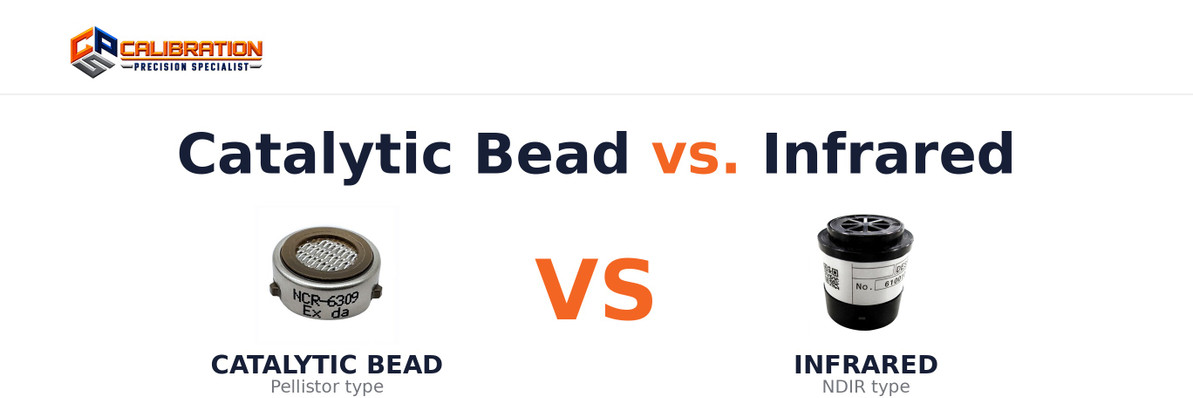
Catalytic Bead vs. Infrared LEL Sensors: When Each Wins
Most gas detectors read %LEL the same way on the display. What's happening behind that number is anything but the same. Two sensor technologies do the heavy lifting in LEL detection — the catalytic bead and the infrared (IR) sensor — and they fail in completely different ways. Picking the wrong one for your application doesn't just cost you money. It can leave you blind exactly when you need your eyes.
Here's how each one works, where each one shines, and the one gotcha that trips people up more than any other.
The Catalytic Bead: The Old Reliable
The catalytic bead — sometimes called a pellistor — has been the workhorse of combustible gas detection for decades. Inside the sensor, a tiny platinum-treated bead is heated to several hundred degrees. When flammable gas reaches it, the gas burns on the catalyst, the bead gets hotter, and the sensor converts that temperature change into a %LEL reading.
Why it's still everywhere:
- It sees everything flammable. Methane, propane, hydrogen, hexane, vapors — if it burns, the bead reacts. No exceptions, no blind spots by gas type.
- It reads the way the hazard behaves. Since it actually burns the gas, its response tracks real combustion energy. That's intuitive for anyone who grew up on LEL readings.
- It costs less. Catalytic instruments and replacement sensors are the budget-friendly option, both up front and at replacement time.
Where it struggles:
- It needs oxygen. Below roughly 10% O₂, a catalytic bead can't burn the gas properly and the reading drops — potentially reading safe when it isn't. Inerted vessels, nitrogen-purged spaces, and some process areas are no-go zones for catalytic LEL.
- It can be poisoned. Silicones (lubricants, sealants, some adhesives), sulfur compounds, and lead permanently damage the catalyst. The sensor doesn't alarm when it's poisoned — it just gets quieter and quieter. This is the single most common reason we see "my detector passed calibration last month but reads wrong today."
- Over-range exposure can kill it. A blast of very high gas concentration can burn the bead out. The sensor may come back reading, but it will never be trustworthy again without replacement.
For everyday confined-space entry and hot-work monitoring in normal air, the catalytic bead is still the default for a reason: broad coverage, honest readings, reasonable price. Nearly every major 4-gas portable is built around one — the RKI GX-3R and SENKO SP-MGT are the two we see most often: four gases, pocket-sized, catalytic LEL channel.
The Infrared Sensor: The Tough Specialist
Infrared sensors don't burn anything. They shine infrared light through the sample and measure how much of it gets absorbed at the wavelength hydrocarbons absorb (around 3.3 microns). More absorption, more gas.
Why people switch to IR:
- No oxygen needed. IR works fine in oxygen-deficient and inert atmospheres — nitrogen purging, inerting operations, anywhere a catalytic bead would go blind.
- Immune to poisoning. Silicones, sulfur, lead — none of them affect an optical measurement. In environments that eat catalytic sensors, IR just keeps working.
- Survives over-range. Blast an IR sensor with 100% gas and it doesn't burn out. It recovers and keeps reading.
- Long, stable life. No catalyst to degrade means longer service intervals and fewer surprise sensor failures — a real advantage for fixed systems that are hard to reach.
Where it struggles:
- It cannot see hydrogen. This is the big one. Hydrogen doesn't absorb infrared light, so an IR sensor reads zero in a hydrogen leak. If hydrogen is anywhere in your hazard profile — battery rooms, some chemical processes, refueling — IR alone is the wrong answer.
- It's gas-specific by design. An IR sensor tuned for methane reads other hydrocarbons with correction factors, but it's fundamentally a hydrocarbon sensor. It won't do double duty on non-IR-absorbing gases.
- It costs more. The instrument and the replacement sensor both run higher than catalytic equivalents.
Configurable multi-gas instruments are built for exactly this kind of decision. The RKI GX-6000 can be fitted with IR sensors for hydrocarbons (0–100% LEL / 0–30% volume or methane 0–100% LEL / 0–100% volume), alongside catalytic, PID, and toxic channels as the job demands. SENKO takes the same approach with the SP-MGTP, which offers its LEL channel in either catalytic or NDIR infrared depending on the configuration you order.
When Each One Wins
| Situation | Winner | Why |
|---|---|---|
| Confined space entry in normal air | Catalytic bead | Broad gas coverage including hydrogen, lower cost |
| Nitrogen purging / inerting | Infrared | Catalytic can't burn gas without oxygen |
| Silicone-rich environments (sealants, lubricants) | Infrared | Silicones poison catalytic beads permanently |
| Battery rooms / hydrogen service | Catalytic bead | IR physically cannot detect hydrogen |
| Fixed monitors in hard-to-reach spots | Infrared | Longer life, fewer unplanned sensor swaps |
| High-concentration process areas | Infrared | Over-range won't burn out the sensor |
| General plant safety on a budget | Catalytic bead | Does the job for less, in normal atmospheres |
The Calibration Reality Nobody Skips
Here's what we tell every customer, whichever technology they run: the sensor type changes the failure mode, not the need for calibration.
Catalytic beads drift and can be poisoned silently — that's why bump-testing before each use matters so much with them. A poisoned bead won't announce itself; it'll just show you a smaller number than the truth. IR sensors are far more stable, but they're still measuring instruments that need periodic verification against known gas.
When instruments come through our lab — whether it's a portable multi-gas or a process instrument off the same plant floor — every LEL channel gets bump-tested, calibrated against NIST-traceable calibration gas, and verified. We calibrate every channel, and the certificate shows as-found and as-left readings so you can see exactly what the sensor was doing when it arrived. If a catalytic bead is poisoned or an IR sensor has drifted, you'll know — from data, not from a guess.
One practical note: IR sensors are calibrated with the gas they're tuned for (typically methane or propane), and getting the span gas wrong is an easy mistake. If you're buying cal gas for an IR instrument, double-check the sensor spec first — or call us at 865-900-8844 and we'll match it for you.
The Bottom Line
There is no universally "better" LEL sensor — there's only the right one for your atmosphere. Normal air, broad coverage, tight budget: catalytic bead. Low oxygen, poisoning risk, over-range exposure, or a sensor you can't reach easily: infrared. Hydrogen in the picture: catalytic, full stop.
And whichever you choose, keep it honest with regular calibration. The sensor is only as trustworthy as its last verification.
Shopping for instruments or replacement sensors? Browse portable gas detection — from 4-gas workhorses like the RKI GX-3R and SENKO SP-MGT up to configurable multi-gas units like the RKI GX-6000 and SENKO SP-MGTP — or shop the sensors themselves: catalytic LEL replacement sensors and IR replacement sensors. Need your fleet verified? Ship your detectors to our lab or have us come to your facility — gas detection and process instruments alike.
Frequently Asked Questions
Can an infrared LEL sensor detect hydrogen? No. Hydrogen does not absorb infrared light, so IR sensors read zero in hydrogen. If hydrogen is part of your hazard profile, you need a catalytic bead (or another hydrogen-capable technology) on that channel.
Does a catalytic bead LEL sensor work in low oxygen? Not reliably. Below roughly 10% O₂, the bead can't combust gas properly and readings drop — possibly showing safe when the atmosphere isn't. Use IR for oxygen-deficient or inerted spaces.
What poisons a catalytic bead sensor? Silicones (lubricants, sealants, adhesives), sulfur compounds, and lead compounds are the main culprits. Poisoning is permanent and silent — the sensor just becomes less responsive. This is why bump-testing before each use is critical with catalytic sensors.
Do infrared sensors still need calibration? Yes. IR sensors are more stable than catalytic beads, but they're still precision instruments. They should be bump-tested and calibrated on schedule with the correct span gas (typically methane or propane, matched to the sensor).
Which LEL sensor lasts longer? Infrared, generally by a wide margin — there's no catalyst to degrade, and over-range exposure doesn't destroy the sensor. Catalytic beads are consumables with a typical life of a few years, shorter in harsh environments.
Can one instrument have both? Yes — the RKI GX-6000 and the SENKO SP-MGTP can both be configured with IR and catalytic channels side by side, so you get IR's stability for hydrocarbons and catalytic coverage for hydrogen and broad flammables in one unit.
Recent Posts
-

Electrochemical Toxic Sensors: Cross-Sensitivities That Fool Your Readings
Your carbon monoxide alarm goes off in the battery room. You sweep the area — there's no CO source a …Oct 8th 2026 -

Why Oxygen Sensors Die — and How to Make Them Last
Every 4-gas monitor has an oxygen channel, and it's the only channel with a built-in expiration date …Oct 7th 2026 -
Catalytic Bead vs. Infrared LEL Sensors: When Each Wins
Most gas detectors read %LEL the same way on the display. What's happening behind that number is any …Oct 6th 2026