
What Is Remote Monitoring for Fixed Gas Detection?
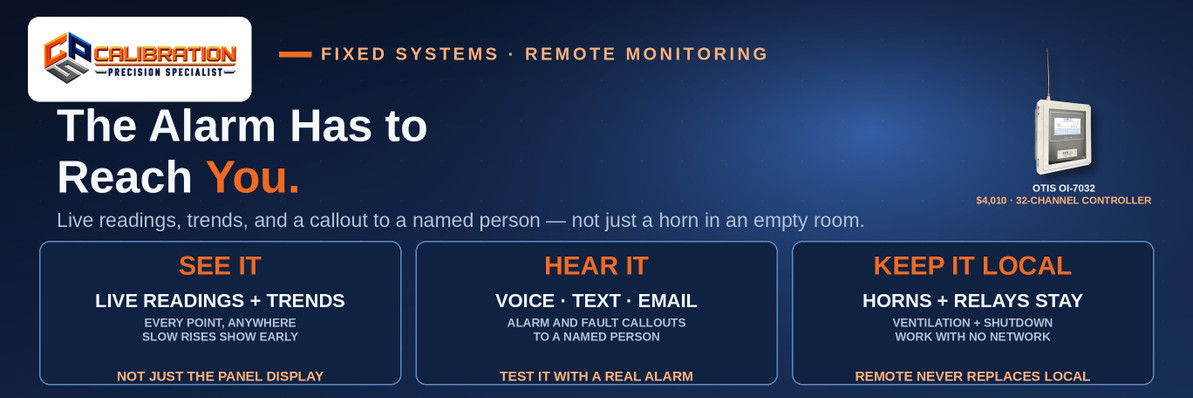
Remote monitoring for fixed gas detection means a fixed system's live readings, trends, and alarm history can be seen away from the controller panel — and an alarm is sent to a named person by voice call, text, or email — instead of only sounding in the room where it happened. A local horn protects people who are on site; remote monitoring protects the hours when nobody is on site.
Most fixed gas detection systems were built for a person standing in the building. The controller displays the reading, the horn sounds in the room, and the relay starts ventilation or shuts a process down. That design is correct — and incomplete. It says nothing about the compressor station at 2 a.m., the water plant on a holiday weekend, or the warehouse where the only person who walks past the controller arrives at 7 a.m. Remote monitoring closes that gap. It does not replace a single detector, relay, or calibration. It makes sure the alarm the system already produces reaches a person who can act on it, wherever that person is.
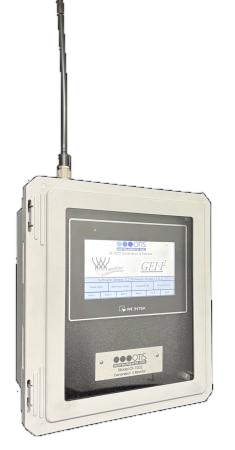
OTIS OI-7032 WireFree 32-Channel Touchscreen Data Logging Controller
32-channel WireFree controller with touchscreen and data logging — the local hub a remote layer builds on.
$4,010
See the OI-7032What does remote monitoring actually add?
Three things, and it is worth separating them because vendors sell them as one blur:
1. Live readings away from the panel. Every point's current value — %LEL, ppm, or % oxygen — visible on a browser, dashboard, or phone, instead of only on a controller display in a mechanical room.
2. Trends and alarm history. A reading that has crept from 2% to 9% LEL over a week tells a different story than a sudden spike, and only a trend shows it. Alarm history with timestamps is also the record an auditor, insurer, or incident review will ask for. Our guide to getting gas detection data into SCADA and building systems covers the signal paths in detail.
3. Callouts that leave the building. When a point crosses a setpoint — see fixed gas detector alarm setpoints — or faults, the system sends a voice call, text, or email to a named recipient. This is the piece that changes outcomes at unmanned sites, and it is the piece most often left untested.
Local protection vs. remote monitoring: what does each job?
| Job | Local system | Remote layer |
|---|---|---|
| Warn people in the area | Horn and beacon at the point | Not a substitute — sound must be heard on site |
| Act on the hazard | Relays start ventilation or shut down equipment — see ventilation interlocks | Reports that the action happened |
| Warn people off site | Nothing, unless a relay is wired to an autodialer or SCADA | Voice, text, and email callouts to a named person |
| Prove what happened | Controller data logging, where fitted | Trends and timestamped alarm history you can pull up anywhere |
How do legacy 4-20 mA and Modbus systems bridge to remote monitoring?
You rarely start from zero. A wired head reporting 4-20 mA to a controller, or a controller speaking Modbus, already produces the signal a remote layer needs. The bridge is one of three shapes: the controller feeds the plant's existing SCADA or PLC, which already reports off site; a gateway or telemetry unit takes the controller output and publishes it to a hosted dashboard; or a wireless controller — the pattern in our wireless fixed gas detection guide — gathers heads without signal wiring and presents one controller point to report from. The OTIS OI-7032 above is that shape: 32 WireFree channels, touchscreen, and data logging in one controller, $4,010 at CPS. Its detector heads are covered in OTIS OI-6900 WireFree detector heads, and controller selection generally in how to choose a gas detection controller.
A note on named platforms: RKI's 24/7 Vision is RKI's own web SCADA service for RKI fixed systems. It is a useful example of what a hosted layer looks like — live data, trends, maps, and alarm callouts — but CPS does not present it as a CPS offering. Whatever platform you choose, judge it on the same test: does a real alarm, and a real fault, reach a real phone?
Use remote monitoring when — and skip it when
Use it when the site is unmanned for long stretches (compressor stations, tank farms, remote pump and lift stations), when one safety manager covers several buildings or sites, when alarm history is needed for audits or incident reviews, or when a slow trend — a seal weeping a little more each week — is the failure you actually fear.
Do not let it substitute when the gap is local: no horn where people work, relays not wired to ventilation, or heads past their calibration date. Remote monitoring cannot fix a detector that reads wrong. It reports the reading it is given — which is why calibration services and a proper fixed system installation come first, and the dashboard comes second.
What should you spec before you buy?
- Both callouts: alarm AND fault (sensor fault, wireless-head low battery, lost communication) — tested live, not assumed.
- Named recipients: a person or on-call rotation for voice, text, and email, with the 2 a.m. action written down.
- Link-loss behavior: local alarms continue with no network, and the loss itself is reported.
- History you keep: trends and timestamped alarm history exportable for an auditor — not locked behind a login you lose when a subscription lapses.
- Security: a secured connection (VPN/HTTPS or private APN on cellular) — gas data is operational data.
Frequently Asked Questions
What is remote monitoring for fixed gas detection?
Remote monitoring means the controller's live readings, trends, and alarm history are available away from the panel — on a browser, dashboard, or phone — and alarms are sent out as voice, text, or email callouts. The detectors and local relays still work on site; remote monitoring adds visibility and notification for the hours nobody is standing in front of the controller.
Does remote monitoring replace local alarms and relays?
No. Local horns, beacons, relays, ventilation, and shutdown interlocks must still work without any network connection. Remote monitoring is a notification and records layer on top of local protection — if the internet connection drops, the site must still alarm and act locally.
How does an old 4-20 mA system get remote monitoring?
A 4-20 mA or Modbus controller output is bridged through a gateway, telemetry unit, or plant SCADA/PLC input that already reports off site. You do not have to replace working detector heads to add remote visibility — you add a reporting path from the controller you already have, then test that a real alarm and a real fault both arrive off site.
What is the difference between an alarm and a fault callout?
An alarm callout means gas reached a setpoint. A fault callout means the system itself needs attention — a sensor fault, low battery on a wireless head, or a lost communication path. Both matter: a fault that nobody hears about can leave a point unprotected until the next calibration visit.
Who should receive gas alarm callouts?
A named person or a staffed on-call rotation — never a shared inbox nobody owns. Write down who receives voice, text, and email callouts, what they do at 2 p.m. versus 2 a.m., and at what reading a site visit becomes a no-entry until the area is ventilated and tested.
What should a remote gas detection dashboard show?
At minimum: the current reading for every point, which points are in alarm or fault, a trend view so a slow rise is visible before the setpoint, and an alarm history with timestamps. If the dashboard cannot show fault status and history, it is a display, not a monitoring record.
Can wireless fixed detectors be monitored remotely?
Yes. Wireless systems such as OTIS WireFree report detector heads to a central controller — the OI-7032 handles 32 channels with touchscreen display and data logging at CPS for $4,010 — and that controller is the point that connects onward to SCADA, a gateway, or a callout path. Wireless removes signal wiring between head and controller; it does not remove the need for a tested alarm path to a person.
Does remote monitoring change how often fixed detectors need calibration?
No. Remote trends can show drift and repeated nuisance alarms earlier, which helps you schedule service, but they do not extend a calibration interval. Fixed heads still need zero and span calibration, alarm and relay testing, and written documentation per point on the manufacturer's interval.
What happens if the internet or cellular link goes down?
Local detection, alarms, and relays must continue, and the system should report the communication loss itself as a fault when the link returns or through a supervised heartbeat. Specify what happens on link loss before you buy — a silent gap in the trend is not the same as a safe site.
How much does remote monitoring for fixed gas detection cost?
The cost is the reporting layer, not the detectors: a gateway or telemetry path, any subscription for a hosted dashboard or callout service, and the labor to configure points, setpoints, recipients, and tests. A controller such as the OTIS OI-7032 is $4,010 at CPS before any remote layer. Get the callout test — a real alarm reaching a real phone — written into the quote, not just the dashboard login.
The Bottom Line
A fixed gas detector that only alarms in an empty room has done half its job. Remote monitoring finishes it: live readings and trends you can see from anywhere, and a voice, text, or email callout that puts the alarm — and the fault — in front of a named person. Keep local horns, relays, and calibration exactly as they are, add the reporting layer on top, and test it with a real alarm before you call it done.
Need a calibration you can file?
In-house calibration at CPS in Rockwood, Tennessee — $55 for single-gas instruments, $90 for 4- and 5-gas — every channel, as-found and as-left data, full certificate.
See Calibration Servicesor call 865-900-8844
Recent Posts
-

What Is Remote Monitoring for Fixed Gas Detection?
Remote monitoring for fixed gas detection means a fixed system's live readings, trends, and alarm hi …Nov 23rd 2026 -

What Are the Key Differences Between the GX-6000 and GX-6100?
The RKI GX-6100 is the current replacement for the discontinued GX-6000: both are pumped 6-gas monit …Nov 22nd 2026 -

How to Read a PID Correction Factor Chart
To read a PID correction factor chart, find your vapor’s row, take the factor under your own lamp en …Nov 21st 2026