
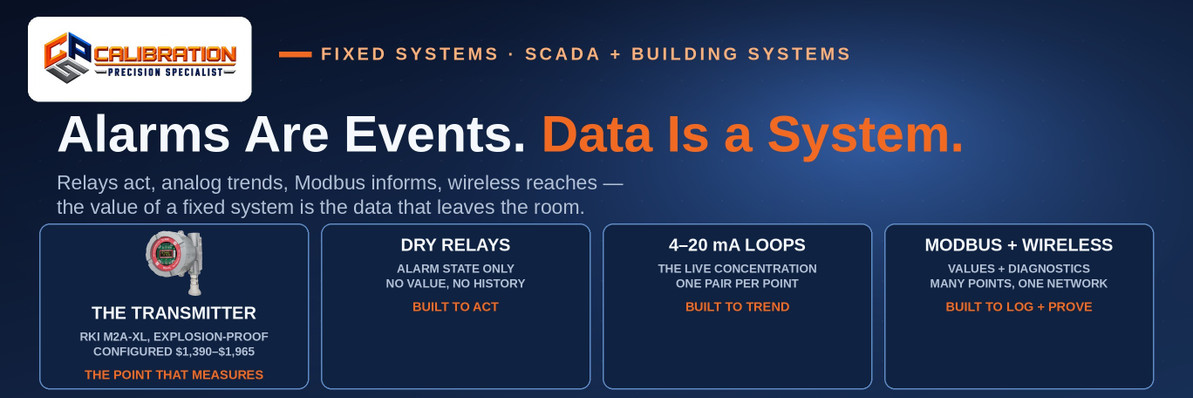
Gas Detection Data: Getting Alarms and Readings Into SCADA and Building Systems
There are four practical ways to get gas detection data into SCADA or a building system, in rising order of information: dry relay contacts, which carry alarm state only; 4–20 mA analog loops, which carry the live concentration from each point on its own pair of wires; Modbus (RTU over RS-485 serial, or TCP over Ethernet), which carries values, alarm states, and diagnostics from many points over one network; and wireless gateways, which carry the same digital data where conduit is impractical. Choose by what you'll do with the data: relays to act, analog to trend, digital to log, diagnose, and prove.
A fixed gas detector that only sounds in the room it's in protects the person standing next to it — who usually isn't there, since the rooms that need fixed detection (compressor sheds, battery rooms, boiler rooms, vaults) stand empty most of the day. The value of a fixed system multiplies the moment its alarms and readings reach a system somebody watches: a SCADA screen in the control room, the building automation system, an alarm historian. This post is the integration map for fixed-system buyers: what each connection type actually carries, what it costs in wiring and hardware, and how to decide — with controller pricing as configured, not as headlined.
What Are Your Four Options for Getting Gas Data Into SCADA?
| Path | What SCADA receives | Wiring | Best at |
|---|---|---|---|
| Dry relay contacts | Alarm / fault / normal — state only, no value | One pair per alarm level (or one pair, one state) | Triggering action: fans, solenoids, beacons, shutdowns, panel inputs |
| 4–20 mA analog loop | The live concentration, continuously | One pair per point, home-run to the controller/PLC | Trending, threshold logic in the PLC, simple long runs |
| Modbus RTU / TCP | Values, alarm states, diagnostics — many points | One RS-485 trunk or Ethernet drop serving many devices | Larger systems, logging, remote diagnosis |
| Wireless gateway | The same digital data, by radio | No signal conduit; power or batteries at the edge | Retrofits, remote points, temporary installs |
The four are not mutually exclusive. Most well-built systems layer them: relays do the acting, a digital or analog path does the recording. Our guide to choosing a gas detection controller covers the controller side of the decision; this post covers the wires (and radios) behind it.
What Do Dry Relay Contacts Actually Give You?
A relay contact is a switch the gas system closes when a condition is true: low alarm, high alarm, fault. It is the oldest, cheapest, and most robust integration there is — and the most limited:
- What travels: one bit. The PLC input knows "Beacon 110, high alarm" — not whether the room is at 21% LEL or 90% LEL, and not whether the reading is still rising.
- What it's perfect for: actions that don't need a number. Start the exhaust fan, drop the fuel solenoid, light the beacon over the door, sound the horn, post the alarm banner in SCADA. The RKI Beacon 110 single-point controller carries three 10-amp relays rated to drive external alarms and loads directly — relays are doing real work in most installed systems, not serving as a placeholder for something better.
- The honest limit: a relay-only system has no history. When the alarm clears, SCADA remembers an event, not an exposure. If the question "how high did it get, and for how long?" will ever be asked — by an incident review, an insurer, or an auditor — relays alone cannot answer it.
Why Is 4–20 mA Still the Workhorse Signal?
The analog loop is the industry's default for a reason. Each transmitter sends its reading as a current: 4 mA means zero gas, 20 mA means full scale, and every value between is proportional. The receiving PLC analog input turns that into a number SCADA can trend, alarm at multiple levels, and archive.
- Live-zero diagnostics: because zero gas reads 4 mA rather than 0, a broken wire or dead transmitter reads 0 mA — visibly different from "no gas." Below-range current is conventionally treated as a fault indication, so the loop supervises itself in a way a 0-based signal can't.
- Distance and noise: current loops shrug off electrical noise and long cable runs that would corrupt a voltage signal; the Beacon 110, for scale, accepts 4–20 mA transmitters with sensor wiring distances up to 5,000 feet.
- The cost shape: one pair per point, home-run. Four points, four pairs; forty points, forty pairs, forty PLC analog inputs. Analog is simple and dependable, and its wiring cost grows linearly until digital starts to win.
A typical mid-point architecture: transmitters like the RKI M2A-XL (explosion-proof build $1,390–$1,965 configured; non-explosion-proof $1,325–$1,750) send 4–20 mA to a controller such as the Beacon 410A ($2,965–$3,440 configured, four channels), whose relays run the room's fans and beacons while its analog output or the PLC's own inputs feed SCADA the numbers.
When Does Modbus Beat Analog Wiring?
Modbus is a digital polling protocol: the SCADA system or PLC, as master, reads registers inside each device. Modbus RTU runs over RS-485 serial cable daisy-chained from device to device; Modbus TCP runs over ordinary Ethernet. What changes versus analog:
- Many values, one cable. A single trunk can carry every point's concentration, alarm state, fault flags, and often calibration/diagnostic data — replacing a home-run pair per point with one daisy chain or switch port per area.
- Identity travels with the data. Registers belong to addressed devices, so a drifting sensor or a faulted transmitter announces which device it is, not just which PLC input went quiet.
- The trade-offs are real: digital integration needs addressing, register maps, and someone who can commission it; a wiring fault on a serial trunk can take down every device downstream of the break, where analog loses one point at a time. And per-model availability varies — confirm the exact output set (relays, analog, Modbus RTU, Modbus TCP) for the controller and transmitter configuration you're quoted, in writing, at spec time. Controller families scale by channel count: at CPS, configured pricing runs from the single-point Beacon 110 at $1,340–$1,620, through the two-channel Beacon 200 at $2,625–$2,780 and four-channel Beacon 410A at $2,965–$3,440, to the eight-channel Beacon 800 at $2,835.
Where Do Wireless Gateways Fit?
Wireless solves the conduit problem: existing buildings where trenching or conduit runs cost more than the instruments, points that move, and temporary installations. A battery- or line-powered transmitter talks to a gateway; the gateway hands SCADA the data by Ethernet or serial like any digital source.
The honest costs: batteries become a maintenance line item, radio coverage must be surveyed rather than assumed (steel, concrete, and distance all vote), and you've added a network to manage and secure. Wireless is the right answer for the point that otherwise wouldn't be monitored at all — which is a common and legitimate case — and usually the wrong first choice for a new build where conduit is cheap during construction.
What Should You Actually Do With the Data?
Integration is justified by use. The four uses that repay it, in the order plants adopt them:
- Alarm in front of a human. Every path achieves this; it's the minimum. Alarms land on a watched screen with the point named, not as a horn in an empty room.
- Alarm and event logging. Time-stamped records of every alarm, its peak value, and its duration — the file an incident review or auditor asks for. This requires values, not just contacts: analog trending or digital polling.
- Trends that predict. A toxic sensor creeping upward over weeks, a combustible sensor's baseline lifting every afternoon — historians turn gas data into maintenance foresight and into evidence for why a sensor was replaced when it was.
- Calibration and compliance support. Logged readings and fault histories feed the records program — which instruments alarmed, which faulted, which are due. Data doesn't replace calibration (a logged lie is still a lie if the sensor has drifted — we calibrate every channel on the fixed systems we service, on-site, quoted in writing), but it tells you where to look between calibrations.
Frequently Asked Questions
What is the simplest way to connect a gas detector to SCADA?
Dry relay contacts. The controller's alarm relays wire to digital inputs on the PLC or SCADA remote I/O, and the system knows the point is in alarm. It's inexpensive, electrically simple, and robust. The trade is information: a contact carries state only — no concentration value, no trend, no peak. If the alarm's story will ever need numbers, pair the relays with an analog or digital path from the start; retrofitting the value path later costs more than installing it with the system.
How does a 4–20 mA gas signal work?
The transmitter drives a current proportional to its reading: 4 mA represents zero gas and 20 mA represents full scale, with the PLC's analog input scaling everything between. Because a healthy loop never reads 0 mA, a broken wire or failed transmitter (0 mA) is immediately distinguishable from a true zero reading — the "live zero" is the loop's built-in fault detection. Current loops also tolerate long runs and electrical noise well, which is why they remain the default point-to-point signal in fixed gas detection.
What is the difference between Modbus RTU and Modbus TCP for gas detection?
The protocol is the same register-based polling; the road differs. Modbus RTU runs over RS-485 twisted-pair serial cable, daisy-chained between devices — economical for a row of controllers or transmitters in one area, with the caveat that a cable break can silence everything downstream. Modbus TCP runs over Ethernet, reaching plant networks and SCADA directly, at the cost of switches, IP addressing, and network management. Choose RTU for compact local trunks; choose TCP when the devices are already near plant Ethernet or the data consumer is the plant historian.
Can one controller feed both relays and SCADA at the same time?
Yes — that's the standard architecture. Relays handle local action (fans, solenoids, horns, door beacons) because they work even if the network doesn't; the analog output or digital port feeds SCADA the values for display, trending, and logging. The RKI Beacon 110 is a compact example: three 10-amp relays, a 4–20 mA signal output, and a built-in audible alarm from one single-point controller. Specify both paths on the quote — output sets vary by model and configuration.
How much do gas detection controllers cost?
Configured — which is the only honest way to quote them — the RKI Beacon line at CPS runs: Beacon 110 single-channel, $1,340–$1,620; Beacon 200 two-channel, $2,625–$2,780; Beacon 410A four-channel, $2,965–$3,440; Beacon 800 eight-channel, $2,835. The RKI M2A-XL stand-alone transmitter runs $1,390–$1,965 configured in its explosion-proof build and $1,325–$1,750 non-explosion-proof. Sensor selection, housing, and options move each configuration within (and define) its range, so the quote that matters is written against your gas list.
Why is the price on the controller's page lower than the configured price?
Because the headline figure is a starting configuration, not the build most plants install. On several Beacon models the headline doesn't correspond to any single orderable configuration once a real sensor and options are selected — the Beacon 110's headline sits below its $1,340 configured floor, and the M2A-XL's headlines ($1,320 explosion-proof / $1,270 non-) match no variant at all. This is common in configured industrial equipment, not a CPS quirk: always budget from the configured range for your gas, sensor type, and housing, and get the configuration itemized in the quote.
Do I need Modbus, or is 4–20 mA enough?
Count points and questions. A handful of points whose values you want trended and logged: analog into the PLC is enough, and simpler to maintain. Dozens of points, a need for per-device diagnostics and fault identity, or long multi-drop runs: Modbus's one-trunk-many-devices economics and richer data win. The deciding questions are what your historian must answer later — peak values and durations point to values (either path); device-level health points to digital.
Can wireless gas detection feed SCADA reliably?
Yes, with engineering honesty: a site radio survey, attention to gateway placement, and a battery/power maintenance plan. The gateway presents the data to SCADA like any digital source, so the SCADA side is conventional; the wireless side is where the diligence goes. Wireless earns its place in retrofits and hard-to-conduit locations — the point that would otherwise go unmonitored — and is usually second choice in new construction where conduit is inexpensive to install while walls are open.
What gas data should be logged for compliance and incident review?
At minimum: every alarm event with point identity, start time, peak concentration, and clear time; every fault event with the device identified; and periodic trend history of live values at an interval your historian can store. That set reconstructs any incident ("how high, how long, which sensor, what else was happening") and doubles as maintenance evidence — rising baselines and repeat faults justify sensor work before the post-incident questions start. Relay contacts alone cannot produce this file; they log that something happened, not what.
Who installs and commissions the SCADA integration?
Typically split: the gas detection supplier (CPS, on the systems we sell) handles instruments, controllers, and their configuration; your controls integrator or plant I&C team handles PLC/SCADA programming, register mapping, and historian setup — with the register map and output specification agreed in writing before installation day. CPS provides design consultation, installation, start-up, training, and system maintenance on the gas systems it supplies, and calibrates the installed points on-site afterward, quoted in writing. The integration failures we've seen were specification failures, not hardware failures: two competent halves, one unwritten interface.
The Bottom Line
Relays act, analog trends, Modbus informs, wireless reaches — and the right system usually layers them: contacts driving the fans and solenoids, values flowing to a watched screen and a historian that keeps peaks, durations, and faults by point. Budget from configured prices (Beacon controllers $1,340–$3,440 by channel count; M2A-XL transmitters $1,325–$1,965), write the output specification into the quote, and the gas system stops being a horn in an empty room and becomes plant data.
Designing a fixed system — or dragging an existing one onto SCADA? Call CPS Calibrations at 865-900-8844. We'll spec the controllers and transmitters against your gas list, write the configuration into the quote, and keep the points calibrated after commissioning. 109 S. Front Street, Rockwood, TN 37854.
CPS Calibrations · 109 S. Front Street, Rockwood, TN 37854 · Calibration Services · The CPS Calibration Program
Need a calibration you can file?
In-house calibration at CPS in Rockwood, Tennessee — $55 for single-gas instruments, $90 for 4- and 5-gas — every channel, as-found and as-left data, full certificate.
See Calibration Servicesor call 865-900-8844
Recent Posts
-

Calibration Gas for PID Instruments: Isobutylene and the 100 ppm Standard
A PID is calibrated on 100 ppm isobutylene — not on the gas you are measuring — because the instrume …Nov 14th 2026 -

OTIS OtisLink: How Remote Gas Detection Reports From Sites With No One There
OTIS OtisLink is a cellular/satellite hybrid telemetry kit ($2,805–$4,740 configured) that connects …Nov 13th 2026 -

Can You Add a Pump to a SENKO SGT-P or MGT?
Yes — SENKO's SP-Pump101 external sampling pump ($330, part AAA006000) fits the SGT, SGT-P, and MGT, …Nov 12th 2026