
OTIS OtisLink: How Remote Gas Detection Reports From Sites With No One There
OTIS OtisLink is a cellular/satellite hybrid telemetry kit ($2,805–$4,740 configured) that connects an OTIS controller to a cloud dashboard, so one kit covering up to 32 sensors sends instant SMS and email alerts and shows live gas levels, sensor battery status, relay conditions, and faults on web and mobile — 24/7 visibility for unmanned sites with no network infrastructure. It is the reporting layer for fixed gas detection at remote wells, tank batteries, water and wastewater sites, and landfills where nobody is there to hear a local alarm.
A fixed gas detector does its job the moment gas reaches the sensor. What it cannot do, on its own, is tell anyone. On a staffed plant floor that is a small problem — a horn sounds, a beacon flashes, people respond. On an unmanned site it is the whole problem: the detector can sit in alarm for hours, doing everything it was built to do, while the one thing that matters — a person knowing — never happens. OtisLink exists to close that gap, and this post explains what it actually reports, what it costs, and where it does and does not belong.
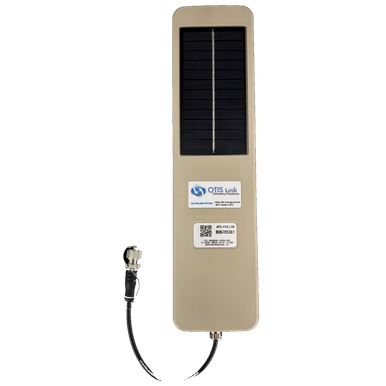
OTIS OtisLink Cellular/Satellite Hybrid Telemetry
Cloud telemetry add-on for OTIS controllers — hybrid cellular/satellite reporting for up to 32 sensors, with instant SMS and email alerts.
$2,805–$4,740 configured
See OtisLinkWhat Is OtisLink, Exactly?
OTIS OtisLink is a cloud-based remote monitoring add-on for OTIS controllers. OTIS's own framing is specific: it is built for sites that do not have — or cannot justify — network infrastructure. Instead of needing the site's LAN, Wi-Fi, or a hardwired run back to a staffed building, the hardware kit connects the controller over hybrid cellular/satellite communication and puts the system on a cloud platform you reach from any web browser or phone.
Three parts of that design decide whether it fits your site:
- The link is hybrid cellular/satellite. Cellular is the ordinary path at most remote sites; satellite is what makes the same product plausible at the sites cellular forgot — the far well pad, the isolated tank battery, the landfill cell. This post makes no carrier or coverage guarantee, and neither does OTIS's sheet: the honest statement is that the kit was designed for places with no network infrastructure to lean on, and the site path gets confirmed when the system is specified.
- One kit covers up to 32 sensors. That matches the 32-channel OTIS controller class (the OI-7032 and OI-7010 controllers are 32-channel units), so a single telemetry kit reports a whole controller's worth of detection points — not one detector at a time.
- It works with wired and wireless OTIS configurations. Whether the heads talk to the controller by wire or by OTIS WireFree radio, the controller's view of the system is what OtisLink carries to the cloud.
The Problem It Solves: An Alarm Nobody Hears
Fixed detection at unmanned sites fails quietly in four familiar ways, and only one of them is a gas leak:
- The real alarm with no audience. Gas reaches a head, the controller alarms locally, relays change state — and the first person to learn about it is whoever drives out next, possibly days later. The detection worked. The notification never existed.
- The dead sensor nobody noticed. A head with a flat battery, a faulted sensor, or a lost radio link stops protecting the site while looking, from the road, exactly like a working system. On a wireless system, battery and communication health are the maintenance — and they are invisible without reporting.
- The relay event with no record. A relay trips a fan or a shutoff exactly as designed, then resets. Without a logged history, nobody can later prove the sequence happened — or reconstruct what the readings were when it did.
- The drive-out check that costs more than it finds. Sending a technician to read a controller screen in person, just to confirm everything is normal, is the most expensive way ever devised to learn nothing is wrong.
OtisLink answers each of those directly: alarms leave the site as SMS and email, sensor battery and fault status report continuously, events land in retained history, and the routine check becomes a glance at a dashboard. What remains for the drive out is the work that actually needs hands — calibration and repair.
What Actually Reports to You
The cloud side is not a single "alarm / no alarm" light. Per OTIS's telemetry sheet and the product listing, OtisLink reports:
| What reports | Why it matters at an unmanned site |
|---|---|
| Live gas levels | You see the reading itself, not just that a threshold crossed — a slow climb and a sudden spike call for different responses |
| Sensor battery status | On wireless heads, the battery is the consumable that ends protection; watching it turns a dead head into a scheduled swap |
| Relay conditions | You can confirm the fan, beacon, or shutoff the controller drives actually changed state |
| Faults | A faulted or offline point is flagged as a fault — visibly different from a clean zero reading |
| Device communication and uptime | The system reports on its own health, so silence itself becomes information |
On top of the live view:
- Instant SMS and email alerts when critical thresholds are met, with configurable alerts and escalation settings — the notification goes to people, not to a screen in an empty building.
- Custom dashboards and scheduled reports, so an operator watches today's sites while a supervisor gets the periodic summary without logging in.
- Historical trends and up to 5 years of data retention. Five years is the number that matters in an audit, an incident review, or a regulator's records request: the readings, alarms, and faults from a season ago are still there.
- Role-based permissions with SSL-encrypted access. The people who need to see a site see it; access is controlled per user rather than shared around as one login.
Our post on getting gas detection data into SCADA and building systems covers the wired plant-floor version of this problem. OtisLink is the answer to the same question asked from a site that has no building system to feed.
What It Works With
OtisLink is an add-on for OTIS controllers, across wired and wireless OTIS configurations. In CPS's catalog that means it sits on top of systems built from:
- OTIS OI-7032 WireFree controller — the 32-channel touchscreen data-logging controller at the centre of larger WireFree systems, and the OI-7010 32-channel hybrid controller.
- OTIS OI-6900 WireFree detector heads — battery-powered wireless heads whose battery and fault status are exactly what remote reporting exists to watch.
- OTIS wired detector heads — 4-20 mA heads on wired configurations; the listing states compatibility with wired configurations as well, so a wired site is not excluded from telemetry for being wired.
If you are still choosing the controller underneath, our guide on how to choose a gas detection controller works through channel counts and output types before telemetry enters the picture. And if the site itself is not built yet, CPS designs and installs the whole system — detection, controller, and reporting — through our fixed system installation service.
The Kit, Priced Honestly
OtisLink is one product with three configuration choices, and the configured range is wide enough that quoting any single number but the base would mislead:
- Base kit — $2,805. No extension cable, no mounting hardware, no airtime plan included.
- Configured range — $2,805–$4,740 across all 16 configurations.
- Airtime: +$1,520 for 1 year of cellular/satellite airtime, the same increment on every configuration that includes it. The listing is plain that a yearly airtime fee applies for the cellular/satellite service — treat airtime as a running cost of the system, like calibration gas, not a one-time extra.
- Mounting: +$95 for the telemetry hardware mount.
- Extension cables: bulkhead cable +$85, 0.5 meter extension cable +$230, 10 meter extension cable +$320, for installations where the telemetry hardware has to sit away from the controller or pass through an enclosure wall.
Two buying consequences follow. First, the honest first-year comparison number for most remote sites is the kit with airtime — $4,325 for the base configuration with one year of service — because a telemetry kit without airtime reports nothing. Second, the per-point math is where OtisLink earns its place: one kit reporting up to 32 sensors costs the same whether it watches 4 points or 30, so on a full controller the reporting layer adds roughly $90–$150 per point at base-kit pricing, while on a 2-point site it is a $2,805 answer to a much smaller question. Size the controller first; telemetry follows the channel count.
When Does OtisLink Make Sense — and When Doesn't It?
It makes sense when:
- The site is unmanned or visited on a rotation — remote production wells, tank batteries, water and wastewater lift and treatment sites, landfills, remote storage — and an alarm's value depends on it reaching a person who is somewhere else.
- The site has no network infrastructure and building some costs more than the telemetry does.
- The heads are wireless, so battery and communication health need watching between visits.
- You need a retained record — readings, alarms, faults — for compliance, an insurer, or your own incident reviews, without sending someone to pull logs off a controller.
It is the wrong buy when:
- The plant is staffed around the clock and its controllers already report into SCADA or a building system the operators actually watch — telemetry would duplicate a path that exists.
- The site is a single detector point beside a staffed building, where a local alarm and a relay output already reach people reliably.
- The real gap is detection itself — missing heads, expired sensors, an uncalibrated system. Telemetry reports what the system sees; it cannot fix what the system cannot see. That work comes first.
Telemetry Does Not Replace Calibration
The most dangerous way to read a remote dashboard is as proof the numbers are right. OtisLink faithfully reports whatever the controller and sensors tell it — including a drifted sensor's wrong reading, delivered instantly, with five years of retention. Remote visibility raises the value of calibration rather than replacing it: when you can watch a system's health from your phone, the site visits that remain should be the ones that keep the readings true — zero and span checks on every head, alarm and relay tests, and a written record per point, the same discipline covered in our fixed calibration coverage and delivered through CPS calibration services. A remote system that is calibrated on schedule is genuinely supervised. A remote system that is never calibrated is just a faster way to be wrong.
Frequently Asked Questions
What is OTIS OtisLink?
OTIS OtisLink is a cloud-based telemetry add-on for OTIS gas detection controllers. The hardware kit connects a controller over hybrid cellular/satellite communication and provides 24/7 web and mobile visibility into gas levels, sensor battery status, relay conditions, and faults for up to 32 sensors, with instant SMS and email alerts. It is configured at $2,805–$4,740 on the CPS store.
How much does OTIS OtisLink cost?
The base OtisLink kit is $2,805 with no extension cable, mount, or airtime included, and the full configured range across all 16 configurations is $2,805–$4,740. Adding 1 year of cellular/satellite airtime adds $1,520, the telemetry hardware mount adds $95, and extension cables add $85 (bulkhead), $230 (0.5 meter), or $320 (10 meter).
How many sensors can one OtisLink kit monitor?
One OtisLink hardware kit monitors up to 32 sensors — the channel capacity of the OTIS 32-channel controller class it connects to, such as the OI-7032 and OI-7010. There is one telemetry kit per controller, not one per detector.
Why does OtisLink use both cellular and satellite?
OtisLink uses hybrid cellular/satellite communication because it is built for sites that do not have, or cannot justify, network infrastructure — remote wells, tank batteries, water and wastewater sites, and landfills. The hybrid link is what makes remote reporting plausible at sites with no LAN or Wi-Fi to connect to. OTIS does not publish a carrier or blanket coverage guarantee, so the communication path for a specific site is confirmed when the system is specified.
What alerts does OtisLink send?
OtisLink sends instant SMS text and email alerts when critical thresholds are met, and alerts and escalation settings are configurable. Between alarms it provides live operational data — gas levels, relay status, sensor battery levels, faults, and device communication and uptime — through web and mobile access.
Can I see my gas detector readings on my phone?
Yes. OtisLink provides real-time data and alarm notifications via web and mobile access, with custom dashboards for live gas levels, sensor battery status, relay conditions, and faults. Access is role-based and SSL-encrypted, and historical data is retained for up to 5 years.
Does OtisLink work with wired OTIS systems or only wireless?
Both. OTIS states OtisLink works with wired and wireless OTIS configurations — it connects through wired or wireless communication to the controller. A site running wired 4-20 mA heads is not excluded from telemetry, and a WireFree wireless site uses the same kit.
Is there a yearly fee for OtisLink?
Yes — a yearly airtime fee applies for the cellular/satellite service, and the honest budget treats it as a running cost. On the CPS listing, the 1-year cellular/satellite airtime option adds $1,520 to any configuration. A kit bought without airtime has no active communication service.
How long does OtisLink keep my data?
OtisLink retains data for up to 5 years, including historical trends and performance data, with custom and scheduled reports available from the cloud platform. That retention is what makes the system useful in audits and incident reviews long after an event.
Does remote monitoring replace calibrating my fixed gas detectors?
No. OtisLink reports whatever the sensors and controller tell it, so a drifted sensor produces a confidently reported wrong reading. Fixed detectors still need scheduled zero and span calibration, alarm and relay testing, and written documentation per point — CPS provides that through its calibration services and fixed system installation work. Telemetry tells you sooner; calibration keeps what it tells you true.
The Bottom Line
A fixed gas detection system on an unmanned site is only half a system until its alarms can leave the site. OTIS OtisLink is that second half for OTIS systems: one kit, up to 32 sensors, hybrid cellular/satellite reporting, instant SMS and email alerts, live health and readings on web and mobile, and up to 5 years of retained record — $2,805–$4,740 configured, plus yearly airtime. Buy it when nobody is there to hear the alarm. Skip it when a staffed control room already hears everything. Either way, keep the underlying system calibrated — telemetry makes a true reading travel; it cannot make a reading true.
Need a calibration you can file?
In-house calibration at CPS in Rockwood, Tennessee — $55 for single-gas instruments, $90 for 4- and 5-gas — every channel, as-found and as-left data, full certificate.
See Calibration Servicesor call 865-900-8844
Recent Posts
-

Calibration Gas for PID Instruments: Isobutylene and the 100 ppm Standard
A PID is calibrated on 100 ppm isobutylene — not on the gas you are measuring — because the instrume …Nov 14th 2026 -

OTIS OtisLink: How Remote Gas Detection Reports From Sites With No One There
OTIS OtisLink is a cellular/satellite hybrid telemetry kit ($2,805–$4,740 configured) that connects …Nov 13th 2026 -

Can You Add a Pump to a SENKO SGT-P or MGT?
Yes — SENKO's SP-Pump101 external sampling pump ($330, part AAA006000) fits the SGT, SGT-P, and MGT, …Nov 12th 2026