
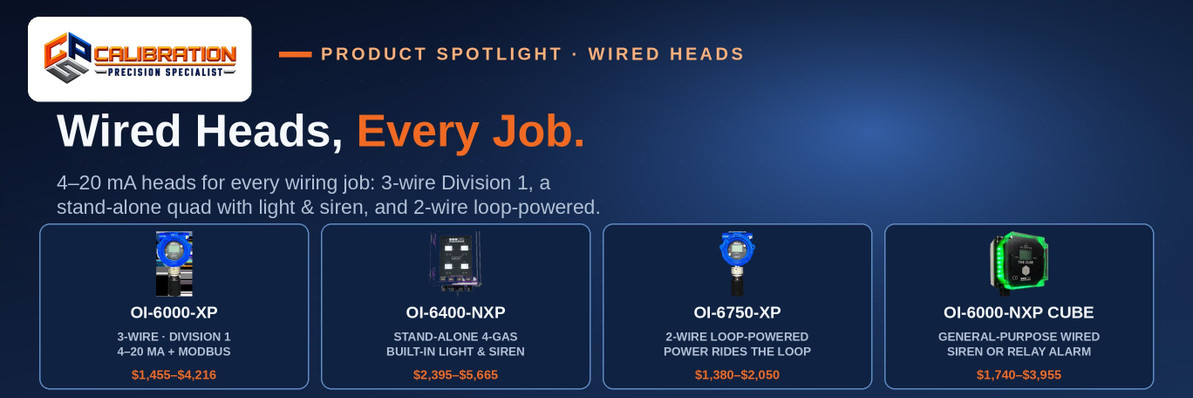
OTIS Wired Detector Heads: OI-6000, OI-6400, and the Loop-Powered OI-6750
OTIS wired detector heads report on the industry-standard 4–20 mA signal: the explosion-proof OI-6000-XP ($1,455–$4,216 by configuration) is a 3-wire Class I Division 1 head with Modbus, optional relays, and an optional radio; its non-XP Cube sibling, the OI-6000-NXP ($1,740–$3,955), trades the classified enclosure for a light-and-siren or relay alarm choice in general-purpose areas; the OI-6400-NXP ($2,395–$5,665) is a stand-alone four-gas head with a built-in light and siren that needs no controller at all; and the 2-wire loop-powered OI-6750 ($1,380–$2,050 XP; $1,195–$1,865 NXP) draws its power from the signal loop itself — two wires carry both power and reading, which makes it the natural retrofit head.
Wireless heads get the attention, but most fixed gas detection installed today is still wired — for good reasons. Wired power never needs a battery change-out, a 4–20 mA loop is understood by every PLC and DCS on earth, and a lot of plants already own the cable. This post walks the OTIS wired family by wiring job: the 3-wire XP and Cube heads, the stand-alone quad, and the loop-powered head that runs on two wires total.
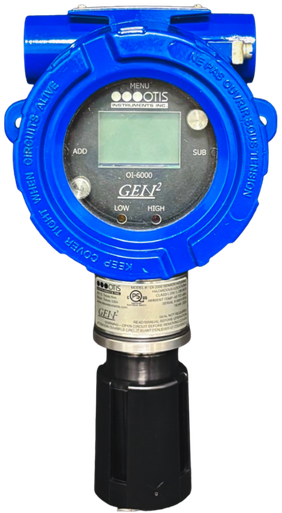
OTIS OI-6000-XP Explosion-Proof Single-Gas Detector Head
OTIS wired heads on 4–20 mA: explosion-proof OI-6000-XP ($1,455–$4,216), Cube OI-6000-NXP ($1,740–$3,955) with light-and-siren or relay alarm options, stand-alone four-gas OI-6400-NXP ($2,395–$5,665, no controller needed), and the 2-wire loop-powered OI-6750 ($1,380–$2,050 XP; $1,195–$1,865 NXP) that runs on the signal loop itself.
$1,455–$4,216 configured
See the OI-6000-XPOI-6000-XP: The 3-Wire Division 1 Head
The OI-6000-XP is the sensor-side building block of an OTIS wired system for classified locations: explosion-proof, Class I Division 1, Groups B, C, D, with ATEX/IECEx ratings. It takes electrochemical, infrared, catalytic-bead, or PID elements across 23 gas and range combinations, runs on 12–35 VDC (3-wire, about 2 W), and reports as 4–20 mA with a fault terminal, plus RS-485 Modbus. Two options matter: an optional GEN II WireFree radio for wireless reporting — note it still needs its wired power, so it is a reporting option, not a battery conversion — and optional dual dry-contact relays for standalone local alarming. Its 102×64 sunlight-readable display and magnetic switches allow calibration without opening the enclosure. It is also compatible with the OI-501-5 remote sensor mounting kit for hard-to-reach sampling points.
OI-6000-NXP 'Cube': The General-Purpose Wired Head
The OI-6000-NXP Cube is the non-explosion-proof wired counterpart for warehouses, mechanical rooms, parking structures, and other unclassified spaces. It speaks 4–20 mA and Modbus across 20 gas and range combinations (toxics, oxygen, hydrogen, LEL by infrared, refrigerants, PID VOCs), with an optional GEN II radio. Its distinguishing choice is the alarm package: a configurable LED ring-light with built-in siren, or two dry-contact relays — local, visible-and-audible alarming at the point, or contacts to drive something else. Like the rest of the family, it calibrates through a magnetic non-intrusive interface.
OI-6400-NXP: The Stand-Alone Quad With Light & Siren
The OI-6400-NXP answers a different question: what if the point needs watching but there is no controller to report to? It is a wire-powered, non-explosion-proof four-gas detector with a built-in strobe (blue or red) and siren — a complete area monitor for general-purpose spaces that alarms locally the moment any channel goes into alarm, no controller required. Listed configurations cover popular 4-gas combinations, including the classic LEL/O2/CO/H2S set, with custom sensor loadouts available. For a warehouse, mechanical room, parking structure, or loading dock that needs one self-contained multi-gas point, the 6400 is the whole system in one enclosure.
OI-6750: The Loop-Powered Retrofit Head
The OI-6750-XP and its non-XP sibling are the simplest wiring job in the family: 2-wire loop-powered, meaning the head draws its operating power from the same twisted pair that carries its 4–20 mA reading back to the controller, PLC, or DCS — no separate power wiring at all. Both offer 24 gas and range combinations, electrochemical, including specialty gases such as arsine, phosphine, ethylene oxide, and methyl mercaptan. That is why the record calls the 6750 a natural retrofit: it drops onto existing 2-wire infrastructure. The XP version carries the Class I Division 1 explosion-proof enclosure; the NXP serves general-purpose areas — at $1,195–$1,865, the lowest entry price in this family.
Wired or Wireless: Which Heads Belong Where?
The deciding factors are the ones wireless fixed gas detection lays out from the other side: wired wins where loops already exist (the 6750's home ground), where a PID's power draw would eat batteries (a wired OI-6000 runs a PID indefinitely), and where continuous, maintenance-free power matters more than installation labor. Wireless wins where new cable is the expensive part. The controllers do not force the choice — a hybrid panel like the OI-7032 runs wired and WireFree points side by side, and the full comparison sits in fixed vs. portable gas detection for the portable side of the family. System design and commissioning are covered in fixed system installation.
Calibration is what makes any of this real. Every head in this family calibrates through magnetic non-intrusive switches or interface — no opening a Division 1 enclosure to span a sensor. We calibrate every channel on the fixed systems we service, through calibration services — 3-wire, loop-powered, and stand-alone heads alike.
Frequently Asked Questions
What is a wired gas detector head?
A permanently mounted gas sensor that runs on wired power and reports its reading as an electrical signal — in this family, the industry-standard 4–20 mA signal (with RS-485 Modbus on the OI-6000 heads) — to a controller, PLC, or DCS. The OTIS wired family covers three wiring jobs: 3-wire heads (OI-6000-XP and Cube), a stand-alone 4-gas head with its own light and siren (OI-6400-NXP), and 2-wire loop-powered heads (OI-6750-XP and NXP).
What is the difference between the OI-6000-XP and the OI-6000-NXP Cube?
Certification and alarm style. The XP ($1,455–$4,216) is explosion-proof for Class I Division 1, Groups B, C, D, takes 23 gas/range combinations including catalytic-bead sensors, outputs 4–20 mA with a fault terminal plus Modbus, and offers optional relays or an optional radio. The NXP Cube ($1,740–$3,955) is for general-purpose areas, covers 20 combinations, and offers a configurable LED ring-light with built-in siren or two relays. The area classification picks the enclosure; both are 3-wire wired heads at heart.
What does loop-powered mean on the OI-6750?
The head takes its operating power from the signal loop itself. Two wires — one twisted pair — carry both the power the OI-6750 runs on and the 4–20 mA reading it sends back to the controller, PLC, or DCS. There is no separate power run to pull, which is why loop-powered heads are the standard retrofit choice: where a 2-wire loop already exists, the new head drops onto the infrastructure that is already in the ground.
What gases can the OI-6750 detect?
Twenty-four gas and range combinations, all electrochemical — common toxics, oxygen, and hydrogen, plus specialty gases such as arsine, phosphine, ethylene oxide, and methyl mercaptan. Both the explosion-proof OI-6750-XP ($1,380–$2,050) and the general-purpose OI-6750-NXP ($1,195–$1,865) offer the same 24 combinations; the difference between them is the enclosure certification, not the gas list.
What is the OI-6400-NXP?
A stand-alone, wire-powered four-gas detector for general-purpose areas with a built-in strobe (blue or red) and siren. It watches four gases at once and alarms locally — no controller required — which makes it a complete one-box area monitor for warehouses, mechanical rooms, parking structures, and loading docks. Listed configurations include the classic LEL/O2/CO/H2S combination, with custom loadouts available. CPS prices run $2,395–$5,665 by configuration.
Do wired detector heads need a controller?
Most do, one stand-alone exception aside. The OI-6000 and OI-6750 heads report 4–20 mA (and Modbus, on the 6000s) to a controller, PLC, or DCS, which displays readings and drives alarms — though an OI-6000 with the optional relay package can alarm standalone at the point. The OI-6400-NXP is designed to work alone: its built-in light and siren are the alarm. A head with relays or a siren can warn locally; a head without them is only as useful as the panel reading it.
Can the wired OI-6000 report wirelessly?
It can report by radio — an optional GEN II 900 MHz or 2.4 GHz WireFree radio is offered on both the OI-6000-XP and the Cube — but it cannot run wire-free: the 6000 still requires wired power (12–35 VDC on the XP). The radio removes the signal run, not the power run. For a head with no wires at all, the battery-powered OI-6900 family is the product built for that job.
How much do OTIS wired detector heads cost?
At live CPS list prices, by configuration: OI-6750-NXP $1,195–$1,865 and OI-6750-XP $1,380–$2,050 (loop-powered); OI-6000-XP $1,455–$4,216 and OI-6000-NXP Cube $1,740–$3,955 (3-wire); OI-6400-NXP stand-alone quad $2,395–$5,665. Controllers, where the design needs one, are separate — $2,680 (OI-7010) to $4,010 (OI-7032). Wired heads generally cost less than battery WireFree heads; their installation — cable and conduit — is where a wired job spends its money.
Which wired head is best for a retrofit?
The loop-powered OI-6750, because retrofits are a wiring problem before they are a sensor problem. It reuses an existing 2-wire 4–20 mA loop — power and signal on the pair that is already installed — so adding or replacing a point does not start with pulling new cable. Choose the XP version where the location is Class I Division 1 and the NXP in general-purpose areas. If no loop exists at the point at all, that is the case where a battery WireFree head earns its higher price.
How are wired heads calibrated if the enclosure is sealed?
By magnet. The OI-6000, OI-6400, and OI-6750 heads all provide a magnetic non-intrusive calibration interface or switches, so zero and span adjustments happen at the face of the unit without opening it — essential for the explosion-proof XP enclosures in Division 1 areas. The procedure still needs calibration gas and a schedule; the magnetic interface removes the enclosure-opening step, not the calibration itself.
The Bottom Line
Four wiring jobs, four heads: the 3-wire OI-6000 in XP or Cube form for controller-based systems, the stand-alone OI-6400 quad where there is no controller to report to, and the loop-powered OI-6750 where an existing 2-wire loop makes the retrofit nearly free of new cable. Wired power never runs out mid-shift — that permanence, on infrastructure most plants already own, is why wired heads still carry most fixed detection.
Designing a wired system — or mixing wired and WireFree points on one controller? Call CPS Calibrations at 865-900-8844 — heads, controllers, installation, and the CPS Calibration Program behind every channel, from Rockwood, Tennessee.
CPS Calibrations · 109 S. Front Street, Rockwood, TN 37854 · Calibration Services · The CPS Calibration Program
Need a calibration you can file?
In-house calibration at CPS in Rockwood, Tennessee — $55 for single-gas instruments, $90 for 4- and 5-gas — every channel, as-found and as-left data, full certificate.
See Calibration Servicesor call 865-900-8844
Recent Posts
-

Can You Add a Pump to a SENKO SGT-P or MGT?
Yes — SENKO's SP-Pump101 external sampling pump ($330, part AAA006000) fits the SGT, SGT-P, and MGT, …Nov 12th 2026 -

What Refrigerant Detection Does a Grocery Store Need?
A grocery store needs refrigerant detection in three places: low-mounted carbon dioxide (R-744) sens …Nov 11th 2026 -

What Is LEL and UEL? The Explosive Range, Gas by Gas
The LEL is the lowest concentration of a gas in air that can explode, and the UEL is the highest: me …Nov 10th 2026