
Fixed vs. Portable Gas Detection: Which Does Your Facility Actually Need?
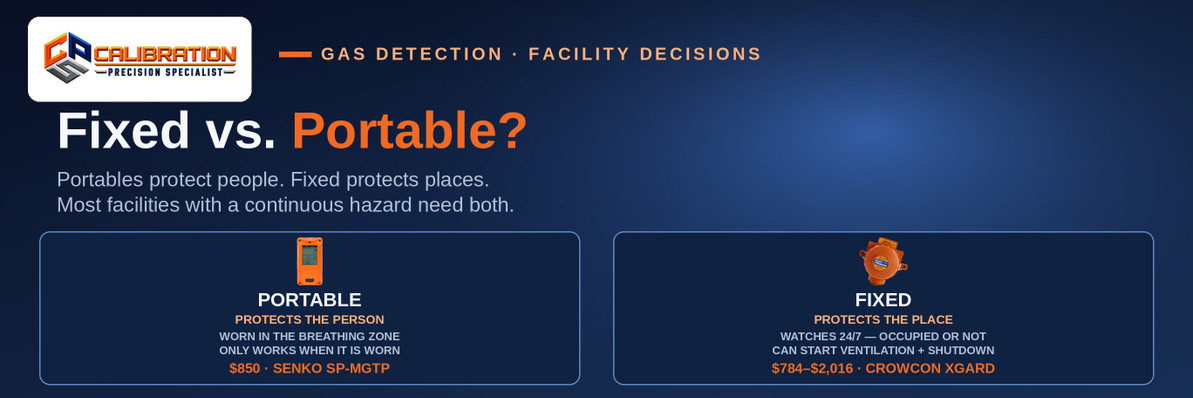
Portable gas detectors protect a person — they are worn in the breathing zone and travel wherever the worker goes — while fixed gas detectors protect a place, monitoring the same room or leak source continuously, 24/7, whether anyone is there or not. Most facilities with a continuous gas hazard need both: fixed points at the likely leak sources and portables on the people, because a fixed system cannot perform a confined-space pre-entry test and a portable detector cannot watch an unoccupied room.
That is the whole decision in two sentences. Everything below is how to apply it to your building: what each type actually does well, where each one fails, what each one really costs, and the worked examples we walk customers through when they are trying to choose.
What Is the Difference Between Fixed and Portable Gas Detection?
| Portable (personal) | Fixed (point) | |
|---|---|---|
| What it protects | The person wearing it | The room, process, or leak source |
| Where it samples | The wearer's breathing zone, wherever they move | One fixed location, at the height the gas occupies |
| When it works | Only when charged, turned on, bump-tested, and worn | Continuously — nights, weekends, and unoccupied hours included |
| Alarm | At the wearer: audible, visual, and vibrating | At a controller, plus horns/strobes where people will see them — including outside the entrance |
| What it can trigger | Nothing — it warns the wearer to leave | Through controller relays: ventilation, equipment shutdown, remote notification |
| Power | Rechargeable or replaceable battery | Wired plant power, usually with backup at the controller |
| Signal out | Data logging on the instrument; docking-station download | 4–20 mA and/or Modbus to a controller, PLC, or building system |
| Maintenance | Bump test before each day's use; full calibration at the manufacturer's interval | Calibration in place at the manufacturer's interval, at every point |
| Cost shape | Per person | Per point, plus controller, wiring, and installation |
The row that decides most purchases is the third one. A portable detector's protection switches off the moment the shift ends, the battery dies, or the monitor is left in a locker. A fixed detector's protection never follows a worker into the next room, a tank, or a trench. They are not two prices for the same job — they are two different jobs.
When Does a Portable Detector Win?
Choose portables as the primary protection when the hazard moves with the work:
- People move between areas. Maintenance, operators making rounds, delivery and service crews — no practical number of fixed points covers a person whose workplace is the whole plant. A personal 4-gas monitor such as the RKI GX-3R ($640) covers the wearer in every area they enter.
- Confined-space entry. OSHA 29 CFR 1910.146 requires atmospheric testing before and during entry, performed with a portable — usually pumped — instrument at the space itself. No fixed system, however good, discharges that duty.
- Intermittent or task-based hazards. Hot work, line breaking, turnarounds, and contractor jobs create hazards for hours or days, not permanently. Portables — and, for a work area, an area monitor — deploy for the task and leave with it.
- Small or leased spaces. If you cannot run conduit, or will not be in the building long enough to justify it, portables protect the crew with no installation at all.
- Personal exposure records matter. A worn monitor logs the exposure of a specific person, which is what an incident investigation or an exposure assessment actually asks for. A wall-mounted point logs a room.
When Does a Fixed Detector Win?
Choose fixed points as the primary protection when the hazard stays in one place — especially when people are not always there:
- The room is hazardous when it is empty. Boiler rooms, compressor rooms, battery-charging rooms, gas storage, and refrigeration machinery rooms can fill with gas at 2 a.m. A fixed point is the only detector on duty. Browse the fixed systems range — detector heads and stand-alone detectors — to see how a point is built.
- The leak sources are known and stationary. Gas trains, regulators, compressors, pumps, and storage vessels leak from identifiable fittings. A detector mounted near the source, at the height the gas occupies, alarms while the leak is still small — the placement rules are covered in where fixed gas detectors should be placed.
- The alarm must act, not just warn. Through a controller, a fixed system starts exhaust ventilation, shuts down equipment, and sounds alarms outside the door — warning the next person before they walk in. A portable can only warn the person already inside.
- A code, insurer, or owner specification requires continuous monitoring. Many occupancies — enclosed parking, battery rooms, refrigerant machinery rooms, hydrogen and fuel-gas areas among them — are required to be continuously monitored. A wearable program does not satisfy a continuous-monitoring requirement.
- The same people are always exposed at the same place. A fixed point at a permanently staffed process protects everyone at that station without relying on each person remembering, charging, and wearing a monitor correctly, every shift, forever.
A typical fixed point is a transmitter like the SENKO SI-200E ($950) or the RKI M2A-XL ($1,320) reporting to a controller such as the RKI Beacon 110 ($1,275, single channel) — the full signal path is explained in how a fixed gas detection system works.
When Do You Need Both?
In most plants that store, pipe, burn, or generate gas continuously, the honest answer is both — layered, each doing the job the other cannot:
- Boiler room with confined-space work. Fixed methane point high over the gas train watches the room around the clock; the mechanic who enters the firebox or the pit still tests and enters with a portable under the confined-space program.
- Wastewater plant. Fixed points watch the wet well and chemical areas continuously; operators making rounds wear portables because their exposure is wherever they are standing, not where the wall point is.
- Warehouse with battery charging. Fixed hydrogen detection over the charging area runs whether or not anyone is charging; forklift and maintenance staff carry portables for everything else they do that day.
- Any fixed system, on calibration day and every day after. Fixed points do not remove the need for personal protection during the tasks fixed points cannot see: vessel work, sampling, leak hunting with a pumped portable, and work in the rooms that have no fixed coverage.
The failure mode to avoid is buying one type to cancel the other. Cancelling portables because "the building has detection" leaves every entrant, roamer, and contractor unprotected outside the fixed points' reach. Cancelling fixed because "everyone wears a meter" leaves the building itself unmonitored for the majority of hours in a week when nobody is wearing anything.
What About Area Monitors — the Middle Ground?
An area monitor is a transportable, battery-powered multi-point monitor — the Crowcon DetectiveIQ ($4,915) is the current example in our range — that is carried to a job, set up around a work zone or a turnaround, and moved when the job moves. It borrows the fixed system's area coverage and remote alarming without the conduit. It is the right answer for shutdowns, construction inside operating plants, and temporary work in hazardous areas. It is not a substitute for either permanent fixed coverage of a permanent hazard, or a personal monitor on a person entering a confined space.
What Does Each One Really Cost?
Compare the shapes, not just the first number:
Portable: cost per person. A quality portable 4-gas monitor is $640 per person at the GX-3R level, plus the ongoing program behind it: calibration gas, bump testing before each day's use, scheduled full calibrations, sensor replacements over the instrument's life, and spares so a failed unit never means an unprotected worker. The instrument is the smallest part of the program cost — a truth that applies to both types.
Fixed: cost per point, plus the system. Detector hardware runs $950 per point for an SI-200E to $1,320 for an M2A-XL, plus a controller ($1,275 for a single-channel Beacon 110), plus the part no catalog can price for you: cable or conduit runs, mounting, commissioning, and startup calibration, which depend entirely on your building. Anyone who quotes you a total installed fixed-system price without walking the site is guessing. CPS quotes fixed work in writing after a site review — the same way we price calibration services on site.
The scaling rule. Headcount drives portable cost; square footage and leak sources drive fixed cost. A 3-person crew in a 200,000-square-foot gas plant is a portable-heavy answer with a few fixed points. A 200-person plant with one small boiler room is a fixed-heavy answer for that room plus portables for the crews who enter it. Count people and places, then price each list separately.
How Many Fixed Points — and How Many Portables?
Portables are simple arithmetic: one per person exposed, plus spares. Fixed points are a layout exercise: one point per enclosed space at minimum, points near each likely leak source at the correct height for the gas, and — in a large open area — the industry rule of thumb of roughly 30 to 40 feet between points, adjusted for racking, walls, and pockets where gas collects. The full method is in how many gas detectors a facility needs.
The Maintenance Truth Both Sides Share
Neither type is fit-and-forget, and this is where both programs quietly fail. Portables need a bump test before each day's use — OSHA's guidance, following the ISEA position — and a full calibration when they fail one and at the manufacturer's interval. Fixed points need calibration in place, at every point, on schedule; a fixed sensor that has drifted is worse than no sensor, because everyone trusts it. Whichever mix you buy, budget the calibration program with it — gas, labor, and records — or use a service that covers every channel on every instrument, portable and fixed alike.
Frequently Asked Questions
What is the difference between fixed and portable gas detection? A portable detector is worn by a person, samples the air in their breathing zone wherever they go, and alarms at the wearer. A fixed detector is permanently mounted at one location, samples the air at that point continuously — 24/7, including unoccupied hours — and reports to a controller that can sound remote alarms, start ventilation, and shut down equipment. Portable protects people; fixed protects places.
Do I need fixed gas detection if my workers already wear portable detectors? If a room or process holds a continuous gas hazard, yes. Portables only protect while they are charged, turned on, and worn — they provide no coverage at night, on weekends, or in any hour the room is empty, and they cannot start ventilation or warn the next person at the door. Fixed points cover the place itself, around the clock, and act through a controller instead of only warning someone already inside.
Can a fixed gas detector replace a portable for confined space entry? No. OSHA 29 CFR 1910.146 requires atmospheric testing of a confined space before and during entry with a portable instrument used at the space — typically a pumped monitor that can sample before anyone enters. A wall-mounted fixed detector elsewhere in the building does not test the space, does not travel with the entrant, and does not satisfy the entry requirement.
How much does a fixed gas detection system cost? Per point, detector hardware typically runs from $950 for a SENKO SI-200E to $1,320 for an RKI M2A-XL transmitter, plus a controller — $1,275 for a single-channel RKI Beacon 110 — plus wiring or conduit, mounting, commissioning, and startup calibration, which depend on the building and are quoted after a site review. There is no honest universal installed price per point; any total quoted without seeing the site is a guess.
How much does a portable gas detector cost? A professional portable 4-gas monitor costs $640 at the RKI GX-3R level, per person, plus the program behind it: calibration gas, daily bump tests, scheduled full calibrations, replacement sensors over the instrument's life, and spare units. Single-gas portables cost less; 5- and 6-gas and PID-equipped portables cost more. Browse portable multi-gas monitors and single-gas monitors for current models and prices.
How many fixed gas detectors does a facility need? At least one point per enclosed space containing a hazard, additional points near each likely leak source mounted at the height the gas occupies — ceiling for methane and hydrogen, near the floor for propane and heavy vapors, breathing zone for toxics — and, in a large open area, points spaced roughly 30 to 40 feet apart as a starting grid, tightened where racking, walls, or low and high pockets trap gas. A site layout, not a formula, gives the final count.
Do fixed gas detectors need to be calibrated? Yes. A fixed detector is a measuring instrument permanently exposed to its environment, and its sensors drift like any others. Every point must be calibrated in place at the manufacturer's recommended interval, and after any sensor replacement. An overdue fixed point is a particular risk because the whole facility trusts its reading — drift in a fixed system fails silently and continuously, not just for one wearer on one shift.
What happens if a gas leak starts at night or on a weekend? With portable-only protection, nothing detects it until the first person walks in wearing a charged, bump-tested monitor — into an atmosphere that may already be dangerous, with no warning at the door. A fixed system detects the leak when it starts, alarms at the controller and at horns and strobes placed outside the entrance, and can start ventilation and shut equipment down through its relays before anyone arrives.
What is an area monitor, and is it fixed or portable? An area monitor is the middle ground: a transportable, battery-powered monitor — the Crowcon DetectiveIQ at $4,915 is the current example we sell — that is carried to a job, positioned around a work zone, and moved when the work moves. It provides area coverage and interlinked alarming without permanent wiring, which suits turnarounds, shutdowns, and construction. It replaces neither permanent fixed coverage of a permanent hazard nor the personal monitor required on an entrant.
Which type of gas detector does OSHA require — fixed or portable? OSHA does not name one type for all workplaces. Its standards require monitoring matched to the hazard: portable atmospheric testing is required for confined-space entry under 29 CFR 1910.146, while continuous fixed monitoring of specific rooms and processes is typically required by fire and building codes, insurers, and equipment standards rather than by OSHA directly. Most facilities with continuous hazards end up required to have portables by one rule and fixed points by another — which is another way of saying they need both.
The Bottom Line
Ask two questions, not one. "Where are my people exposed?" — that list gets portables, one per person, worn in the breathing zone. "Where can gas accumulate whether or not anyone is there?" — that list gets fixed points, at the leak sources, watched by a controller, 24/7. If a facility's honest answers produce both lists, it needs both systems, and buying either one to avoid the other leaves a named gap in its protection.
Not sure which list your building produces? Call 865-900-8844 or reach us through Contact Us. We will walk the layout with you — fixed systems, portable multi-gas monitors, calibration gas, and the calibration services that keep both types honest.
CPS Calibrations · 109 S. Front Street, Rockwood, TN 37854
Need a calibration you can file?
In-house calibration at CPS in Rockwood, Tennessee — $55 for single-gas instruments, $90 for 4- and 5-gas — every channel, as-found and as-left data, full certificate.
See Calibration Servicesor call 865-900-8844
Recent Posts
-

Can You Add a Pump to a SENKO SGT-P or MGT?
Yes — SENKO's SP-Pump101 external sampling pump ($330, part AAA006000) fits the SGT, SGT-P, and MGT, …Nov 12th 2026 -

What Refrigerant Detection Does a Grocery Store Need?
A grocery store needs refrigerant detection in three places: low-mounted carbon dioxide (R-744) sens …Nov 11th 2026 -

What Is LEL and UEL? The Explosive Range, Gas by Gas
The LEL is the lowest concentration of a gas in air that can explode, and the UEL is the highest: me …Nov 10th 2026