
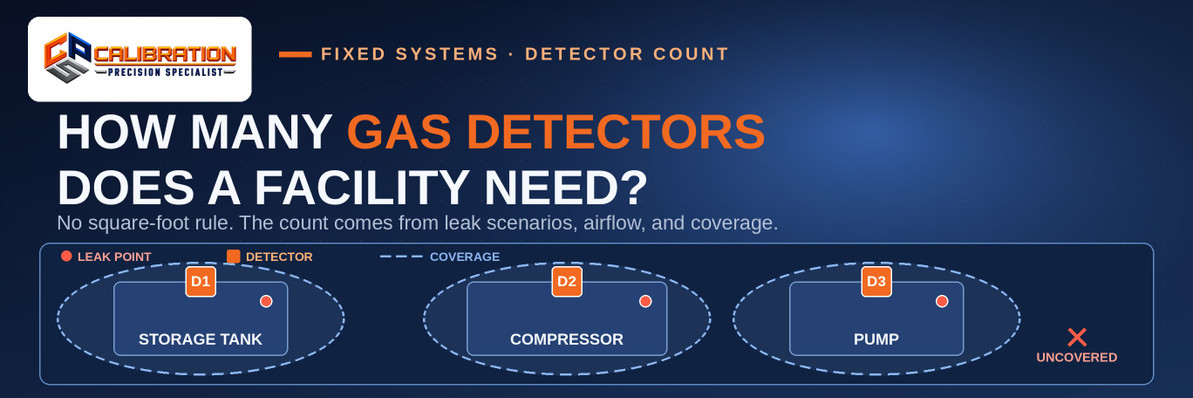
How Many Gas Detectors Does a Facility Need?
A facility needs as many gas detectors as it takes to cover its credible leak scenarios — there is no detectors-per-square-foot rule in any major standard, because a point gas detector only detects gas that physically reaches its sensor. The count is set by three things: where gas can credibly leak (flanges, valves, pump seals, compressors, loading connections), where that gas will go once it escapes (its density, plus the room's ventilation and airflow), and the coverage target set for each area — the performance-based approach formalized in ISA TR84.00.07, which grades a detector layout by geographic coverage and scenario coverage rather than by spacing. Two rooms of exactly the same size can legitimately need one detector or a dozen.
Ask ten people how many gas detectors a building needs and most will reach for an area rule — one detector per so many square feet, spaced evenly on a grid. It feels like engineering. It isn't. A grid treats every square foot of floor as equally likely to produce a leak and equally worth watching, and neither is true: leaks come from equipment, not from floor space, and gas travels where density and airflow take it, not where the grid assumes. This post lays out the method the fire and gas industry actually uses — count the scenarios, follow the gas, then measure coverage — and ends with the honest answer about who can give you a final number for your plant. Detector placement itself — heights, densities, mounting — is covered in our guide to where fixed gas detectors should be placed; this post is the step before it: how many positions there should be at all.
Why Is There No Detectors-Per-Square-Foot Rule?
Because a gas detector is not a sprinkler head. A sprinkler covers the floor beneath it whether anything is there or not. A point gas detector covers nothing at all in that sense — it samples the air at one location and reports the concentration there. Gas that never reaches the sensor might as well be in another building. Detection therefore depends on the relationship between three moving parts — where the leak starts, how the cloud travels and dilutes, and where the sensor sits — and none of those is a function of room area.
Rules of thumb do circulate. Industry guidance has long used a nominal detection radius of roughly 5 metres around a point detector in open areas as a starting figure for early layouts, and the earliest fire and gas designs genuinely were drawn as uniform grids — one widely cited history of the practice describes 5-metre grid spacing chosen to catch a design-basis gas cloud. The same history explains why the industry moved on: grid-based design produced very large, expensive detector counts while saying nothing about whether the leaks that actually happen would be caught. Geographic spacing optimizes spacing. It does not optimize detection. That gap is exactly what performance-based design was created to close.
Step 1: Count Your Leak Scenarios, Not Your Square Feet
A scenario is a specific, credible release: this flange, on this line, leaking at a plausible rate. Walk the process and list what can actually let go:
- Flanges and gasketed joints — the most numerous leak points in any process area
- Valve stems and packing — small, chronic leakers
- Pump and compressor seals — pressurized, moving equipment; the classic significant release
- Loading and unloading connections — hoses, arms, and couplings that are made and broken by people
- Sample points, vents, and relief paths — designed openings that can release by design or by failure
- Storage vessels and their fittings — tanks, bullets, and cylinder manifolds
Each scenario carries three facts that drive the count: how likely it is, how much gas it releases and how fast, and what happens if it runs undetected. A hydrogen line at pressure and a solvent drum in a corner are both "leak sources," but they do not earn the same coverage. The count of detectors a facility needs is, at bottom, a count of the scenarios it has decided it cannot afford to miss — which is why two identical rooms with different equipment inside them get different answers.
Step 2: Follow the Gas
A scenario only becomes a detection problem when the cloud reaches a sensor at alarm concentration — typically 10–20% of the lower explosive limit for flammables. Whether it does depends on physics the room controls:
- Density. Light gases (hydrogen, methane) rise and pool at ceilings and in roof voids; near-neutral gases like carbon monoxide mix; heavy gases (propane, chlorine, most solvent vapors) sink and run along floors and into pits and trenches. Our explainer on where gas goes when it leaks works through the densities — a detector placed for a rising gas will never taste a sinking one.
- Ventilation and airflow. Mechanical ventilation is the biggest single mover of gas indoors. It can carry a cloud straight to a well-placed detector — or dilute it below alarm, or blow it past every sensor in the room. Air changes, supply and exhaust locations, and dead zones where air barely moves all change which positions work.
- Obstructions and layout. Vessels, racks, and equipment split clouds, shadow areas, and create pockets. The same room, re-equipped, is a new detection problem.
This is the step a grid skips entirely, and it is why detector count and detector placement cannot be decided separately: adding a detector in the wrong air path adds cost without adding detection.
Step 3: Think in Coverage, Not Spacing
The performance-based method — formalized in ISA TR84.00.07, the fire and gas systems technical report — scores a layout with two coverage measures instead of a spacing rule:
- Geographic coverage: the fraction of an area in which a release, if it occurred there, would be detected. This is the map view — useful, but blind to where leaks actually happen.
- Scenario coverage: the fraction of the facility's defined release scenarios that the detector layout would actually detect, weighted by how likely and how serious each scenario is. This is the richer and more demanding measure, because it grades the layout against the plant's real leak picture.
Facilities set coverage targets by risk: the highest-consequence, highest-likelihood areas get the most demanding targets and, often, redundancy — more than one detector able to see the same scenario, so a single failed or impaired detector doesn't open a hole. Lower-risk areas get lighter targets. The detector count is whatever it takes to hit the targets — no more, and the discipline cuts both ways: mapping studies routinely find positions that can be removed as well as gaps that must be filled.
The same coverage logic governs the optical side. A flame detector protects the volume inside its cone of view, out to a rated distance for a rated fire size — the geometry we work through in how far a flame detector can see. Facilities that layer flame detection over gas detection — and the case for layering is our post on flame detector vs. gas detector — run coverage thinking for both: cones over the fire scenarios, point sensors on the leak scenarios.
What Do Codes and Insurers Actually Require?
Less about count than most people expect — and more about performance. No mainstream code hands you a universal gas detector spacing table the way fire codes do for some other devices. What exists instead is a patchwork: occupancy- and hazard-specific rules that require detection in certain spaces (engine and machinery rooms, parking structures, battery rooms, refrigerant plant rooms), manufacturer listing and installation instructions, and, for flame detectors wired into a fire alarm system, the inspection and testing regime of NFPA 72. ISA TR84.00.07 itself is guidance, not law — a recommended method for designing and proving a layout, which insurers and corporate engineering standards increasingly point to because it produces something an auditor can check: a stated coverage target, a layout, and a calculation showing the layout meets it.
The practical consequence: the person who ultimately "approves" your count is usually a combination of your insurer, your corporate standards if you have them, and the authority having jurisdiction — and what satisfies them is a defensible method, not a magic density. "One per thousand square feet because that's what we always do" is not a method. A scenario list, a coverage target, and a layout that demonstrably meets it is.
A Worked Illustration: Two Rooms, Same Footprint
Take two rooms of identical size. The first is a compressor room: two gas compressors with pressurized seals, a run of flanged discharge piping, a vessel with a relief path, and mechanical ventilation pulling air across all of it. Its scenario list is long and serious — seal failures at pressure, flange leaks, a relief event — and the airflow means cloud paths are predictable but fast. A coverage-based layout for that room plausibly needs a detector at the seals, coverage of the flange run and the vessel, attention to where the ventilation carries gas, and redundancy on the highest-consequence scenario. Several detectors, each one earning its place against a named scenario.
The second room is a warehouse bay storing sealed drums of solvent. Its credible scenarios are few and slow — a damaged drum, a spill during handling — and the right answer may be one or two detectors placed where vapor from a floor-level spill would travel, plus handling procedures. Same square footage, a fraction of the count — and a grid rule would have given both rooms the same number, over-protecting the warehouse and under-protecting the compressors at the same time. That is the whole argument in one picture.
Is More Always Safer? The Cost of Over-Counting
If under-counting leaves gaps, why not blanket the plant? Because every detector is a lifelong obligation, not a one-time purchase. Each fixed head must be calibrated on schedule, bump-checked, kept clean, and eventually re-sensored — the maintenance world described in our overview of how a fixed gas detection system works. A plant that installs forty detectors where coverage analysis supports twenty-five has not bought extra safety; it has bought fifteen extra calibration intervals to keep up with forever — and in practice, oversized systems are the ones whose maintenance quietly slips, leaving impaired detectors nobody noticed. Detectors also need a controller with channels to land on, which is its own sizing exercise (see choosing the right RKI controller). The defensible target is the count that meets your coverage goals and that your maintenance program can actually sustain.
So Who Gives You the Final Number?
A walkthrough of your actual facility, by someone who will build the scenario list with you: the equipment, the gases, the ventilation, the occupancy, and the consequences. For large or high-hazard process areas, that walkthrough becomes a formal fire and gas mapping study — the ISA TR84.00.07 method done with dispersion and coverage software. For the far more common case — a machinery room, a battery room, a loading area, a parking structure — it is a site survey and a layout drawn against your scenario list and coverage targets, which is work CPS does as part of specifying a fixed system. What nobody honest can give you is a defensible count from a floor plan alone, and you should be suspicious of any quote that tries: the number is in the equipment list and the airflow, not in the square footage.
Frequently Asked Questions
How many gas detectors do I need per square foot? There is no per-square-foot rule in any major standard. Detector count is driven by coverage of credible leak scenarios, not floor area: a point detector only detects gas that physically reaches it, so the count depends on where leaks can start, where the gas travels, and the coverage target for the area. Two rooms of identical size can legitimately need very different numbers of detectors.
Is there a code that specifies gas detector spacing? No universal one. Some hazard-specific rules require gas detection in particular spaces, and insurers and corporate standards may set expectations, but no mainstream code publishes a general spacing table for gas detectors. The recognized design method is performance-based — ISA TR84.00.07 grades layouts by geographic and scenario coverage against targets the facility sets — rather than a fixed distance between detectors.
What is fire and gas mapping? Fire and gas (F&G) mapping is the engineering study that decides where detectors go and how many there are. Following ISA TR84.00.07, it builds the facility's credible release scenarios, models where gas or fire would travel, and scores the proposed layout for geographic coverage (fraction of the area where a release would be detected) and scenario coverage (fraction of the defined scenarios detected). The detector count is the output of the study, not an input.
What is the difference between geographic coverage and scenario coverage? Geographic coverage is the fraction of an area where a release would be detected if it happened there — it looks only at detector positions and their reach. Scenario coverage is the fraction of the facility's actual defined leak scenarios that the layout would detect, accounting for where leaks really occur, how often, and how big. Scenario coverage is the more meaningful number, because a layout can blanket empty floor (high geographic coverage) while missing the pump seal that actually leaks.
Can one gas detector cover a whole room? Sometimes — if the room's credible leak scenarios are few and the gas from any of them will reliably reach that one detector at alarm concentration, given the room's density behavior and airflow. Small, simple rooms with a single leak source and predictable ventilation can qualify. The moment a room has several separated leak sources, mixed densities, or strong or complex airflow, one detector stops being coverage and becomes a hope.
How many gas detectors does a warehouse need? It depends entirely on what is stored and handled there. Sealed-container storage with one credible spill scenario may need only a detector or two placed where vapor would travel; a warehouse with bulk transfer, repackaging, or charging operations has more scenarios and needs more coverage. Square footage alone doesn't set the number — the scenario list does.
Do I need a gas detector at every possible leak point? Not necessarily at every point — you need coverage of every scenario you've decided matters, which is a risk decision. High-consequence or high-likelihood leak points typically get direct coverage, sometimes from more than one detector. Trivial or extremely unlikely points may be accepted as residual risk. What you can't do is skip the decision: an unexamined leak point isn't accepted risk, it's an unknown gap.
Does ventilation change how many gas detectors I need? Yes — ventilation is one of the biggest variables. Airflow decides where a gas cloud goes, how fast it dilutes, and whether it ever reaches a sensor at alarm concentration. Strong, well-directed ventilation can make a layout work with fewer, well-placed detectors; poor or complex airflow creates dead zones that need their own coverage. Any change to a room's ventilation is a reason to re-check the detector layout.
How many flame detectors does a facility need? Flame detectors are counted by coverage too, but the geometry is optical: each unit protects the volume inside its cone of view, out to its rated distance for the fire size it must catch. The count comes from laying cones over the fire scenarios — transfer points, pressurized fuel, open areas — with overlaps where a single detector's view could be obstructed. It's the same coverage discipline as gas detection, drawn in cones instead of cloud paths.
Is it safer to just install extra gas detectors? Not automatically. Every added detector is a permanent calibration, testing, and maintenance obligation, and systems that outgrow their maintenance programs end up with impaired detectors that nobody noticed — less real protection than a smaller system kept in perfect order. Extra detectors placed without scenario thinking also add cost without adding detection. The safer system is the one sized to its coverage targets and maintained without exception.
The Bottom Line
"How many gas detectors do we need?" has no square-foot answer because detection isn't about area — it's about whether the leaks that can actually happen will reach a sensor in time. Count the scenarios, follow the gas through your real ventilation, set a coverage target for each area the way ISA TR84.00.07 formalized, and the count falls out of the work. Facilities that skip the method get one of two failures: a grid that wastes detectors on empty floor while a pump seal leaks unwatched, or a blanket installation their calibration program can't sustain. The number you're looking for is in your equipment list and your airflow — and getting it right starts with a walkthrough, not a formula.
Want a count you can defend — to your insurer, your AHJ, and yourself? Call 865-900-8844 or reach us through Contact Us — we'll walk the area with you, build the scenario list, and lay out a system sized to your coverage targets. The systems themselves are in our fixed system overview, and the keeping-them-honest side lives at Calibration Services.
CPS Calibrations · 109 S. Front Street, Rockwood, TN 37854 · Calibration Gas · Calibration Services · Contact Us
Recent Posts
-

PID vs. LEL for VOC Detection: Which Sensor Do You Actually Need?
Use a PID to detect VOCs and an LEL sensor to detect explosive atmospheres — they measure different …Oct 21st 2026 -

Semiconductor (MOS) Gas Sensors: Where They Work and Where They Lie
A semiconductor (MOS) gas sensor measures gas with a heated film of metal oxide — usually tin dioxid …Oct 21st 2026 -

What Do Firefighters Use a Gas Meter For?
Firefighters use a gas meter — usually a 4-gas monitor reading oxygen (O₂), combustible gas as a per …Oct 21st 2026