
Wireless Fixed Gas Detection: How WireFree Systems Work
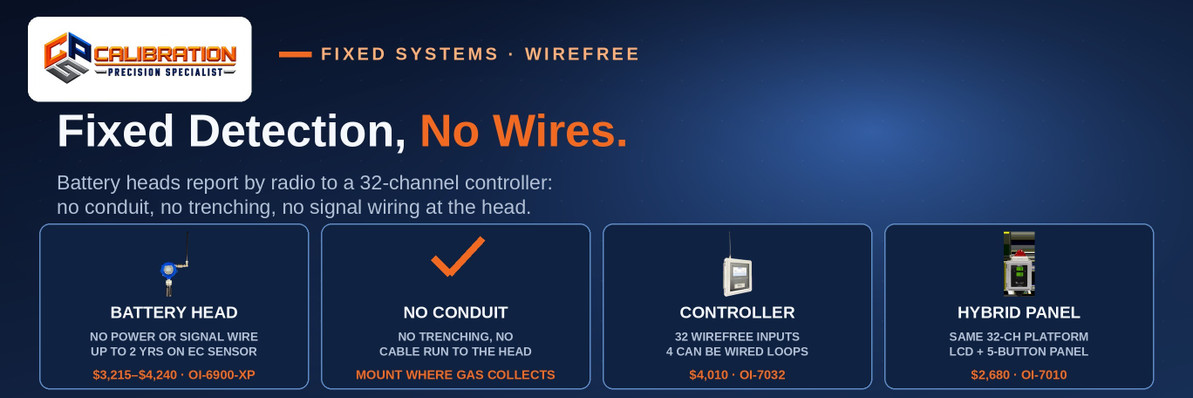
A wireless fixed gas detection system replaces the power and signal cable at each detector head with batteries and a radio: in the OTIS GEN II WireFree system, battery-powered OI-6900 detector heads report readings over 900 MHz or 2.4 GHz radio to a controller such as the 32-channel OI-7032 ($4,010) or OI-7010 ($2,680), so a detection point can be added with no conduit, no trenching, and no signal wiring at the head — while wired 4–20 mA heads still rule where existing loops, continuous power, and hardwired alarming are already in place.
Every fixed gas detection point has always needed three things: a sensor where the gas can collect, power to run it, and a signal path back to somewhere a person will see the alarm. For decades the power and the signal path were the same job — pull cable, in conduit, to every point. Wireless changes which part of that job is hard. The sensor still has to sit where the gas is. The cable no longer has to reach it.
How Does a WireFree System Actually Work?
In three parts, each doing the job the cable used to do:
- The head senses and transmits. A battery-powered detector head — the OTIS OI-6900-XP for classified areas — measures its gas continuously and reports the reading over GEN II WireFree radio, at 900 MHz or 2.4 GHz, to a controller or gateway. On the 900 MHz band the radio supports 52 networks with 255 addresses per network, so heads are individually identified points, not a shared shout.
- The controller collects, displays, and alarms. A controller such as the OTIS OI-7032 or the OTIS OI-7010 takes up to 32 WireFree inputs, shows each channel's reading, and drives four dry-contact alarm relays. Its RS-485 Modbus output passes readings and alarms on to a plant PLC or SCADA system, so the wireless system still lands in the same plant systems a wired one does.
- Nothing about the gas side changes. The head still uses a real sensor element — electrochemical, low-power infrared, or PID on the OI-6900 family — still alarms at set points, and still needs calibration. Wireless replaces the wire, not the measurement. The full head-by-head breakdown is in OTIS OI-6900 WireFree detector heads.
What Powers a Wireless Detector Head?
Batteries — and the honest answer on battery life is that it depends on the sensor, because sensors draw very different power. The OI-6900-XP runs on dual 3.6V lithium-thionyl chloride batteries (38Ah total, nonrechargeable): up to 2 years on an electrochemical sensor, up to 1 year on a low-power infrared sensor, and 14 or more days on a PID (VOC) sensor. The four-sensor OI-6940-XP quad head runs up to 6 months on its four cells — about 45 days if a PID sensor is in the mix. Battery life is a maintenance schedule, not a footnote: a wireless point is only monitored while its batteries live, so the sensor choice and the change-out interval belong in the design, not in a surprise.
When Does Wireless Win?
Wherever the wire is the expensive, slow, or impossible part of the job:
- Remote and spread-out points — the store record for the OI-6900-XP names remote wellheads and tank batteries, where pulling wire is impractical or cost-prohibitive. The same logic fits tank farms, lift stations, and outbuildings anywhere.
- Retrofits in finished spaces — adding a detection point without opening walls, trenching across a yard, or shutting down a process area to run conduit.
- Sites that grow — a system built on a 32-channel controller can add heads as areas are instrumented, point by point, instead of in one construction project.
- Classified areas where conduit work is costly — the OI-6900-XP and OI-6940-XP are certified Class I Division 1, Groups B, C, D, so the wireless option reaches hazardous locations, not just offices and warehouses. (The non-XP Cube heads are for general-purpose areas only.)
The planning side — sensor placement, controller choice, and alarm wiring — is the same discipline as any fixed job; see fixed system installation and how to choose a gas detection controller.
Where Does Wired Still Rule?
Honestly, in plenty of places — which is why the OTIS controllers are hybrids, not wireless-only:
- Where loops already exist. If 4–20 mA wiring is in the ground or the tray, a loop-powered wired head drops onto it and the wireless advantage mostly evaporates — see OTIS wired detector heads.
- Where continuous power matters more than installation cost. A wired head never has a battery interval. PID sensing is the sharp example: a PID that runs 14-plus days per battery set in a wireless head runs indefinitely on wired power.
- Where the head must drive local devices directly. Wired heads with relay options alarm standalone at the point; a wireless head reports to its controller, which is where the relays live.
Most real facilities end up mixed — wired where the infrastructure is, wireless where it isn't — which is exactly the hybrid case the OI-7032 controller is built for, and the fixed side of fixed vs. portable gas detection.
Calibration is what makes any of this real. A wireless head with a drifted sensor reports a wrong number just as confidently as a wired one. We calibrate every channel on fixed systems we service, through calibration services — and the magnetic, non-intrusive switches on these heads let that calibration happen without opening an explosion-proof enclosure in a Division 1 area.
Frequently Asked Questions
What is wireless fixed gas detection?
Fixed gas detection in which the detector heads are permanent, wall- or structure-mounted sensors — but instead of power and signal cable run to each head, each head runs on batteries and reports its reading by radio to a central controller. In the OTIS GEN II WireFree system, OI-6900 heads transmit over 900 MHz or 2.4 GHz radio to controllers such as the 32-channel OI-7032 ($4,010). The sensing, alarming, and calibration are the same as a wired system; only the wiring is gone.
How does a WireFree gas detector report its readings?
By radio. An OTIS OI-6900 head sends its gas reading over a GEN II WireFree radio link — 900 MHz (52 networks, 255 addresses per network) or 2.4 GHz (78 networks) — to an OTIS controller or gateway. The controller displays each channel, drives alarm relays, and can pass everything to a plant PLC or SCADA system over RS-485 Modbus, so wireless readings end up in the same plant systems wired readings do.
Do wireless gas detectors need any wires at all?
A true battery WireFree head like the OTIS OI-6900-XP needs none — no power wiring and no signal wiring; it runs on dual lithium batteries and reports by radio. That is the dividing line inside the OTIS line: the wired OI-6000-XP offers an optional radio for wireless reporting but still requires 12–35 VDC wired power, so it is wireless-reporting, not wire-free. When a quote says wireless, ask whether power is wired — the installation cost difference lives in that answer.
How long do wireless gas detector batteries last?
It depends on the sensor type, and any single number without the sensor named is incomplete. The OTIS OI-6900-XP is rated up to 2 years on an electrochemical sensor, up to 1 year on a low-power infrared sensor, and 14 or more days on a power-hungry PID (VOC) sensor. The four-sensor OI-6940-XP quad head runs up to 6 months, or about 45 days with a PID fitted. Battery change-outs are part of a wireless system's maintenance plan from day one.
How many detectors can one wireless controller handle?
The OTIS OI-7032 and OI-7010 controllers each handle up to 32 WireFree sensor inputs. Four of those 32 channels can instead be wired 4–20 mA analog inputs, so one controller can run a mixed system — existing wired loops kept in service alongside new wireless points. On the radio side, a single GEN II network supports 255 addresses, so the 32-channel controller, not the radio, is the practical limit in this system.
Is wireless gas detection allowed in hazardous locations?
Yes — with the right head. The OTIS OI-6900-XP and OI-6940-XP quad heads are certified for Class I Division 1, Groups B, C, D hazardous locations, so wireless detection is available in classified areas. The non-explosion-proof versions — the OI-6900-NXP Cube — are for general-purpose areas only and must not be substituted into a classified location. The enclosure rating, not the radio, decides where a head may go.
When is wired gas detection better than wireless?
When the wiring already exists, when a sensor's power draw makes batteries impractical, or when the head must switch local equipment directly. An existing 4–20 mA loop makes a loop-powered wired head the cheap, permanent answer; a PID sensor that exhausts wireless batteries in about two weeks runs indefinitely on wired power; and wired heads with relay options can alarm standalone at the point. Wireless wins on installation cost and reach — wired wins on permanence where infrastructure is already in place.
Can wireless and wired detectors run on the same controller?
Yes — the OTIS 32-channel controllers are hybrids built for exactly that. Of the OI-7032's or OI-7010's 32 inputs, up to four can be wired 4–20 mA analog inputs — including third-party transmitters — while the rest are WireFree heads. That lets a facility keep good wired loops working and add wireless points only where new cable would be expensive or impractical, all reporting to one display, one set of relays, and one Modbus feed.
What does a wireless fixed gas detection system cost?
At live CPS list prices: detector heads run $1,495–$2,960 for the OI-6900-NXP Cube, $3,215–$4,240 for the explosion-proof OI-6900-XP, and $4,440–$7,350 for the four-sensor OI-6940-XP quad — each priced by gas configuration. Controllers are $2,680 (OI-7010) and $4,010 (OI-7032). The honest comparison is installed cost: a wireless head costs more than a basic wired head, but it carries no conduit, trenching, or cable labor, which is where wired installations spend their money.
Do wireless gas detectors still need calibration?
Yes — the sensor inside a wireless head is the same kind of sensor as in a wired head, and it drifts the same way. The OTIS WireFree heads are built for it: magnetic non-intrusive switches allow calibration without opening the enclosure, which matters in a Division 1 area. What wireless removes is the cable, not the maintenance — sensors still need scheduled calibration and batteries still need scheduled replacement.
The Bottom Line
A WireFree fixed system is a fixed system: real sensors, a real controller, real alarms — with batteries and a GEN II radio doing the job conduit used to do. Wireless wins where the wire is the expensive part; wired still rules where loops and continuous power already exist; and the 32-channel hybrid controllers exist because most facilities honestly need both.
Planning a fixed system — wireless, wired, or mixed? Call CPS Calibrations at 865-900-8844 — system design, installation, and the CPS Calibration Program behind every channel, from Rockwood, Tennessee.
CPS Calibrations · 109 S. Front Street, Rockwood, TN 37854 · Calibration Services · The CPS Calibration Program
Need a calibration you can file?
In-house calibration at CPS in Rockwood, Tennessee — $55 for single-gas instruments, $90 for 4- and 5-gas — every channel, as-found and as-left data, full certificate.
See Calibration Servicesor call 865-900-8844
Recent Posts
-

Can You Add a Pump to a SENKO SGT-P or MGT?
Yes — SENKO's SP-Pump101 external sampling pump ($330, part AAA006000) fits the SGT, SGT-P, and MGT, …Nov 12th 2026 -

What Refrigerant Detection Does a Grocery Store Need?
A grocery store needs refrigerant detection in three places: low-mounted carbon dioxide (R-744) sens …Nov 11th 2026 -

What Is LEL and UEL? The Explosive Range, Gas by Gas
The LEL is the lowest concentration of a gas in air that can explode, and the UEL is the highest: me …Nov 10th 2026