
OTIS OI-7032: The 32-Channel WireFree Controller, Explained
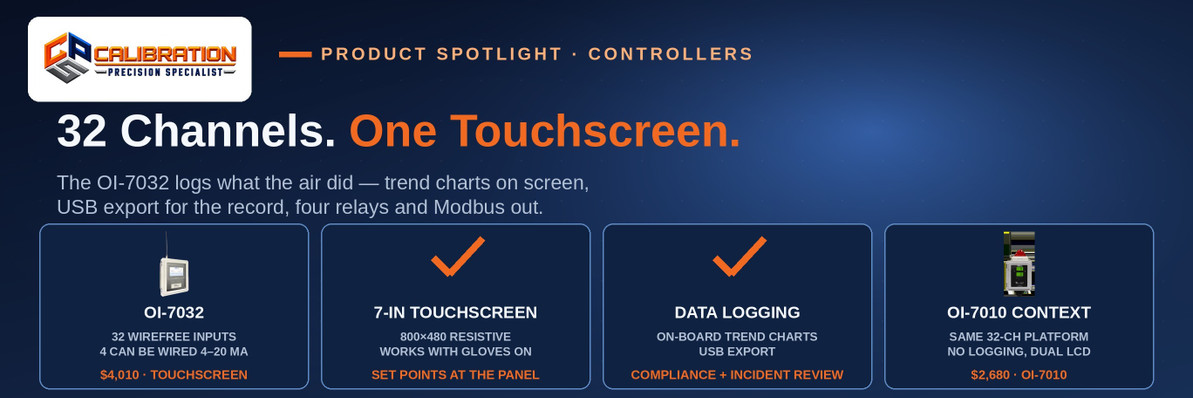
The OTIS OI-7032 ($4,010) is a 32-channel hybrid gas detection controller: it accepts up to 32 WireFree sensor inputs — four of which can instead be wired 4–20 mA analog inputs — drives four dry-contact alarm relays, and passes readings to plant systems over RS-485 Modbus. What sets it apart from the OI-7010 ($2,680) on the same platform is the front panel and the memory: a 7-inch touchscreen, and built-in data logging with on-screen trend charts and USB export.
A controller is the part of a fixed gas detection system people actually interact with — the screen they read, the relays that start fans and sound alarms, the record that proves what the air was doing last Tuesday. The OI-7032 is OTIS's logging, touchscreen version of its 32-channel WireFree platform. This post explains what those 32 channels actually manage, what the logging is for, and where the simpler OI-7010 is the right buy instead.
What Do 32 Channels Actually Manage?
Thirty-two individually identified sensor inputs, each with its own gas, range, and alarm set points, all reporting to one display. In a WireFree system those inputs are battery-powered heads like the OI-6900 series reporting by GEN II radio at 900 MHz or 2.4 GHz — a tank farm's worth of points with no signal cable home-run to the panel. Four of the 32 channels can instead be wired 4–20 mA analog inputs, so existing wired loops — including third-party transmitters — join the same screen instead of being ripped out. The controller's outputs do the acting: four dry-contact alarm relays (replaceable 4A fuses, NO/NC, latching or non-latching) for fans, beacons, and shutdowns, and an RS-485 Modbus feed that hands every reading and alarm to the plant PLC or SCADA system.
What Does the Touchscreen Add?
A 7-inch, 800×480 resistive touchscreen in place of the OI-7010's dual 128×64 LCDs and five-button interface. Resistive is the deliberate choice for an industrial panel: it works with gloves on. Day to day, the touchscreen is how channels get named, set points get changed, and alarms get acknowledged — the configuration work that on a button-driven panel is a manual-and-patience exercise. The controller behind the screen is otherwise the same hybrid platform, in a larger fiberglass enclosure with a clear window (12 × 10 × 6 in, 12.15 lbs), running on 24 VDC.
What Is the Data Logging For?
Three jobs, and they are the reason to choose this controller over its sibling:
- Compliance documentation. The OI-7032 records gas levels over time on board. When an auditor, an insurer, or your own safety program asks what concentrations an area actually saw, the answer is a record, not a recollection.
- Incident review. After an alarm event, the logged trend shows what rose, how fast, and when it cleared — the difference between investigating an incident and guessing at one.
- Spotting slow problems before they alarm. On-screen trend charts make a creeping trend visible — a seal starting to weep, ventilation degrading — while it is still a maintenance ticket instead of an evacuation. USB export moves the record off the panel for reports and archiving.
The worked example of the heads feeding it is wireless fixed gas detection; the selection logic across controller types is in how to choose a gas detection controller.
OI-7032 or OI-7010: Which One Fits?
Same 32-channel hybrid platform, same four relays, same Modbus output, same GEN II radio. The differences, from the live product records:
- Display: 7-inch touchscreen (OI-7032) vs. two 128×64 LCDs with a 5-button interface (OI-7010).
- Data logging: built in, with trend charts and USB export (OI-7032) vs. not a listed feature (OI-7010).
- Compatibility: the OI-7032 works with both GEN I and GEN II WireFree devices — the natural upgrade path for an older OTIS wireless installation; the OI-7010 is listed for the GEN II family.
- Operating temperature: −20 to +50 °C (OI-7032) vs. −40 to +70 °C (OI-7010) — the wider-range panel is the simpler one, which matters for unheated or outdoor enclosures.
- Price: $4,010 (OI-7032) vs. $2,680 (OI-7010), both flat at CPS list.
The plain reading: if you need a logged record, glove-friendly configuration, or GEN I compatibility, the OI-7032 earns its $1,330 difference. If the panel lives in a harsh-temperature spot and a PLC already logs everything, the OI-7010 manages the same 32 channels for less. Neither answer is a recommendation against the other — they are two configurations of one platform, and the site decides. Installed and commissioned as part of a system, this is the work in fixed system installation.
Calibration is what makes any of this real. A controller faithfully displays, relays, and logs whatever its heads tell it — including a drifted head's wrong number, now with a permanent record. We calibrate every channel on the systems we service, through calibration services, so the log the OI-7032 keeps is a log worth keeping.
Frequently Asked Questions
What is the OTIS OI-7032 controller?
A 32-channel hybrid gas detection controller from OTIS Instruments. It accepts up to 32 WireFree (wireless) sensor inputs — four of which can instead be wired 4–20 mA analog inputs — and presents them on a 7-inch touchscreen, with built-in data logging, four dry-contact alarm relays, and an RS-485 Modbus output to plant systems. It is the display, alarm, and record-keeping center of an OTIS fixed gas detection system. CPS list price is $4,010.
How many detectors can the OI-7032 handle?
Up to 32 sensor inputs. Most are WireFree heads reporting by GEN II radio (900 MHz or 2.4 GHz); up to four of the 32 channels can be wired 4–20 mA analog inputs instead, including third-party transmitters. That hybrid design lets one controller run a mostly wireless system while keeping existing wired loops in service on the same screen, the same relays, and the same data log.
Does the OI-7032 log gas readings?
Yes — data logging is its defining feature over the OI-7010. The OI-7032 records gas levels over time on board, draws trend charts on its touchscreen, and exports the record by USB. That serves compliance documentation, incident review after an alarm, and spotting slow-developing trends — a creeping leak or degrading ventilation — before they reach an alarm set point.
What is the difference between the OTIS OI-7032 and OI-7010?
Display, logging, compatibility, temperature range, and price — on the same 32-channel hybrid platform with the same four relays and Modbus output. The OI-7032 ($4,010) has a 7-inch touchscreen, built-in data logging with USB export, and works with GEN I and GEN II WireFree devices, rated −20 to +50 °C. The OI-7010 ($2,680) uses dual LCDs and push buttons, has no listed data logging, is GEN II, and is rated −40 to +70 °C.
Can the OI-7032 work with wired gas detectors?
Yes. Four of its 32 channels can be wired 4–20 mA analog inputs, and it works with any wired 4–20 mA sensors, including third-party transmitters. The remaining channels take WireFree heads. That is the point of a hybrid controller: a facility does not have to choose one technology for the whole plant — wired loops stay where they are, and wireless points are added where cable would be expensive or impractical.
Does the OI-7032 work with older GEN I WireFree devices?
Yes — the OI-7032 is listed as compatible with both GEN I and GEN II WireFree devices, which makes it the natural controller upgrade for an older OTIS wireless installation whose heads are still serviceable. The OI-7010, by contrast, is listed for the GEN II family. If an existing GEN I system needs a new panel with logging, the OI-7032 is the path that keeps the installed heads working.
How does the OI-7032 alarm?
Through four dry-contact relays with replaceable 4A fuses, configurable normally-open or normally-closed and latching or non-latching — the standard way to start exhaust fans, drive beacons and horns, or signal a shutdown. Readings and alarm states also pass to a plant PLC or SCADA system over RS-485 Modbus. The heads sense and the controller decides and acts: alarm set points live in the controller, per channel.
What power does the OI-7032 need?
24 VDC, drawing 300 mA maximum, with an optional AC supply available. The controller is the wired heart of a wireless system — the heads run on batteries, but the panel that displays, relays, logs, and exports the data is a powered, permanently installed device in a fiberglass enclosure with a clear window (12 × 10 × 6 inches). Its operating temperature range is −20 to +50 °C.
What does the OTIS OI-7032 cost?
$4,010 at CPS list, flat — the price does not vary by configuration. The OI-7010 on the same platform is $2,680. Detector heads are separate: WireFree heads run $1,495–$2,960 (OI-6900-NXP Cube), $3,215–$4,240 (OI-6900-XP), and $4,440–$7,350 (OI-6940-XP quad) by gas configuration. A full system price is therefore the controller plus the heads for the points being monitored, plus installation.
Who installs and calibrates a system built on the OI-7032?
CPS Calibrations designs and installs fixed systems — controller, heads, relays, and Modbus handoff — and calibrates every channel on the systems it services. Calibration matters doubly behind a logging controller: the OI-7032's data log is only as trustworthy as the heads feeding it, so each channel's calibration is what makes the recorded history worth relying on for compliance and incident review.
The Bottom Line
The OI-7032 is the 32-channel WireFree platform with a memory: up to 32 hybrid inputs, a glove-friendly touchscreen, four relays and Modbus out — plus a logged, exportable record of what the air actually did. Choose it over the OI-7010 when the record, the touchscreen, or GEN I compatibility is worth $1,330 to your site; the channels it manages are identical either way.
Spec'ing a 32-channel system — or upgrading an older OTIS panel? Call CPS Calibrations at 865-900-8844 — controllers, heads, installation, and the CPS Calibration Program behind them, from Rockwood, Tennessee.
CPS Calibrations · 109 S. Front Street, Rockwood, TN 37854 · Calibration Services · The CPS Calibration Program
Need a calibration you can file?
In-house calibration at CPS in Rockwood, Tennessee — $55 for single-gas instruments, $90 for 4- and 5-gas — every channel, as-found and as-left data, full certificate.
See Calibration Servicesor call 865-900-8844
Recent Posts
-

Can You Add a Pump to a SENKO SGT-P or MGT?
Yes — SENKO's SP-Pump101 external sampling pump ($330, part AAA006000) fits the SGT, SGT-P, and MGT, …Nov 12th 2026 -

What Refrigerant Detection Does a Grocery Store Need?
A grocery store needs refrigerant detection in three places: low-mounted carbon dioxide (R-744) sens …Nov 11th 2026 -

What Is LEL and UEL? The Explosive Range, Gas by Gas
The LEL is the lowest concentration of a gas in air that can explode, and the UEL is the highest: me …Nov 10th 2026