
How to Choose a Gas Detection Controller
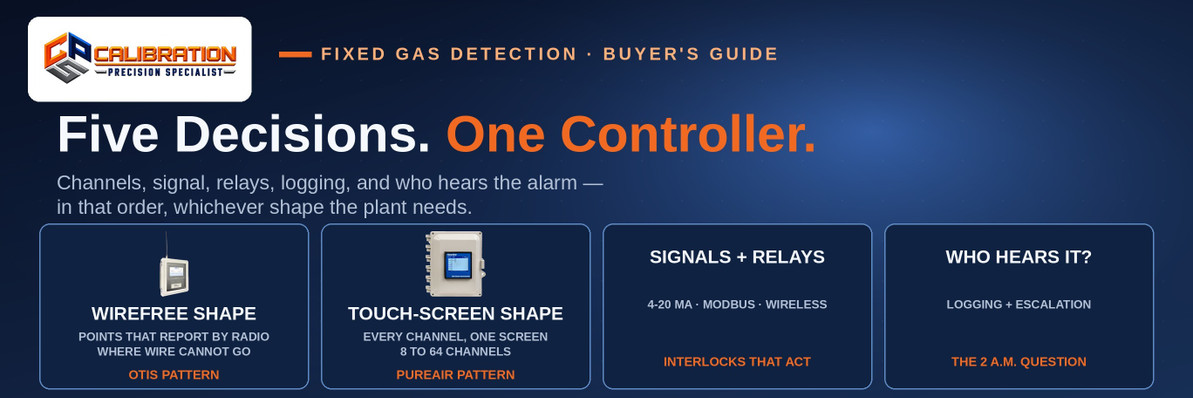
Choose a gas detection controller by five decisions, in order: how many channels (today's points plus honest growth), which signal the points speak (4–20 mA analog, Modbus digital, or wireless), what the relays and interlocks physically do in an alarm, what the system logs, and who actually hears the alarm. The controller is the system — detectors only make readings; the controller collects them, acts on them, and remembers them.
Buyers shop for controllers the way they shop for detectors — by brand and channel count — and then discover the mismatches later: points that cannot report the way the plant logs, relays too few for the shutdown the process needs, an alarm that sounds in an empty room. The five decisions below prevent those discoveries. They are architecture decisions, and they hold across every maker CPS sells.
Decision 1: How Many Channels Do You Actually Need?
Count points, not rooms — every detector is a channel. Then add growth honestly: the points the plant will add in the controller's service life, not the points it might add in a fantasy expansion. Controllers come in natural sizes — PureAire's touch-screen line, for example, runs 8, 16, 32, and 64 channels ($4,135 for 8 and $7,685 for 16 at list; the larger sizes are quoted) — and the cost of one size up is usually small against the cost of a second controller later. The failure modes are symmetric: exactly-at-count leaves nowhere to land next year's point; wildly oversized spends on channels that never exist. One more channel question matters: can a channel be taken offline alone — for calibration or a sensor swap — without blinding the rest of the plant? PureAire's controllers allow exactly that, and any controller on your list should.
Decision 2: 4–20 mA, Modbus, or Wireless?
The signal is how a point's reading travels, and each shape has its honest trade:
- 4–20 mA analog — one wired loop per point, carrying one live reading. Simple, robust, understood by every electrician and PLC on earth; the PureAire Universal detectors output an active 4–20 mA signal as their standard. Its limits are structural: one value per wire, no diagnostics beyond the loop itself, and a wire home-run for every point.
- Modbus (typically RTU over RS-485) — one digital bus carrying readings, alarm states, and faults from many points, readable directly by PLCs and SCADA. PureAire's controllers output Modbus RTU for exactly this reason. It asks more of the installer and the integrator, and returns far more information per wire.
- Wireless (wirefree) — points that report by radio where trenching and conduit are impractical: across a yard, in an existing building, at a temporary or sprawling site. The OTIS OI-7032 wirefree controller is this shape. It removes the wire, not the engineering: power at the point, radio path, and battery or supply maintenance become the design questions instead.
Most real plants are hybrids — analog points near the panel, a Modbus uplink to the control room, a wireless point where wire cannot go. Choose the controller that speaks what your points and your plant already speak, and be suspicious of any design that translates everything twice.
Decision 3: What Do the Relays and Interlocks Do?
A reading that only displays is information; a relay is action. Decide, per alarm level, what physically happens: horn and strobe in the area, exhaust ventilation started, a process feed shut, a door released, a signal to the fire panel. Count the actions before you count the relays — a controller whose relay count forces you to gang unrelated actions onto one contact has made a safety decision for you. Interlocks deserve their own question: which actions must happen even if nobody responds — automatic shutdowns and ventilation starts — and which require a human's judgment first? The Crowcon Vortex control panels and Crowcon GMS controllers are worked examples of the dedicated-panel shape built around this relay-and-interlock logic.
Decision 4: What Does the System Remember?
After an incident, the questions are factual: what did the point read, when did it cross the alarm, who acknowledged it, what did it read during the last calibration? A controller with data logging — or a Modbus feed into a system that logs — answers them from record. A controller without logging answers them from memory, which is to say it does not. Logging also earns its keep quietly: trend data shows a point drifting weeks before it fails a calibration, and the as-found record at calibration closes the loop. Decide what retention and export your safety program needs before the hardware decides for you.
Decision 5: Who Hears the Alarm?
The most-skipped decision, and the one that decides whether the other four matter. An alarm is a message with an audience: the operator in the room, the control room across the plant, a phone at 2 a.m. Map it honestly — where people actually are on every shift, how an alarm escalates if unacknowledged, and how remote notification reaches whoever carries it. A horn in an unoccupied room is a tree falling. The RKI Beacon controllers — the 110, 200, 410A, and 800 — are the wall-controller shape sized for the smaller end of this problem, where the audience is one building and the points are few; the PureAire controllers are the touch-screen shape for the plant-wide end. The shapes differ; the audience question is identical.
The Three Shapes, Side by Side
- Dedicated panel (the Vortex/GMS pattern): a purpose-built gas panel — channels, relays, and interlocks engineered as one safety appliance, typically where the system's job is alarm and shutdown first.
- Touch-screen multi-channel (the PureAire pattern): one screen showing every channel in its own units — ppm, ppb, % — with per-channel offline for calibration and a Modbus uplink; the plant-wide watching shape.
- Wirefree (the OTIS pattern): a controller whose points arrive by radio, for sites where wire is the expensive part.
None of the three is the recommendation; the five decisions are. Run your plant through them and the shape selects itself. Layout, wiring, and commissioning help sit under fixed system installation — and whatever you choose, we calibrate every channel behind it, through calibration services.
Frequently Asked Questions
What does a gas detection controller do?
It collects a fixed system's detectors into one system: it displays every channel's reading, decides alarm states, drives relays and interlocks (horns, strobes, ventilation, shutdowns), logs readings and events, and reports to plant systems. Detectors make readings; the controller is what turns readings into action and record.
How many channels do I need on a gas detection controller?
As many as you have detector points, plus the growth you honestly expect during the controller's service life. Count points, not rooms. PureAire's touch-screen line, for example, sizes at 8, 16, 32, and 64 channels. Buying exactly at today's count is the common mistake — the next added point then has nowhere to land.
Should I choose 4–20 mA or Modbus for gas detection?
They do different jobs and often coexist. 4–20 mA is a simple, robust analog loop carrying one live reading per wired point — the standard output on detectors like the PureAire Universal line. Modbus is a digital bus carrying readings, alarm states, and faults from many points to controllers, PLCs, and SCADA — PureAire's controllers output Modbus RTU. Analog at the point and digital onward to the plant is a common, sound hybrid.
When does wireless gas detection make sense?
When wire is the problem: points across a yard, in existing buildings where conduit runs are disruptive, or at sprawling or temporary sites. Wirefree controllers such as the OTIS OI-7032 pattern remove the signal wire, but the point still needs power and a workable radio path — wireless changes the installation engineering; it does not remove it.
What is a relay interlock in gas detection?
A relay is a controller output contact that does something physical in an alarm — starts ventilation, sounds a horn, signals a fire panel. An interlock is a relay action wired into the process itself, such as shutting a feed or stopping equipment automatically at a high alarm. Count the actions your alarm plan requires, then make sure the controller has the relays to do them without ganging unrelated actions together.
Why does data logging matter on a gas controller?
Because after an event, the questions are factual — what the point read, when it alarmed, who acknowledged it — and only a log answers them. Logging (on the controller, or via its Modbus feed into a plant system) also shows drift trends before a point fails calibration. A system without logging reconstructs its history from memory, which is not evidence.
Who should receive a gas detection alarm?
Whoever can act on it, on every shift: the people in the affected area first (horn and strobe), then the control room or responsible operator, with escalation and remote notification if the alarm is unacknowledged. Map the audience before choosing hardware — an alarm sounding only in an unoccupied room protects no one, at any channel count.
What are the main types of gas detection controller?
Three shapes cover most plants: dedicated safety panels built around channels, relays, and interlocks (the Crowcon Vortex and GMS pattern); touch-screen multi-channel controllers that display every point plant-wide with a digital uplink (the PureAire pattern, 8–64 channels); and wirefree controllers whose points report by radio (the OTIS pattern). Smaller wall controllers such as the RKI Beacon line serve the few-point end. The right shape follows from channel count, signal, relay, logging, and audience decisions — in that order.
Can one controller watch different gases at once?
Yes — a channel is a channel regardless of its gas, and a multi-gas plant is the normal case. What matters is that each channel is displayed and alarmed in its own gas's units and levels: PureAire's controllers, for example, designate each channel in ppm, ppb, or % to match the detector behind it.
How much does a gas detection controller cost?
It scales with channel count and shape. As a verified anchor: PureAire's 8-channel touch-screen controller is $4,135 and its 16-channel is $7,685 at CPS list, with 32- and 64-channel sizes quoted. Detector points, relays, installation, and commissioning are separate from the controller price — a system quote should name each part, which is how CPS quotes fixed systems.
The Bottom Line
Decide channels, signal, relays, logging, and audience — in that order — and the controller chooses itself. Detectors make readings; the controller is the part that acts on them, remembers them, and makes sure a human hears them. Size it to the plant you have plus the growth you honestly expect, and calibrate every channel behind it.
Choosing or replacing a controller? Call CPS Calibrations at 865-900-8844 — PureAire, Crowcon, RKI, and OTIS controllers, fixed system installation, and the CPS Calibration Program behind them, from Rockwood, Tennessee.
CPS Calibrations · 109 S. Front Street, Rockwood, TN 37854 · Calibration Services · The CPS Calibration Program
Need a calibration you can file?
In-house calibration at CPS in Rockwood, Tennessee — $55 for single-gas instruments, $90 for 4- and 5-gas — every channel, as-found and as-left data, full certificate.
See Calibration Servicesor call 865-900-8844
Recent Posts
-

Can You Add a Pump to a SENKO SGT-P or MGT?
Yes — SENKO's SP-Pump101 external sampling pump ($330, part AAA006000) fits the SGT, SGT-P, and MGT, …Nov 12th 2026 -

What Refrigerant Detection Does a Grocery Store Need?
A grocery store needs refrigerant detection in three places: low-mounted carbon dioxide (R-744) sens …Nov 11th 2026 -

What Is LEL and UEL? The Explosive Range, Gas by Gas
The LEL is the lowest concentration of a gas in air that can explode, and the UEL is the highest: me …Nov 10th 2026