
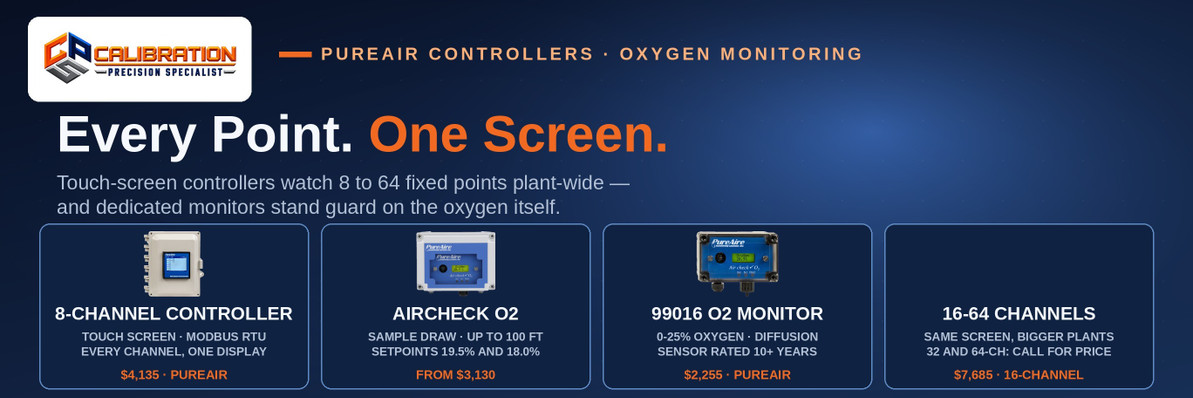
PureAire Controllers and AirCheck O2: Watching Oxygen and Toxics Plant-Wide
PureAire's touch-screen controllers watch 8, 16, 32, or 64 fixed gas points on one screen — every channel displayed in ppm, ppb, or %, with Modbus RTU output to the plant — while the AirCheck O2 sample-draw monitor (from $3,130, sampling up to 100 feet away) and the 99016 oxygen deficiency monitor ($2,255, 0–25% O2 on a 10+ year sensor) guard the oxygen side of the same plant.
A fixed detector alarms where it stands. A plant with thirty points has thirty separate rumors unless something collects them — shows every reading in one place, drives the horns and interlocks, and hands the data to the systems that log it. That collecting job is the controller's. Oxygen gets its own dedicated monitors for a different reason: oxygen is the one reading that describes the air itself, and the spaces that need it watched are often spaces a diffusion point cannot reach.
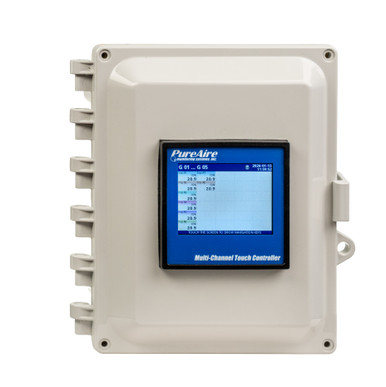
PureAire 8-Channel Touch Screen Programmable Controller
PureAire touch-screen controllers watch 8, 16, 32, or 64 fixed points plant-wide (8-channel $4,135, 16-channel $7,685, Modbus RTU output), while the AirCheck O2 sample-draw monitor (from $3,130) and the 99016 oxygen deficiency monitor ($2,255, 0–25% O2, 10+ year sensor) stand guard on oxygen itself.
$4,135
See the 8-Channel Touch ScreenWhat Do the PureAire Touch-Screen Controllers Do?
They are the plant-wide end of the PureAire Universal detector platform. Per the products' specification tables, each controller:
- Displays every channel on a touch-screen LCD — digital and graphic readings from all connected monitors, each channel designated in PPM, PPB, or % to match its gas
- Takes channels offline individually for calibration or sensor replacement without blinding the rest of the plant
- Outputs Modbus RTU (RS-485) — readings and alarms handed to a PLC, SCADA, or building system
- Drives relays, including horn and strobe control, so an alarm acts where people actually are
- Runs on 100–240 VAC with a built-in 24 VDC supply for the detector loop, in a NEMA 4X / IP67 enclosure
The line scales by channel count: the 8-channel controller is $4,135 and the 16-channel controller is $7,685 at list; 32- and 64-channel controllers are quoted — call for pricing. Channel count is a design decision, not a bragging number: it should match the points the plant actually has, plus the growth it honestly expects — the full thinking is in how to choose a gas detection controller.
Why Does Oxygen Get Its Own Monitors?
Because oxygen deficiency is a different failure. A toxic point watches for something added to the air; an oxygen point watches for the air itself being displaced — by nitrogen, argon, CO2, or any gas a process stores in bulk. The thresholds are close together and unforgiving: normal air is 20.9% oxygen, and below 19.5% the atmosphere is oxygen-deficient. Two PureAire monitors cover the job in two shapes:
- The AirCheck O2 sample-draw monitor (from $3,130; configurations to $3,880) pulls its sample to the instrument on a built-in pump at 250 cc/min, from up to 100 feet away — the point being watched can be inside a space nobody should enter to check. It carries two relay setpoints, defaulting to 19.5% and 18.0%, and connects onward to multi-channel controllers and existing fire alarm systems. Its sensor life is stated at 10 years under normal conditions.
- The 99016 oxygen deficiency monitor ($2,255) is the diffusion point for a room: 0–25% O2, a sensor rated for 10+ years of continuous operation under normal conditions, relays and an active 4–20 mA output so it can alarm locally and report centrally at the same time.
Sample draw versus diffusion is a placement decision: draw the sample when the point is inaccessible, enclosed, or stratified; diffuse when the point sits in the room air people breathe. Layout and commissioning for either pattern sit under fixed system installation.
Calibration is what makes any of this real. A controller faithfully displays whatever its points send it — including a drifted point's wrong number, now with plant-wide confidence. We calibrate every channel behind the screen, through calibration services.
Frequently Asked Questions
What does a PureAire gas detection controller do?
It collects a plant's fixed gas detectors into one system: a touch-screen display shows every channel's live reading (each designated in ppm, ppb, or %), channels can be taken offline individually for calibration, relays drive horns, strobes, and other actions, and a Modbus RTU (RS-485) output hands readings and alarms to a PLC, SCADA, or building system. PureAire controllers come in 8, 16, 32, and 64-channel sizes.
How much does a PureAire controller cost?
At CPS list prices, the 8-channel touch-screen controller is $4,135 and the 16-channel is $7,685. The 32- and 64-channel controllers are quoted — call CPS at 865-900-8844 for pricing on those sizes rather than guessing from the smaller units.
What is the PureAire AirCheck O2?
A sample-draw oxygen monitor: a built-in pump (250 cc/min) pulls air from the sampling point — up to 100 feet away — to the instrument, so oxygen can be watched inside spaces that should not be entered just to check them. It has two relay setpoints defaulting to 19.5% and 18.0%, connects to multi-channel controllers and existing fire alarm systems, and its sensor life is stated at 10 years under normal conditions. Prices run from $3,130 to $3,880 by configuration.
What is the PureAire 99016 oxygen monitor?
A diffusion oxygen deficiency monitor reading 0–25% O2, with a sensor rated for 10+ years of continuous operation under normal conditions. It carries alarm relays and an active 4–20 mA output, so it can sound a local alarm and report its reading to a controller at the same time. It is $2,255 at CPS list price.
At what oxygen level should a monitor alarm?
PureAire's AirCheck O2 ships with two relay setpoints defaulting to 19.5% and 18.0%. The 19.5% figure is the OSHA line: below 19.5% oxygen an atmosphere is oxygen-deficient, against a normal of 20.9%. The second, lower setpoint at 18.0% gives an escalating alarm as conditions worsen. Setpoints are user settings — the defaults exist because those are the numbers the standard is built on.
Can PureAire controllers talk to a PLC or SCADA system?
Yes — the controllers provide a Modbus RTU (RS-485) output, per their specification tables. Modbus is the common language of plant control systems, so channel readings and alarm states can be logged, trended, and acted on by the same systems that run the process, instead of living only on the controller's screen.
How many gas detectors can one PureAire controller watch?
8, 16, 32, or 64, depending on the controller. The right size matches the plant's actual point count plus honest growth: a controller bought exactly at today's count leaves nowhere to land next year's added point, and a controller bought far oversized spends money on channels that may never exist.
What is the difference between the AirCheck O2 and the 99016?
Sampling pattern. The AirCheck O2 is sample draw — a pump pulls air from a point up to 100 feet away, for enclosed or inaccessible spaces. The 99016 is a diffusion monitor that reads the air at its own location, for room protection. Both watch 0–25%-class oxygen ranges with relays; the choice is where the air being measured lives relative to where the instrument can sit.
Do PureAire controllers work with the PureAire Universal detectors?
They are the same platform family: Universal detectors output an active 4–20 mA signal, and the controllers exist to collect fixed points like them plant-wide — the AirCheck O2's description likewise states it connects to multi-channel controllers. A Universal point can also alarm standalone on its own two relays where no controller is fitted.
How often do fixed oxygen monitors need calibration?
On the manufacturer's specified interval for the instrument — a long-life sensor is not a no-calibration sensor. The 99016's sensor is rated for 10+ years of operation and the AirCheck's for 10 years under normal conditions, but the reading still has to be verified against known gas on schedule: an oxygen monitor that reads 20.9% in air that is not is the most dangerous instrument in the building. Keep fixed points on a written calibration schedule with documented as-found and as-left readings.
The Bottom Line
Detectors make readings; controllers make a system — one screen for 8 to 64 points, relays that act, and Modbus that reports — and oxygen earns dedicated monitors of its own, sample-draw where the space cannot be entered and diffusion where the room itself is the point. Size the controller to the plant, and calibrate every channel behind the screen.
Planning a fixed system or replacing a controller? Call CPS Calibrations at 865-900-8844 — PureAire controllers and oxygen monitors, installation, and the CPS Calibration Program behind them, from Rockwood, Tennessee.
CPS Calibrations · 109 S. Front Street, Rockwood, TN 37854 · Calibration Services · The CPS Calibration Program
Need a calibration you can file?
In-house calibration at CPS in Rockwood, Tennessee — $55 for single-gas instruments, $90 for 4- and 5-gas — every channel, as-found and as-left data, full certificate.
See Calibration Servicesor call 865-900-8844
Recent Posts
-

Can You Add a Pump to a SENKO SGT-P or MGT?
Yes — SENKO's SP-Pump101 external sampling pump ($330, part AAA006000) fits the SGT, SGT-P, and MGT, …Nov 12th 2026 -

What Refrigerant Detection Does a Grocery Store Need?
A grocery store needs refrigerant detection in three places: low-mounted carbon dioxide (R-744) sens …Nov 11th 2026 -

What Is LEL and UEL? The Explosive Range, Gas by Gas
The LEL is the lowest concentration of a gas in air that can explode, and the UEL is the highest: me …Nov 10th 2026