
PureAire Universal Gas Detectors: One Platform for the Semiconductor Gas List
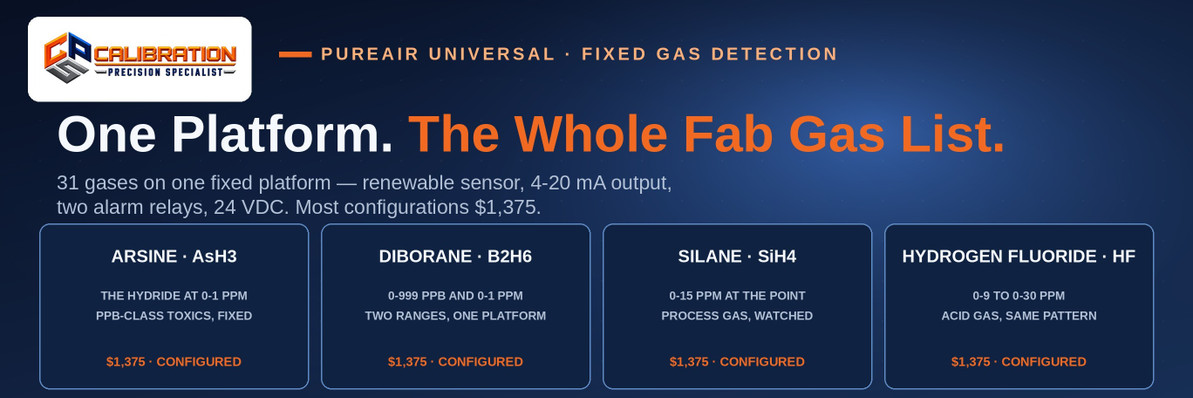
PureAire Universal Gas Detectors cover 31 specialty gases — arsine (0–1 ppm), diborane (0–999 ppb and 0–1 ppm), silane (0–15 ppm), hydrogen fluoride, phosphine, chlorine and more — on one fixed-detector platform: a renewable electrochemical sensor, digital display, active 4–20 mA output, two user-adjustable alarm relays, and 24 VDC power, with most models at $1,375 list.
A semiconductor fab, a research lab, or a specialty-gas user does not have one gas problem. It has a list — hydrides, acid gases, oxidizers — each toxic at its own level, each needing its own fixed point. The usual answer is a shelf of unrelated detectors, each with its own manual, spare, and calibration routine. The Universal line is the opposite answer: one detector platform, configured gas by gas, so the list shares an enclosure, an output, a power supply, and a maintenance pattern.
What Gases Does the Universal Platform Cover?
The 31 gases on the CPS store, each a configured detector on the same platform. The semiconductor core of the list:
- Arsine (AsH3) — 0–1 ppm, $1,375
- Diborane (B2H6) — 0–999 ppb and 0–1 ppm, $1,375
- Silane (SiH4) — 0–15 ppm, $1,375
- Hydrogen fluoride (HF) — 0–9 to 0–30 ppm, $1,375
- Phosphine (PH3) — 0–999 ppb to 0–1 ppm, $1,375
Around that core sit the rest of the working list — chlorine ($1,535), hydrogen ($1,705, percent-volume ranges), boron trichloride and trifluoride, dichlorosilane, disilane, tri-chlorosilane, fluorine, hydrogen bromide, hydrogen cyanide, hydrogen selenide, hydrogen sulfide, ozone, and a run of acid and specialty vapors from acetic acid to hydrazine. The range that matters is the pattern: hydride gases read in parts per billion where the hazard lives there, and in ppm where it does not — diborane and phosphine both offer a 0–999 ppb range alongside 0–1 ppm.
What Does "Universal" Actually Mean Here?
One platform, not one sensor. Each detector is configured for its gas — its own sensor configuration and range — while the parts a facility actually lives with stay common across the whole list, per the products' specification tables:
- Renewable electrochemical sensor behind a digital concentration display
- Active 4–20 mA output — the signal a controller or plant system reads (the receiving end is covered in PureAire controllers and AirCheck O2)
- Two user-adjustable alarm relays, with audible and visual alarm indication at the detector
- 24 VDC regulated power, and a remote sensor option with cable lengths up to 30 ft — the sensor goes where the gas is; the display stays where people are
That commonality is the operational point. A technician who can calibrate, bump, and troubleshoot one Universal detector already knows the other thirty: same wiring, same output, same relay behavior, same spares logic. Where a point needs to draw its sample instead of waiting for gas to arrive, a sample-draw instrument such as the SENKO SI-H100 covers that different job shape — diffusion and sample-draw are different tools, and a fab usually needs both patterns somewhere in the plant.
Where Do These Detectors Belong?
Wherever the gas list lives: gas cabinets and valve manifold boxes, process-tool surroundings, gas rooms and distribution runs, research laboratories handling hydrides or acid gases, and the support spaces around them. The placement rule does not change with the brand: the point goes at the likely leak source and at the air people breathe, and the range is chosen for the gas's own hazard level — which is why the ppb ranges exist. Fixed-system layout, installation, and commissioning are covered under fixed system installation.
Calibration is what makes any of this real. A ppb-range hydride point that drifts is worse than no point, because its clean reading gets believed. We calibrate every channel on the fixed systems we support, through calibration services.
Frequently Asked Questions
What is a PureAire Universal Gas Detector?
A fixed gas detector platform from PureAire Monitoring Systems that is configured gas by gas — 31 gases on the CPS store, from arsine and diborane to silane and hydrogen fluoride. Every configuration shares the same platform: a renewable electrochemical sensor, digital concentration display, active 4–20 mA output, two user-adjustable alarm relays, audible and visual alarm indication, and 24 VDC regulated power.
What gases can the PureAire Universal detector measure?
Thirty-one gases as listed at CPS, including arsine, diborane, silane, phosphine, hydrogen fluoride, chlorine, fluorine, hydrogen, hydrogen bromide, hydrogen cyanide, hydrogen selenide, hydrogen sulfide, boron trichloride, boron trifluoride, dichlorosilane, disilane, tri-chlorosilane, ozone, hydrazine, and a range of acid and specialty vapors. Each gas is its own configured detector model on the shared platform — one detector measures one gas.
How much does a PureAire Universal Gas Detector cost?
Most models are $1,375 at CPS list price — arsine, diborane, silane, hydrogen fluoride, and phosphine configurations are all $1,375. A few configurations price higher: chlorine is $1,535 and the percent-volume hydrogen model is $1,705. The product page for each gas shows its own configured price before you buy.
What range does the PureAire Universal arsine detector have?
0–1 ppm. Arsine is one of the hydride gases the platform was built around, and its range sits in low ppm. Diborane and phosphine go lower still, with 0–999 ppb ranges available alongside 0–1 ppm — the range is matched to each gas, which is the point of a gas-by-gas platform.
Does the PureAire Universal detector have a 4–20 mA output?
Yes — an active 4–20 mA output, per the products' specification tables. That is the standard analog signal a multi-channel controller, PLC, or plant system reads, so a Universal point can alarm locally on its own two relays and report its live reading to a central controller at the same time.
How many alarm relays does a PureAire Universal detector have?
Two user-adjustable alarm relays, with audible and visual alarm indication at the detector. Two relays let a point do two different jobs at two different levels — for example, a local horn or strobe at the low alarm and a ventilation or shutdown action at the high alarm — set to the levels each gas requires.
Can the PureAire Universal sensor be mounted remotely?
Yes. A remote sensor option is available with cable lengths up to 30 ft, per the specification tables. The sensor mounts where the gas would appear — inside or beside a gas cabinet or process enclosure — while the detector display and relays stay accessible outside it.
What power does a PureAire Universal detector need?
24 VDC regulated power, per the specification tables. That is the standard fixed-detection supply voltage, and it is the same across the platform's configurations, which keeps power supplies and wiring practice common across a whole gas list.
Is the PureAire Universal a sample draw or diffusion detector?
The Universal platform is a point detector — the gas reaches its sensor at the mounting location, with a remote-sensor option up to 30 ft for placing the sensing point inside an enclosure. Sample draw is a different pattern, where a pump pulls air from the point to the instrument; facilities use both patterns in different places, chosen by where the gas is and how fast the reading has to arrive.
How often do PureAire Universal detectors need calibration?
On the interval the manufacturer specifies for each gas configuration — ppb-range hydride sensors and ppm acid-gas sensors do not share one honest number. The failure that matters is drift on a low-range toxic point, because its reading is believed. Keep every fixed point on a written calibration schedule with as-found and as-left readings documented; CPS calibrates fixed channels through its calibration services and fixed system installation work.
The Bottom Line
Thirty-one gases, one platform: the Universal line turns a semiconductor gas list from a shelf of unrelated detectors into a single pattern of sensor, output, relays, and power that a facility can install, calibrate, and maintain the same way everywhere. Most configurations are $1,375, and the ranges go down to parts per billion where the gases demand it.
Working through a fab or lab gas list? Call CPS Calibrations at 865-900-8844 — PureAire detectors, controllers, and the CPS Calibration Program behind them, from Rockwood, Tennessee.
CPS Calibrations · 109 S. Front Street, Rockwood, TN 37854 · Calibration Services · The CPS Calibration Program
Need a calibration you can file?
In-house calibration at CPS in Rockwood, Tennessee — $55 for single-gas instruments, $90 for 4- and 5-gas — every channel, as-found and as-left data, full certificate.
See Calibration Servicesor call 865-900-8844
Recent Posts
-

Can You Add a Pump to a SENKO SGT-P or MGT?
Yes — SENKO's SP-Pump101 external sampling pump ($330, part AAA006000) fits the SGT, SGT-P, and MGT, …Nov 12th 2026 -

What Refrigerant Detection Does a Grocery Store Need?
A grocery store needs refrigerant detection in three places: low-mounted carbon dioxide (R-744) sens …Nov 11th 2026 -

What Is LEL and UEL? The Explosive Range, Gas by Gas
The LEL is the lowest concentration of a gas in air that can explode, and the UEL is the highest: me …Nov 10th 2026