
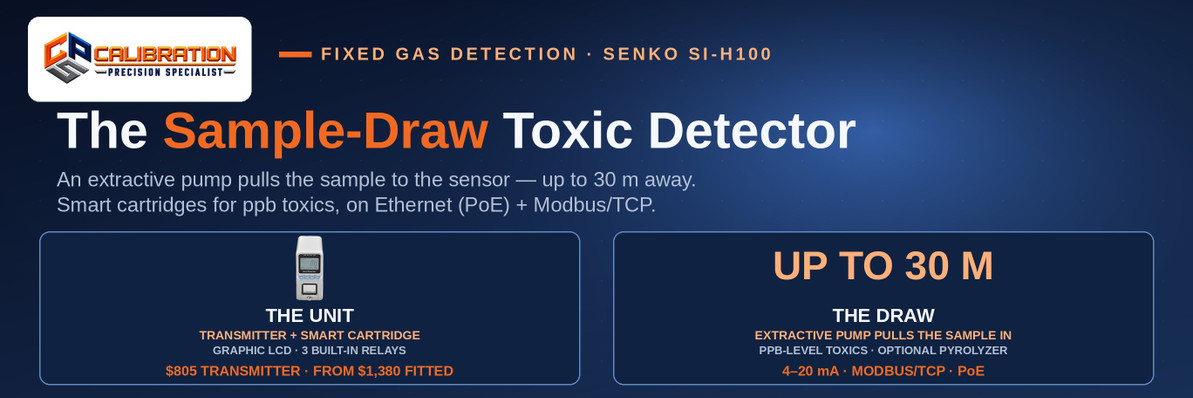
SENKO SI-H100: The Sample-Draw Toxic Gas Detector
The SENKO SI-H100 is a sampling-type fixed gas detector: an extractive pump draws a gas sample through up to 30 m of tubing to a smart sensor cartridge inside a wall-mounted transmitter, so toxic gases can be monitored continuously at points where no diffusion sensor could be mounted or serviced — at parts-per-billion (ppb) levels on its specialty-gas cartridges. List pricing in SENKO's semi-industry price list (V02.0, 08-01-2025) is $805 for the transmitter alone, and $1,380 to $1,840 for a transmitter fitted with a cartridge, depending on the gas.
On our store: SENKO SI-H100 Pumped Detector Head — $1,380–$1,667.50 by gas configuration.
It is the second sample-draw unit in this two-post series, paired with the RKI GD-70D. Both exist for the same reason — the sample point and the sensor hardware should not have to be in the same place — and they differ in sensor menu, connections, and price shape. This post sticks to what SENKO's own price list documents, and says plainly where the document stops.
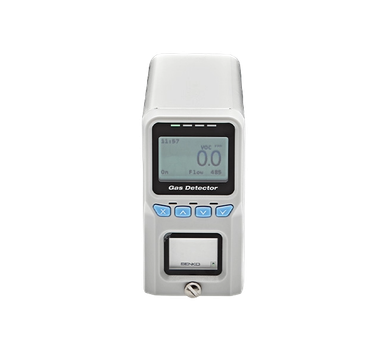
Senko SI-H100 Pumped Detector Head
The SENKO SI-H100 draws gas up to 30 m to smart sensor cartridges for ppb-level toxics — transmitter $805, fitted from $1,380, with PoE, Modbus/TCP and 4–20 mA.
$1,380–$1,840 configured
See the SI-H100What Is the SENKO SI-H100?
SENKO describes the SI-H100 in its price list as a sampling type fixed gas detector for semi-industry, and lists the design goals in plain language: simple to install, easy to use. In structure it is the classic extractive layout:
- A sample point at the end of a tubing run, placed where the gas is — inside a cabinet, duct, or process area.
- An extractive pump system that pulls the sample to the transmitter. SENKO rates the pump system at a 2-year lifetime and the sampling distance at up to 30 m.
- A smart sensor cartridge inside the transmitter that does the measuring — one cartridge, one gas, chosen from SENKO's cartridge menu for the target gas.
- A wall-mounted transmitter with a large, bright graphic LCD, built-in alarm relays, and plant communications, mounted where people can read and service it.
If the concept is new to you, sample-draw detection explained through the RKI GD-70D covers the sample-draw vs. point (diffusion) trade-off in full; the short version is that diffusion sensors must live at the leak point, and sample-draw sensors must not.
How Far Can the SI-H100 Draw a Sample?
Up to 30 m, per SENKO's price list — roughly 100 feet of tubing between the sample point and the transmitter. That number is the one that decides most sample-draw layouts: it is the radius inside which a hostile, enclosed, or unreachable point can be handed to a transmitter mounted in a survivable, serviceable place. The pump behind it is an extractive system with a stated 2-year lifetime, which makes the pump a planned maintenance item rather than a fit-and-forget component — budget for it the way you budget for sensor cartridges.
Use the SI-H100 when the point is within a 30 m draw of a good transmitter location and the gas is on its cartridge menu. If the point is farther than the draw allows, or the environment is ordinary accessible space, a conventional point detector from the fixed systems range is the simpler answer.
What Gases Does the SI-H100 Detect?
One smart cartridge at a time, from a menu built for semiconductor and specialty-process work. Examples read directly from the price list, with the ranges SENKO prints for them:
| Gas (cartridge) | Range / note (as listed) | Transmitter + cartridge (list) |
|---|---|---|
| Arsine (AsH₃) | 0.016–0.4 ppm | $1,610 |
| Diborane (B₂H₆) | 0.04–0.4 ppm | $1,610 |
| Boron trichloride (BCl₃) | 0.7–10 ppm | $1,667.50 |
| Hydrogen fluoride (HF) | — | $1,529.50 |
| Hydrogen chloride (HCl) | — | $1,667.50 |
| Chlorine (Cl₂) | — | $1,380 |
| Carbon monoxide (CO) | — | $1,380 |
| Hydrogen (H₂) | ppm and %LEL versions | $1,380 |
| Hydrogen sulfide (H₂S) | — | $1,380 |
| Ammonia (NH₃) | — | $1,380 |
| Phosphine (PH₃) | — | $1,380 |
| Silane (SiH₄) | — | $1,380 |
| Oxygen (O₂) | — | $1,380 |
| Acetylene / ethylene | 4–100 %LEL | $1,380 |
| VOC | 0–2,000 ppm | $1,840 |
Beyond the table, the list carries the wider specialty family — boron trifluoride, chlorine trifluoride, dichlorosilane, nitrogen trifluoride, tungsten hexafluoride, and a long run of precursor chemistries — which is why SENKO labels the line "semi-industry": this is a process-gas menu, not a general-plant one. Two honest limits: each transmitter monitors one gas at one point, and where the price list prints no range for a gas, this post prints none either — ranges come from SENKO's documentation for the specific cartridge, confirmed when the unit is specified.
The ppb claim deserves its own sentence, because it is the headline capability: SENKO states the SI-H100 detects gas at parts-per-billion (ppb) levels, and the printed ranges back it up — the arsine cartridge starts at 0.016 ppm, which is 16 ppb. That is the measurement class hydride-gas safety programs are written around.
What Is a Smart Sensor Cartridge?
The sensing element of the SI-H100 is a smart sensor cartridge with onboard memory — the cartridge carries its identity and data with it, rather than the transmitter treating every sensor as an anonymous cell. Practically, a cartridge system is what makes a one-transmitter-many-gases platform workable: the transmitter is the common hardware, the cartridge is the gas-specific part, and a gas change or a sensor replacement is a cartridge change.
The price list prices the pieces separately, which tells you the ownership shape honestly: transmitter-only at $805, cartridge-only at $575 to $1,035 depending on the gas, and the fitted package as in the table above. The cartridge is a consumable line item over the unit's life — plan on it the way you plan on sensors in any fixed system, alongside the 2-year pump.
What Does the Optional Pyrolyzer Module Do?
Some process gases cannot be sensed directly by a cartridge, so SENKO offers an optional pyrolyzer module: the pyrolyzer thermally breaks the sampled gas down into a form the sensor cartridge can measure, extending the platform to gases that would otherwise need a different technology entirely. The price list carries pyrolyzer pricing against specific gas configurations — it is a per-gas option confirmed at specification time, not a universal add-on. If your target gas is one of the fluorinated or precursor compounds on the menu, the pyrolyzer question is part of the specifying conversation.
How Does the SI-H100 Connect to a Plant?
This is where the SI-H100 is unusually modern for a fixed detector, per its price list:
- Ethernet (PoE) — power and communications on the network cable.
- Modbus/TCP over Ethernet, for connection to control and alarm systems.
- RS-485, alongside the TCP Ethernet connection to alarm systems.
- 4–20 mA analog output, with event reporting and fault signaling.
- 3 built-in relays — first alarm, second alarm, and fault — for local action without any network at all.
- A large, bright graphic LCD with an icon-based display at the unit itself.
- Firmware updates via the web, so the transmitter is maintained like network equipment.
Use it stand-alone on its display and relays, or land it on the plant network and let the control system see a ppb toxic point the way it sees every other instrument. For the conventional side of SENKO's fixed range — the detectors that are listed online today — see SENKO fixed detector heads and SENKO pumped detectors, or the full SENKO brand range.
SI-H100 or GD-70D: Which Sample-Draw Detector Fits?
The paired post covers the RKI GD-70D ($1,595, 29 sensor configurations, stand-alone relays or Beacon controller and PLC integration). The honest comparison, using only each unit's documented facts:
| SENKO SI-H100 | RKI GD-70D | |
|---|---|---|
| Published draw distance | Up to 30 m (price list) | Not stated on its product page — confirmed at design time |
| Sensor format | Smart cartridge with onboard memory | Smart sensor, hot-swappable, no tools, carries its calibration data |
| Communications | Ethernet (PoE), Modbus/TCP, RS-485, 4–20 mA, 3 built-in relays | Stand-alone display and relays; PLC protocols and RKI Beacon controllers |
| Price shape (list) | $805 transmitter; $1,380–$1,840 fitted by gas | $1,595 transmitter; configurations $1,570–$2,100 by sensor |
| Standout option | Optional pyrolyzer module for gases that can't be sensed directly | Hydrogen-specific and LEL versions; VHP (hydrogen peroxide vapor) configurations |
Neither row is a verdict. The GD-70D's sensor menu and RKI ecosystem suit facilities already standardized on RKI; the SI-H100's published 30 m draw, PoE networking, and lower transmitter price suit network-first installations and SENKO-standardized sites. The gas list decides first — a detector only earns its place on a point if its cartridge or sensor menu covers your gas at your range.
What Does the SI-H100 Cost — and Can You Buy It Online?
From SENKO's price list (V02.0, 08-01-2025), list pricing:
- Transmitter only: $805 — the same on every row of the list.
- Transmitter + cartridge: $1,380 to $1,840 by gas — $1,380 covers most common gases; many specialty toxics fall in a $1,495–$1,667.50 band (hydrogen bromide and dichlorosilane at $1,495, hydrogen fluoride at $1,529.50, arsine and diborane at $1,610, boron trichloride and hydrogen chloride at $1,667.50); the VOC configuration tops the list at $1,840.
- Cartridge only: $575 to $1,035 by gas — the replacement-consumable price to budget over the unit's life.
- Plus, honestly: the sample-line installation, any pyrolyzer option specified for your gas, network or 4–20 mA integration, and calibration over the unit's life — CPS supplies calibration gas (every cylinder's QR code scans to its SDS and Certificate of Analysis, and CPS charges no hazmat fee on calibration gas) and quotes fixed-system service in writing through calibration services.
Availability, stated plainly: the SI-H100 is not currently listed for online ordering on the CPS store — there is no product page to check out from today, and this post will not pretend otherwise. SENKO's conventional fixed detectors are listed, under SENKO fixed detector heads and the SENKO brand page. For the SI-H100 itself, call 865-900-8844 and we will specify and quote it in writing — gas, range, draw distance, pyrolyzer if your gas needs it, and the cartridge it ships with.
Frequently Asked Questions
What is the SENKO SI-H100? The SENKO SI-H100 is a sampling-type fixed gas detector for semi-industry. An extractive pump draws a gas sample through up to 30 m of tubing to a smart sensor cartridge inside a wall-mounted transmitter with a graphic LCD, three built-in relays, and Ethernet (PoE), Modbus/TCP, RS-485, and 4–20 mA connections. List pricing is $805 for the transmitter and $1,380 to $1,840 fitted with a cartridge, depending on the gas.
How far can the SI-H100 draw a gas sample? Up to 30 m — about 100 feet of tubing between the sample point and the transmitter, per SENKO's price list. That published draw distance is what lets the sample point sit inside a cabinet, duct, or process area while the transmitter mounts somewhere accessible. The extractive pump system behind it carries a stated 2-year lifetime, making the pump a planned maintenance item.
What gases does the SENKO SI-H100 detect? One smart cartridge at a time, from a semiconductor and specialty-process menu. Documented examples include arsine (0.016–0.4 ppm), diborane (0.04–0.4 ppm), boron trichloride (0.7–10 ppm), hydrogen fluoride, hydrogen chloride, chlorine trifluoride, nitrogen trifluoride, silane, phosphine, and tungsten hexafluoride, alongside everyday gases — chlorine, carbon monoxide, hydrogen sulfide, ammonia, hydrogen, and oxygen — plus acetylene and ethylene at 4–100 %LEL and a VOC configuration at 0–2,000 ppm.
How much does the SENKO SI-H100 cost? List pricing in SENKO's semi-industry price list (V02.0, 08-01-2025) is $805 for the transmitter alone and $1,380 to $1,840 for a transmitter fitted with a sensor cartridge, depending on the gas: $1,380 for most common gases, $1,495 to $1,667.50 for many specialty toxics, and $1,840 for the VOC configuration. Replacement cartridges alone list at $575 to $1,035. Installation, integration, and any pyrolyzer option are additional.
What is a smart sensor cartridge on the SI-H100? It is the SI-H100's sensing element: a gas-specific cartridge with onboard memory that fits the common transmitter. The transmitter is the shared hardware — pump, display, relays, communications — and the cartridge is the part that decides which gas the unit measures. Cartridges list separately at $575 to $1,035 by gas, which is the consumable cost to budget over the transmitter's life, alongside the pump's stated 2-year lifetime.
What does the pyrolyzer option do on the SI-H100? The optional pyrolyzer module thermally breaks down sampled gases that a sensor cartridge cannot measure directly, converting them into a measurable form so the platform can cover gases that would otherwise need a different detection technology. SENKO's price list carries pyrolyzer pricing against specific gas configurations, so whether your gas needs it — and what it adds — is confirmed when the unit is specified.
How does the SI-H100 connect to a control system? Several ways at once: Ethernet with PoE (power over the network cable), Modbus/TCP for control and alarm systems, RS-485, and a 4–20 mA analog output with event reporting and fault signaling. It also has three built-in relays — first alarm, second alarm, and fault — so it can act locally with no network at all, plus a graphic LCD at the unit and firmware updates via the web.
Can the SI-H100 really detect gases at ppb levels? Yes, on its specialty cartridges. SENKO states the SI-H100 detects gas at parts-per-billion (ppb) levels, and its printed cartridge ranges back that up: arsine reads from 0.016 ppm — 16 ppb — to 0.4 ppm, and diborane from 0.04 ppm. Those are the ranges hydride-gas safety programs are written around, and they are why a sample-draw cartridge platform exists instead of a general-purpose wall sensor.
Is the SENKO SI-H100 available to buy online? Not from CPS today — the SI-H100 is not currently listed for online ordering on our store, and we will not imply otherwise. SENKO's conventional fixed detectors are listed online under SENKO fixed detector heads and the SENKO brand page. For the SI-H100, call CPS at 865-900-8844 and we will specify the gas, range, draw, and any pyrolyzer option and quote it in writing.
Should I choose the SENKO SI-H100 or the RKI GD-70D? Start with the gas list: both are single-gas sample-draw platforms, so the unit whose sensor menu covers your gas at your range wins the first round. Beyond that, the SI-H100 publishes a 30 m draw, networks natively (Ethernet/PoE and Modbus/TCP), and starts at an $805 transmitter list price ($1,380–$1,840 fitted). The GD-70D ($1,595; configurations $1,570–$2,100) offers 29 smart-sensor configurations that hot-swap with no tools and carry their calibration data, stand-alone relays, and integration with RKI Beacon controllers and PLCs. Facilities standardized on one brand's ecosystem usually stay with it.
The Bottom Line
The SENKO SI-H100 is the network-native sample-draw option: an extractive pump rated to draw up to 30 m, smart sensor cartridges that reach genuine ppb levels — arsine from 16 ppb — an optional pyrolyzer for gases no cartridge can read directly, and Ethernet (PoE), Modbus/TCP, RS-485, and 4–20 mA with three built-in relays, at $805 for the transmitter and $1,380–$1,840 fitted by gas. It is not listed for online ordering at CPS yet, so treat this post as the specification brief: pick the gas and the point, confirm the draw is inside 30 m, and call for a written quote.
Specifying a sample-draw point — in the Oak Ridge corridor or anywhere specialty toxics are handled? CPS is at 109 S. Front Street, Rockwood, TN 37854, about 30 minutes from Oak Ridge. Call 865-900-8844 or reach us through Contact Us. Meanwhile, browse SENKO fixed detector heads, SENKO pumped detectors, the fixed systems range, and our calibration services.
CPS Calibrations · 109 S. Front Street, Rockwood, TN 37854
Need a calibration you can file?
In-house calibration at CPS in Rockwood, Tennessee — $55 for single-gas instruments, $90 for 4- and 5-gas — every channel, as-found and as-left data, full certificate.
See Calibration Servicesor call 865-900-8844
Recent Posts
-

Can You Add a Pump to a SENKO SGT-P or MGT?
Yes — SENKO's SP-Pump101 external sampling pump ($330, part AAA006000) fits the SGT, SGT-P, and MGT, …Nov 12th 2026 -

What Refrigerant Detection Does a Grocery Store Need?
A grocery store needs refrigerant detection in three places: low-mounted carbon dioxide (R-744) sens …Nov 11th 2026 -

What Is LEL and UEL? The Explosive Range, Gas by Gas
The LEL is the lowest concentration of a gas in air that can explode, and the UEL is the highest: me …Nov 10th 2026