
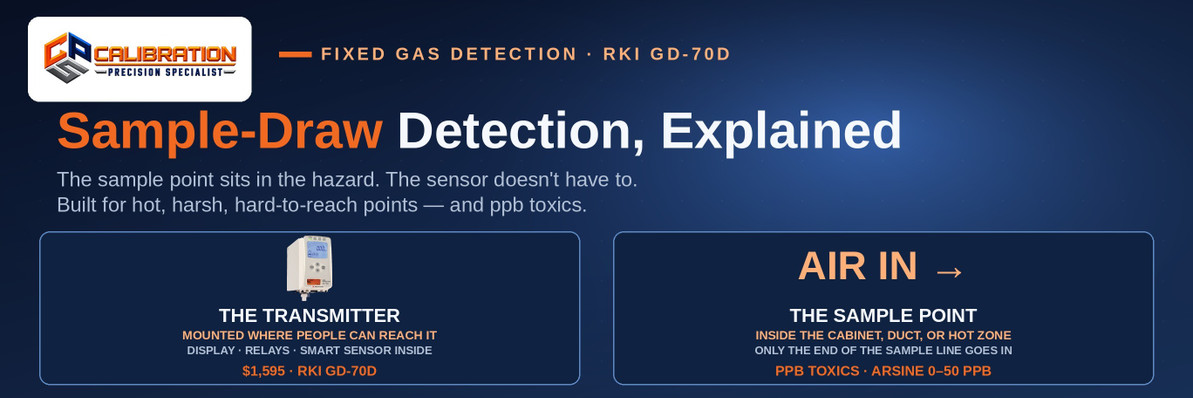
RKI GD-70D: Sample-Draw Gas Detection, Explained
A sample-draw (extractive) gas detector uses a built-in pump to pull air through tubing from the point that needs watching — inside a gas cabinet, a duct, or a hot, corrosive, or hard-to-reach process area — to a sensor in a transmitter mounted where people can safely read and service it. The RKI GD-70D ($1,595) is built exactly this way, with plug-in smart sensors covering 29 gas configurations, including toxic gases at parts-per-billion levels such as arsine at 0–50 ppb.
That separation — sample point in the hazard, sensor and display somewhere reachable — is the entire idea. Everything below explains when it beats a conventional wall-mounted point detector, what the GD-70D itself does, and where sample-draw is honestly the wrong tool.
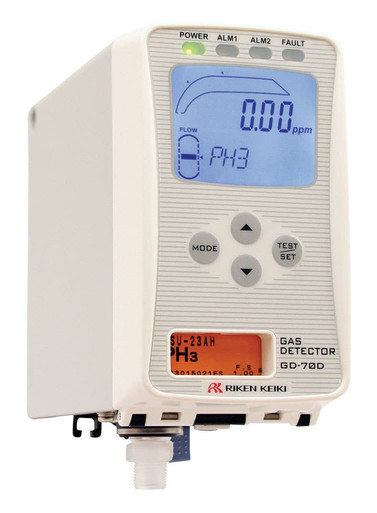
RKI GD-70D Sample Drawing Sensor / Transmitter For Toxic Gases
Sample-draw detection pulls air from harsh hard-to-reach points to one transmitter. The RKI GD-70D ($1,595) does it for ppb toxics — how it works, when it wins.
$1,570–$4,460 configured
See the GD-70D Sample DrawingWhat Is Sample-Draw Gas Detection?
There are two ways to get gas to a fixed sensor:
- Diffusion (point) detection. The sensor sits at the monitoring point and waits for gas to drift across it. Simple, no moving parts, nothing between the leak and the reading — but the sensor, its display, and the technician servicing it all have to live wherever the gas is.
- Sample-draw (extractive) detection. A pump pulls a continuous sample through tubing from a remote sample point to the sensor. The transmitter mounts on an accessible wall; only the end of the sample line has to be in the harsh spot.
The pumped-vs-diffusion mechanics are covered for portables in pumped vs. diffusion gas detectors; sample-draw is the same principle applied to a fixed installation, and the fixed-vs-portable framing is in fixed vs. portable gas detection. A sample-draw transmitter is a fixed detector — it just doesn't have to be fixed at the gas.
Sample-Draw vs. Point Detection: What Actually Changes?
| Point (diffusion) | Sample-draw (extractive) | |
|---|---|---|
| Where the sensor lives | At the leak point itself | In a transmitter mounted where people can reach it |
| What reaches the hazard | The whole detector | The end of a sample line |
| Harsh environments | Sensor must survive heat, corrosion, washdown, vibration | Sample point can sit in conditions no display or electronics should |
| Service and calibration | Done standing at the point — sometimes in PPE, on a lift, or in the hazard | Done at the transmitter, at working height, outside the hazard |
| Low-level toxics | Limited to sensors that can live at the point | Specialty sensors — ppb ranges included — live in a controlled transmitter |
| Moving parts | None | A pump, which is a maintenance item |
| Installed cost shape | Detector plus wiring | Transmitter plus tubing run and installation |
Neither column wins everywhere. The rest of this post is about reading your own application down the left column until a row decides it.
What Can a Sample Point Watch That a Wall Sensor Cannot?
Four recurring situations push facilities to sample-draw:
- The point is too harsh for electronics. Heat, corrosive atmospheres, condensing moisture, and heavy dust attack a diffusion sensor and its display continuously. A sample line tolerates environments a transmitter cannot — the sensitive hardware stays in a survivable location.
- The point cannot be reached for service. Inside gas cabinets, ducts, scrubbers, process tools, and enclosures, a diffusion head might be installable once and effectively unserviceable afterward. A detector nobody can reach gets calibrated late or never — and a fixed sensor that has drifted is worse than none, because everyone trusts it.
- The gas is a specialty toxic at very low levels. Hydride and acid gases used in semiconductor, research, and fuel processes are hazardous at parts per billion. The sensors that measure them belong in a controlled transmitter, not scattered across a plant — and several of them simply are not offered in general-purpose diffusion heads.
- The reading must be seen somewhere safe. A sample-draw transmitter puts its display, alarm status, and relays where operators actually are, instead of inside the area the alarm is warning them about.
Use sample-draw when the monitoring point is hot, corrosive, enclosed, elevated, or otherwise hostile or unreachable, or when the gas list is specialty toxics at ppm and ppb levels. Use a point detector when the location is ordinary, accessible industrial space — diffusion is simpler, has no pump to maintain, and costs less per point. Browse the conventional options under fixed systems and detector heads to see the point-detection side of the range.
What Is the RKI GD-70D?
The RKI GD-70D is RKI's sample-draw smart transmitter for toxic gases, listed at $1,595. From its product page:
- Sample-draw design with a long-life, high-capacity pump. Pump flow is self-tuning for maintenance-free operation.
- Smart sensors that swap in seconds, with no tools. The sensing elements are replaceable in the field and retain all calibration and sensor-specific data in non-volatile memory, so sensors can be hot-swapped with no programming required. Because every GD-70D base unit is identical, one transmitter accepts any sensor in the range.
- Calibration that comes to the bench, not the field. Because the smart sensor retains its calibration information, it can be calibrated separate from the transmitter — avoiding transport of calibration gases to the field location.
- Drift correction in firmware. The GD-70D automatically corrects for long-term zero and span drift, minimizing maintenance between calibrations.
- A real transmitter front panel. A large, easy-to-read integral LCD, a tri-color bar graph showing alarm status at a glance, programmable low and high alarm relays, and a fault relay are all built in.
- Unusual sensor breadth. RKI offers sensor technologies on this platform that include hydrogen-specific and LEL versions alongside the toxic-gas range — the full configuration list is in the next section.
One application RKI calls out by name: vaporized hydrogen peroxide (VHP) detection for fumigation disinfection in medical facilities, pharmaceutical environments including cleanrooms and production filling lines, and chemical fogging in the food industry — a low-level toxic measurement in spaces people must re-enter, which is sample-draw's home ground.
Which Gases Does the GD-70D Detect?
One transmitter carries one smart sensor at a time, chosen from 29 configurations on the product page. Examples, with the ranges exactly as listed there:
| Gas | Range (as listed) |
|---|---|
| Arsine (AsH₃) | 0–0.2 ppm, and 0–50 ppb |
| Diborane (B₂H₆) | 0–0.3 ppm |
| Hydrogen selenide (H₂Se) | 0–0.2 ppm |
| Germane (GeH₄) | 0–8 ppm |
| Hydrazine (N₂H₄) | 0–5 ppm |
| Hydrogen chloride (HCl) | 0–6 ppm |
| Hydrogen bromide (HBr) | 0–6 ppm and 0–9 ppm |
| Bromine (Br₂) | 0–1 ppm |
| Hydrogen peroxide (H₂O₂) | 0–3 ppm, and 0–400 ppb |
| Silane | 0–15 ppm and 0–2 ppm (sensor-dependent) |
| Nitrogen trifluoride (NF₃) | 0–30 ppm |
| Acetic acid | 0–30 ppm |
| Ethylene (C₂H₄) | 0–2,000 ppm |
| Hydrogen (H₂) | 0–2% vol |
| Methane (CH₄) | 0–100% LEL and 0–2% vol |
Read the pattern, not just the list: hydrides, acid gases, and oxidizers at ppm and ppb levels, plus hydrogen and LEL versions for the support areas around them. This is the gas menu of semiconductor fabrication, advanced research, and fuel-process support labs — facilities where the toxic inventory is exotic, the exposure limits are tiny, and the leak points live inside equipment. It is not a general-purpose 4-gas wall unit, and it is not priced or specced like one.
How Does the GD-70D Fit Into a Fixed System?
Two ways, both from the product page:
- Stand-alone. The built-in LCD, bar graph, and alarm and fault relays let a GD-70D watch a point and announce its own alarms without any other hardware.
- Integrated. The transmitter offers communication protocols to existing PLC systems, and it can be integrated with RKI's Beacon series of single- and multi-channel controllers — see the controller range for how multi-point systems are built out. The general signal path is explained in how a fixed gas detection system works.
What we deliberately do not do in this post is publish a sample-line length or a response-time figure for the GD-70D: the live product page does not state one, and line length, tubing, and layout are design decisions for the specific installation. If draw distance is your deciding spec, the paired unit in this series — the SENKO SI-H100 — publishes a 30 m draw in its price list, and we cover it in its own post.
Who Uses Sample-Draw Detection?
The buyers share a profile rather than an industry: a specialty toxic gas, a hostile or enclosed leak point, and a safety program that needs a documented, serviceable measurement.
- Semiconductor and advanced-electronics processes — hydride and etch gases inside cabinets and tools.
- Research and fuel-fabrication support labs — the same hydride and acid-gas families, at bench and process scale, monitored continuously rather than by rounds.
- Pharmaceutical and medical facilities — VHP fumigation monitoring in cleanrooms, filling lines, and disinfection spaces.
- Any plant with one bad point — a single corrosive, hot, or unreachable location in an otherwise ordinary fixed system, where one sample-draw transmitter solves the point that diffusion cannot.
The honest mirror image: if your hazard list is the standard industrial set — methane, CO, H₂S, oxygen — in accessible rooms, a conventional fixed point (or a portable program) is the simpler and cheaper answer, and a sample-draw transmitter is capability you will never use. Sample-draw earns its premium at the points where diffusion cannot go.
What Does a GD-70D Installation Really Cost?
The transmitter is listed at $1,595. On the product page, configured prices run $1,570 to $2,100 depending on the sensor chosen — most toxic-gas configurations sit at $1,680, and the specialty ppb configurations at $2,100. Around that hardware price, budget honestly for:
- The sample line itself — tubing, fittings, and the labor of the run from sample point to transmitter.
- Integration — relay wiring, or connection to a Beacon controller or plant PLC, if the point reports into a larger system.
- Calibration over the unit's life. Fixed points are calibrated in place on schedule. The GD-70D's smart-sensor design cuts the labor in one specific way: the sensor can be calibrated separate from the transmitter, so calibration gas does not have to travel to the field location. CPS supplies the calibration gas — every cylinder carries a QR code that scans to that cylinder's SDS and Certificate of Analysis, the documentation trail QA-driven facilities ask for — and CPS charges no hazmat fee on calibration gas. Fixed-system service is quoted in writing through our calibration services, because installed work is priced by the site, not a rate card.
Frequently Asked Questions
What is a sample-draw gas detector? A sample-draw (extractive) gas detector uses a built-in pump to pull air through tubing from a remote sample point to a sensor inside a transmitter. The sample point sits where the gas is — inside a cabinet, duct, or process area — while the transmitter, display, and sensor mount where people can safely reach them. It is a fixed detector whose sensing point and whose hardware do not have to be in the same place.
What is the difference between sample-draw and diffusion gas detection? A diffusion detector's sensor sits at the monitoring point and samples whatever air drifts across it, so the sensor and anyone servicing it must live in that environment. A sample-draw detector pulls the air to the sensor instead, which lets the sample point sit in hot, corrosive, enclosed, or unreachable locations while service happens at an accessible transmitter. Diffusion is simpler and has no pump; sample-draw reaches points diffusion cannot survive or cannot be serviced at.
How much does the RKI GD-70D cost? The RKI GD-70D transmitter is listed at $1,595 at CPS. Configured prices on the product page run $1,570 to $2,100 depending on the sensor selected — most toxic-gas configurations are $1,680, and the specialty parts-per-billion configurations are $2,100. Tubing, installation, and any controller or PLC integration are additional and are quoted for the specific site.
What gases can the RKI GD-70D detect? One smart sensor at a time, chosen from 29 configurations listed on the product page. The range is specialty toxics: arsine (0–0.2 ppm and 0–50 ppb), diborane (0–0.3 ppm), hydrogen selenide (0–0.2 ppm), germane, hydrazine, silane, nitrogen trifluoride, hydrogen chloride, hydrogen bromide, bromine, and hydrogen peroxide (0–3 ppm and 0–400 ppb), plus hydrogen (0–2% vol) and methane and other LEL versions. The full configuration list is on the GD-70D product page.
Can a sample-draw detector measure gases at ppb levels? Yes — that is one of its main reasons to exist. On the RKI GD-70D, the arsine configuration reaches 0–50 ppb and a hydrogen peroxide configuration reaches 0–400 ppb, levels at which several process toxics have their exposure limits. Keeping those specialty sensors inside a controlled, accessible transmitter — instead of mounted at a hostile point — is what makes ppb measurement practical to maintain.
Where do you mount a sample-draw detector? The transmitter mounts where people can read its display, hear and act on its alarms, and service its sensor — typically on an accessible wall outside the hostile area. Only the end of the sample line goes to the monitoring point itself: inside the gas cabinet, duct, scrubber, or process enclosure. That split is the design decision: sample point at the hazard, hardware at working height in a survivable location.
Does the RKI GD-70D need a controller? No. The GD-70D runs stand-alone with its own integral LCD, tri-color alarm bar graph, programmable low and high alarm relays, and a fault relay. When a facility wants the point inside a larger system, the product page states it offers communication protocols to existing PLC systems and can be integrated with RKI's Beacon series of single- and multi-channel controllers.
How do you calibrate an RKI GD-70D? The GD-70D's smart sensors retain their calibration and sensor-specific data in non-volatile memory, so a sensor can be calibrated separate from the transmitter — calibration gas does not have to be transported to the field location — and sensors hot-swap with no tools and no programming. The firmware also auto-corrects long-term zero and span drift between calibrations. CPS calibrates every channel on the instruments it services and supplies certified calibration gas with a QR-linked Certificate of Analysis per cylinder.
When is sample-draw detection the wrong choice? When the monitoring point is ordinary, accessible industrial space and the gas list is standard — methane, carbon monoxide, hydrogen sulfide, oxygen — a diffusion point detector is simpler, has no pump to maintain, and costs less per point. Sample-draw also carries one sensor per transmitter, so covering many gases at many points multiplies hardware. It earns its cost at hostile, enclosed, or unreachable points and at ppb-level toxics, not as a default for every wall.
Who uses sample-draw gas detection? Facilities whose toxic gases live inside equipment: semiconductor and advanced-electronics processes using hydride and etch gases, research and fuel-process support labs handling the same gas families, and pharmaceutical and medical sites monitoring vaporized hydrogen peroxide fumigation in cleanrooms and filling lines. The common thread is a specialty toxic at a point a diffusion sensor cannot be mounted at, survived by, or serviced in.
The Bottom Line
Sample-draw detection exists for the points a wall sensor cannot watch: too hot, too corrosive, too enclosed, too high, or measuring a toxic gas at parts per billion. The RKI GD-70D ($1,595) answers those points with a self-tuning pump, 29 interchangeable smart-sensor configurations down to 0–50 ppb arsine, bench-calibratable sensors that swap in seconds with no tools, and stand-alone relays or Beacon and PLC integration. If your points are ordinary rooms and standard gases, buy diffusion and save the money — if one point on your list defeats a wall sensor, this is the instrument class built for it.
Working on a sample-draw point near Oak Ridge or anywhere your facility runs specialty toxics? CPS is at 109 S. Front Street, Rockwood, TN 37854 — about 30 minutes from Oak Ridge. Call 865-900-8844 or reach us through Contact Us. See the RKI GD-70D, the wider RKI Instruments range, fixed systems, and the calibration services that keep fixed points honest.
CPS Calibrations · 109 S. Front Street, Rockwood, TN 37854
Need a calibration you can file?
In-house calibration at CPS in Rockwood, Tennessee — $55 for single-gas instruments, $90 for 4- and 5-gas — every channel, as-found and as-left data, full certificate.
See Calibration Servicesor call 865-900-8844
Recent Posts
-

Can You Add a Pump to a SENKO SGT-P or MGT?
Yes — SENKO's SP-Pump101 external sampling pump ($330, part AAA006000) fits the SGT, SGT-P, and MGT, …Nov 12th 2026 -

What Refrigerant Detection Does a Grocery Store Need?
A grocery store needs refrigerant detection in three places: low-mounted carbon dioxide (R-744) sens …Nov 11th 2026 -

What Is LEL and UEL? The Explosive Range, Gas by Gas
The LEL is the lowest concentration of a gas in air that can explode, and the UEL is the highest: me …Nov 10th 2026