
Crowcon Vortex Control Panels: 4, 8, or 12 Channels Watching Every Detector
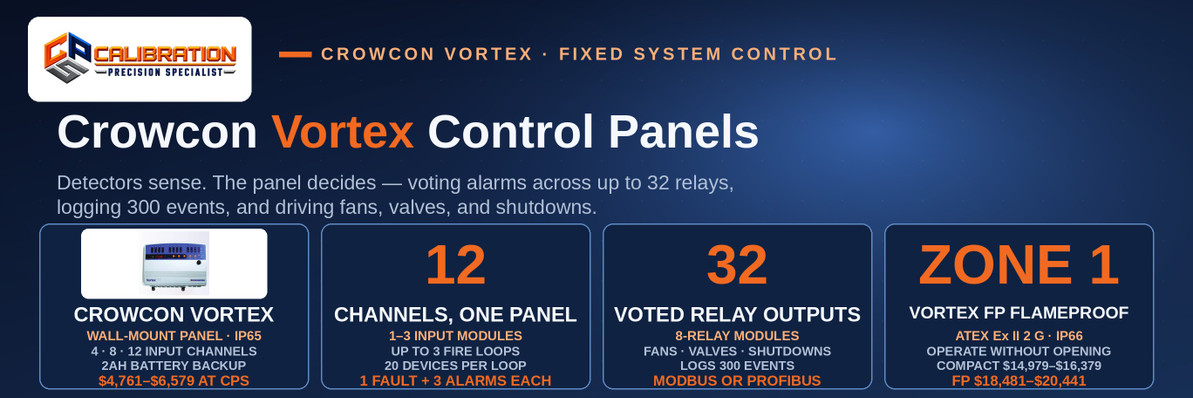
The Crowcon Vortex is a modular gas detection control panel that watches up to 12 detector channels at once — CPS sells it in 4-, 8-, and 12-input configurations — and turns what those detectors see into decisions and action. Every channel carries one fault level and three alarm levels that can be voted in any combination to trigger up to 32 relay outputs, the panel stores up to 300 alarm, power, fault, and system events in non-volatile memory, and it reports to plant systems over Modbus or Profibus. The same electronics come in three enclosures: the standard Vortex wall panel for safe areas at $4,761–$6,579, the flameproof Vortex FP for ATEX Zone 1 and 2 locations at $18,481–$20,441, and the smaller Vortex FP Compact at $14,979–$16,379.
A fixed gas detection system is only as smart as its panel. The detectors scattered around your plant are senses — they sit where the gas would be and report what they find. The panel is the brain that reads every report, decides what it means, and acts on it. This post explains how the Vortex's modular architecture works, how the three versions differ, what the CPS configurations cost, and where the family's real limits are.
The Panel Is the Brain
A detector head on its own can do exactly one thing: measure gas at its location and output a signal — on a Vortex channel, a 4–20 mA current proportional to the reading. It cannot start an exhaust fan when the reading climbs, close a feed valve at the high alarm, sound a building-wide evacuation tone, shut a process down, or remember what happened last Tuesday. Those are panel jobs, and they are the difference between detecting gas and doing something about it.
The Vortex does four things with every channel, continuously:
- It decides. Each channel's reading is compared against one fault level and three alarm levels that you set — a warning at the first level, a stronger response at the second, evacuation or shutdown at the third.
- It votes. Alarm and fault levels from different channels can be combined in any pattern to trigger a relay, so a plant shutdown can require two detectors in alarm while a single detector still raises a local warning. Voting is covered in its own section below.
- It acts. Up to 32 relay outputs switch the outside world — fans, valves, beacons, sounders, and the contact that tells your process control system to trip.
- It remembers. Up to 300 alarm, power, fault, and system events are stored in non-volatile memory, so the record survives a power cut and is there when an incident gets reviewed.
Sizing a Vortex is therefore three questions, in order: how many detector points do you have (channels), what has to happen when one alarms (relays), and where is the panel itself allowed to sit (enclosure). The rest of this post takes them in that order.
Built From Modules, Not Models
Most control panels are sold as fixed models — a 4-channel box, an 8-channel box — and outgrowing one means replacing it. The Vortex is built from plug-in modules on a shared bus, and the configuration you buy is simply how many of each module the panel is assembled with:
- Quad Channel Input Modules take four detector channels each. One module gives a 4-channel panel, two give 8, three give the maximum 12. Channels accept 2- or 3-wire 4–20 mA detectors (sink or source) and 0–5 V signals — Crowcon's own detector heads such as the Xgard range, and, because the input is a standard industrial signal, 4–20 mA gas detectors from many other manufacturers as well. One honest exception: the Vortex has no direct input for mV pellistor heads. Legacy pellistor detectors connect through converter boxes that turn the mV signal into 4–20 mA — CPS's price book lists them at $420 for one head up to $813 for four.
- Up to three channels can be fire loops instead of gas. A fire channel takes conventional smoke and heat detectors and manual call points — up to 20 devices on one loop — so one panel can watch gas and fire together in a small plant room.
- Relay Output Modules carry eight SPCO relays each, contacts rated 6 A at 250 Vac, and up to four modules give 32 relay outputs. There is a physical trade-off: input and relay modules share the panel's space, so a fully loaded 12-input panel tops out at three relay modules (24 relays), while 4- and 8-input panels can take all four. Relays are assigned either as common outputs (mains fail, battery low, battery fail) or as voted outputs driven by alarms, faults, and system events, and each relay can be energized or de-energized, latched or non-latched, time-delayed, or pulsed.
- The display is deliberately simple: a green two-digit LED shows the channel number, a red four-digit LED shows its reading in %LEL, ppm, %Vol, or Fire, and an internal piezo sounder plus per-channel fault LEDs and per-zone inhibit LEDs show status. On the wall-mounted unit the LEDs stay dark until something needs attention, so a healthy system reads as a healthy system at a glance. Day-to-day operations run from front-panel push buttons; full configuration is done with Crowcon's Panels Pro software over an RS-232 link, and a panel can be factory-set to your requirements before it ships.
- Plant communications are RS-485 Modbus as the standard digital link, with Profibus as an option — either way the panel reports readings and status to a PLC, DCS, or SCADA system instead of keeping them to itself. Four 24 Vdc 0.5 A supplies are also provided for driving external sounders and beacons through the relays.
- Reliability details are built in rather than added on: the system monitors its relay coils continuously and flags a coil fault immediately, separate zones can be inhibited individually so you can work in one area without blinding the rest of the plant, and the design is validated to IEC 61508.
Standard, FP, or FP Compact: Where the Panel Has to Sit
The electronics are the same family in all three. What changes is the enclosure — and the enclosure decides where the panel may legally be installed, which is why the prices diverge so sharply.
| Vortex | Vortex FP | Vortex FP Compact | |
|---|---|---|---|
| Built for | Safe-area mounting — control room, MCC, plant office wall | Sitting inside an ATEX Zone 1 or 2 area itself | Zone 1 or 2 areas where wall space is restricted |
| Enclosure | Aluminium back-box, ABS front cover, IP65 | LM25 aluminium flameproof, IP66 | Flameproof enclosure, smaller casting |
| Size / weight | 470 × 306 × 170 mm (18.5 × 12 × 6.5 in) / 12 kg (27 lb) | 440 × 640 × 332 mm (17.3 × 25 × 13 in) / ~70 kg (154 lb) | 450 × 330 × 289 mm (17.6 × 13 × 11.4 in) / ~37.5 kg (83 lb) |
| Channels | 4, 8, or 12 | 4, 8, or 12 | 4, 8, or 12 |
| Relay ceiling | Up to 32 | Up to 32 (with bus extension) | Up to 16 |
| Battery backup | 2 Ah internal, monitored | Not available | Not available |
| IS barriers | External | Up to 4 inside the enclosure | Housed in a separate enclosure |
| CPS price range | $4,761–$6,579 | $18,481–$20,441 | $14,979–$16,379 |
The standard Vortex is the panel most plants need: the detectors live in the hazardous area, the panel lives somewhere safe and convenient, and it can still form part of an intrinsically safe system (to EN 60079-25) with barriers fitted for IS detectors. Crowcon also builds the same electronics in panel-mount and 19-inch rack formats; the configurations CPS lists are the wall-mounted assemblies — ask us if a rack or cabinet build fits your installation better.
The Vortex FP exists for the sites where there is no convenient safe area near the detectors — offshore modules, analyser houses, and process areas where the panel has to live in the zone it monitors. Its flameproof enclosure is ATEX certified (Ex II 2G D, Zones 1 and 2, with IECEx optional), and Crowcon designed it so the enclosure stays shut in daily use: every day-to-day operation is done from the front, and displayed information can be changed and outputs inhibited during calibration with a magnetic key — no opening the flameproof box, and no hot-work permit just to run the panel. The enclosure also has room for up to four intrinsically safe barriers inside, for interfacing with IS detectors and alarms.
The Vortex FP Compact is the same flameproof idea in a casting roughly half the FP's weight and footprint, for locations that cannot accommodate the full FP. The compromises are specific: relay capacity tops out at 16 instead of 32 — and a 12-input Compact can only fit one relay module (8 relays), because the smaller box runs out of room sooner — and IS barriers must live in a separate enclosure rather than inside the panel.
Alarm Voting: Why "Any Pattern" Matters
Voting is the most consequential word in the Vortex specification, and it deserves a plain explanation. On a simple panel, one detector in alarm fires the output: one channel, one vote — what engineers call 1oo1. That is the most responsive arrangement and the most prone to false trips, because a single faulty or drifting detector can shut your process down.
A voted output requires a pattern instead — classically, two detectors covering the same area must both reach alarm level before the shutdown relay fires (2oo2 or 2oo3 logic). One detector alone still raises warnings, starts ventilation, and logs the event; it just cannot stop the plant by itself. Because gas spreads and a real release will reach neighbouring detectors, true events vote through in seconds, while a single sick sensor does not cost you a shutdown.
The Vortex lets any channel's fault and alarm levels be combined in any pattern to trigger its relays, so one panel can run both philosophies at once: 1oo1 voting for the beacons and fan starters that should respond to the first hint of gas, 2ooN voting for the process trip that should only fire on corroborated evidence. Combined with relay modes like time delay (ride out a transient before acting) and latching (stay in alarm until a person acknowledges it), voting is what makes a 12-channel panel behave like a designed safety system instead of twelve alarms wired to a buzzer.
Configurations and Prices at CPS
CPS sells the Vortex family as factory-configured assemblies — you choose the input count and the relay count, and the panel arrives built that way. Prices are list.
Standard Vortex — 14 configurations, $4,761–$6,579. The pattern is easy to read: each additional input module (four more channels) adds roughly $420–$480, and each relay module (eight more relays) adds about $280.
| Inputs | No relays | 1 relay module (8) | 2 relay modules (16) | 3 relay modules (24) | 4 relay modules (32) |
|---|---|---|---|---|---|
| 4 | $4,761 | $5,041 | $5,319 | $5,601 | $5,880 |
| 8 | $5,321 | $5,600 | $5,880 | $6,161 | $6,440 |
| 12 | $5,740 | $6,020 | $6,300 | $6,579 | — |
Vortex FP — 14 configurations, $18,481–$20,441. The same 4/8/12 inputs and 0–4 relay modules inside the flameproof enclosure: 4-input panels run $18,481–$19,600, 8-input $19,039–$20,160, and 12-input $19,601–$20,441. The step up from the standard panel is mostly the casting — a 70 kg certified flameproof enclosure costs what it costs — and it buys the ability to mount the panel in the zone.
Vortex FP Compact — 5 configurations, $14,979–$16,379. Four inputs with 8 relays is $14,979; eight inputs with 8 relays $15,680; twelve inputs with 8 relays $16,379; and the two 16-relay builds are $15,540 (4 inputs) and $16,239 (8 inputs). There is no 12-input/16-relay Compact — the relay limitation in the smaller enclosure rules it out.
Two budget notes. First, these prices are the configured panel: detector heads, IS barriers where the design needs them, mV converter boxes for legacy pellistor heads, and cabling are separate — budget the whole system, not just the brain. Second, if your system is smaller than four points or needs only a relay or two, a full Vortex is more panel than the job requires — our GMS controller spotlight covers Crowcon's 1- and 4-channel controllers built for exactly that scale.
The Honest Limits
- Twelve channels is the ceiling. A Vortex watches up to 12 gas points (plus fire loops). A plant with 30 detector points needs multiple panels or a different class of controller — the Vortex is a small-system panel and does not pretend otherwise.
- The flameproof versions have no battery backup. The standard Vortex carries a monitored 2 Ah internal battery pack; on the FP and FP Compact, battery backup is not available, so a power cut takes the panel down with it unless your site supplies backed power. Design the power feed accordingly.
- Certification, stated plainly for US buyers. The FP's certification is ATEX (IECEx optional) — Crowcon's current book lists no UL version of the Vortex, and the standard panel's approvals are the EN 61010-1 safety standard plus EMC compliance (EN 50270 and FCC Part 15). The common US arrangement is the standard panel in a safe area, where panel certification is not the gating issue; a Zone 1 panel installation is a specification decision to make with your AHJ and insurer, not an assumption.
- No mV input. Pellistor heads from an older system need converter boxes ($420–$813 in the book, depending on head count) before a Vortex can read them — a real cost when retrofitting a legacy installation.
- The panel does not include the detectors. Every channel still needs a detector head at the other end of the cable, and the panel's 300-event log and voting logic are only as trustworthy as those heads are calibrated.
- Respect the operating range. The panel is rated −10 °C to +40 °C (14–104 °F) and 0–95% RH non-condensing — a control room or MCC wall is fine, an unheated outdoor cabinet in a hard winter deserves a second thought.
Keeping the Whole System Honest
A control panel's event log makes it tempting to treat the fixed system as fit-and-forget. It is not: the panel faithfully reports whatever its detectors tell it, and an electrochemical or pellistor detector drifts with age whether it is wired to a panel or not. The panel will flag a channel fault when a detector fails outright, but slow drift is invisible to it — that is what calibration is for. CPS calibrates every channel of a fixed system, detectors included, and our turnkey fixed-system installation service covers the whole job — detectors, panel, relays, and the voting logic programmed to your cause-and-effect chart — when a Vortex is going in new.
Specifications
| Crowcon Vortex family | |
|---|---|
| Channels | Up to 12 (1–3 × 4-way input modules); up to 3 channels configurable as fire loops |
| Inputs | Gas: 2- or 3-wire 4–20 mA (sink or source), 0–5 V · Fire: smoke/heat detectors, manual call points, up to 20 devices per loop |
| Alarm levels | 1 fault level + 3 alarm levels per channel, combinable in any pattern (voting) |
| Relays | 8-way SPCO modules, contacts 6 A @ 250 Vac; up to 32 outputs (FP Compact up to 16); energized/de-energized, latched/non-latched, time-delayed, pulsed |
| Display | 2-digit green LED channel number · 4-digit red LED reading · units %LEL, ppm, %Vol, Fire · piezo internal sounder |
| Logging | Up to 300 alarm, power, fault, and system events in non-volatile memory |
| Communications | RS-485 Modbus or Profibus to DCS/PLC/PC · RS-232 local configuration link (software supplied) |
| Power | AC mains 110/120 V & 220/240 V switchable or 20–30 Vdc (model dependent) · 2 Ah internal battery backup, standard Vortex only |
| Operating range | −10 °C to +40 °C (14–104 °F) · 0–95% RH non-condensing |
| Functional safety | Validated to IEC 61508 |
Frequently Asked Questions
How many gas detectors can a Crowcon Vortex panel monitor? Up to 12 gas detector channels, built from 4-way input modules — CPS sells 4-, 8-, and 12-input configurations. Up to three of the channels can instead be fire loops carrying conventional smoke and heat detectors and manual call points, with up to 20 devices per loop, so a small site can watch gas and fire from one panel.
How many relays does a Vortex have, and what can they do? Relays come in 8-way SPCO modules (contacts rated 6 A at 250 Vac), and a panel takes up to four modules for 32 outputs — except that a 12-input panel tops out at three modules (24 relays), and the FP Compact at 16. Relays start fans, close valves, drive beacons and sounders, and trip processes, and each can be latched, time-delayed, or pulsed.
What is the difference between the Vortex and the Vortex FP? The enclosure, and therefore where the panel may sit. The standard Vortex (IP65, 12 kg) mounts in a safe area such as a control room. The Vortex FP puts the same electronics in a 70 kg ATEX flameproof enclosure rated for Zone 1 and 2, so the panel can be installed in the hazardous area itself. The FP costs $18,481–$20,441 against $4,761–$6,579 for the standard panel, and it gives up the standard panel's internal battery backup.
What is the Vortex FP Compact? A smaller flameproof version of the FP for Zone 1 and 2 locations where wall space is restricted: 450 × 330 × 289 mm and about 37.5 kg, against the FP's 440 × 640 × 332 mm and roughly 70 kg. It takes the same 4, 8, or 12 inputs but tops out at 16 relays (only 8 on a 12-input build), its IS barriers must be housed separately, and CPS prices it at $14,979–$16,379.
How much does a Crowcon Vortex cost? At CPS, list prices run $4,761–$6,579 for the standard Vortex, $18,481–$20,441 for the Vortex FP, and $14,979–$16,379 for the FP Compact. Within each range, price follows the configuration: more input channels and more relay modules cost more — on the standard panel, roughly $420–$480 per extra 4-channel input module and about $280 per 8-relay module. Detector heads, barriers, and cabling are priced separately.
What does alarm voting mean on a gas detection panel? Voting means an output relay fires only when a defined pattern of channels is in alarm, instead of any single channel. A Vortex lets any channel's fault and alarm levels be combined in any pattern — so ventilation can start on one detector (1oo1) while a process shutdown requires two detectors in alarm (2ooN), which keeps a single faulty sensor from stopping the plant while still catching real releases.
Can a Vortex work with gas detectors from other manufacturers? Yes, provided they speak the panel's language: Vortex channels accept standard 2- or 3-wire 4–20 mA signals (sink or source) and 0–5 V, and Crowcon's manual confirms detectors from many other manufacturers can be used. The exception is raw mV pellistor heads, which need a converter box ($420–$813 depending on head count) to turn their signal into 4–20 mA first.
Does the Crowcon Vortex have battery backup? The standard Vortex does — a 2 Ah internal battery pack that the panel monitors continuously for charge level and connection. The flameproof versions do not: battery backup is not available on the Vortex FP or FP Compact, so those panels need a backed power supply from the site if they must ride through an outage.
Can a Vortex connect to a PLC, DCS, or SCADA system? Yes. The panel provides RS-485 Modbus communications as its standard digital link, with Profibus available as an option, so readings, alarms, and faults report into plant control systems. A local RS-232 link with Crowcon's configuration software is also supplied for setting the panel up.
Can you operate a Vortex FP without opening the enclosure? Yes — that is one of its design points. All day-to-day operations are completed from the front panel without opening the flameproof enclosure, so no hot-work permit is needed for routine tasks, and a magnetic key lets you alter displayed information and inhibit outputs during calibration with the box still shut.
The Bottom Line
The Vortex is what a small fixed gas detection system should be built around: a modular panel that reads up to 12 channels, votes their alarms intelligently across up to 32 relays, logs what happened, and reports to the plant systems that need to know. Buy the standard panel when it can live in a safe area — most can. Buy the FP when the panel itself has to live in a Zone 1 or 2 area, and the FP Compact when it has to live there and space is tight. Just size it honestly: count your detector points, decide what each alarm must do, and remember that twelve channels is the family's ceiling.
Planning a fixed system around a Vortex — or want the detectors on your existing panel calibrated? Call 865-900-8844 or reach us through Contact Us. CPS Calibrations · 109 S. Front Street, Rockwood, TN 37854 · Calibration Gas · Calibration Services
CPS Calibrations · 109 S. Front Street, Rockwood, TN 37854
Need a calibration you can file?
In-house calibration at CPS in Rockwood, Tennessee — $55 for single-gas instruments, $90 for 4- and 5-gas — every channel, as-found and as-left data, full certificate.
See Calibration Servicesor call 865-900-8844
Recent Posts
-

Can You Add a Pump to a SENKO SGT-P or MGT?
Yes — SENKO's SP-Pump101 external sampling pump ($330, part AAA006000) fits the SGT, SGT-P, and MGT, …Nov 12th 2026 -

What Refrigerant Detection Does a Grocery Store Need?
A grocery store needs refrigerant detection in three places: low-mounted carbon dioxide (R-744) sens …Nov 11th 2026 -

What Is LEL and UEL? The Explosive Range, Gas by Gas
The LEL is the lowest concentration of a gas in air that can explode, and the UEL is the highest: me …Nov 10th 2026