
Crowcon Xgard: The Fixed Gas Detector Range, Explained by Type
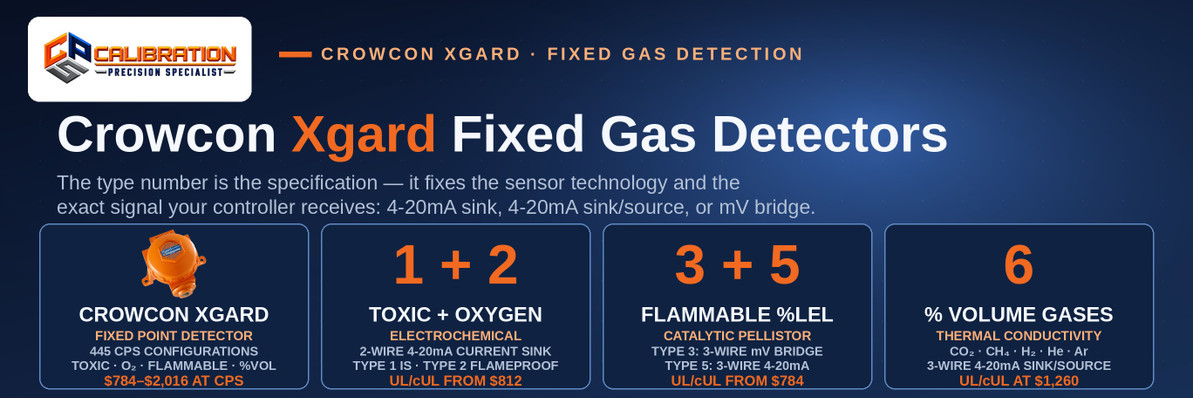
The Crowcon Xgard is a fixed point gas detector range for toxic gases, oxygen, flammable gases, and percent-volume gases — and the type number is the specification. Type 1 (intrinsically safe) and Type 2 (flameproof) use electrochemical sensors for toxic gas and oxygen on a 2-wire 4-20mA output; Type 3 and Type 5 use catalytic pellistors for flammable gas, Type 3 on a 3-wire mV bridge output and Type 5 on a 3-wire 4-20mA output; Type 6 uses a thermal conductivity sensor for percent-volume gases on 3-wire 4-20mA. CPS's build spans 445 Xgard configurations at $784–$2,016, led by the 125 UL/cUL-certified builds.
Ask for "an Xgard" and you have not actually specified a detector. Crowcon has sold the Xgard name for decades over a family of detectors that share a junction box, a mounting footprint, and a plug-in sensor philosophy — but differ in the three things that decide whether a fixed installation works: what sensor is inside, what explosion protection it carries, and what electrical signal it sends back to your controller. All three are encoded in the type number. This guide decodes it: what each type detects, what signal it outputs and why that has to match your panel, which housing and thread to choose, what the certifications mean for a US buyer, and what the range costs at CPS.
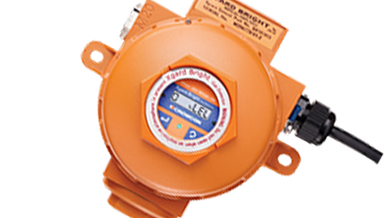
Crowcon Xgard Bright Fixed Gas Detector
Crowcon Xgard fixed gas detectors explained by type: Types 1, 2, 3, 5 and 6 — sensors, mV bridge vs 4-20mA outputs, housings, UL/cUL. CPS $784–$2,016.
$1,000–$2,310 configured
See the Xgard BrightThe Type System at a Glance
| Type | Detects | Sensor | Output | Protection concept | UL/cUL builds at CPS from |
|---|---|---|---|---|---|
| Type 1 | Toxic gas + oxygen | Electrochemical | 2-wire 4-20mA (current sink) | Intrinsically safe (Zone 0, 1, 2) | $1,022 |
| Type 2 | Toxic gas + oxygen | Electrochemical | 2-wire 4-20mA (current sink) | Flameproof (Zone 1, 2) | $812 |
| Type 3 | Flammable gas (%LEL) | Catalytic pellistor | 3-wire mV bridge | Flameproof (Zone 1, 2) | $784 |
| Type 5 | Flammable gas (%LEL) | Catalytic pellistor | 3-wire 4-20mA (sink or source) | Flameproof (Zone 1, 2) | $826 |
| Type 6 | % volume gases | Thermal conductivity | 3-wire 4-20mA (sink or source) | Flameproof (Zone 1, 2) | $1,260 |
One sibling completes the picture: Type 4 is the high-temperature flammable detector — the same catalytic bead and mV bridge output as a Type 3, in a taller stainless-sensor housing rated for ambients up to +150 °C (302 °F). It exists for ovens, drying plants, and hot process areas where a standard detector's electronics would cook. Only a handful of Type 4 configurations appear in Crowcon's current book, and none in the UL/cUL first wave, so it is a call-and-configure option rather than a stocked line.
Why the Type Matters: Match the Detector to the Panel Input
This is the part of fixed gas detection that bites people, so it is worth slowing down. An Xgard — like almost every fixed detector head — is one channel of a system. It senses gas and converts the reading into an electrical signal. Something else — a gas detection controller, a PLC analog input, a building system — has to receive that signal, decide it is an alarm, and do something about it: sounders, beacons, ventilation, shutdowns. The detector and the receiver have to speak the same electrical language, and the Xgard range speaks three:
- 2-wire 4-20mA (Types 1 and 2). The industry-standard loop. The detector is powered by the same two wires that carry the signal, drawing 4 mA at zero gas and 20 mA at full scale. It is a current sink: the loop supply comes from the panel side, and the detector controls the current flowing through it. Any controller, PLC, or DCS analog input that accepts 4-20mA reads it, cable runs can be long, and a reading below 4 mA (or a broken wire at 0 mA) is itself a fault signal. This is the output to choose when the detector must land on general-purpose control hardware.
- 3-wire 4-20mA (Types 5 and 6). Same 4-20mA language, but the detector gets its own power pair plus a signal wire — three wires — because a heated pellistor or thermal conductivity sensor draws more power (50 mA at 24 V) than a 2-wire loop can supply. These types can be configured as current sink or current source, which settles the wiring question on panels that expect the detector to drive the loop. If your panel takes 4-20mA, Types 5 and 6 plug into the same world as Types 1 and 2.
- 3-wire mV bridge (Type 3, and Type 4). The traditional catalytic-sensor connection. There is no transmitter electronics package converting the reading to milliamps — the panel supplies a precise 2.0 V excitation to the pellistor bridge and reads back a raw millivolt signal (typically 12–15 mV per %LEL on methane). That only works with a controller that has dedicated mV bridge input channels. Crowcon's own panels have long been built that way — the GMS controllers in Crowcon's current book are specified by how many mA and how many mV inputs they carry, which tells you the two signal types coexist on real sites. But a PLC's standard 4-20mA analog card cannot read an mV bridge head, and bridge signals are also more sensitive to cable resistance and run length than a current loop.
The practical rule: choose the type by the input your panel already has, not the other way round. Replacing like-for-like on an existing mV bridge system? Type 3 keeps the wiring and the panel. Building new, or landing detectors on a PLC? Take the 4-20mA types (1, 2, 5, 6) and never think about bridge excitation again. Getting this wrong is not a settings change — it is a different detector, which is why the type decision comes before the gas decision, not after.
Types 1 and 2: Toxic Gas and Oxygen
Types 1 and 2 are the same detector wearing two different protection concepts. Both use electrochemical sensors — the broadest catalogue in the range, covering more than two dozen gases: oxygen 0–25% vol, carbon monoxide to 1,000 ppm, hydrogen sulfide to 1,000 ppm, ammonia to 1,000 ppm, chlorine, chlorine dioxide, sulfur dioxide, nitrogen dioxide, nitric oxide, hydrogen cyanide, hydrogen chloride, hydrogen fluoride, ozone, phosphine, and a tail of exotic semiconductor-plant gases (arsine, diborane, germane, silane, phosgene, fluorine) at 1–2 ppm ranges. Both output the loop-powered 2-wire 4-20mA sink signal on an 11–30 V dc supply, draw just 24 mA maximum, respond in under 10 seconds on oxygen (toxic response is sensor-dependent), and use a 2-year-life oxygen sensor — double the roughly 1-year life of a conventional O₂ cell, which halves oxygen sensor replacement cost on the channels every site has most of.
The difference is how each is allowed to survive a hazardous area:
- Type 1 is intrinsically safe (ATEX II 1 G Ex ia IIC T4; UL/cUL Class 1 Division 1 Groups A, B, C, D). Its circuits are energy-limited so they cannot ignite gas even in a fault, which earns it Zone 0 — the classification for areas where an explosive atmosphere is present continuously or for long periods. The trade: an intrinsically safe loop needs a zener barrier or galvanic isolator between the detector and the panel, an extra component that belongs in the project budget from day one. ATEX Type 1 detectors come in a glass-reinforced nylon housing as standard; UL builds and the stainless option use metal housings.
- Type 2 is flameproof (ATEX II 2 GD Ex d IIC T6). The enclosure is built to contain an internal ignition and cool the escaping gases, so it suits Zone 1 and 2 areas without a barrier — but it cannot go into Zone 0. In exchange it is the cheaper toxic/O₂ build in aluminium: CPS's UL/cUL Type 2 configurations start at $812, against $1,022 for Type 1.
Choose Type 1 when the area classification says Zone 0, or when the detector must live inside the hazard continuously. Choose Type 2 for the far more common Zone 1/2 wall-mount points and keep the barrier out of the panel.
Types 3 and 5: Flammable Gas
Types 3 and 5 detect flammable gas from 0–100% LEL with a catalytic pellistor — Crowcon specifies poison-resistant pellistors across the flammable range, for hydrocarbons, hydrogen, ammonia, jet fuel, leaded petrol, and halogen-bearing vapours. The sensor, the flameproof enclosure (ATEX II 2 GD Ex d; Type 3 T4, Type 5 T6), the −40 °C starting temperatures, and the T90 response under 15 seconds are the same. The only difference is the output — which, per the section above, is the difference that decides your panel:
- Type 3 outputs a 3-wire mV bridge signal. It is the legacy connection: no 4-20mA transmitter, just the raw bridge. Buy it to match existing mV-input controllers and wiring, or Crowcon panels specified with mV channels. It is also the lowest-cost flammable head in the range — UL/cUL builds at CPS run $784–$812.
- Type 5 outputs 3-wire 4-20mA, sink or source. Same pellistor, with the transmitter electronics to speak the universal language. Buy it for new systems, PLC landing, long cable runs, and anywhere the panel is a standard analog input. UL/cUL builds at CPS run $826–$1,204, the top of that range being stainless housings.
Two honest pellistor notes. A catalytic sensor needs oxygen to burn gas on the bead — in an inerted or oxygen-depleted atmosphere it under-reads, which is exactly the situation Type 6 (below) or an infrared detector addresses; Crowcon's infrared fixed line is a separate family (IRmax), not the classic Xgard. And poison-resistant is not poison-proof: the bump test and calibration schedule in your site policy still applies.
Type 6: Thermal Conductivity, for Percent-Volume Gases
Type 6 answers a different question. %LEL detectors measure trace-to-flammable concentrations; some processes need to know gas concentration at percent-by-volume levels — far above any LEL — or need to watch a gas that has no meaningful LEL reading at all. The thermal conductivity sensor measures how well the gas mixture carries heat away from a heated element, which tracks concentration across the full 0–100% volume range. Crowcon's Type 6 ranges include carbon dioxide 0–50% and 0–100% vol, methane 0–10/25/100% vol, hydrogen 0–5/10/50% vol in air (and percentage ranges of hydrogen in nitrogen), helium 0–5% up to 0–100% vol, argon 0–25% vol, and propane/butane 0–25% vol.
The jobs are specific: CO₂ at process levels in fermentation and carbonation, inert-gas blanketing and purge verification (argon, helium), hydrogen concentration in process streams and in nitrogen, and biogas-style methane-in-CO₂ mixtures. Type 6 is flameproof (ATEX II 2 GD Ex d IIC T6), outputs 3-wire 4-20mA sink or source, and runs over a narrower +10 to +55 °C ambient window than the rest of the range — thermal measurement is temperature-sensitive, and the detector says so in its spec. CPS's UL/cUL Type 6 builds sit at $1,260. What Type 6 is not: a life-safety %LEL or ppm toxic detector. It measures bulk concentration, not trace exposure — pair it with the right Types 1/2/3/5 points for the safety layer.
Housings and Threads: Nylon, Aluminium, Stainless
Every Xgard type is a junction box plus a plug-in sensor, and the box comes in three materials. The choice is about corrosion and weight, not performance — the sensor inside is the same:
- Glass-reinforced nylon (GRP) — standard on ATEX Type 1. At 0.5 kg it is a third of the metal weight, it cannot corrode, and it shrugs off chemical atmospheres that eat painted metal. The intrinsically safe toxic/O₂ detector is the one most often mounted in numbers, and nylon keeps those installs light and cheap.
- Aluminium (polyester-coated alloy) — standard for the flameproof types and for UL Type 1 builds. 1 kg, tough coated finish, the default for general industrial areas. If you need a 3/4" NPT cable entry, note it is only available on aluminium boxes.
- 316 stainless steel — the corrosion-proof option for offshore, marine, food-and-beverage washdown, and aggressive chemical plants. It costs more and weighs 3.1 kg — triple the alloy — so it earns its place where the environment would destroy the cheaper boxes, not as a default.
All types mount on a wall or ceiling without extra brackets, at 156 × 166 × 111 mm (the Type 4 is taller, at 195 mm). Sealing is IP65 as standard, IP66 with the optional weatherproof cap — the cap (or the spray deflector) is the right add-on for washdown areas and offshore exposure. Cable entries on the CPS builds are M20 or 1/2" NPT; pick NPT for US conduit practice, M20 where the plant standard is metric glands. Sensors and sinters swap through the junction box lid, and spare sensors simply plug in — many spares are common across Xgard models, which keeps the shelf stock for a mixed-type site small.
Certifications: What UL/cUL vs ATEX/IECEx Means for a US Buyer
The Xgard is a British-designed range, and Crowcon's book is ATEX-first — which is why reading the certification column matters more than the price column. Of the 445 Xgard configurations in Crowcon's current book, 276 are ATEX/IECEx builds, 44 are INMETRO (Brazil), and 125 are UL/cUL-described — Class 1 Division 1 approvals for the US and Canada. The classic Xgard is the one Crowcon fixed family with a real US-certified subset, and it is the subset CPS leads with: a detector installed in a classified location in the US needs the listing your AHJ and insurer expect, and a lower-priced ATEX-only row is not a substitute for it.
Per type, the headline approvals are: Type 1 — ATEX II 1 G Ex ia IIC T4, UL/cUL Class 1 Div 1, IECEx, and MED marine for the oxygen version; Types 2, 3, 5 and 6 — ATEX II 2 GD Ex d flameproof approvals with IECEx, and UL Class 1 Div 1 versions of Types 2, 3, 5 and 6 in the book. If your site standard is a global ATEX/IECEx spec, the other 276 builds are available to order — talk to us and we will quote the exact certified configuration rather than a near-enough one.
No Display Is a Design Choice — Read This Before You Compare
The classic Xgard has no display, no alarm relays, and no sounder at the detector. That is not a missing feature; it is the architecture. The Xgard is a sensor-and-transmitter head: it sends its 4-20mA (or mV) signal to a controller, and the controller provides the display, the alarm relays, the sounders, and the event record. Judged as a system component it is exactly right — small, cheap per point, and honest. Judged as a standalone alarm it does nothing, because on its own it is not one.
If your application wants the display and relays at the point of detection — local readout for operators, relay contacts without a separate panel — that is the job of the Xgard's younger sibling, the Xgard Bright, which adds a display, relays, and optional HART to the same fixed-point role; see the Crowcon Xgard Bright. And if you are planning a system rather than a single point, CPS designs and installs complete fixed systems — detectors, panel, and alarm devices — through our fixed system installation service. (Fixed detectors and flame detectors also answer different questions — heat-radiation versus gas concentration — which we separate in flame detector vs gas detector.)
Configurations and Prices at CPS
CPS's Xgard build is drawn from the 445 complete configurations in Crowcon's current price book — 231 Type 1, 74 Type 2, 32 Type 3, 95 Type 5, and 9 Type 6 builds (plus the handful of Type 4s) — at list prices from $784 to $2,016, with the 125 UL/cUL-certified configurations leading the range. Configuration in words: pick the type by gas and panel input, then the housing (nylon on ATEX Type 1; aluminium standard elsewhere; stainless where corrosion rules), then the thread (M20 or 1/2" NPT), then the gas and range. The UL/cUL anchors:
| Type | UL/cUL configurations at CPS |
|---|---|
| Type 1 (toxic/O₂, IS) | $1,022–$2,016 — aluminium from $1,022; stainless builds to $2,016 |
| Type 2 (toxic/O₂, flameproof) | $812–$1,302 — aluminium from $812; stainless at $1,302 |
| Type 3 (flammable, mV bridge) | $784–$812 — aluminium |
| Type 5 (flammable, 4-20mA) | $826–$1,204 — aluminium from $826; stainless from $1,176 |
| Type 6 (thermal conductivity) | $1,260 |
The price drivers are visible in that table: stainless roughly adds a third to a half over aluminium on the same type, and the intrinsically safe Type 1 carries its safety concept in the price. What the detector price does not include: the controller or panel it lands on, the zener barrier a Type 1 loop requires, cable and glands, or commissioning and calibration — a fixed point is a system purchase, and we quote it that way when you ask for a complete install.
The Honest Limits
- One detector, one gas, one point. Every Xgard measures a single gas at a single location. Coverage of a room or process is a placement-and-quantity design question, not a detector upgrade.
- It cannot alarm by itself. No display, no relays, no sounder — without a controller or panel input receiving its signal, an Xgard detects silently. Budget the receiving end.
- Type 3's mV bridge ties you to bridge-input panels. It will not land on a standard 4-20mA analog card, and bridge runs are more cable-sensitive than current loops. Fine for like-for-like replacement; the wrong default for a new system.
- Type 1 needs its barrier. Intrinsically safe loops require a zener barrier or galvanic isolator — a real component with a real cost, omitted from the detector price.
- Pellistors need oxygen and can still be poisoned. Poison-resistant is Crowcon's design goal, not immunity; and in oxygen-free atmospheres a catalytic sensor under-reads. For those duties, thermal conductivity (Type 6) or infrared is the right technology.
- Electrochemical sensors are consumables. Toxic and oxygen cells drift and deplete; the 2-year oxygen sensor life is a genuine saving, but no Xgard is fit-and-forget — it calibrates on your site schedule like every fixed head.
- Certification is configuration-specific. Only 125 of the 445 book configurations carry UL/cUL. The ATEX/IECEx builds are excellent detectors that do not answer a US classified-location listing requirement.
Specifications
| Gases | Toxic + O₂ (electrochemical) · Flammable 0–100% LEL (pellistor) · % volume CO₂/CH₄/H₂/He/Ar (thermal conductivity) |
| Outputs | 2-wire 4-20mA sink (T1/T2) · 3-wire mV bridge (T3/T4) · 3-wire 4-20mA sink or source (T5/T6) |
| Size | 156 × 166 × 111 mm (6.1 × 6.5 × 4.3 in); Type 4: 195 × 166 × 111 mm |
| Weight | Nylon 0.5 kg · Aluminium 1 kg · 316 stainless 3.1 kg |
| Housings | Glass-reinforced nylon · polyester-coated aluminium · 316 stainless steel |
| Cable entry | 1 × M20 or 1/2" NPT (3/4" NPT on aluminium boxes) |
| Ingress protection | IP65; IP66 with weatherproof cap (Type 4: IP54) |
| Operating temperature | T1/T2 −20 to +50 °C · T3 −40 to +80 °C · T4 −20 to +150 °C · T5 −40 to +55 °C · T6 +10 to +55 °C |
| Supply | T1/T2: 11–30 V dc, 24 mA max · T3/T4: 2.0 V dc bridge excitation · T5/T6: 10–30 V dc, 50 mA at 24 V |
| Response | T90 <10 s (oxygen) · <15 s (flammable) · toxic sensor-dependent |
| Approvals | ATEX + IECEx across the types; UL/cUL Class 1 Div 1 versions (125 book configurations); MED marine (oxygen) |
Frequently Asked Questions
What is the difference between Crowcon Xgard Type 1, 2, 3, 5 and 6?
The sensor and the output signal. Types 1 and 2 use electrochemical sensors for toxic gas and oxygen on a 2-wire 4-20mA output — Type 1 is intrinsically safe (Zone 0, needs a barrier), Type 2 is flameproof (Zone 1/2). Types 3 and 5 use catalytic pellistors for flammable gas: Type 3 outputs a 3-wire mV bridge signal, Type 5 outputs 3-wire 4-20mA. Type 6 uses a thermal conductivity sensor for percent-volume gases on 3-wire 4-20mA. Type 4 is the high-temperature (to +150 °C) mV bridge flammable version.
How much does a Crowcon Xgard cost?
Across the 445 configurations in Crowcon's current book, CPS prices run $784–$2,016 at list. The UL/cUL-certified builds CPS leads with start at $784 (Type 3, aluminium), $812 (Type 2), $826 (Type 5), $1,022 (Type 1), and $1,260 (Type 6); stainless housings and intrinsically safe builds sit at the upper end. The controller, barrier (Type 1), and installation are separate.
Does the Xgard work on its own, or does it need a controller?
It needs a controller. The Xgard is a detector head with no display, relays, or sounder — it sends a 4-20mA or mV bridge signal to a gas detection controller, PLC, or panel, and that device displays the reading and raises the alarm. If you want display and relays at the detector itself, look at the Xgard Bright instead.
What is an mV bridge output, and will my panel read it?
It is the raw signal from a catalytic pellistor: the panel supplies a precise 2.0 V excitation and reads back roughly 12–15 mV per %LEL. Only controllers with dedicated mV bridge input channels can read it — a standard 4-20mA analog input card cannot. Type 3 (and Type 4) Xgards are mV bridge; if your panel is 4-20mA, choose Type 5 for flammable gas instead — same sensor, transmitter output.
What does 4-20mA sink vs source mean?
It describes which end of the loop drives the current. A sink detector controls current supplied from the panel side; a source detector drives the loop itself. Types 1 and 2 are 2-wire current sink (loop-powered). Types 5 and 6 are 3-wire and can be configured either way, which lets them match panels wired for either convention.
Is the Crowcon Xgard UL listed?
Versions of it are. Of the 445 configurations in Crowcon's current book, 125 are UL/cUL-described, with Class 1 Division 1 approvals across Types 1, 2, 3, 5 and 6 — Type 1 is UL/cUL Class 1 Div 1 Groups A, B, C, D as to intrinsic safety. The remaining configurations are ATEX/IECEx or INMETRO builds. Certification attaches to the exact configuration, so the listing must be checked per build — CPS leads its range with the UL/cUL subset for US classified locations.
What gases can the Xgard detect?
Three sensor families cover the list. Electrochemical (Types 1/2): oxygen and 25+ toxics including CO, H₂S, NH₃, Cl₂, SO₂, NO₂, NO, HCN, HCl, HF, O₃ and PH₃. Catalytic pellistor (Types 3/4/5): flammable gases 0–100% LEL — methane, propane, butane, hydrogen, acetylene, petrol vapours and more. Thermal conductivity (Type 6): percent-volume CO₂, methane, hydrogen, helium and argon.
Does the Crowcon Xgard have a display?
No. The classic Xgard has no local display, relay outputs, or alarm sounder — readings and alarms live on the controller it is wired to. That keeps the per-point cost low on multi-point systems. For a fixed detector with a display, relays, and optional HART at the point of detection, Crowcon's Xgard Bright is the step-up model.
Which Xgard housing should I choose — nylon, aluminium or stainless?
Match it to the environment. Glass-reinforced nylon (standard on ATEX Type 1) is light at 0.5 kg and corrosion-proof for general toxic/O₂ duty. Polyester-coated aluminium (1 kg) is the standard flameproof housing for general industry. 316 stainless steel (3.1 kg) is for offshore, marine, washdown, and corrosive chemical service — worth its premium and weight only where the environment would attack the other two.
How often does an Xgard need calibration and sensor replacement?
On the schedule your site's gas-detection policy sets — the detector cannot report its own drift, so fixed heads are function-checked and span-calibrated with the correct gas on a planned interval, and that record is what an audit reads. Electrochemical sensors are consumables: Crowcon's oxygen sensor in Types 1 and 2 is rated for a 2-year life, roughly double a conventional cell, and spares plug into the junction box without rewiring. CPS calibrates fixed systems on site and as part of complete installs — calibration services covers the details.
The Bottom Line
The Xgard endures because the type system makes the engineering decision explicit: sensor technology and output signal first, gas and housing second. Types 1 and 2 give you the broadest toxic and oxygen catalogue on a loop-powered 4-20mA signal, in intrinsically safe or flameproof form. Types 3 and 5 put the same poison-resistant pellistor behind either the legacy mV bridge connection or modern 4-20mA — pick by the panel you own. Type 6 covers the percent-volume world the others can't measure. Specify the type to match your controller and area classification, the housing to match your environment, and insist on the UL/cUL configuration where US classified-location listing matters — that is the whole game with this range, and it is why it has been specified for decades.
Planning a fixed system, or replacing detector heads on an existing panel? Call 865-900-8844 or reach us through Contact Us. CPS Calibrations · 109 S. Front Street, Rockwood, TN 37854 · Fixed System Installation · Calibration Services
Need a calibration you can file?
In-house calibration at CPS in Rockwood, Tennessee — $55 for single-gas instruments, $90 for 4- and 5-gas — every channel, as-found and as-left data, full certificate.
See Calibration Servicesor call 865-900-8844
Recent Posts
-

Can You Add a Pump to a SENKO SGT-P or MGT?
Yes — SENKO's SP-Pump101 external sampling pump ($330, part AAA006000) fits the SGT, SGT-P, and MGT, …Nov 12th 2026 -

What Refrigerant Detection Does a Grocery Store Need?
A grocery store needs refrigerant detection in three places: low-mounted carbon dioxide (R-744) sens …Nov 11th 2026 -

What Is LEL and UEL? The Explosive Range, Gas by Gas
The LEL is the lowest concentration of a gas in air that can explode, and the UEL is the highest: me …Nov 10th 2026