
Crowcon GMS Controllers: 1- and 4-Channel Gas Detection Control
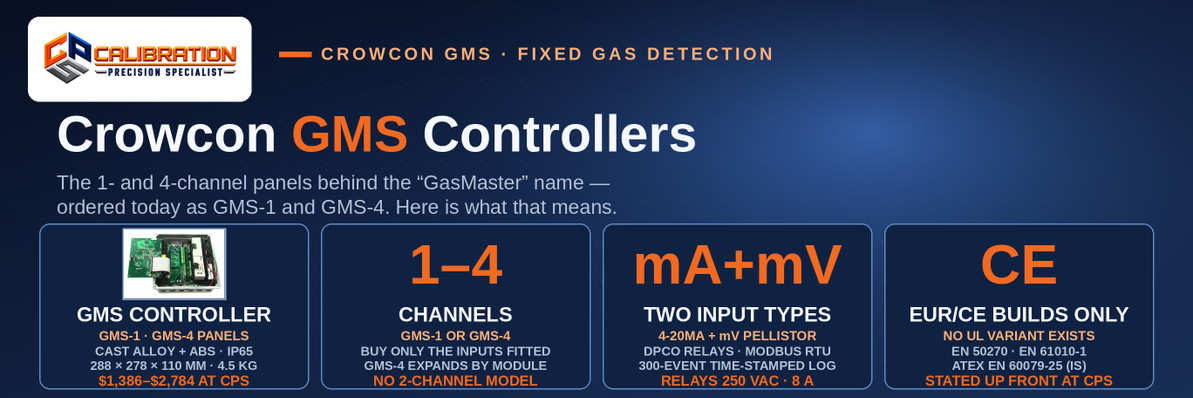
The Crowcon GMS-1 and GMS-4 are the 1- and 4-channel gas detection controllers Crowcon sells today in the class most buyers still search for as "GasMaster" — and the name matters, because Crowcon's current price book contains no complete GasMaster controller at all, only GasMaster spare parts. The panels themselves are ordered as GMS-1 (one channel, six configurations, $1,386–$1,722 at CPS) and GMS-4 (up to four channels, thirty configurations, $1,819–$2,784). Both accept a mix of 4-20mA and mV pellistor detector inputs, carry DPCO alarm relays and RS-485 Modbus RTU communications, and — stated plainly — are European CE builds: no UL variant exists.
If you have a Gasmaster on your wall, or a specification that calls for one, this post explains what the name on the panel means, what you can actually buy today, how the GMS-1 and GMS-4 differ, what the configurations cost, and where the honest limits are.
The Name Problem: "GasMaster" vs. GMS
Crowcon's 1- and 4-channel control panel has been sold for years under the Gasmaster name — Gasmaster 1 for a single detector, Gasmaster 4 for up to four. Manuals, installed panels, and a generation of specifications all use that name, which is why it is still the term everyone searches.
Here is what Crowcon's current (FY27) price book actually contains under that name: no complete controllers. Every GasMaster-named row in the book is a component — an auxiliary power supply (the most expensive, at $1,077), display and terminal PCBs (up to $1,013.52), comms kits and assemblies. Those are spare parts for panels already installed. There is no row you can order that puts a complete 1-, 2-, or 4-channel "GasMaster" controller in a box.
The complete small controllers in the same book are coded differently:
- GMS-1 — the 1-channel panel, six configurations.
- GMS-4 — the 4-channel panel, thirty configurations.
That is not a rebrand to learn for its own sake; it is how you avoid two expensive mistakes. The first is speccing or searching for a product name that resolves only to spare parts. The second is buying a "GasMaster" PCB or PSU from a surplus listing believing it is a controller — it is not; it is one board out of one. If you are replacing or extending an installed Gasmaster, or buying this class of panel new, GMS-1 and GMS-4 are the order codes to work from. (Independent dealers list the same panel the same way — the 4-channel unit's order number is GMS-4.)
How to tell what you have: an installed panel with the Gasmaster nameplate and a single channel display is the 1-channel unit; the four-channel version shows all channels at once. Either way, the GMS-coded units are the current equivalents for parts support, expansion, and like-for-like replacement planning.
What the GMS Panels Are
The GMS panels are wall-mounted gas and fire control panels that sit between your fixed detectors and everything that has to react — beacons, horns, ventilation, shutdown systems, and your plant control system. Both sizes share one platform:
- Enclosure: 288 × 278 × 110 mm (11.3 × 10.9 × 4.3 in), 4.5 kg (10 lb), cast aluminium backbox with a flame-retardant ABS front cover, sealed to IP65 — the panel itself can live in wet areas without a second enclosure.
- Power: 100–240 Vac (50–60 Hz) or 20–30 Vdc, 60 W maximum, with 1.2 Ah internal battery backup fitted as standard, so a mains failure doesn't blind the system.
- Display: a large backlit LCD showing every channel's gas level simultaneously — in ppb, ppm, % volume, or % LEL — with scrolling alphanumeric status, alarm/fault/power/warning LEDs, and an integral 85 dB sounder. Alarm messages can be customised to name the detector or its location. The panel even warns you when a connected detector's calibration is due.
- Operating range: −10 °C to +50 °C (14 °F to 122 °F), 0–95% RH non-condensing.
- Inputs beyond gas: each channel can alternatively serve a fire loop (up to 20 conventional smoke/heat detectors or manual call points), a flame detector (4-20mA or digital contact signal — see our flame detector coverage), or a Crowcon ESU sampling fan. Remote inhibit and remote reset are provided via normally-open contacts.
GMS-1 vs. GMS-4: The Differences That Matter
| GMS-1 | GMS-4 | |
|---|---|---|
| Channels | 1 | 1 to 4 |
| Detector inputs | One 4-20mA detector or one mV pellistor detector (input fit chosen at order) | Up to four detectors, mA and mV inputs mixed in the fit chosen at order |
| Relays | Low alarm, high alarm and fault relays (DPCO, 250 Vac 8 A) | Low and high alarm per channel, plus common low, high and fault relays (DPCO, 250 Vac 8 A) |
| Analogue output | One 4-20mA (or 1-5 Vdc) output | One 4-20mA (or 1-5 Vdc) output per channel |
| Expansion | Fixed — one channel is the whole panel | Modular — buy the input modules you need now, add more later |
| CPS configurations | 6 | 30 |
| CPS price range | $1,386–$1,722 | $1,819–$2,784 |
The decision is mostly arithmetic. One detector, one hazard, one location — a boiler room CO point, a single chlorine head at a water plant — is GMS-1 work, and paying for three empty channels buys you nothing. The moment a second detector is plausible, the GMS-4 is the better buy: its modular inputs mean a two-detector site fits two input modules today and can grow to four without replacing the panel. What the GMS-4 is not is a starting point for a big system — four channels is its ceiling, and Section "The Honest Limits" below covers what to look at instead.
Inputs: Why the mA/mV Mix Is the Whole Configuration
The two digits in the middle of every GMS code are the fitted input counts — how many 4-20mA inputs and how many mV inputs the panel is built with — and choosing them is the one decision that has to be right at order time.
- 4-20mA inputs take standard 2- or 3-wire gas transmitters (sink or source) — the modern default, including Crowcon's Xgard family. The signal carries the reading and fault states down one loop, and the detector does its own signal processing.
- mV inputs take pellistor flammable-gas detector heads directly — simple catalytic heads with no electronics of their own. They cost less per point than a full transmitter, and the panel handles their calibration from its own front panel, so the head doesn't need to be accessed until the sensor itself is replaced (typically years later). Crowcon's pellistor-saver mode even cuts power to an mV head above 95% LEL to protect the sensing element.
Plants with a generation of mV pellistor heads already wired in can keep them and modernise only the panel; plants starting fresh usually go all-mA. The GMS-4's thirty configurations exist precisely because real sites are mixed — one mV legacy head, three mA transmitters, and so on. The price follows the hardware: on the GMS-4, each fitted mV input adds roughly $210 and each mA input roughly $154 over the base build.
Outputs, Relays, and Integration
A controller earns its place by what it can switch and what it can tell the rest of the plant:
- Relays: DPCO contacts rated 250 Vac, 8 A (non-inductive). Alarm relays can be configured rising or falling, latching or non-latching, energised or de-energised, with adjustable hysteresis on low alarms — enough flexibility to drive beacons and horns directly, start ventilation, or feed a shutdown circuit. A dedicated A/V alarm drive output (12 or 24 Vdc, 650 mA max) runs audible/visual devices.
- Analogue: 4-20mA retransmission (current source, 700 Ω max loop) or 1-5 Vdc, per channel on the GMS-4 — your DCS or data logger sees the same reading the panel displays.
- Digital: an RS-485 Modbus RTU serial link (9600 baud) for monitoring and control from DCS, SCADA, or PLC systems.
- Event log: the panel keeps a time-stamped log of up to 300 events — alarms, faults, and system interventions — held in non-volatile memory and uploaded through the communications port using Crowcon's PC software, which also handles reconfiguration. After an incident, that log is the difference between reconstructing events and guessing at them.
The communications fit is the second choice in the order code ("C" vs "Z" in CPS's listings): comms-fitted builds carry the panel's communications option for plant-system connection and PC configuration/event-log upload. If the panel will ever report to a PLC or need its log downloaded, order it fitted — it is a $126 step at build time.
Configurations and Prices at CPS
CPS lists both panels at Crowcon list price, configured by input fit and comms:
- GMS-1 — six configurations, $1,386–$1,722. The base build (no comms) is $1,386. Adding comms is +$126 ($1,512). An mA input fit runs $1,540 (no comms) / $1,666 (comms); the mV input fit runs $1,596 / $1,722.
- GMS-4 — thirty configurations, $1,819–$2,784. The base build is $1,819 ($1,945 with comms). Price climbs with the fitted inputs: a four-mA build is $2,435 / $2,561 with comms, a two-and-two mixed build $2,547 / $2,673, and the top of the range — four mV inputs with comms — is $2,784.
Two things those numbers do not include, because a controller is only the middle of a system: the detectors themselves, and installation. Detector heads are priced separately (Crowcon's fixed heads start in the hundreds per point depending on gas and certification), and CPS designs and installs complete fixed systems — panel, heads, cabling, and commissioning — under our turnkey fixed system installation service.
The Honest Limits
- CE-only certification. Every GMS build in Crowcon's current book is a European (EUR/CE) build, approved to EN 50270 (EMC) and EN 61010-1 (electrical safety), with ATEX EN 60079-25 covering intrinsically safe system combinations. No UL or CSA variant exists. For many US plants a CE panel is acceptable; for others — an AHJ inspection, a corporate spec written around UL — it is a genuine obstacle. We state it up front rather than after the purchase order: if your site requires UL, tell us before ordering and we will point you at the right panel, including non-Crowcon options we install and service.
- Four channels, maximum. The GMS line stops at four detectors. Bigger or more complex systems — more channels, voting logic, rack mounting, flameproof panels — are a different product class; our companion guide to Crowcon Vortex control panels covers Crowcon's step-up range, and CPS will happily quote either.
- The event log needs the PC kit. Log upload and reconfiguration require Crowcon's PC software and the communications port — budget for the comms fit if records matter to you (they should).
- A panel is not a system. The GMS watches detectors; it is not itself a detector. Placement, detector selection per gas, and calibration are what make the installation protect anyone — which is the part CPS does for a living.
A Note on Legacy: Gasmonitor and GM Rack Systems
Older Crowcon installations may run on Gasmonitor or GM-series rack systems — 19-inch rack-based controllers from the generation before the current panel lines, built for larger channel counts with rack-mounted modules. Those systems are legacy platforms now: they are not what a new small installation should be designed around, and their presence in the field is mostly a service-and-spares story. CPS calibrates and services installed fixed systems regardless of controller vintage — if you have a rack system still in service, we can keep its detectors calibrated and talk honestly about when replacement planning makes more sense than another repair.
Calibration and Service From CPS
However a fixed system is controlled, its protection is only as good as the calibration of the detectors feeding it. CPS calibrates fixed gas detection systems — every channel, at the detector, with the panel readings verified against applied gas — and services the Crowcon lines we sell alongside the other major brands. See our calibration services for how ship-in and on-site work runs, or browse the Crowcon brand page for the full line. Questions about whether a GMS fits your application — or what to do about a Gasmaster already on your wall? Call 865-900-8844 or contact us. CPS Calibrations, 109 S. Front Street, Rockwood, TN 37854.
Frequently Asked Questions
Can I still buy a Crowcon GasMaster? Not as a complete controller from Crowcon's current price book. Every GasMaster-named item in the current book is a spare part — power supplies, display and terminal PCBs, comms kits — for panels already installed. The complete 1- and 4-channel controllers in that class are ordered today as GMS-1 and GMS-4. If a seller offers you a "GasMaster" at a controller price, check exactly what the box contains before you pay for it.
What is the difference between the Crowcon GMS-1 and GMS-4? Channels and everything that follows from them. The GMS-1 monitors a single detector with low, high, and fault relays and one analogue output. The GMS-4 monitors up to four detectors — with the mA/mV input mix chosen at order — provides low and high alarm relays per channel plus common relays, an analogue output per channel, and modular inputs you can expand later. GMS-1 configurations run $1,386–$1,722 at CPS; GMS-4 configurations run $1,819–$2,784.
How much does a Crowcon GMS controller cost? At CPS, the GMS-1 runs $1,386–$1,722 across six configurations and the GMS-4 runs $1,819–$2,784 across thirty. The price is set by the fitted input modules (each mV input adds roughly $210, each 4-20mA input roughly $154 on the GMS-4) and by the communications option (+$126). Detectors and installation are separate.
Is the Crowcon GMS UL listed? No. Every GMS build in Crowcon's current book is a European CE build (EN 50270 EMC, EN 61010-1 electrical safety; ATEX EN 60079-25 for intrinsically safe system combinations), and no UL or CSA variant exists. If your authority having jurisdiction or your company specification requires UL, raise it before ordering — CPS will tell you straight whether the GMS works for your site or which panel to use instead.
What detectors can I connect to a Crowcon GMS panel? Any 2- or 3-wire 4-20mA gas detector (sink or source) — including Crowcon's Xgard transmitters — and direct mV pellistor flammable-gas heads, in the input mix the panel was built with. Channels can alternatively serve fire loops of up to 20 conventional smoke/heat detectors or call points, a flame detector, or a Crowcon ESU sampling fan.
Does the Crowcon GMS have Modbus output? Yes — the platform provides an RS-485 Modbus RTU serial link (9600 baud) for monitoring and control from DCS, SCADA, and PLC systems. CPS's comms-fitted GMS builds (the "C" configurations, +$126) carry the communications option, which also enables PC configuration and event-log upload. If integration matters, order the comms fit at build time.
Is there a 2-channel Crowcon GMS controller? No — Crowcon builds this panel in 1-channel (GMS-1) and 4-channel (GMS-4) sizes only, and there is no 2-channel model in the current book. For two detectors, the answer is a GMS-4 fitted with two input modules; its modular design lets you add the third and fourth channels later without replacing the panel.
How many relays does the Crowcon GMS-4 have? Low and high alarm relays for each of the four channels, plus common low, high, and fault relays — all DPCO contacts rated 250 Vac 8 A, configurable as rising or falling, latching or non-latching. The GMS-1 provides low alarm, high alarm, and fault relays. Both sizes also carry a 12/24 Vdc, 650 mA audible/visual alarm drive output.
Does the Crowcon GMS log alarm events? Yes. The panel keeps a time-stamped log of up to 300 events — alarms, faults, and system interventions — in non-volatile memory. Uploading the log (and reconfiguring the panel) is done with Crowcon's PC software through the communications port, so specify the comms-fitted build if you want that record.
What if I need more than four channels on a Crowcon controller? You've outgrown the GMS class. Crowcon's step up is the Vortex range — configurable multi-channel panels (including flameproof versions) for larger and more complex systems, covered in our Vortex guide. Tell CPS your detector count and gases and we'll quote the right panel rather than the nearest one.
The Bottom Line
"GasMaster" is the name on the installed base and in everyone's search bar — but the controllers Crowcon sells in that class today are the GMS-1 ($1,386–$1,722) and GMS-4 ($1,819–$2,784): honest, well-proven 1- and 4-channel panels with mixed mA/mV inputs, real relay capacity, Modbus integration, and a 300-event log. Buy the input mix your detectors actually need, take the comms fit, and go in knowing the one real limitation — these are CE builds with no UL variant. CPS sells, installs, and calibrates them: 865-900-8844, 109 S. Front Street, Rockwood, TN 37854.
Need a calibration you can file?
In-house calibration at CPS in Rockwood, Tennessee — $55 for single-gas instruments, $90 for 4- and 5-gas — every channel, as-found and as-left data, full certificate.
See Calibration Servicesor call 865-900-8844
Recent Posts
-

Can You Add a Pump to a SENKO SGT-P or MGT?
Yes — SENKO's SP-Pump101 external sampling pump ($330, part AAA006000) fits the SGT, SGT-P, and MGT, …Nov 12th 2026 -

What Refrigerant Detection Does a Grocery Store Need?
A grocery store needs refrigerant detection in three places: low-mounted carbon dioxide (R-744) sens …Nov 11th 2026 -

What Is LEL and UEL? The Explosive Range, Gas by Gas
The LEL is the lowest concentration of a gas in air that can explode, and the UEL is the highest: me …Nov 10th 2026