
RKI Beacon Controllers: 110, 200, 410A, and 800 — How Many Channels Do You Need?
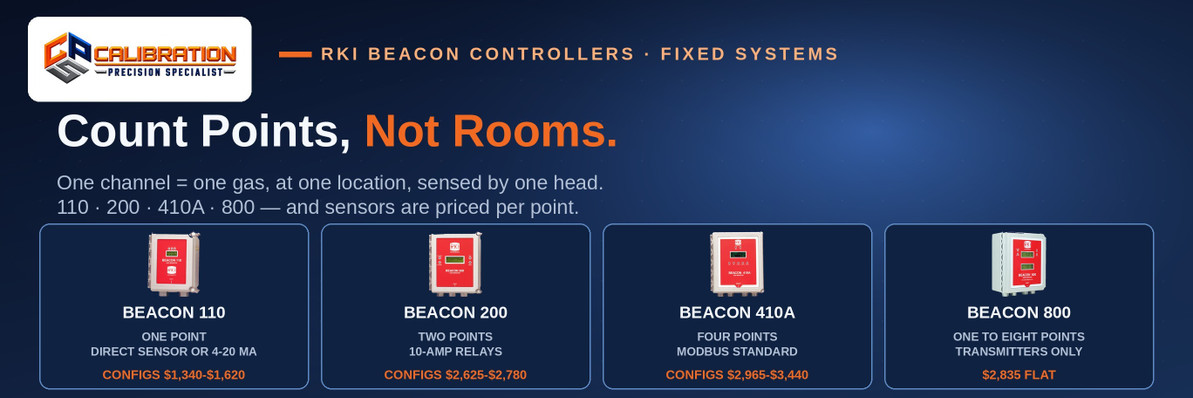
Count detection points, not rooms: one channel is one gas sensed at one location by one head. The RKI Beacon 110 runs 1 point (listed at $1,275; configured builds $1,340–$1,620), the Beacon 200 runs 2 (listed at $2,500; configured $2,625–$2,780), the Beacon 410A runs 4 (listed at $2,825; configured $2,965–$3,440), and the Beacon 800 runs anywhere from 1 to 8 transmitter points for $2,835 — and every price is the controller only, with sensors priced per point on top.
Every fixed gas detection system starts with the same arithmetic problem. The detector heads go where the gas is; the controller is the wall-mounted brain that displays every reading in one place, sounds the alarm, and throws the relays that start ventilation or shut a process down. RKI's Beacon line is that brain at four scales. Pick too few channels and a future point means a second controller; pick the wrong model and you can strand yourself on inputs — because channel count is only the first of the three questions that decide this purchase. This post works the count first, then the two questions behind it.
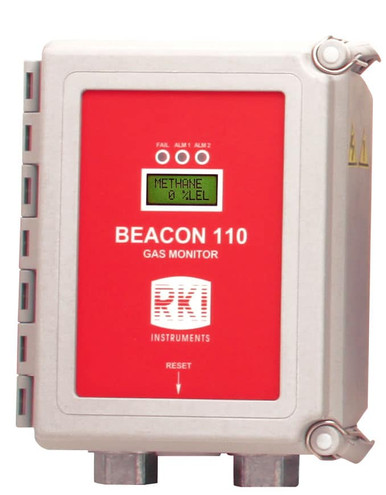
RKI Beacon 110 Controller for Fixed Gas Detection Systems
How many channels does your fixed gas detection system need? One per point: Beacon 110 (1 point, listed $1,275), Beacon 200 (2, $2,500), Beacon 410A (4, $2,825, Modbus standard), Beacon 800 (1–8 transmitter points, $2,835) — inputs, relays, and why sensors are a separate per-point cost.
$1,340–$1,620 configured
See the Beacon 110How Do You Count the Channels a System Needs?
One channel equals one point: one gas, at one location, sensed by one head. RKI's fixed heads are single-gas devices, so the count follows the hazards, not the floor plan:
- One room can be several points. A wastewater lift station that needs hydrogen sulfide inside the wet well and combustibles at the hatch is two points — two gases, two heads, two channels — in a single structure.
- One gas can be several points. Two combustible heads at opposite ends of a warehouse are two points, because each head reports its own location's air.
- Four gases in one room are four points. LEL, oxygen, CO, and H2S over one process is a four-channel job even though everything hangs on the same wall.
Write the point list first — gas, location, head type — and the channel count falls out of it. Where the heads themselves should mount is its own discipline; the controller decision starts once the points are settled.
The Beacon Lineup at a Glance
All four controllers are microprocessor-based, wall-mount units in NEMA 4X weather-tight enclosures, and all four are controller only — RKI sells the sensing side separately, and every configuration name on the listings says so ("no sensor"). Budget the heads per point on top of these prices.
- Beacon 110 — 1 channel. Listed at $1,275; configured builds run $1,340–$1,620 depending on battery charger, strobe, and horn options. Accepts RKI direct-connect sensors for LEL, oxygen, H2S, or CO, or any 4–20 mA transmitter (2- or 3-wire, 24 VDC). Three relays rated 10 amps — strong enough to power external alarms and horns directly — and a digital display with simultaneous readout of gas type and concentration.
- Beacon 200 — 2 channels. Listed at $2,500; configured builds run $2,625–$2,780, including hydrogen-specific versions at $2,730 for battery-room H2 duty. Same input flexibility as the 110 — direct-connect RKI sensors (LEL, O2, H2S, CO) or any 4–20 mA transmitter — with 10-amp relays that actuate most external alarms and horns without slave relays.
- Beacon 410A — 4 channels. Listed at $2,825; configured builds run $2,965–$3,440. Displays gas type, readings, and status for all four channels simultaneously; each channel carries up to three fully configurable alarm points, two dedicated relays per channel plus a common relay bank, a 4–20 mA output per channel, and a standard Modbus interface for remote data logging. Its direct-connect menu is the widest in the line — LEL, O2, CO2, and toxic sensors — alongside any 4–20 mA transmitter.
- RKI Beacon 800 — 1 to 8 channels. $2,835. Two large digital displays identify gas type and concentration for all eight channels simultaneously. The trade: the 800 accepts 4–20 mA transmitters only — direct-connect sensors are not compatible with it. It runs on 24 VDC or 85–264 VAC and ships with a wall-mount installation kit.
The oddity in that list is real: the eight-channel 800 costs $10 more than the four-channel 410A at list. Channel count alone would make the 800 the automatic buy — which is exactly why the next two questions matter more than the count.
What Kind of Heads Are You Wiring to It?
This is the input decision that splits the family. Direct-connect sensors are sensing heads without their own transmitter electronics: the sensor wires straight to the controller, the controller does the amplifying, and calibration adjustments for that head are made at the controller. They are the economical way to build a point. 4–20 mA transmitters carry their own electronics at the head — RKI's M2A-XL stand-alone transmitter is the typical example, and the type covers heads a plain sensor cannot be, including sample-draw transmitters like the GD-70D ($1,595), which pulls a sample to the sensor for points a diffusion head cannot sit in.
The hard line: the Beacon 800 takes transmitters only. If your existing points are direct-connect heads, an 800 is not a controller swap — it is a controller plus a new transmitter at every point. The 110, 200, and 410A take either input, channel by channel, so a system can mix a direct-connect LEL head on one channel with a transmitter on the next. Our companion post on how to choose a gas detection controller works this input/output decision in full.
What Has to Happen When It Alarms?
A controller earns its keep in the seconds after a reading crosses a setpoint. The 110 and 200 carry 10-amp relays — enough to drive horns, strobes, and fan starters directly. The 410A is the records model: up to three alarm points per channel, a 4–20 mA output per channel for a PLC or recorder, and standard Modbus so readings can be logged centrally instead of living only on the controller's screen. The 800 shows all eight channels at once on two displays, which is the visibility a multi-point transmitter floor needs. If the readings have to live inside plant control — trended, audited, interlocked — that output list, not the channel count, is what separates a 410A from an 800.
Will the System Grow?
The 110, 200, and 410A are fixed counts: a 200 with a third point in its future is a 200 plus a second controller later. If a third point is plausible, price the step up now. The 800 is the flexible chassis — it runs anywhere from one to eight transmitter points, so a system can start at three and grow to eight in the same box, as long as every head is a transmitter. And when a job outgrows eight wired points entirely — or the points cannot be wired at all — the architecture changes: RKI's AirLink wireless platform runs on Beacon-style controllers without the cable runs, and CPS's fixed systems range covers the larger counts.
Calibration is part of the count, too. Every channel is a sensor that drifts, and a controller faithfully displaying a drifted head's reading is worse than no display at all. We calibrate every channel on the systems above through calibration services — and fixed systems are serviced on site, quoted in writing, because the heads do not come to the bench.
Frequently Asked Questions
How many channels does my gas detection system need?
One channel per detection point, where a point is one gas sensed at one location by one head. One room with four gases to watch is four points; one gas watched at two locations is two points. Write the point list — gas, location, head type — before choosing a controller, because the count falls out of that list: 1 point fits the Beacon 110, 2 fit the Beacon 200, up to 4 fit the Beacon 410A, and 1–8 transmitter points fit the Beacon 800.
What is the difference between the RKI Beacon 110, 200, 410A, and 800?
Channel count first: the 110 runs one point, the 200 two, the 410A four, and the 800 one to eight. Inputs second: the 110, 200, and 410A accept RKI direct-connect sensors as well as any 4–20 mA transmitter, while the 800 accepts transmitters only. Outputs third: the 410A adds a 4–20 mA output per channel and standard Modbus logging, and the 110 and 200 carry 10-amp relays that drive horns and alarms directly.
How much does an RKI Beacon controller cost?
At live CPS list prices: the Beacon 110 is listed at $1,275 with configured builds at $1,340–$1,620; the Beacon 200 is listed at $2,500 with configurations at $2,625–$2,780; the Beacon 410A is listed at $2,825 with configurations at $2,965–$3,440; and the Beacon 800 is $2,835. Every figure is the controller only — sensors and transmitters are priced separately, per point.
Does a Beacon controller include the sensors?
No. Every configuration of every Beacon is the controller only — the listings state "no sensor" in the configuration names. The sensing side is bought per point: direct-connect sensors are the economical heads for the 110, 200, and 410A, and 4–20 mA transmitters such as the M2A-XL (listed at $1,270–$1,320 depending on housing) serve any model in the line, and are the only input the Beacon 800 accepts.
Can a Beacon controller accept other brands' transmitters?
Yes, on the transmitter side. All four Beacons accept any standard 4–20 mA transmitter — 2- or 3-wire, 24 VDC — regardless of brand, which makes transmitters the natural choice when a system mixes head types or replaces one brand's heads over time. Direct-connect inputs are the exception: those channels are built for RKI's own direct-connect sensors.
Why does the 8-channel Beacon 800 cost about the same as the 4-channel 410A?
Because they are built for different jobs, and the live list prices show it: the Beacon 800 is $2,835 and the Beacon 410A is listed at $2,825. The 800 gives you up to eight transmitter-only channels with all eight readings displayed at once. The 410A gives you four channels that also accept direct-connect sensors, up to three alarm points per channel, a 4–20 mA output per channel, and standard Modbus. Buy the outputs and inputs your system needs, not the channel count alone.
What is a direct-connect sensor?
A sensing head without its own transmitter electronics. The sensor wires straight to the controller, the controller amplifies and reads the signal, and calibration adjustments for that head are made at the controller. Direct-connect sensors are the economical way to build a point, and the Beacon 110, 200, and 410A accept them — LEL, oxygen, CO, and H2S on the 110 and 200, widening to CO2 and more toxics on the 410A. The Beacon 800 does not accept them at all.
Can one Beacon controller watch two buildings?
It can, but every point is a cable run home to the controller, so distance and routing become part of the design. Two points in two separate buildings are often better served by two small controllers — a Beacon 110 or 200 in each — than by one large controller with two long runs. Where cable runs are impractical altogether, wireless transmitters on RKI's AirLink platform report to a central controller without the wire.
Do Beacon controllers talk to a PLC or SCADA system?
The Beacon 410A is the model built for it: a 4–20 mA output per channel plus a standard Modbus interface for remote logging. The 110 and 200 output a 4–20 mA signal proportional to the reading for a recorder or PLC input. A dedicated controller and a PLC often pair rather than compete — the Beacon keeps local display, alarm, and relay duties while the plant system reads and trends its channels.
How often do Beacon system sensors need calibration?
On the interval each head's manufacturer specifies — the heads, not the controller, set the schedule, and LEL, oxygen, and toxic sensors do not share one honest number. Every channel drifts independently, so a four-channel system is four calibration obligations. Keep every point on a written schedule with as-found and as-left readings documented; CPS calibrates fixed systems on site under a written quote.
The Bottom Line
Count points, not rooms — one gas at one location is one channel. One point is a Beacon 110, two a Beacon 200, four with records and Modbus a Beacon 410A, and up to eight transmitter points a Beacon 800 — and on every model, the sensors are a separate per-point line item.
Counting points for a fixed system? Call CPS Calibrations at 865-900-8844 — controllers, heads, installation, and calibration, backed by the CPS Calibration Program, from Rockwood, Tennessee.
CPS Calibrations · 109 S. Front Street, Rockwood, TN 37854 · Calibration Services · The CPS Calibration Program
Need a calibration you can file?
In-house calibration at CPS in Rockwood, Tennessee — $55 for single-gas instruments, $90 for 4- and 5-gas — every channel, as-found and as-left data, full certificate.
See Calibration Servicesor call 865-900-8844
Recent Posts
-

Can You Add a Pump to a SENKO SGT-P or MGT?
Yes — SENKO's SP-Pump101 external sampling pump ($330, part AAA006000) fits the SGT, SGT-P, and MGT, …Nov 12th 2026 -

What Refrigerant Detection Does a Grocery Store Need?
A grocery store needs refrigerant detection in three places: low-mounted carbon dioxide (R-744) sens …Nov 11th 2026 -

What Is LEL and UEL? The Explosive Range, Gas by Gas
The LEL is the lowest concentration of a gas in air that can explode, and the UEL is the highest: me …Nov 10th 2026