
RKI AirLink: Wireless Gas Detection on the Beacon Platform
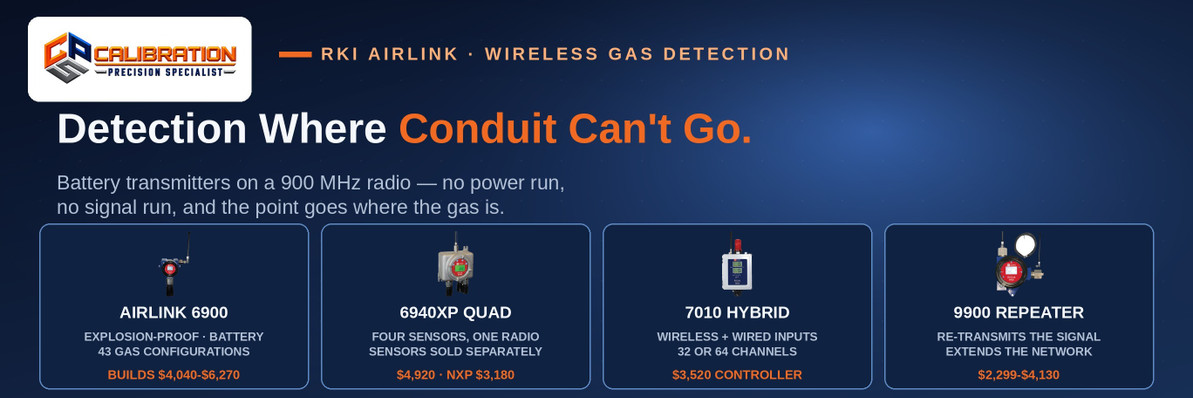
RKI AirLink is the wireless branch of RKI's fixed gas detection family: battery-powered transmitters — the explosion-proof AirLink 6900 ($4,246 as configured for common gases; builds run $4,040–$6,270) and the four-sensor AirLink 6940XP quad ($4,920) — report by 900 MHz radio to AirLink controllers, the hybrid 7010 ($3,520; 32 or 64 channels, wireless and wired) and the 32-channel 7032 ($5,270–$5,810), with 9900 signal repeaters ($2,299–$4,130) extending the network where walls and distance eat the signal.
Every wired fixed system carries a hidden line item: the wire. Conduit, trenching, penetrations, and electrician hours routinely cost more than the detectors, and some points — across a roadway, inside a finished building, on a structure that cannot be shut down — cannot be wired at any reasonable price. AirLink removes the signal and power run from the point: the transmitter is battery-powered and talks by radio, so a detection point goes where the gas is, not where the conduit can reach. This post maps the family — transmitters, quads, controllers, repeaters — with live pricing, and the honest limits that decide when wireless wins and when wire still rules.
RKI AirLink 6900 Wireless Gas Transmitter
RKI AirLink brings fixed gas detection where conduit can't go: battery-powered 900 MHz transmitters (6900 from $4,040, 6940XP quad $4,920), the hybrid 7010 controller ($3,520, 32/64 channels, wired + wireless) and 32-channel 7032 ($5,270–$5,810), plus 9900 repeaters — the full family, priced live, with when wireless wins and when wire still rules.
$4,040–$6,270 configured
See the AirLink 6900 WirelessThe Transmitters: Points Without Wire
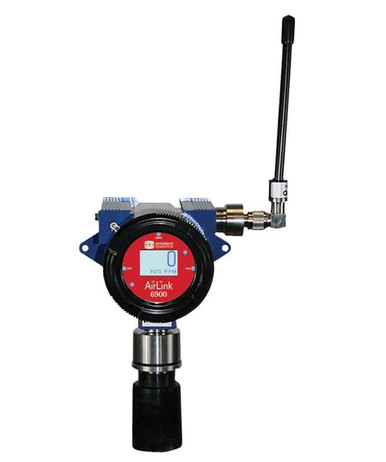
- AirLink 6900 — the explosion-proof single-gas transmitter. Dual battery powered, with a 900 MHz radio, built to mount where wiring cannot go. Forty-three configurations cover the gas list: CO, oxygen, H2S in ranges to 2,000 ppm, ammonia, chlorine, hydrogen chloride, hydrogen cyanide, phosphine, combustibles by catalytic and infrared sensors, CO2, and PID VOC builds. Common-gas configurations price at $4,246; the full range runs $4,040–$6,270 by sensor.
- AirLink T3A — the wireless sensor/transmitter. The same gas breadth in the T3A form factor: base configurations at $4,136, running to $5,126 for the specialty toxics (phosphine at the top of the range).
- AirLink Alert — the entry transmitter. Configurations from $1,975 to $4,510 — the lowest-cost way onto the AirLink network for the gases its menu covers.
- AirLink 6940XP and 6940NXP — the quads. One unit monitors up to four sensor assemblies (sold separately) and transmits all four channels wirelessly: $4,920 for the explosion-proof XP, $3,180 for the NXP. A quad is how a four-gas location — the lift-station pattern of LEL, O2, CO, and H2S — goes wireless as one installation instead of four.
- AirLink VOC Pro — the PID transmitter, for wireless VOC points, configured builds $5,478–$6,369.
The Controllers: Where the Radios Report
Wireless points still need a brain — somewhere the readings display, the alarms are decided, and the relays live. AirLink offers two, and the difference is whether wired points join the same panel:
- AirLink 7010 hybrid controller — $3,520. Receives AirLink wireless transmitters and wired inputs on 32 or 64 channels. The hybrid is the bridge product: an existing wired system can grow wireless points onto the same controller instead of running a second panel — the Beacon-platform idea, extended past the reach of cable.
- AirLink 7032 controller — $5,270–$5,810 by configuration. A 32-channel wireless controller with full alarm and relay handling for a complete wireless system — the panel for a facility designed wireless from the start.
Around them sits the support cast: the 9850 digital interface (configurations $2,772–$5,500) for getting AirLink data into other systems, the 7530 relay module ($2,770–$5,335) for relay capacity out in the network, the 5900/5950 converter ($1,386–$2,222) for bringing switch states and existing signals onto the radio network, and the 9100 signal strength meter ($1,620) — the survey tool that proves a radio path before anyone mounts hardware on it.
What Does a Repeater Do?
Radio obeys physics, not floor plans. Steel structures, distance, and terrain attenuate a 900 MHz signal, and a transmitter that cannot reach the controller is a point that does not exist. The AirLink 9900 signal repeater ($2,299–$4,130 by radio band and power type) re-transmits signals between transmitters and the controller, extending the network around corners and across yards. Repeaters are why a site survey — with the 9100 meter, before installation — is part of a serious wireless design: the network is engineered, not hoped for. CPS lays out and proves systems like this under fixed system installation.
When Does Wireless Win — and When Does Wire?
Wireless wins where the run is the problem: points across roads, rail, or water; finished or historic interiors; temporary or phased construction; structures where hot-work permits and shutdowns make conduit installation the most expensive week of the project. Battery transmitters also relocate — a point that moves with the process keeps its detection.
Wire still wins where it is cheap and permanent: new construction with open walls, dense clusters of points in one room (a quad of wired heads on a Beacon controller costs less per point than four radios), and anywhere a facility simply prefers powered, wired infrastructure with no batteries to manage. The honest comparison is installed cost per point — hardware plus installation — and on many sites the hybrid answer wins: wired where wire is easy, AirLink where it is not, both reporting to one 7010. The full decision framework is in how to choose a gas detection controller.
Wireless does not exempt a point from calibration. A battery transmitter's sensor drifts exactly like a wired head's, and its alarm is only as true as its last proof. We calibrate every channel on AirLink systems the same as wired ones — the radio changes the wiring, never the standard.
Frequently Asked Questions
What is RKI AirLink?
RKI's wireless fixed gas detection platform: battery-powered transmitters (the explosion-proof AirLink 6900, the T3A, the AirLink Alert, the four-sensor 6940XP/NXP quads, and the VOC Pro PID) that report by 900 MHz radio to AirLink controllers — the hybrid 7010 (32 or 64 channels, wireless plus wired inputs) and the 32-channel 7032 — with 9900 repeaters extending the network. It is the wireless branch of the same fixed-detection family the wired Beacon controllers anchor.
How much does an AirLink wireless gas detection system cost?
At live CPS list prices: AirLink 6900 transmitters run $4,040–$6,270 by gas ($4,246 for common-gas configurations); the T3A runs $4,136–$5,126; the AirLink Alert $1,975–$4,510; the 6940XP quad is $4,920 and the 6940NXP $3,180; the 7010 hybrid controller is $3,520; the 7032 controller is $5,270–$5,810; and 9900 repeaters run $2,299–$4,130. Compare installed cost per point — wireless hardware costs more than wired heads, and saves the conduit and electrician hours a wired point needs.
Do AirLink transmitters need power wiring?
The flagship 6900 is dual battery powered — no power run and no signal run to the point, which is what lets it mount where wiring cannot go. Controllers and repeaters are powered equipment at their own locations, and repeaters are ordered by power type. The battery design moves the maintenance obligation rather than removing it: batteries become a scheduled item, like calibration.
How many sensors can one AirLink transmitter handle?
One gas per standard transmitter — the 6900, T3A, and Alert are single-gas points. For multi-gas locations, the 6940XP and 6940NXP quads each monitor up to four sensor assemblies (sold separately) and transmit all four channels wirelessly from one unit: $4,920 explosion-proof, $3,180 non-explosion-proof.
What is the difference between the AirLink 7010 and 7032 controllers?
The 7010 ($3,520) is the hybrid: it takes AirLink wireless transmitters and wired inputs together, on 32 or 64 channels — the bridge for growing wireless points onto an existing wired system. The 7032 ($5,270–$5,810) is the 32-channel wireless controller with full alarm and relay handling, built for a system designed wireless from the start.
How far can AirLink wireless signals reach?
It depends on the site — steel, distance, and terrain all attenuate the 900 MHz radio, and no honest answer is a single number of feet. That is why the platform includes the 9900 signal repeater, which re-transmits signals between transmitters and the controller to extend the network, and the 9100 signal strength meter ($1,620), which surveys and proves a radio path before hardware is mounted. A wireless system is designed from a site survey, not from a range figure.
Can AirLink mix with wired Beacon controllers?
Yes — that is the 7010 hybrid controller's job: wireless transmitters and wired inputs on one 32- or 64-channel panel. A facility can wire the points where wire is easy, put AirLink radios where conduit cannot go, and run both from one controller. The wired side of that decision — Beacon 110 through 800 — is covered in the Beacon controller guide on this site.
What gases can AirLink transmitters detect?
The configuration lists cover the fixed-detection staples and well beyond: carbon monoxide, oxygen, hydrogen sulfide (ranges to 2,000 ppm), ammonia, chlorine, hydrogen chloride, hydrogen cyanide, nitrogen dioxide, sulfur dioxide, ozone, formaldehyde, hydrogen fluoride, phosphine, ethylene oxide, arsine, combustibles by catalytic and infrared sensors, carbon dioxide, hydrogen, and VOCs by PID. Each transmitter is configured for one gas and range when ordered.
Do wireless gas detectors need calibration?
Yes — on the same discipline as wired heads. The radio link does not change the sensor, and the sensor is what drifts. Every AirLink channel needs scheduled calibration with as-found and as-left readings documented, exactly like a Beacon point; CPS calibrates fixed systems on site under a written quote, wireless systems included.
When is wireless gas detection the wrong choice?
When wire is cheap: new construction with open walls, or several points clustered in one room, where wired heads on a Beacon controller cost less per installed point and carry no batteries to manage. Wireless earns its price where installation is the obstacle — crossings, finished interiors, shutdown-bound structures, and points that may move. Price both ways as installed cost per point before deciding.
The Bottom Line
AirLink puts RKI fixed detection where conduit cannot go: battery transmitters from $1,975, quads that carry four sensors on one radio, hybrid and wireless controllers at $3,520 and $5,270–$5,810, and repeaters to engineer the network around the building. Wireless changes the wiring — never the calibration standard.
Designing a wireless or hybrid fixed system? Call CPS Calibrations at 865-900-8844 — site survey, installation, and calibration, backed by the CPS Calibration Program, from Rockwood, Tennessee.
CPS Calibrations · 109 S. Front Street, Rockwood, TN 37854 · Calibration Services · The CPS Calibration Program
Need a calibration you can file?
In-house calibration at CPS in Rockwood, Tennessee — $55 for single-gas instruments, $90 for 4- and 5-gas — every channel, as-found and as-left data, full certificate.
See Calibration Servicesor call 865-900-8844
Recent Posts
-

Can You Add a Pump to a SENKO SGT-P or MGT?
Yes — SENKO's SP-Pump101 external sampling pump ($330, part AAA006000) fits the SGT, SGT-P, and MGT, …Nov 12th 2026 -

What Refrigerant Detection Does a Grocery Store Need?
A grocery store needs refrigerant detection in three places: low-mounted carbon dioxide (R-744) sens …Nov 11th 2026 -

What Is LEL and UEL? The Explosive Range, Gas by Gas
The LEL is the lowest concentration of a gas in air that can explode, and the UEL is the highest: me …Nov 10th 2026