
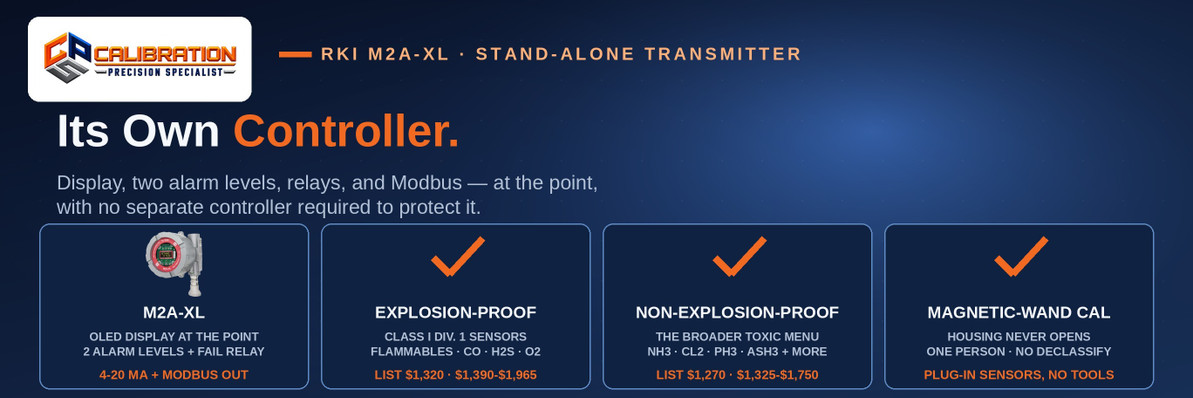
RKI M2A-XL: The Stand-Alone Transmitter That Is Its Own Controller
The RKI M2A-XL is a gas transmitter that does not need a controller to protect a point: it carries its own OLED display, two alarm levels with relays plus a fail relay, and both 4–20 mA and Modbus outputs, so one point can alarm, act, and report on its own — listed at $1,320 in an explosion-proof housing (configured builds $1,390–$1,965 by sensor) and $1,270 in a non-explosion-proof housing (configured $1,325–$1,750).
Most fixed gas detection is sold as a pair: a head that senses, and a controller somewhere else that decides. The M2A-XL collapses the pair into one housing at the point itself. It senses the gas, displays the reading through its front window, sounds its own alarm levels through its own relays, and — when a plant system wants the data anyway — still hands over a standard 4–20 mA signal and a Modbus output. For a single point, or a point far from the controller wall, that changes both the parts list and the wiring bill. This post covers what "stand-alone" actually buys, the two housings, and the sensor menu the price hangs on.
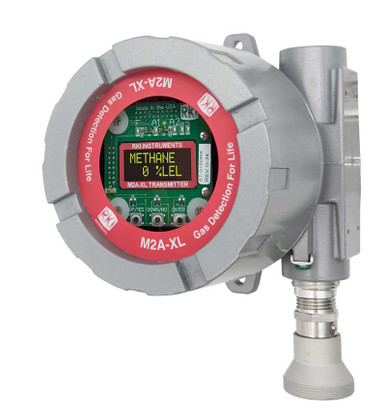
RKI M2A-XL Explosion Proof Housing Stand Alone Transmitter
The RKI M2A-XL needs no controller: its own OLED display, two alarm levels with relays, a fail relay, and 4–20 mA + Modbus outputs protect a point on their own. Explosion-proof listed at $1,320 (configured $1,390–$1,965), non-explosion-proof at $1,270 (configured $1,325–$1,750) — housings, sensor menus, and magnetic-wand calibration explained.
$1,390–$1,965 configured
See the M2A-XL Explosion ProofWhat Makes the M2A-XL Stand-Alone?
Everything a controller would have done for one point, done at the point:
- Its own display. An OLED display shows the gas concentration through the front window, with alarm and status lights beside it — a reading you can check standing at the unit, not back at a panel.
- Its own alarms. Two levels of alarms with relays, plus a fail alarm with its own relay — so the unit can drive a horn, a strobe, or a fan starter at the point, and announce its own faults instead of going silently dark.
- Its own outputs. A 4–20 mA analog output and a Modbus digital output, so the same unit that protects a point alone today can feed a controller, PLC, or DCS tomorrow — it operates as an independent, stand-alone monitor or as part of an integrated system.
That is the whole idea: the stand-alone capability is not a lesser mode. The relays and outputs are the same ones a system would use; they are simply all in the box at the sensing point.
Explosion-Proof or Non-Explosion-Proof Housing?
The M2A-XL comes in two housings, and the choice is the classified-area question for the location it will guard:
- M2A-XL, explosion-proof housing — listed at $1,320; configured builds $1,390–$1,965. The sensor construction is rated Class I, Division 1, Groups B, C, and D for flammables, CO, H2S, O2, and CO2, and Class I, Division 2 for all other toxics. Its menu runs to 19 configurations: catalytic LEL, methane in ppm and %LEL, hydrogen-specific LEL, oxygen, CO, H2S, HCN, and infrared methane, hydrocarbon, and CO2 sensors.
- M2A-XL, non-explosion-proof housing — listed at $1,270; configured builds $1,325–$1,750. The wider toxic menu: 25 configurations, adding the CT-7 style toxic sensors — ammonia to 500 ppm, chlorine, chlorine dioxide, nitrogen dioxide, sulfur dioxide — and ESM-01 style sensors for arsine, phosphine, and more, alongside oxygen, CO, H2S, and infrared CO2.
The $50 list difference is not the decision; the area classification and the gas list are. A classified location takes the explosion-proof build. An unclassified room watching a toxic the XP menu does not carry takes the non-XP build — its sensor list is the broader one.
How Do You Calibrate a Transmitter Without Opening It?
With a magnetic wand, from outside the housing. The M2A-XL's setup runs through push buttons and OLED menus, and routine zeroing and calibration are non-intrusive: the housing does not need to be opened, which means the area does not need to be declassified for routine maintenance, and a complete field calibration can be performed by one person. An automatic zero-drift correction feature holds readings more stable between calibrations and reduces adjustments caused by sensor aging. When a toxic sensor does reach end of life, the electrochemical sensors are plug-in style — field-replaceable with no tools required.
That maintenance shape is a large part of what a stand-alone point costs to own. A point that alarms locally still needs its sensor proved on schedule — we calibrate every channel on transmitters like this one, and fixed points are serviced on site under a written quote; see calibration services and our fixed system installation work for how a point gets placed and proven.
When Do You Still Want a Controller?
Stand-alone is the right shape for one point, or for points scattered too far apart for home-run wiring to one panel. A controller earns its place when several points need one display wall, one alarm logic, and one place to check the whole system — the job the Beacon controllers do at one to eight channels, and the decision our controller selection guide works through. The M2A-XL sits comfortably in both worlds: its 4–20 mA and Modbus outputs feed any Beacon channel or plant system, so a point that starts stand-alone is never stranded when the system grows.
Frequently Asked Questions
What is the RKI M2A-XL?
A stand-alone gas transmitter: a fixed detector head with its own OLED display, two alarm levels with relays, a fail relay, and 4–20 mA plus Modbus outputs, all in one housing at the sensing point. It can protect a single point entirely on its own — sensing, displaying, alarming, and switching relays — or feed its signals to a controller, PLC, or DCS as part of a larger system.
How much does the RKI M2A-XL cost?
At live CPS list prices: $1,320 listed for the explosion-proof housing, with configured builds at $1,390–$1,965 depending on the sensor chosen, and $1,270 listed for the non-explosion-proof housing, with configured builds at $1,325–$1,750. The sensor drives the spread — a catalytic LEL build prices differently from an infrared CO2 or a specialty toxic build.
What is the difference between the explosion-proof and non-explosion-proof M2A-XL?
The housing rating and the sensor menu. The explosion-proof build (listed $1,320) carries sensor construction rated Class I, Division 1, Groups B, C, and D for flammables, CO, H2S, O2, and CO2, with Division 2 for other toxics, across 19 configurations. The non-explosion-proof build (listed $1,270) offers 25 configurations and the broader toxic list — ammonia, chlorine, chlorine dioxide, nitrogen dioxide, sulfur dioxide, arsine, phosphine, and more. Choose by the location's area classification and the gas you need to sense.
Does a stand-alone transmitter need a controller?
No — that is the point of the design. The M2A-XL displays its own reading, runs two alarm levels with relays plus a fail relay, and can drive local horns, strobes, or ventilation directly. A controller becomes necessary when multiple points need one central display and shared alarm handling, and the M2A-XL's 4–20 mA and Modbus outputs let it join such a system at any time.
What gases can the M2A-XL detect?
Combustibles (catalytic LEL and methane, including hydrogen-specific and infrared versions), oxygen 0–25%, carbon monoxide 0–300 ppm, hydrogen sulfide 0–100 ppm, carbon dioxide by infrared (ppm ranges up to percent-volume ranges), and a long toxic list on the non-explosion-proof build: ammonia, chlorine, chlorine dioxide, nitrogen dioxide, sulfur dioxide, hydrogen cyanide, arsine, and phosphine. Each unit is built around one sensor — one M2A-XL watches one gas at one point.
How is the M2A-XL calibrated?
Non-intrusively, with a magnetic wand, through OLED menus — the housing is not opened for zeroing or calibration, so the area does not have to be declassified for routine maintenance, and one person can perform a complete field calibration. The unit also applies automatic zero-drift correction between calibrations, which keeps readings more stable as the sensor ages.
Can the M2A-XL connect to a PLC or SCADA system?
Yes. It provides a 4–20 mA analog output and a Modbus digital output in addition to its relay outputs, and connects to virtually any controller, PLC, or DCS. That is what makes it a safe starting point: a point installed stand-alone today reports into plant systems tomorrow without replacing the head.
What relays does the M2A-XL have?
Two levels of gas alarms, each with relays, plus a separate fail alarm with its own relay. The two alarm levels let a point warn first and act second — a strobe at the low alarm, a fan or shutdown at the high alarm — and the fail relay announces a fault condition instead of letting a dead point look like a safe point.
How long do M2A-XL sensors last, and can they be replaced?
The toxic sensors are electrochemical plug-in style, designed for high specificity, fast response, and long life — and when one reaches end of life it is field-replaceable with no tools required. Exact life depends on the gas and the environment the point lives in, which is why the calibration schedule matters: a sensor is proved at every calibration, and a channel that will not hold span is a sensor to replace, not to adjust around.
Stand-alone transmitter or Beacon controller — which do I need?
One point, or points too scattered for home-run wiring: the stand-alone M2A-XL, which alarms and acts at the point itself. Several points that need one display, one alarm logic, and central logging: a Beacon controller (1, 2, 4, or up to 8 channels) with transmitters or direct-connect sensors wired to it. Many systems use both — M2A-XL units feeding a Beacon — because the transmitter's outputs work in either architecture.
The Bottom Line
The M2A-XL puts the controller's jobs — display, alarm levels, relays, fail supervision, 4–20 mA and Modbus out — inside the transmitter at the point, listed at $1,320 explosion-proof and $1,270 non-explosion-proof, with the sensor menu setting the configured price. One point can protect itself; a growing system can adopt it.
Placing a stand-alone point or building out a fixed system? Call CPS Calibrations at 865-900-8844 — transmitters, controllers, installation, and calibration, backed by the CPS Calibration Program, from Rockwood, Tennessee.
CPS Calibrations · 109 S. Front Street, Rockwood, TN 37854 · Calibration Services · The CPS Calibration Program
Need a calibration you can file?
In-house calibration at CPS in Rockwood, Tennessee — $55 for single-gas instruments, $90 for 4- and 5-gas — every channel, as-found and as-left data, full certificate.
See Calibration Servicesor call 865-900-8844
Recent Posts
-

Can You Add a Pump to a SENKO SGT-P or MGT?
Yes — SENKO's SP-Pump101 external sampling pump ($330, part AAA006000) fits the SGT, SGT-P, and MGT, …Nov 12th 2026 -

What Refrigerant Detection Does a Grocery Store Need?
A grocery store needs refrigerant detection in three places: low-mounted carbon dioxide (R-744) sens …Nov 11th 2026 -

What Is LEL and UEL? The Explosive Range, Gas by Gas
The LEL is the lowest concentration of a gas in air that can explode, and the UEL is the highest: me …Nov 10th 2026