
OTIS OI-6900 WireFree Detector Heads: Gas Detection With No Signal Wiring
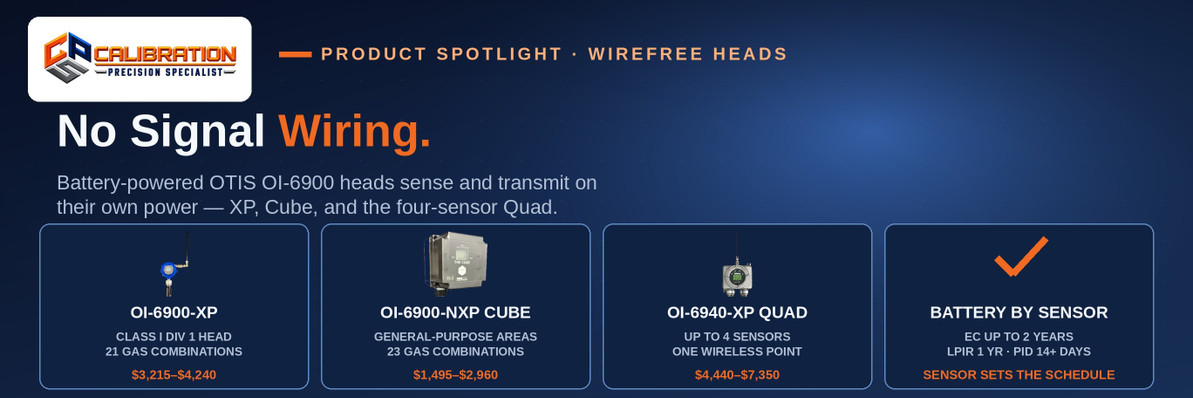
OTIS OI-6900 WireFree detector heads need no wiring at all — no signal wiring and no power wiring: the explosion-proof OI-6900-XP ($3,215–$4,240 by gas configuration) runs on dual lithium batteries for up to 2 years on an electrochemical sensor and reports over GEN II 900 MHz or 2.4 GHz radio; the non-XP OI-6900-NXP 'Cube' ($1,495–$2,960) covers general-purpose areas at roughly half the price; and the OI-6940-XP quad head ($4,440–$7,350) puts up to four sensors in a single wireless enclosure.
A fixed detector head is normally two installations: the sensor, and the cable run that feeds and reads it. The OI-6900 family deletes the second one. Mount the head where the gas collects, and it senses, displays, and transmits on its own batteries. This post walks the three heads in the family — XP, NXP Cube, and the quad — with the battery numbers stated the way the store records state them: by sensor type, because that is what decides them.
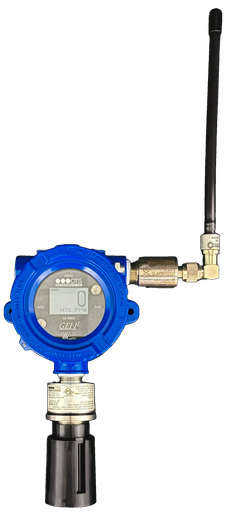
OTIS OI-6900-XP Battery-Powered WireFree Gas Detector Head
OTIS OI-6900 WireFree heads need no signal or power wiring: OI-6900-XP ($3,215–$4,240) runs up to 2 years on batteries in Class I Division 1 areas, the OI-6900-NXP Cube ($1,495–$2,960) covers general-purpose areas, and the OI-6940-XP quad ($4,440–$7,350) puts four sensors in one wireless enclosure. Battery life stated honestly, by sensor.
$3,215–$4,240 configured
See the OI-6900-XP Battery-Powered WireFreeOI-6900-XP: The Classified-Area WireFree Head
The OI-6900-XP is the explosion-proof head, certified Class I Division 1, Groups B, C, D (with ATEX/IECEx ratings) for hazardous locations — remote wellheads and tank batteries are the applications its record names, where pulling wire is impractical or cost-prohibitive. It offers 21 gas and range combinations across electrochemical, low-power infrared, and PID sensor elements — toxics, oxygen, combustible gas via low-power IR, and VOCs via PID. Power is dual 3.6V lithium-thionyl chloride batteries, 38Ah total, nonrechargeable. The radio is GEN II at 900 MHz or 2.4 GHz through an external N-female antenna connector. A 102×64 sunlight-readable display and magnetic non-intrusive switches let it be calibrated without opening the enclosure — a real advantage in a Division 1 area.
OI-6900-NXP 'Cube': The General-Purpose WireFree Head
The OI-6900-NXP Cube is the same wire-free idea in a non-explosion-proof, clear-window polycarbonate enclosure (NEMA 4/4X/6, IP66) for areas that do not require a classified enclosure: its record names warehouses, mechanical rooms, and parking structures. It runs on dual 3.6V/19Ah lithium batteries, reports over the same GEN II 900 MHz or 2.4 GHz radio through an internal wire antenna, and offers 23 gas and range combinations — toxics, oxygen, hydrogen, ozone, combustible gas, and PID VOCs. The honest boundary: the Cube is the economical choice only where the area is genuinely unclassified. It is not a cheaper way into a Division 1 location — that job belongs to the XP head, and substituting the NXP there is not a savings, it is a violation.
How Long Do the Batteries Really Last?
By sensor, from the live records — because a single headline number would mislead:
- OI-6900-XP, electrochemical sensor: up to 2 years. This is the configuration the two-year figure belongs to.
- OI-6900-XP, low-power infrared sensor: up to 1 year.
- OI-6900-XP, PID (VOC) sensor: 14 or more days. A PID lamp is a power-hungry device; on batteries it is a short-interval sensor, and a permanent PID point is usually a wired point for exactly this reason.
- OI-6940-XP quad: up to 6 months on electrochemical and low-power IR sensors — about 45 days with a PID fitted.
The OI-6900-NXP record does not state a battery duration, so this post does not claim one for the Cube. What the numbers mean practically: an electrochemical wireless head is a set-and-schedule device — calibrate on schedule, change batteries on the multi-year interval. A wireless PID head is a commitment to frequent battery service, and that trade should be made knowingly, at design time. The system these heads report to is explained in wireless fixed gas detection, and the controller end is the OI-7032.
OI-6940-XP: Four Sensors, One Wireless Point
The OI-6940-XP 'WireFree Quad' mounts up to four sensor housings in one explosion-proof enclosure — multi-gas coverage from a single wireless point, on four 3.6V/19Ah cells (76Ah total). Its listing covers the popular factory configurations: 2-, 3-, and 4-gas combinations of LEL, oxygen, carbon monoxide, hydrogen sulfide, sulfur dioxide, and ammonia, priced per the OTIS list as base unit plus each sensor (other gases, including PID and phosphine, are built as custom configurations). A 160×104 display shows all channels at once. Where a process area needs the classic multi-gas picture at one location, the quad replaces four separate single-gas heads — and four separate battery schedules become one.
Calibration is what makes any of this real. Every head above calibrates through magnetic non-intrusive switches without opening its enclosure — but the calibration still has to happen, on schedule, channel by channel. We calibrate every channel on the fixed systems we service, through calibration services and fixed system installation — wireless heads included, batteries checked as part of the visit.
Frequently Asked Questions
What is the OTIS OI-6900?
A battery-powered WireFree fixed gas detector head: it mounts where gas can collect, senses continuously, and reports its reading by GEN II radio (900 MHz or 2.4 GHz) to an OTIS controller — with no power wiring and no signal wiring. The family has three members: the explosion-proof OI-6900-XP for Class I Division 1 areas, the non-XP OI-6900-NXP 'Cube' for general-purpose areas, and the four-sensor OI-6940-XP quad head.
What is the difference between the OI-6900-XP and the OI-6900-NXP Cube?
The enclosure and the certification. The XP ($3,215–$4,240) is explosion-proof and certified Class I Division 1, Groups B, C, D for hazardous locations, with an external antenna and 21 gas/range combinations. The NXP Cube ($1,495–$2,960) is a non-explosion-proof polycarbonate enclosure for general-purpose areas — warehouses, mechanical rooms, parking structures — with an internal antenna and 23 gas/range combinations. Both are fully wire-free; the area classification decides which one may be used.
How long do OI-6900 batteries last?
On the OI-6900-XP, it depends on the sensor: up to 2 years on an electrochemical sensor, up to 1 year on a low-power infrared sensor, and 14 or more days on a PID (VOC) sensor — all on dual 3.6V lithium-thionyl chloride batteries. The OI-6940-XP quad runs up to 6 months, about 45 days with a PID fitted. The OI-6900-NXP Cube's record does not state a battery duration. Sensor type, not the radio, is what sets battery life.
What gases can the OI-6900 detect?
The XP offers 21 gas and range combinations and the NXP Cube 23, across electrochemical, infrared (low-power IR on the XP), and PID sensor elements — covering toxic gases, oxygen, hydrogen and ozone (Cube), combustible gas, and volatile organic compounds via PID. The OI-6940-XP quad combines up to four sensors in one enclosure, with listed configurations built from LEL, oxygen, CO, H2S, SO2, and ammonia, and custom configurations available for other gases.
What is the OI-6940-XP quad head?
A battery-powered WireFree head that carries up to four sensor housings in a single Class I Division 1 explosion-proof enclosure — multi-gas detection from one wireless point. Four lithium cells (76Ah total) power it for up to 6 months (about 45 days with a PID sensor), a 160×104 display shows all channels at once, and listed configurations cover 2-, 3-, and 4-gas combinations of LEL, O2, CO, H2S, SO2, and NH3. CPS prices run $4,440–$7,350 by configuration.
How much does an OI-6900 head cost?
At live CPS list prices, by gas configuration: the OI-6900-NXP Cube runs $1,495–$2,960, the explosion-proof OI-6900-XP runs $3,215–$4,240, and the four-sensor OI-6940-XP quad runs $4,440–$7,350. A controller is separate — $2,680 for the OI-7010 or $4,010 for the logging OI-7032, each handling up to 32 inputs. Against a wired head, the wireless head costs more and the installation costs less: no conduit, cable, or trenching.
Can an OI-6900 be used in a Class I Division 1 area?
The XP versions can: both the OI-6900-XP and the OI-6940-XP quad are certified Class I Division 1, Groups B, C, D. The NXP Cube cannot — it is a non-explosion-proof enclosure for general-purpose areas only. Division 1 is also where the heads' magnetic, non-intrusive calibration matters most: the enclosure never has to be opened in the classified area to calibrate the sensor inside it.
How do OI-6900 readings reach the controller?
By GEN II WireFree radio — 900 MHz (52 networks, 255 addresses per network) or 2.4 GHz (78 networks) — to an OTIS controller or gateway, which displays the channel, applies its alarm set points, drives relays, and can forward everything over Modbus. The XP head uses an external antenna on an N-female connector; the NXP Cube uses an internal wire antenna. Each head is an individually addressed point on the network.
How is a sealed wireless head calibrated?
Through magnetic non-intrusive switches: a magnet operated at the head's face runs the calibration sequence without opening the enclosure, alongside its push buttons and sunlight-readable display. That design exists for classified areas, where opening an explosion-proof enclosure in the field is exactly what you want to avoid. The calibration itself is unchanged — zero and span with calibration gas, on the manufacturer's schedule, for every channel.
Is a wireless PID head a good idea?
Only with eyes open about batteries. A PID sensor draws far more power than an electrochemical cell: the OI-6900-XP is rated 14 or more days per battery set with a PID, and the quad about 45 days. For a short campaign or a hard-to-wire temporary point, that service interval may be acceptable. For a permanent VOC point, a wired head on continuous power is usually the honest answer — the same trade the wired OI-6000 family is built for.
The Bottom Line
The OI-6900 family is one idea at three scales: a Division 1 single-gas head that runs up to two years on batteries, a general-purpose Cube at half the price for unclassified areas, and a four-sensor quad that turns one wireless point into a multi-gas station. No signal wiring, no power wiring — just a sensor where the gas is, a radio report to the controller, and a battery schedule you plan instead of discover.
Adding wireless detection points — or a whole WireFree system? Call CPS Calibrations at 865-900-8844 — heads, controllers, installation, and the CPS Calibration Program behind every channel, from Rockwood, Tennessee.
CPS Calibrations · 109 S. Front Street, Rockwood, TN 37854 · Calibration Services · The CPS Calibration Program
Need a calibration you can file?
In-house calibration at CPS in Rockwood, Tennessee — $55 for single-gas instruments, $90 for 4- and 5-gas — every channel, as-found and as-left data, full certificate.
See Calibration Servicesor call 865-900-8844
Recent Posts
-
Can You Add a Pump to a SENKO SGT-P or MGT?
Yes — SENKO's SP-Pump101 external sampling pump ($330, part AAA006000) fits the SGT, SGT-P, and MGT, …Nov 12th 2026 -

What Refrigerant Detection Does a Grocery Store Need?
A grocery store needs refrigerant detection in three places: low-mounted carbon dioxide (R-744) sens …Nov 11th 2026 -

What Is LEL and UEL? The Explosive Range, Gas by Gas
The LEL is the lowest concentration of a gas in air that can explode, and the UEL is the highest: me …Nov 10th 2026