
Calibration Gas for PID Instruments: Isobutylene and the 100 ppm Standard
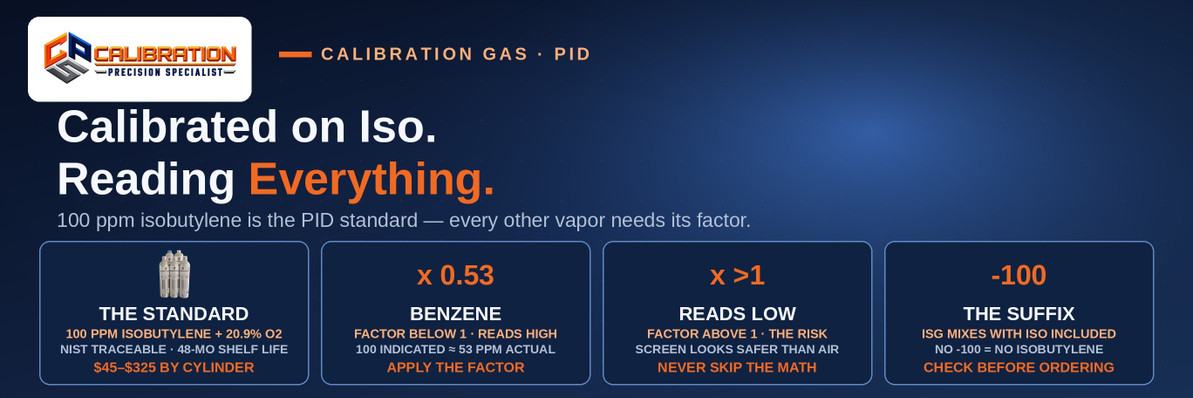
A PID is calibrated on 100 ppm isobutylene — not on the gas you are measuring — because the instrument only reports in isobutylene equivalents, and every other vapor's true concentration is that reading multiplied by its correction factor for your lamp: benzene, at about 0.53, reads high, so 100 ppm indicated is roughly 53 ppm actual, while a vapor with a factor above 1 reads low. Calibrate on the 100 ppm standard, then apply the factor before you trust the number.
That one fact — the PID does not measure your vapor directly — explains almost every confusing PID reading in the field. This post covers why isobutylene became the universal reference, what the 100 ppm standard actually sets, how correction factors change the number on the screen, how the ISG “-100” suffix on multi-gas mixes fits in, and how to buy the right cylinder the first time: size, connection, and regulator.
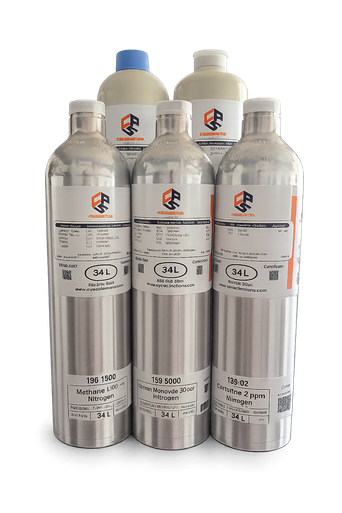
Isobutylene 100 ppm + O₂ 20.9% Calibration Gas – Nitrogen Balance
The 100 ppm PID span standard, with 20.9% oxygen in nitrogen balance — NIST traceable, made in the USA, QR code to its own SDS and Certificate of Analysis.
$45–$325 configured
See the Isobutylene GasWhy Is Isobutylene the PID Calibration Gas?
A photoionization detector does not identify a vapor. Its ultraviolet lamp ionizes whatever it can — any vapor whose ionization energy is below the lamp energy, 10.6 eV on the standard lamp — and measures the resulting current. That current has to be turned into a concentration against something, and the industry settled on isobutylene for practical reasons: it responds strongly and repeatably on a 10.6 eV lamp, it is stable in a cylinder, it is available at a clean, certifiable concentration, and every major maker publishes its correction-factor tables relative to it. Calibrate on anything else and none of those published tables line up.
So a span calibration does one narrow job: you flow 100 ppm isobutylene, tell the instrument “this signal is 100,” and from then on the display reads in isobutylene equivalents. For isobutylene itself, the reading is the concentration. For everything else, it is a starting point — which is why the next section matters more than the calibration itself.
What Happens After Calibration: Correction Factors
Different vapors ionize with different efficiency. A vapor that ionizes more readily than isobutylene produces more signal per ppm, so the instrument — thinking in isobutylene — overstates it. A vapor that ionizes less readily is understated. The correction (response) factor for your lamp converts between the two:
True concentration = displayed reading × correction factor (for that vapor, that lamp, that maker’s table).
- Factor below 1 — the meter reads high. Benzene is the classic example at about 0.53 on a 10.6 eV lamp: 100 ppm on the screen is roughly 53 ppm of benzene in the air. Acting on the raw 100 would overstate the exposure; ignoring the factor in the other direction is where people get hurt.
- Factor above 1 — the meter reads low. A vapor with a factor of 2 shows half its true concentration. This is the dangerous direction: the screen looks reassuring while the actual concentration is double.
- Factor of 1 — only isobutylene itself. Everything else needs the math, or an instrument programmed with the factor so it applies it for you.
Three cautions that keep the math honest. First, factors are lamp-specific — a factor published for a 10.6 eV lamp does not transfer to an 11.7 eV lamp. Second, factors are maker-specific — never read one manufacturer’s chart for another manufacturer’s instrument. Third, a PID still cannot see a vapor whose ionization energy is above its lamp energy at any factor: methane, for example, is not a PID gas at all — that job belongs to an LEL sensor. Our companion post works the factor math in full: PID correction factors, explained, and PID vs. LEL for VOC detection covers which sensor owns which vapor.
Where Do PIDs Earn Their Keep?
The instruments this gas serves — instruments such as the RKI GX-6100 family and the SENKO V-PRO — exist because a PID sees VOCs at ppm levels an LEL sensor cannot: solvent and fuel vapors during tank and remediation work, benzene screening, leak hunting, and hazmat surveys. That sensitivity is exactly why the calibration discipline matters. At ppm decision levels — comparing a reading to an exposure limit — a factor-of-two error is not rounding; it is the difference between “keep working” and “get out.” Bumping and spanning on the 100 ppm standard, then applying the right factor for the vapor you actually expect, is the whole method.
What About the “-100” on Multi-Gas Mixes?
Buyers meeting isobutylene a second time usually meet it inside a multi-gas calibration mix, and there the naming rule is different. On ISG part numbers, a mix that includes isobutylene at 100 ppm carries -100 at the end of the part number; the same base number without -100 is that mix with no isobutylene in it. The suffix is not a size, a pressure, or a revision — it is the flag that the PID channel has something to span on. Ordering the no-suffix version for a fleet that includes a PID leaves that channel uncalibrated no matter how fresh the cylinder is, so check the suffix against the instruments on your bench before you order any mix. Browse the full range under calibration gas.
Buying the Cylinder: Sizes, Connections, and Shelf Life
The CPS listing for the straight PID standard — 100 ppm isobutylene with 20.9% oxygen, nitrogen balance — is priced by cylinder, $45–$325 configured across nine sizes:
- 11L — $45, trigger valve (minimum order 6); 17L — $59 and 34L — $74, CGA-600 connection.
- 60L — $174, 66L — $175, 103L — $174, and 120L — $165, C-10 connection.
- 221L — $199, CGA-165; 680L — $325, CGA-specific connection.
Two buying rules follow. First, match the connection to your regulator before you match the size to your budget — a 34L cylinder on a CGA-600 fitting does not feed a C-10 regulator, and calibration morning is the wrong time to learn that. Whether you need fixed-flow or demand-flow delivery depends on whether the instrument is pumped or diffusion — the distinction that decides regulator choice is covered in our regulator coverage linked from the calibration gas category. Second, shelf life on this mixture is 48 months per the listing — unusually long next to reactive multi-gas mixes — so a larger cylinder is a rational buy for a bench that spans PIDs regularly, while a site that calibrates twice a year should stay small and fresh. Every cylinder is NIST traceable, made in the USA, and carries a QR code to its own cylinder-specific SDS and Certificate of Analysis. Calibration gas is non-returnable, so verify concentration, size, and connection before ordering — or call us and we will match it to your instrument.
Frequently Asked Questions
What gas do you use to calibrate a PID?
You calibrate a PID on 100 ppm isobutylene, with the CPS standard supplied as 100 ppm isobutylene plus 20.9% oxygen in nitrogen balance. Isobutylene is the industry reference gas for PIDs: every major maker publishes its correction-factor tables relative to it, so calibrating on anything else breaks the tables.
Why is isobutylene the standard PID calibration gas?
Isobutylene responds strongly and repeatably on the standard 10.6 eV PID lamp, is stable in a cylinder, and can be certified cleanly at 100 ppm. Because the whole industry calibrates on it, a PID display reads in isobutylene equivalents until you apply another vapor’s correction factor.
How much does 100 ppm isobutylene calibration gas cost?
At CPS the 100 ppm isobutylene / 20.9% oxygen cylinder is $45–$325 configured by size: 11L $45 (minimum order 6), 17L $59, 34L $74, 60L $174, 66L $175, 103L $174, 120L $165, 221L $199, and 680L $325. The 17L and 34L use a CGA-600 connection; the 60L through 120L sizes use C-10.
What is a PID correction factor?
A correction factor converts a PID’s isobutylene-equivalent reading into the true concentration of the vapor actually present: true concentration = displayed reading × correction factor. Benzene’s factor is about 0.53 on a 10.6 eV lamp, so 100 ppm indicated is roughly 53 ppm actual. Factors are specific to the vapor, the lamp energy, and the instrument maker’s table.
Does a PID read benzene accurately after isobutylene calibration?
Only after you apply benzene’s correction factor, about 0.53 for a 10.6 eV lamp. Without it the PID overstates benzene — 100 ppm on screen is roughly 53 ppm in the air. Some instruments can be programmed with the factor so the display applies it automatically; the raw sensor signal is always in isobutylene equivalents.
Can a PID detect methane?
No. Methane’s ionization energy is above what a standard 10.6 eV (or 11.7 eV) PID lamp can ionize, so no correction factor makes a PID see it. Methane is measured with a combustible (LEL) sensor; a PID is for VOCs and other ionizable vapors at ppm levels.
What does the -100 suffix mean on a calibration gas part number?
On ISG part numbers, -100 at the end means the multi-gas mix includes isobutylene at 100 ppm for the PID channel. The same base part number without -100 is the same mix with no isobutylene. Ordering the no-suffix version leaves a PID channel with nothing to span on.
How long does isobutylene calibration gas last?
The CPS 100 ppm isobutylene / 20.9% oxygen mixture carries a 48-month shelf life per its listing — much longer than reactive multi-gas mixes. Store cylinders as directed, check the date before a calibration, and do not span an instrument on an expired cylinder.
What regulator do I need for isobutylene calibration gas?
You need a regulator that matches the cylinder connection — CGA-600 on the 17L and 34L cylinders, C-10 on the 60L, 66L, 103L, and 120L sizes — and the flow type your instrument requires, fixed-flow for a pumped draw or demand-flow where the instrument’s manual calls for it. Verify both against your instrument manual before ordering; calibration gas is non-returnable.
Can you calibrate a PID with the gas you are measuring instead?
Technically some instruments allow a custom span gas, but doing so breaks the published correction-factor framework, which is built entirely on isobutylene equivalents, and most target vapors are impractical or unsafe to bottle at a certified concentration. Calibrate on 100 ppm isobutylene and apply the factor — that is the method the tables, and your documentation, assume.
The Bottom Line
A PID’s number is only ever an isobutylene number until you do the factor math. Calibrate on the 100 ppm isobutylene standard — $45–$325 by cylinder size at CPS, 48-month shelf life, NIST traceable with a QR-linked Certificate of Analysis — in the connection your regulator actually takes, apply the correction factor for the vapor and lamp in front of you, and watch for the -100 suffix when a multi-gas mix has to span a PID channel too. Do those three things and the ppm reading on the screen is a number you can defend.
Need a calibration you can file?
In-house calibration at CPS in Rockwood, Tennessee — $55 for single-gas instruments, $90 for 4- and 5-gas — every channel, as-found and as-left data, full certificate.
See Calibration Servicesor call 865-900-8844
Recent Posts
-

Calibration Gas for PID Instruments: Isobutylene and the 100 ppm Standard
A PID is calibrated on 100 ppm isobutylene — not on the gas you are measuring — because the instrume …Nov 14th 2026 -

OTIS OtisLink: How Remote Gas Detection Reports From Sites With No One There
OTIS OtisLink is a cellular/satellite hybrid telemetry kit ($2,805–$4,740 configured) that connects …Nov 13th 2026 -

Can You Add a Pump to a SENKO SGT-P or MGT?
Yes — SENKO's SP-Pump101 external sampling pump ($330, part AAA006000) fits the SGT, SGT-P, and MGT, …Nov 12th 2026