
PID Correction Factors Explained: Why Your Isobutylene Reading Isn't Your Solvent Reading
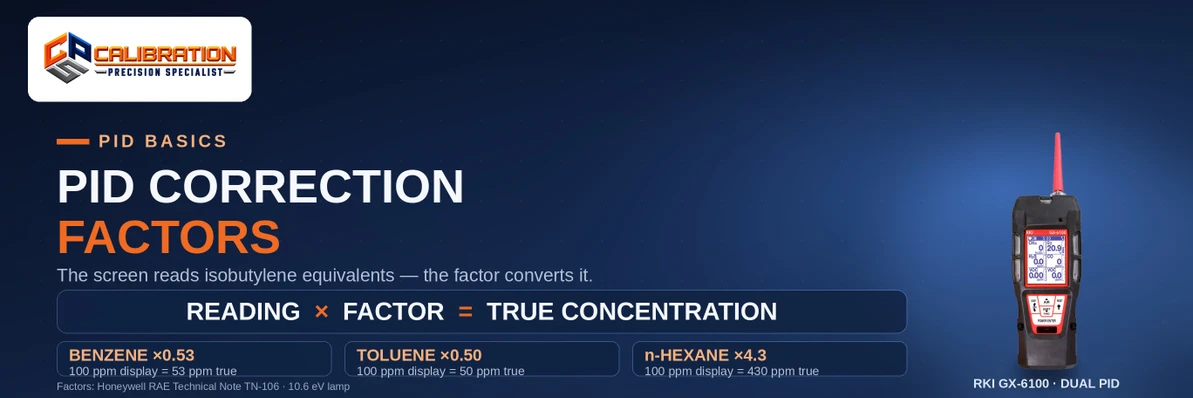
A PID is calibrated on isobutylene, so its display reads in isobutylene equivalents — not in the concentration of the vapor actually being measured. To get the true concentration, multiply the reading by that compound's correction factor from Honeywell RAE's Technical Note TN-106: a 100 ppm display is 53 ppm of benzene (factor 0.53), 50 ppm of toluene (0.50), or 430 ppm of hexane (4.3). Until you apply the factor, the number on the screen is a well-organized estimate about a gas you are probably not measuring.
This is not a defect. It is the price of the PID's great virtue — one instrument that responds to hundreds of volatile organic compounds — and the correction factor is how that virtue is made quantitative. Our primer on what a PID measures covers the instrument itself; this page is about the arithmetic that makes its readings honest.
Why Does a PID Read in Isobutylene Equivalents?
A photoionization detector works by shining ultraviolet light into the sample: molecules whose ionization energy (IE) is below the lamp's photon energy are ionized, and the resulting current is proportional to concentration. But "proportional" is doing heavy lifting — each compound ionizes with a different efficiency, so each produces a different current per ppm. One UV lamp cannot be independently calibrated for the hundreds of vapors it can see.
The industry's answer is to calibrate every PID on a single reference gas — isobutylene — and publish how every other compound responds relative to it. Isobutylene is the reference because its response sits mid-range among common VOCs, it is stable in a cylinder, and its ionization energy (9.24 eV, per TN-106) sits comfortably under the standard 10.6 eV lamp — so the calibration gas itself responds strongly and consistently. The display therefore reads "ppm of isobutylene that would have produced this signal." Your solvent produced the signal; isobutylene just gets the credit on screen.
What Does a Correction Factor Do to the Reading?
The correction factor converts the display into the target compound's true concentration:
True concentration = displayed reading × correction factor (CF)
Which side of 1.0 the factor sits on tells you the story. A CF below 1 (benzene 0.53, toluene 0.50) means the compound ionizes more readily than isobutylene — the PID over-responds to it, so the truth is lower than the display. A CF above 1 (hexane 4.3, ammonia 9.7) means the compound responds weakly, and the truth is higher — in hexane's case, more than four times higher than the number you are looking at. The values below are from TN-106's published table, for the standard 10.6 eV lamp, with each compound's ionization energy:
| Compound | Correction factor (10.6 eV) | Ionization energy | A 100 ppm display really means |
|---|---|---|---|
| Isobutylene (calibration gas) | 1.00 | 9.24 eV | 100 ppm |
| Benzene | 0.53 | 9.25 eV | 53 ppm |
| Toluene | 0.50 | 8.82 eV | 50 ppm |
| Styrene | 0.40 | 8.43 eV | 40 ppm |
| m-Xylene | 0.44 | 8.56 eV | 44 ppm |
| Gasoline (92 octane) | 1.0 | mixture | ≈100 ppm |
| Methyl ethyl ketone (MEK) | 0.90 | 9.51 eV | 90 ppm |
| Acetone | 1.1 | 9.71 eV | 110 ppm |
| Vinyl chloride | 2.0 | 9.99 eV | 200 ppm |
| n-Heptane | 2.8 | 9.92 eV | 280 ppm |
| Hydrogen sulfide | 3.3 | 10.45 eV | 330 ppm |
| n-Hexane | 4.3 | 10.13 eV | 430 ppm |
| n-Pentane | 8.4 | 10.35 eV | 840 ppm |
| Ammonia | 9.7 | 10.16 eV | 970 ppm |
TN-106's own worked examples make the same point at smaller scale: a 10 ppm reading over butyl acetate (CF 2.6) is 26 ppm of butyl acetate, and the same 10 ppm over trichloroethylene (CF 0.54) is 5.4 ppm. Note also what the IE column is quietly telling you — the closer a compound's ionization energy sits to the lamp's 10.6 eV, the weaker and less certain the response tends to be. Hexane at 10.13 eV and pentane at 10.35 eV are being ionized near the edge of the lamp's reach, and their large factors are the price.
Correction Factors and Alarms: Run the Math Backward
A factor changes alarm setpoints just as much as readings — the same trap as on the LEL channel. If you need an alarm at a true 50 ppm of hexane, the display must be set at 50 ÷ 4.3 ≈ 11.6 ppm isobutylene equivalents; set it at 50 on the display and it will not sound until the true hexane concentration reaches 215 ppm. TN-106 works its own version of this calculation for exposure limits — converting a compound's 8-hour TLV into the isobutylene-equivalent reading at which the alarm should trip (benzene's 8-hour TLV in the note is 0.5 ppm, which corresponds to a display of roughly 0.5 ÷ 0.53 ≈ 0.94 ppm). Many modern instruments do this for you: select the target gas from the instrument's built-in library and the factor is applied internally, so the display reads in the target gas directly. Which raises the important question of whose factor the instrument is using — Honeywell's own support guidance for the MultiRAE family lists benzene's factor in the instrument library as 0.48, against TN-106's generic 0.53. The note itself is a general table meant to cover many instruments; the library in your specific instrument governs.
What Can't a 10.6 eV PID See at All?
Anything whose ionization energy exceeds the lamp's energy is invisible — TN-106 marks those compounds "NR," no response:
- Methane (IE 12.61 eV) — NR at every lamp in TN-106's table, including the 11.7 eV lamp. A PID cannot substitute for an LEL sensor, ever.
- Chlorine (IE 11.48 eV) — no response on a 10.6 eV lamp; TN-106 lists a factor of 1.0 only under the 11.7 eV lamp. Carbon tetrachloride (IE 11.47 eV) is likewise NR at 10.6 eV.
- The common inorganic gases your 4-gas monitor handles — and most very light compounds — are simply outside the PID's physics.
This is why serious VOC instruments so often pair the two technologies in one housing: the RKI GX-6100 (from $1,597 by configuration; the 4-gas + PID build is the store's $3,455 headline) runs a PID alongside %LEL and toxic channels, so the invisible-to-PID gases still get measured — our GX-6100 walk-through covers its full sensor menu. The lamp choice cuts the other way, too: a lower-energy 9.8 eV lamp responds to fewer compounds but can be more selective for aromatics like benzene and toluene. Lamp energy is a coverage decision, not an upgrade ladder.
What About Mixtures of Vapors?
Real solvent vapor is usually a blend, and a PID reads the blend as one signal — it cannot speciate. TN-106 publishes the method for a known mixture: the combined factor is computed from each component's mole fraction and its own factor, CFmix = 1 ÷ (X₁/CF₁ + X₂/CF₂ + …). In the note's worked example, a vapor of 5% benzene and 95% n-hexane has a combined factor of 3.2, so a reading of 100 corresponds to 320 ppm of total mixture — of which only about 16 ppm is benzene and 304 ppm is hexane. Two lessons sit inside that example. The total can be estimated if the recipe is known. And the component you care most about — here the benzene, with its sub-ppm exposure limit — is a small, uncertain slice of a big blended number. For an unknown mixture, the honest statement of a PID reading is "total ionizable vapor, in isobutylene equivalents," and nothing more specific.
The Honest Limits of Correction Factors
- They are approximations with a pedigree. TN-106 flags each of its values as confirmed or as preliminary/estimated and subject to change — the note itself tells you not to treat the table as gospel.
- They are instrument-specific in the end. Generic table vs. built-in library: benzene is 0.53 in TN-106 and 0.48 in the MultiRAE library per Honeywell's support guidance. Use your instrument's library first, the generic table second.
- The atmosphere itself bends response. TN-106 documents matrix effects: high concentrations of methane, methanol, or water vapor reduced a MiniRAE's response by about 20% at 15,000 ppm and about 40% at 30,000 ppm. Humidity and a fouled lamp shift readings in the field in ways no factor anticipates.
- A factor is not a calibration. TN-106's own guidance is blunt in paraphrase: the best way to calibrate a PID for a compound is with a standard of that compound. Factors exist for the common case where that is impractical — screening, leak hunting, and total-VOC trending — and they are the right tool there, used with their error bars understood.
The Bottom Line
A PID's display is a reading in isobutylene equivalents, and the correction factor is the exchange rate into the vapor you are actually measuring: multiply the display by the factor — 0.53 for benzene, 0.50 for toluene, 4.3 for hexane — and divide your alarm setpoints by it. Below-1 factors mean the truth is lower than the screen; above-1 factors mean it is higher, sometimes much higher. And no factor exists at all for the gases a 10.6 eV lamp cannot ionize, methane first among them.
The instruments this arithmetic belongs to are the SENKO V-PRO at $3,947 and the RKI GX-6100 — and the isobutylene span gas that calibrates them is in our calibration gas category. If your crew is reading PID numbers as if they were solvent concentrations, that is a fixable misunderstanding — and if the instrument is due, we calibrate every channel. Call 865-900-8844 or reach us through Contact Us.
Frequently Asked Questions
What is a PID correction factor? A multiplier that converts a PID's displayed reading — which is expressed in isobutylene equivalents, because the instrument was calibrated on isobutylene — into the true concentration of the compound actually being measured. The factors are published by the manufacturer; the standard reference is Honeywell RAE's Technical Note TN-106. True concentration = display × correction factor.
Why are PIDs calibrated with isobutylene? Because one calibration gas has to stand in for hundreds of compounds. Isobutylene's response sits mid-range among common VOCs, it is stable as a cylinder standard, and its ionization energy (9.24 eV, per TN-106) sits comfortably below the standard 10.6 eV lamp, so it responds strongly and consistently. Every other compound's response is then published relative to it as a correction factor.
How do you calculate the actual concentration from a PID reading? Multiply the displayed reading by the compound's correction factor for your lamp energy. Examples from TN-106 (10.6 eV lamp): a display of 100 ppm over benzene (CF 0.53) is 53 ppm of benzene; over toluene (0.50) it is 50 ppm; over n-hexane (4.3) it is 430 ppm. If your instrument has a target-gas library, selecting the gas applies its built-in factor automatically — use the library value over a generic table.
What is the correction factor for benzene on a PID? 0.53 in Honeywell RAE's Technical Note TN-106 for a 10.6 eV lamp — a PID over-responds to benzene, so true benzene is about half the displayed isobutylene-equivalent reading. Note that instrument libraries can differ: Honeywell's support guidance lists 0.48 for the MultiRAE family. Your specific instrument's library value is the one to use.
What is the correction factor for toluene? 0.50 at a 10.6 eV lamp, per TN-106 (ionization energy 8.82 eV). Toluene responds about twice as strongly as isobutylene, so the true concentration is half the display: a 200 ppm reading over pure toluene vapor is 100 ppm of toluene.
Why does my PID read higher than the actual benzene concentration? Because benzene ionizes more efficiently than isobutylene under a 10.6 eV lamp. The instrument reports the isobutylene concentration that would have produced the same signal; benzene produces that signal at roughly half the concentration. Its correction factor, 0.53, exists precisely to remove that overstatement — uncorrected, the display is conservative for benzene, which is the safe direction, but it is still wrong.
Can a PID measure methane? No. Methane's ionization energy is 12.61 eV — above even the 11.7 eV lamp — and TN-106 lists it as NR (no response) at every lamp energy. A PID is blind to methane and to most light inorganic gases. Combustible gas measurement requires an LEL sensor (catalytic or infrared); that is why combination instruments like the RKI GX-6100 carry a PID and an LEL channel side by side.
What does a 10.6 eV lamp mean on a PID? It is the energy of the ultraviolet photons the lamp emits. A compound can only be ionized — and therefore measured — if its ionization energy is below the lamp's: a 10.6 eV lamp sees benzene (9.25 eV) and hexane (10.13 eV) but not chlorine (11.48 eV) or methane (12.61 eV). 10.6 eV is the standard general-purpose lamp; 9.8 eV lamps trade coverage for selectivity, and 11.7 eV lamps reach a few higher-energy compounds.
What is the correction factor for hexane on a PID? 4.3 for n-hexane at a 10.6 eV lamp, per TN-106. Hexane responds weakly — its ionization energy of 10.13 eV sits close to the lamp's limit — so the true concentration is 4.3 times the display: a 10 ppm reading is 43 ppm of hexane, and a 100 ppm reading is 430 ppm. Weak-response compounds are where skipping the factor is most dangerous.
Are PID correction factors exact? No. TN-106 itself marks its values as confirmed or as preliminary estimates subject to change, and field conditions — humidity, high background concentrations of other gases, lamp condition — shift PID response in ways a fixed factor cannot capture. A factor gets you a defensible estimate for screening and trending. When the number itself is the decision, calibrate the instrument with a standard of the target gas, which is TN-106's own recommended practice.
CPS Calibrations · 109 S. Front Street, Rockwood, TN 37854 · Portable Gas Detection · Calibration Gas · Calibration Services · Contact Us
Recent Posts
-

What Is a Confined Space? OSHA's Definition, the 3 Tests, and When It Becomes Permit-Required
A confined space is a space that passes all three of OSHA's tests at the same time: it is large enou …Oct 21st 2026 -

PID vs. LEL for VOC Detection: Which Sensor Do You Actually Need?
Use a PID to detect VOCs and an LEL sensor to detect explosive atmospheres — they measure different …Oct 21st 2026 -

Semiconductor (MOS) Gas Sensors: Where They Work and Where They Lie
A semiconductor (MOS) gas sensor measures gas with a heated film of metal oxide — usually tin dioxid …Oct 21st 2026