
What Does a PID Actually Measure? The SENKO V-PRO for VOC Monitoring
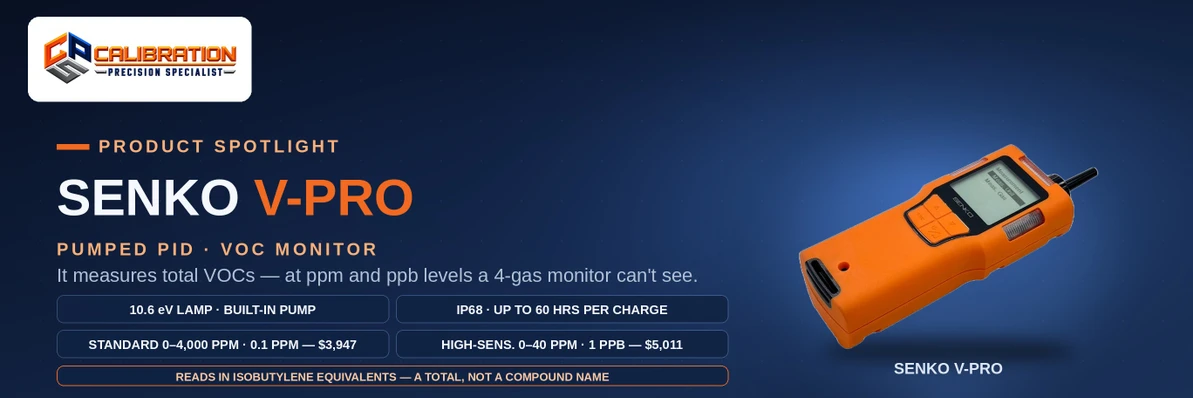
A PID (photoionization detector) measures total volatile organic compounds (VOCs) in the air, in real time, at parts-per-million and parts-per-billion levels a standard 4-gas monitor cannot see. The SENKO V-PRO is a portable PID with a 10.6 eV lamp and a built-in pump, offered in a 0–4,000 ppm configuration with 0.1 ppm resolution ($3,947) and a high-sensitivity 0–40 ppm configuration with 1 ppb resolution ($5,011), in an IP68 housing, with up to 60 hours of runtime on its rechargeable 4,400 mAh battery.
That is the short answer. The rest of this post is what the number on a PID screen actually means, why your 4-gas monitor is blind to the hazard a PID catches, how isobutylene calibration and correction factors work, and how to decide whether the job in front of you calls for a PID, a 4-gas, or both.
What Is a PID, and What Does It Actually Measure?
A photoionization detector shines ultraviolet light from a lamp — 10.6 electron volts (eV) on the standard V-PRO — across the sampled air. VOC molecules that absorb that energy give up an electron and become charged ions, and the instrument measures the tiny electrical current that results. More ions, more current, higher reading. Nothing burns, nothing reacts chemically, and the sample passes through unchanged, which is why a PID answers in seconds and can be used continuously while you work.
Two consequences of that physics shape everything else about PID use:
- It measures a total, not a name. A PID adds up every ionizable compound in the sample and reports one combined VOC number. It cannot tell you the vapor is toluene rather than xylene, or that part of the reading is one solvent and part another. That total is exactly what you want for screening, leak hunting, and "is something here, and how much" questions — and it is not compound identification.
- The lamp sets what it can see. A compound responds only if its ionization energy is below the lamp energy. A 10.6 eV lamp sees most common solvent and chemical vapors — and it cannot see methane, whose ionization energy is above the lamp's output. A PID is not an LEL meter, and an LEL meter is not a PID. They answer different questions, which is the subject of the next section.
On the V-PRO, the result shows in real time on the LCD, with audible, visual LED, and vibration alarms when levels cross the programmed thresholds — 50 ppm low / 100 ppm high on the standard range, 10 ppm low / 25 ppm high on the high-sensitivity range, per SENKO's data sheet.
Why Is a 4-Gas Monitor Blind to ppm-Level VOCs?
Not because it is broken — because of the scale it reads on. The combustible channel on a 4-gas monitor reports %LEL: percent of the lower explosive limit. For methane, 100% LEL is 5% gas by volume — 50,000 ppm. Do the division and one 1% LEL step, the smallest move most LEL sensors display, represents roughly 500 ppm.
Now put a VOC exposure next to that step. The health hazard from solvent vapors lives at tens of ppm and below — the V-PRO's own alarm points (50 ppm, and 10 ppm on the sensitive range) sit there for a reason. A worker can be standing in vapor at a concentration that matters for exposure while the LEL channel shows a calm, honest zero, because zero on an explosion scale and "nothing here" are not the same statement. This is the same lesson our sensor-technology posts keep arriving at from different directions: every sensor sees the hazard its physics lets it see, and no channel covers a hazard it was never built to measure.
Add the second gap: many VOCs are not the 4-gas monitor's assigned targets at all. Its other channels are single-gas electrochemical sensors for oxygen, carbon monoxide, and hydrogen sulfide. A solvent vapor that is neither combustible at %LEL scale nor one of those three gases has no channel to land on. The PID is the channel built for it.
What Does the SENKO V-PRO Add? The Instrument Itself
The SENKO V-PRO is a single-purpose VOC instrument — it does the PID job properly rather than bolting a compromise channel onto a general monitor. The verified specifications from the listing and SENKO's data sheet:
- Two ranges, one decision. Standard: 0–4,000 ppm with 0.1 ppm resolution, $3,947. High-sensitivity: 0–40 ppm with 1 ppb resolution, $5,011. Both use the standard 10.6 eV lamp; SENKO notes other lamp options may be available — call us for configuration help.
- Built-in pump. The V-PRO draws the sample to the sensor instead of waiting for vapor to diffuse to it, which is what makes it practical for confined-space checks, hard-to-reach locations, leak investigation, and industrial hygiene surveys. (Pumped sampling is also why SENKO's docked and pumped monitors show up alongside it in our SENKO range.)
- IP68 housing. Polycarbonate with a rubberized exterior, rated dust-tight and immersion-resistant — rain, washdowns, and plant grime are working conditions, not warranty claims. The instrument weighs 12.70 oz (360 g) and measures 2.76 × 8.46 × 1.69 in., with a four-button interface and an LCD showing concentration, alarm, and diagnostic information.
- Up to 60 hours of runtime. The rechargeable 3.7 V, 4,400 mAh lithium-ion battery runs up to 60 hours under typical use — a week of shifts of screening and surveys between charges, on an instrument class that used to mean daily charging discipline.
- Records on board. The V-PRO stores the 30 most recent alarm events and logs measurement data, events, calibration, and bump-test records, downloadable through SENKO IR-LINK or supported short-range wireless communication.
- Certified for hazardous locations. IECEx, ATEX, and CSA/UL approvals for applicable hazardous locations, an operating range of -4°F to +122°F (-20°C to +50°C), and a 2-year warranty from the date of purchase — with the honest footnote SENKO prints on the listing: the PID sensor itself is excluded from the standard warranty.
- A complete field kit. Hard case, charging adapter, activated carbon filter, tubing and quick connector, sensor removal tool, syringe filter, five filter elements, fittings, and O-rings are supplied with the instrument.
Which Range Do You Need: 0–4,000 ppm or 0–40 ppm?
Choose by the concentrations your work actually produces, not by which specification sounds more impressive:
- The 0–4,000 ppm standard range is the general industrial instrument: leak investigation around process equipment, tank and confined-space screening, spill response, and any job where vapor levels can climb into the hundreds or thousands of ppm. Its 0.1 ppm resolution still reads far below anything an LEL channel can resolve, and its range will not overrange on a real leak.
- The 0–40 ppm high-sensitivity range is the industrial-hygiene instrument: exposure screening, low-level leak detection, and cleanup verification, where the question is single ppm and ppb. Its 1 ppb resolution resolves levels the standard range rounds away — and its 40 ppm ceiling means a significant leak will pin it, which is information, but not a measurement.
If your crews do both kinds of work at meaningfully different levels, that is a two-instrument conversation — or a conversation about which question gets asked more often. Call us at 865-900-8844 and describe the application; range selection is the decision that determines whether the instrument answers your question or just a nearby one.
Why Does a PID Read in Isobutylene Equivalents? Correction Factors, Explained
This is the part of PID ownership that surprises people, and it matters more than any single specification above.
A PID is spanned on a reference gas — for PIDs, that gas is isobutylene. (Our post on when standard 4-gas calibration gas isn't enough covers the V-PRO's place in that picture: a PID channel is one of the clearest cases where the standard bottle stops being enough.) When the V-PRO is calibrated on 100 ppm isobutylene calibration gas, the number it later displays means "VOC concentration equivalent to this much isobutylene" — because isobutylene is the yardstick the instrument was taught with.
Other compounds do not ionize exactly as eagerly as isobutylene. Some respond more strongly, some less, so the raw reading for a specific compound is adjusted with that compound's correction factor (also called a response factor): apply the factor for the vapor you know you are measuring, and the isobutylene-equivalent reading becomes an estimate of that compound's actual concentration. Skip the factor on a known single-vapor job and you can be meaningfully over- or under-reading while the display looks perfectly confident.
Two working rules follow:
- Known vapor, use its factor. If the job is one identified compound — a specific solvent in a specific process — the correction factor is part of reading the instrument correctly.
- Unknown or mixed vapor, read it as a total. With mixed or unidentified vapors there is no single correct factor, and the honest reading is the total VOC level in isobutylene equivalents: a screening number that tells you something is present and roughly how much, and that further identification takes a different method.
And the calibration itself is two halves, as on any instrument we bench: the V-PRO zero-calibrates using the supplied activated carbon filter, which strips VOCs to give the sensor a true zero, and span-calibrates on standard calibration gas — the isobutylene span above. Zeroed but never spanned is not calibrated, on a PID exactly as on a 4-gas channel.
Choose a PID When — and a 4-Gas When
Choose a PID like the V-PRO when:
- The hazard is VOC vapor — solvents, fuels, chemical process vapors — at ppm or ppb levels, well below any %LEL reading.
- You are screening before or during confined-space work, hunting leaks, surveying for industrial hygiene, or verifying a cleanup, and you need a real-time total-VOC number.
- You need to sample remotely or in hard-to-reach spots — the built-in pump draws the sample to the instrument.
- Your 4-gas reads zero but the odor, the process, or the paperwork says vapor is present. That gap is the PID's home ground.
A 4-gas monitor is the right tool when:
- The job is the standard confined-space and personal-safety set: combustible gas at %LEL, oxygen depletion or enrichment, carbon monoxide, and hydrogen sulfide — the four channels a SENKO SP-MGT or similar monitor watches continuously on the worker. (Our SP-MGT and Docking Station II spotlight covers that fleet side.)
- The combustible hazard includes methane or hydrogen at explosive-range concentrations — gases and scales a 10.6 eV PID is not the instrument for.
- You need continuous personal alarming on specific toxic gases (CO, H₂S) rather than a total-VOC screen.
Most facilities that take VOCs seriously end up with both, doing different jobs: the 4-gas lives on the worker, and the PID comes out for screening, surveys, entry checks, and leak work. They complement each other; neither replaces the other.
Calibration and Service, From Our Bench
A PID earns its keep on the quality of its calibration. The lamp and sensor assembly see everything the pump pulls in — solvent vapor, dust, and humidity included — so span checks against known isobutylene are what keep the total-VOC number honest between surveys. Keep the V-PRO's own records working for you: its logged calibration and bump-test history is the audit trail that shows the readings were verified, not assumed.
When a V-PRO — or any channel on any instrument in your fleet — needs calibration or service, ship it to our Rockwood lab or have us come to your facility: we calibrate every channel, and the certificate shows as-found and as-left readings. Questions about range selection, lamp configuration, or correction factors for a specific vapor? Call us at 865-900-8844 before you order — the application decides the instrument, not the other way around.
The Bottom Line
A PID measures total VOCs at the ppm and ppb levels where vapor exposure actually happens — a scale a 4-gas monitor's %LEL channel physically cannot resolve. The SENKO V-PRO does that job as a dedicated instrument: 10.6 eV lamp, built-in pump, a 0–4,000 ppm standard range at $3,947 or a 1 ppb high-sensitivity range at $5,011, IP68 construction, and up to 60 hours per charge. Read its number for what it is — a total, in isobutylene equivalents, corrected when the vapor is known — and it will show you the hazard your other instruments were never built to see.
Ready to add VOC monitoring? Start with the SENKO V-PRO, keep it spanned with 100 ppm isobutylene, and browse the wider SENKO instruments we carry. Questions? Call 865-900-8844.
Frequently Asked Questions
What does a PID actually measure? Total volatile organic compounds (VOCs) in the air, reported as one combined concentration — not one named chemical. A PID ionizes vapor molecules with an ultraviolet lamp (10.6 eV on the standard SENKO V-PRO) and measures the resulting current, so it reports how much ionizable vapor is present, in real time, at ppm and ppb levels.
How much does the SENKO V-PRO cost? $3,947 for the standard 0–4,000 ppm configuration (0.1 ppm resolution), and $5,011 for the high-sensitivity 0–40 ppm configuration (1 ppb resolution). Both configurations include the built-in pump, the 10.6 eV lamp, and the supplied field kit with hard case, charging adapter, carbon filter, and tubing.
Can a PID replace my 4-gas monitor? No — they measure different hazards on different scales. A 4-gas monitor watches combustible gas at %LEL, oxygen, CO, and H₂S continuously on the worker. A PID measures total VOCs at ppm/ppb levels, and a 10.6 eV PID cannot even see methane. Most operations that need VOC monitoring run both, for different jobs.
Why can't my 4-gas monitor see VOCs at ppm levels? Scale. Its combustible channel reads %LEL, and for methane 100% LEL equals 50,000 ppm — so a single 1% LEL display step is roughly 500 ppm. VOC exposure hazards live at tens of ppm and below, underneath the LEL channel's first step, and most VOCs have no dedicated channel on a 4-gas instrument at all.
What gas is a PID calibrated with? Isobutylene is the standard span gas for PIDs — the V-PRO span-calibrates on standard calibration gas such as 100 ppm isobutylene, after zero calibration with its activated carbon filter. Readings are therefore in isobutylene equivalents, and a compound-specific correction factor converts the reading when you are measuring one known vapor.
What is a correction factor on a PID? A multiplier that converts the instrument's isobutylene-equivalent reading into an estimated concentration of the specific compound being measured, because different VOCs ionize with different strength under the same lamp. It applies when the vapor is known and identified; with mixed or unknown vapors, the uncorrected total-VOC reading is the honest number.
How long does the V-PRO battery last? Up to 60 hours of continuous operation under typical conditions, from its rechargeable 3.7 V, 4,400 mAh lithium-ion battery — per SENKO's listing and data sheet specifications.
Is the SENKO V-PRO rated for hazardous locations? Yes. The listing documents IECEx, ATEX, and CSA/UL approvals for applicable hazardous locations, and the housing is rated IP68 — dust-tight and immersion-resistant. SENKO warrants the detector for 2 years from the date of purchase; the PID sensor is excluded from the standard warranty.
Can the V-PRO tell me which chemical is in the air, like benzene specifically? No. The V-PRO reports total VOCs — benzene vapor in the sample contributes to that total, but the instrument does not separate or identify individual compounds. If your application requires compound-specific measurement, call us at 865-900-8844 and we will talk through what the job actually calls for.
CPS Calibrations · 109 S. Front Street, Rockwood, TN 37854 · Portable Gas Detection · Calibration Gas · Calibration Services · Contact Us
Recent Posts
-

What Is a Confined Space? OSHA's Definition, the 3 Tests, and When It Becomes Permit-Required
A confined space is a space that passes all three of OSHA's tests at the same time: it is large enou …Oct 21st 2026 -

PID vs. LEL for VOC Detection: Which Sensor Do You Actually Need?
Use a PID to detect VOCs and an LEL sensor to detect explosive atmospheres — they measure different …Oct 21st 2026 -

Semiconductor (MOS) Gas Sensors: Where They Work and Where They Lie
A semiconductor (MOS) gas sensor measures gas with a heated film of metal oxide — usually tin dioxid …Oct 21st 2026