
Fixed Gas Detector Alarm Setpoints: Who Decides, and What Do They Set?
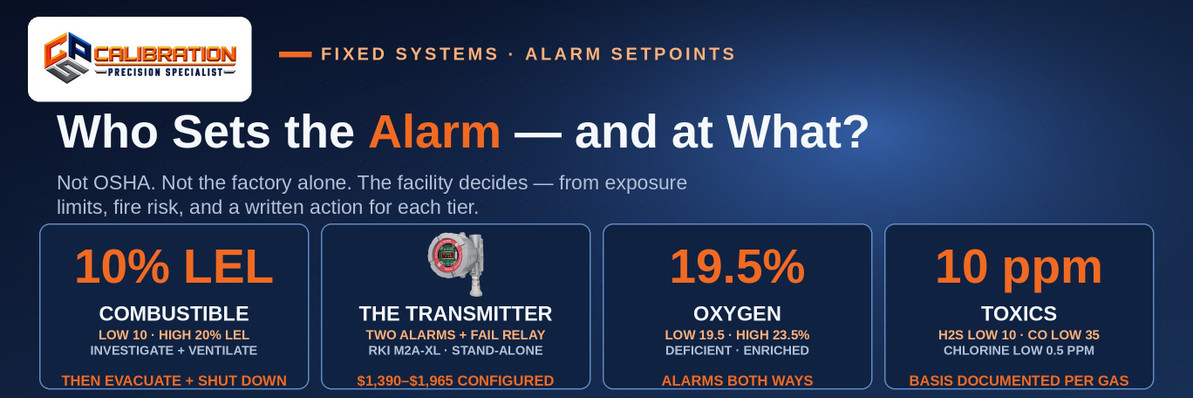
Fixed gas detector alarm setpoints are decided by the facility — not by OSHA, and not by the factory default alone — using exposure limits and fire risk: combustible gas typically alarms at 10% LEL low and 20% LEL high, oxygen at 19.5% low and 23.5% high, hydrogen sulfide at 10 ppm low and 15 ppm high, and carbon monoxide at 35 ppm low and 200 ppm high. Each tier needs a named action — investigate and ventilate at the low alarm, evacuate and shut down at the high alarm — or the setpoint is just a noise the plant learns to ignore.
Ask in most plants who chose the alarm numbers on the fixed gas detection system and the answer is a shrug, a point at the installer, or "that's how it came." That is a problem hiding in plain sight. The setpoint is the moment a measurement becomes a decision — fans start, processes shut down, people leave or stay. A number nobody chose deliberately, with no documented basis and no action attached, protects on paper only. This post names who actually decides, gives the typical numbers by gas with the basis behind each one, and shows the one-page setpoint schedule every detection point should have on file. For the systems these numbers live in, see fixed gas detection systems.
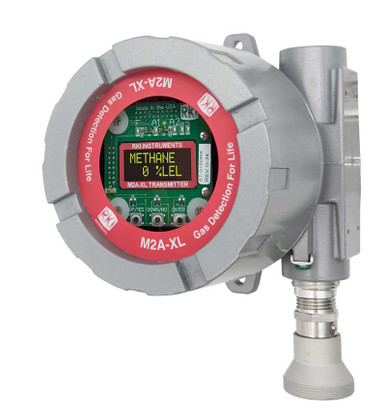
RKI M2A-XL Explosion Proof Housing Stand Alone Transmitter
Stand-alone fixed transmitter with display, two alarm levels with relays, plus a separate fail alarm — it is its own controller.
$1,390–$1,965 configured
See the M2A-XLWho Decides Fixed Gas Detector Alarm Setpoints?
The facility decides — specifically, the person or team who owns the site's risk assessment, usually the EHS or safety manager working with operations and the system designer. Nobody higher up hands the numbers down:
- OSHA sets limits, not setpoints. OSHA publishes permissible exposure limits in 29 CFR 1910.1000 and defines a hazardous atmosphere in 29 CFR 1910.146 — oxygen below 19.5% or above 23.5%, flammable gas above 10% of its lower flammable limit. Those are the raw material for setpoints. No OSHA table tells a chlorine head to alarm at 0.5 ppm or a combustible head at 10% LEL; the employer builds that from the limits. The limit system itself is explained in what a PEL is.
- Codes and the authority having jurisdiction can dictate pieces. A refrigeration machinery room, a parking garage, or a classified process area may carry code-driven requirements for detection, ventilation, and shutdown that constrain where setpoints can sit. Where a code speaks, it outranks preference.
- Insurers and corporate standards tighten, never loosen. Many companies adopt the NIOSH or ACGIH number instead of the older OSHA number as their internal basis — a stricter, documented choice.
- The manufacturer default is a starting point, not an authority. Defaults are sensible general-purpose numbers (the table below is largely what reputable makers ship). They are not a site risk assessment, and leaving them in place without checking them against your gases, your limits, and your response plan is a decision too — just an undocumented one.
- The installer or calibration provider programs what the facility specifies. A competent provider will flag a setpoint that makes no sense — one above a ceiling limit, or a combustible high alarm at 60% LEL — but the specification, and the signature under it, belong to the facility.
What Are the Typical Fixed Alarm Setpoints by Gas?
These are the widely used low and high instantaneous setpoints for fixed systems, with the basis for each. "Typical" is the honest word: verify yours against your site's adopted limits, because makers and facilities vary — hydrogen sulfide below is the clearest example.
| Gas | Low alarm | High alarm | Basis |
|---|---|---|---|
| Combustible (%LEL) | 10% LEL | 20% LEL | OSHA treats above 10% of the lower flammable limit as a hazardous atmosphere; both alarms sit far below 100% LEL, where the mixture can ignite |
| Oxygen (O2) | 19.5% | 23.5% | OSHA 1910.146: below 19.5% is oxygen-deficient, above 23.5% is oxygen-enriched |
| Carbon monoxide (CO) | 35 ppm | 200 ppm | NIOSH REL 35 ppm TWA and 200 ppm ceiling — not the 50 ppm OSHA TWA (see below) |
| Hydrogen sulfide (H2S) | 10 ppm | 15 ppm | NIOSH ceiling 10 ppm (10 minutes); some makers set the high alarm at 20 ppm, the OSHA ceiling — a difference that should be chosen, not inherited |
| Ammonia (NH3) | 25 ppm | 35 ppm | NIOSH REL / ACGIH TLV 25 ppm TWA and 35 ppm STEL, below the 50 ppm OSHA PEL |
| Chlorine (Cl2) | 0.5 ppm | 1 ppm | NIOSH ceiling 0.5 ppm (15 minutes); OSHA ceiling 1 ppm, never to be exceeded |
| Carbon dioxide (CO2) | 5,000 ppm | Site-set | OSHA PEL / NIOSH REL 5,000 ppm TWA; 30,000 ppm is the NIOSH STEL reference, not a factory default high alarm |
Two rows deserve a second look. Carbon monoxide's low alarm is not 50 ppm even though 50 ppm is the OSHA PEL, because the PEL is an 8-hour average and a fixed head alarms on the concentration right now. Makers who default CO to 35 ppm are following the NIOSH recommended average, with the 200 ppm NIOSH ceiling as the high tier — the instantaneous numbers borrowed from the limit system are the ceiling and the protective average, not the legal average alone. Hydrogen sulfide's high alarm genuinely varies — 15 ppm in some manufacturers' defaults, 20 ppm in others — because the limit system itself offers both a 15 ppm short-term figure and a 20 ppm OSHA ceiling. Either can be defended. What cannot be defended is not knowing which one your plant has, or why.
Why Is a PEL Not an Alarm Setpoint?
Because they answer different questions. A PEL is a legal limit on a worker's average exposure across a shift, measured — if it is measured for compliance — in that worker's breathing zone. A fixed detector measures the air at one wall, ceiling, or sample point, continuously, and alarms the instant its threshold is crossed. It never meets the worker, and it does not average a shift.
That mismatch cuts both ways, and a good setpoint basis accounts for both:
- A fixed alarm is not a PEL violation. A head alarming at 35 ppm CO proves the concentration at that head reached 35 ppm in that moment. It does not prove any worker's 8-hour average exceeded 50 ppm — and treating every low alarm as a compliance emergency trains people to silence alarms instead of investigating them.
- Silence is not compliance either. A room can sit at 45 ppm CO all shift — under a 50 ppm instantaneous glance, over nothing on paper — while the workers in it finish the day at an average no program should accept. This is why the low tier is set at the protective number and tied to ventilation and investigation, not ignored because "it's under the PEL." How averaging actually works is covered in TWA and STEL alarms, explained.
- Location is part of the number. A setpoint assumes the head is where the gas goes and where the reading means something — gas behavior and placement decide whether 10 ppm at the sensor is early warning or already late. A setpoint review that never looks at placement is half a review.
What Should Each Alarm Tier Actually Do?
A setpoint without a wired, written action is decoration. The standard two-tier philosophy — the same cause-and-effect logic behind ventilation interlocks — is:
- Low alarm — investigate and ventilate. Local beacon and sounder, notification to a staffed point, exhaust ventilation starts or speeds up, and a named person investigates with a portable monitor. Work may continue under the response plan while the cause is found. The low tier is deliberately early: it is set where a leak is news, not yet an emergency.
- High alarm — evacuate and shut down. Area evacuation, the affected process or fuel supply shuts down on interlock, and emergency response takes over. Nobody investigates a high alarm from inside the atmosphere that caused it.
- Fault — treat it as its own alarm. A failed sensor, a broken loop, or a head in fault is a blind spot, not an all-clear. Transmitters built for fixed duty separate this out — the RKI M2A-XL stand-alone transmitter ($1,390–$1,965 configured), for example, carries two alarm levels with relays plus a separate fail alarm with its own relay — so a dead channel announces itself instead of reading zero forever. Choosing hardware that can execute your alarm philosophy is part of choosing a gas detection controller.
Two settings inside each tier matter as much as the number. Latching decides whether the alarm stays until a person acknowledges it (right for high alarms and shutdowns) or clears itself when the gas does (acceptable for some low-tier ventilation stages — and dangerous if it also erases the only record anyone was there). Delay decides how long the threshold must hold before outputs fire: a few seconds of delay ignores a transient puff during a cylinder change without meaningfully delaying a real leak's response, while a long delay on a fast gas like chlorine is response time given away. Both belong on the schedule, in writing, per point.
The Setpoint Schedule: One Page Per System
The deliverable of a real setpoint decision is a schedule — one line per detection point — kept with the system's calibration records. Each line names:
- The point: sensor location, gas, range, and what the point protects.
- The setpoints: low and high values, latching or non-latching, any delay.
- The basis in one phrase: "NIOSH ceiling," "OSHA 1910.146 definition," "corporate standard," "code requirement" — the reason the number is what it is.
- The action at each tier: what starts, what stops, who is notified, who investigates.
- The owner and review date: who approved it, and when it is looked at again.
That page is what turns an alarm event from an argument into a procedure, and it is what an auditor, an insurer, or an incident review asks for first. Its absence is one of the classic signs a fixed gas detection system is being neglected — alongside expired sensors still "working" and calibration dates nobody owns. Setpoints also get proven, not just programmed: a proper fixed-system calibration visit applies gas, watches each head cross its low and high tiers, and verifies the relays, ventilation, and shutdowns those tiers are supposed to drive — which is why how often fixed detectors need calibration and how they are set are the same conversation. CPS designs, installs, and calibrates fixed systems — see fixed system installation — and a setpoint review rides along with that work when a facility wants its numbers documented instead of inherited.
Frequently Asked Questions
What are typical fixed gas detector alarm setpoints?
Combustible gas typically alarms at 10% LEL low and 20% LEL high; oxygen at 19.5% low and 23.5% high; carbon monoxide at 35 ppm low and 200 ppm high; hydrogen sulfide at 10 ppm low and 15 ppm high (some makers use 20 ppm high); ammonia at 25 ppm low and 35 ppm high; chlorine at 0.5 ppm low and 1 ppm high; and carbon dioxide at 5,000 ppm low with the high stage set by the site. These are widely used defaults — the facility is responsible for confirming them against its own adopted limits.
Who decides gas detector alarm setpoints?
The facility decides — usually the EHS or safety manager who owns the site's risk assessment, working with operations and the system designer. OSHA sets exposure limits, codes and the authority having jurisdiction constrain some applications, insurers and corporate standards may tighten the basis, and the manufacturer default is only a starting point. The installer or calibration provider programs and can flag a setpoint, but the specification belongs to the facility.
Does OSHA set gas detector alarm setpoints?
No. OSHA sets permissible exposure limits in 29 CFR 1910.1000 — for example, carbon monoxide at 50 ppm as an 8-hour average and chlorine at a 1 ppm ceiling — and defines hazardous atmospheres in 29 CFR 1910.146, including oxygen below 19.5% or above 23.5% and flammable gas above 10% of its lower flammable limit. Facilities build detector setpoints from those limits; OSHA does not publish a low/high setpoint table for fixed detectors.
What should a combustible gas detector alarm at?
Typically 10% LEL for the low alarm and 20% LEL for the high alarm. The low tier sits at the level OSHA's confined-space definitions treat as a hazardous atmosphere — above 10% of the lower flammable limit — and both tiers sit far below 100% LEL, the concentration at which the mixture can ignite, leaving room to ventilate, shut down, and evacuate before the atmosphere reaches the flammable range.
What are the oxygen alarm setpoints for a fixed gas detector?
19.5% for the low alarm and 23.5% for the high alarm, from OSHA's definitions in 29 CFR 1910.146: below 19.5% oxygen by volume is oxygen-deficient, and above 23.5% is oxygen-enriched. Oxygen is the only common channel that alarms in both directions — low for the asphyxiation hazard of displaced oxygen, high because enriched air makes ordinary materials ignite easily and burn fiercely. Normal air is 20.9% oxygen.
What should a hydrogen sulfide detector alarm at?
Commonly 10 ppm low and 15 ppm high. The 10 ppm low tier matches the NIOSH recommended ceiling of 10 ppm over 10 minutes; OSHA's enforceable limit is a 20 ppm ceiling (with a 50 ppm, 10-minute peak once per shift if there is no other measurable exposure), and ACGIH's guideline is far lower at 1 ppm TWA and 5 ppm STEL. Some manufacturers default the high alarm to 20 ppm instead of 15 ppm — either should be a documented choice, because H2S is IDLH at 100 ppm.
Should gas detector alarm setpoints be set at the PEL?
Not mechanically. A PEL is an 8-hour average exposure limit for a worker, while a fixed detector alarms instantly on the concentration at one location — different measurements. In practice, instantaneous tiers are borrowed from the ceiling and short-term values in the limit system (NIOSH's 200 ppm CO ceiling as a high alarm, its 10 ppm H2S ceiling as a low alarm) and from protective averages (35 ppm for CO), so alarms come early enough to act. Setting a fixed CO alarm at the 50 ppm PEL average, as an instantaneous trip, misunderstands both numbers.
What is the difference between a low alarm and a high alarm on a fixed gas detector?
The low alarm is the early tier: investigate and ventilate — beacon and notification, exhaust starts, a named person checks the area with a portable monitor, and work may continue under the response plan. The high alarm is the emergency tier: evacuate the area, shut down the affected process or fuel supply on interlock, and hand over to emergency response. Each tier also carries its own latching and delay settings, which belong in writing on the setpoint schedule.
Can you change fixed gas detector alarm setpoints?
Yes — setpoints are field-configurable on fixed transmitters and controllers, and changing them is sometimes correct: a new process gas, a stricter corporate standard, or a pattern of nuisance alarms from a tier set below a normal background all justify a review. What a change requires is the same discipline as the original decision — a basis, a named action at the new number, approval by the person who owns the risk assessment, and an updated setpoint schedule. Raising a setpoint only to stop alarms, without finding why gas is reaching the old one, removes the warning and keeps the leak.
How often should fixed gas detector alarm setpoints be reviewed?
At least whenever the system is calibrated and whenever anything the setpoint depends on changes: a new gas or process in the area, a revised exposure limit or corporate standard, a code change, repeated nuisance alarms, or an alarm event that the tiers handled badly. The calibration visit is the natural checkpoint because it proves the setpoints in practice — gas is applied and each head is watched crossing its low and high tiers, with the relays and ventilation it drives verified at the same time.
The Bottom Line
Fixed alarm setpoints are a facility decision with a paper trail, not a factory setting to inherit: combustible at 10% and 20% LEL, oxygen at 19.5% and 23.5%, toxics built from the ceiling and short-term values in the OSHA/NIOSH/ACGIH limit system — each tier tied to a named action, latched and delayed on purpose, and written on a setpoint schedule an auditor can read. If nobody at your plant can say who chose your numbers or why, that — not the numbers themselves — is the finding. CPS Calibrations in Rockwood, Tennessee designs, installs, and calibrates fixed gas detection systems, and proves every setpoint with gas at every visit — every channel, as-found and as-left, with a full certificate.
Need a calibration you can file?
In-house calibration at CPS in Rockwood, Tennessee — $55 for single-gas instruments, $90 for 4- and 5-gas — every channel, as-found and as-left data, full certificate.
See Calibration Servicesor call 865-900-8844
Recent Posts
-

Can You Add a Pump to a SENKO SGT-P or MGT?
Yes — SENKO's SP-Pump101 external sampling pump ($330, part AAA006000) fits the SGT, SGT-P, and MGT, …Nov 12th 2026 -

What Refrigerant Detection Does a Grocery Store Need?
A grocery store needs refrigerant detection in three places: low-mounted carbon dioxide (R-744) sens …Nov 11th 2026 -

What Is LEL and UEL? The Explosive Range, Gas by Gas
The LEL is the lowest concentration of a gas in air that can explode, and the UEL is the highest: me …Nov 10th 2026