
What Happens on a Fixed Gas Detection Calibration Visit?
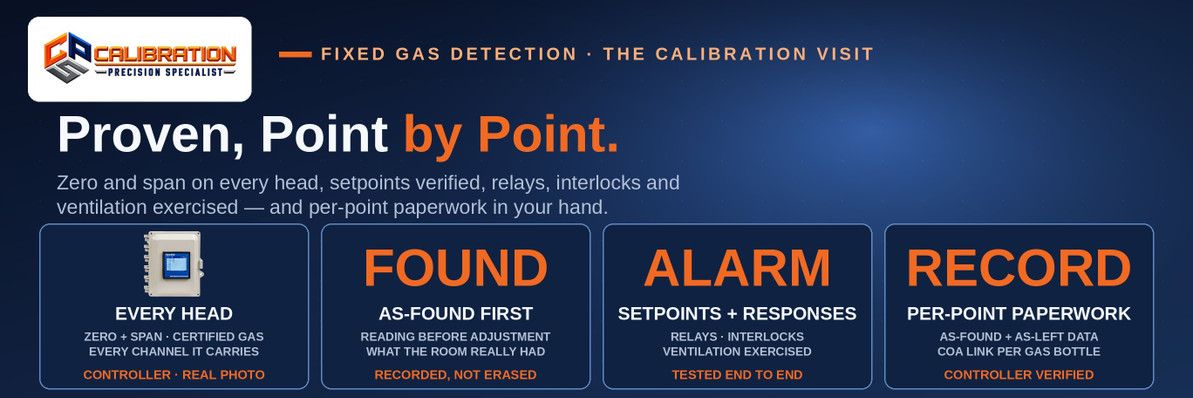
On a proper fixed gas detection calibration visit, every head in the system is calibrated — zero and span, with certified gas — and that is only the start: alarm setpoints are verified, the relay, interlock, and ventilation responses those alarms trigger are tested, the readings are confirmed at the controller, and you are left with written documentation for every point, including each head's as-found reading from before it was adjusted. If a visit does less than that, it is a sensor adjustment, not a calibration of the system that is supposed to protect the room.
Most people have never watched a fixed calibration done properly, so they have no way to judge the one they are paying for — or the one a well-meaning employee does with a single gas bottle and good intentions. This post is the visit, step by step, exactly as CPS runs it: what happens at each head, what gets tested beyond the head, what you should have ready before the technician arrives, and what paperwork should be in your hand when the truck leaves. It sits alongside how often fixed gas detectors need calibration, 5 signs your fixed gas detection system is being neglected, and fixed system calibration: your own staff or a service provider?, and the service itself starts at fixed system installation and service.
Step 1 — The Walk-Through and the As-Found Record
The visit starts with the system as it actually is, not as the drawings say it should be. Each head is located, identified, and matched to its point on the controller. Before anything is adjusted, the head's condition is noted — physical damage, obstruction, paint, a blocked inlet — and, critically, its as-found state is captured as calibration begins: what the head reads when certified gas is applied, before any adjustment. That as-found record is the most honest document in the whole visit. It tells you what protection the room actually had during the months since the last calibration, and over several visits it tells you which heads drift, how fast, and in which environments. A visit that adjusts first and records later has thrown that evidence away.
Step 2 — Zero and Span on Every Head, With Certified Gas
The calibration itself is done head by head, in place: a zero adjustment in clean air, then a span adjustment using certified calibration gas at a known concentration. We calibrate every channel on every head — on a multi-gas head, each channel gets its own zero and span; there is no sampling a few convenient points and calling the system done. The gas matters as much as the procedure: certified gas is what makes the as-left reading traceable to a known concentration rather than to whatever was in an unlabeled bottle. When a head will not calibrate — it cannot reach span, or its reading is unstable — that is a finding, not a footnote: the head or sensor needs attention, and any repair or parts work is quoted in writing before it is done, never folded silently into the visit.
Step 3 — Alarm Setpoints and the Responses They Trigger
A detector that reads correctly but never acts is a display, not a safety system. So the visit verifies alarm setpoints: each head is taken through its alarm levels with gas, and the setpoints are confirmed against what the system is supposed to do. Then the responses are tested end to end — the relays operate, interlocks respond, ventilation starts or changes state as designed, and any connected notification does what the design says it should. This is the step most often skipped in a quick visit, and it is where neglected systems confess: relays that were bypassed during a nuisance-alarm week and never restored, ventilation that no longer starts, outputs nobody has exercised in years. Finding that on a scheduled Tuesday is the entire point; finding it during a leak is the failure the system exists to prevent.
Step 4 — Controller Readout Verification
Finally, what the head measures is checked against what the controller shows. The reading at the point of detection and the reading an operator sees at the panel have to agree — a correct head feeding a mis-scaled or mislabeled controller channel produces confident, wrong information at exactly the place people look during an event. Each point's readout is verified against the calibrated head, point names and locations are confirmed against reality, and discrepancies are corrected or documented. The system you are left with is one where the number on the screen is the number at the head, for every point.
What Should You Have Ready Before the Visit?
A little preparation makes the visit faster and the testing complete. Have access arranged for every head — ladders, lifts, keys, and escorts for restricted areas — because a head that cannot be reached cannot be calibrated, and it will be documented as not done. Tell the technician about any known problems up front: the head that alarms for no reason, the relay that was bypassed, the point that has read oddly since the renovation. Flag anything that will be affected by response testing — ventilation changes, interlocked equipment, notifications — so operations can plan around alarms being deliberately triggered. And have the system's previous records available if they exist; the as-found comparison across visits is where drift patterns show up. None of this is onerous, and the visit still works without most of it — but response testing in particular goes better when nobody is surprised by a fan starting.
What Documentation Do You Hold Afterward?
Written documentation per point: every head identified, its as-found and as-left readings, setpoint verification, the response tests performed, and any findings — heads that could not be reached, heads that failed calibration, recommended repairs with written quotes where work is needed. CPS certificates carry one tier only: the full breakdown, as-found and as-left data, and a clickable Certificate of Analysis link for each calibration gas bottle used, so every number traces back to documented gas. Each point also enters the CPS Calibration Program record — one record per point, with its next due date set and a reminder ahead of it — so this visit becomes the baseline the next one is measured against, instead of a certificate in a drawer nobody can find. If your last calibration left you with a single line saying "system serviced," hold it up against this list: the gap between the two is the gap between an adjustment and a calibration.
Frequently Asked Questions
What happens during a fixed gas detection calibration visit?
Every head is calibrated in place — zero and span with certified gas, on every channel the head carries — with its as-found reading recorded before adjustment. Alarm setpoints are then verified, the relay, interlock, and ventilation responses are tested end to end, the readout is confirmed at the controller, and you receive written documentation per point. Anything found beyond calibration, such as a failed sensor, is quoted in writing before work is done.
How long does a fixed gas detection calibration visit take?
It depends on the system: the number of points, how accessible each head is, and how much response testing the design requires — a handful of heads with simple relay outputs is a shorter visit than a large system with interlocks and ventilation sequences to exercise. The honest answer for your system comes when the visit is scheduled, once the point count and access are known. Call 865-900-8844 and we will scope it from your actual system rather than guess.
What is an as-found reading, and why is it recorded before adjustment?
The as-found reading is what a head actually reads when certified gas is applied to it before anything is adjusted — a measurement of the protection the room really had since the last calibration. Recording it first is what separates calibration from a quick tweak: it proves how far the head had drifted, identifies heads and environments that drift fastest, and gives the next visit a baseline. Adjusting first and recording afterward destroys that evidence permanently.
Does a calibration visit test alarms, relays, and ventilation too?
A proper one does — and that testing is the difference between calibrating sensors and calibrating a system. Setpoints are verified with gas, and the responses they trigger are exercised: relays operate, interlocks respond, and ventilation starts or changes state as designed. That is how bypassed relays and dead outputs are found on a scheduled visit instead of during a real release. If a visit only adjusts heads and leaves, half the safety function was never tested.
What should we have ready before a fixed calibration visit?
Access to every head — ladders, lifts, keys, and escorts for restricted areas — plus a heads-up about known problems such as nuisance alarms or bypassed relays. Let operations know that response testing will deliberately trigger alarms and may start ventilation or exercise interlocks, so nobody is surprised. Previous calibration records help if you have them, because comparing as-found readings across visits is how drift patterns are spotted. A head that cannot be reached will be documented as not calibrated.
What documentation do we get after a fixed calibration visit?
Written documentation per point: each head identified, its as-found and as-left readings, alarm setpoint verification, the response tests performed, and any findings or recommended work. CPS certificates are one tier — the full breakdown every time, including as-found and as-left data and a clickable Certificate of Analysis link for each calibration gas bottle used on the job. Each point's record and next due date are also kept in the CPS Calibration Program, with a reminder before it comes due.
What happens if a head fails calibration during the visit?
You get the finding in writing: the head's as-found condition, what it would not do, and a written quote for the repair or parts it needs — before any of that work is done. A calibration visit is never a blank check that quietly becomes a repair bill. You decide whether to approve the work, and the rest of the system is still calibrated, tested, and documented, with the failed point clearly flagged rather than buried.
Will the calibration visit set off our alarms and ventilation?
Yes, deliberately — that is the response-testing step, and it is arranged with you in advance. Triggering each alarm level with gas is the only way to prove setpoints, relays, interlocks, and ventilation actually respond. Operations should know it is happening and roughly when; anything that must not be exercised can be identified beforehand and its exclusion documented, rather than the testing being skipped silently.
Do you calibrate every channel, or just check the system overall?
Every channel, on every head. A multi-gas head gets a zero and span for each of its channels with certified gas — there is no representative sampling of a few points to stand in for the system. Each point then gets its own as-found and as-left record, because heads in different environments drift at different rates and a system-level average would hide exactly the head that needs attention.
How do we book a fixed gas detection calibration visit?
Call CPS Calibrations at 865-900-8844. We will walk through your system's points, access, and response-testing needs, and schedule the on-site visit. You can also start from fixed system installation and service or calibration services. After the visit, your per-point records live in the CPS Calibration Program with due-date reminders, so booking the next one is not something anybody has to remember unaided.
The Bottom Line
A fixed calibration visit, done properly, is a full proof of the system: zero and span on every channel of every head with certified gas, as-found readings captured before adjustment, setpoints verified, relays, interlocks, and ventilation exercised, controller readouts confirmed, and written per-point documentation left in your hand. Anything less tests the sensors and trusts the rest.
Ready to see your system actually proven? Call CPS Calibrations at 865-900-8844 to schedule the visit.
CPS Calibrations · 109 S. Front Street, Rockwood, TN 37854 · Calibration Services · Fixed System Installation · How Often Do Fixed Gas Detectors Need Calibration?
Ready to mail yours in?
Start the ship-in request, pack the meter, and we handle the rest — every channel calibrated as configured, full certificate returned with it.
Start Your Ship-In Requestor call 865-900-8844
Recent Posts
-

Can You Add a Pump to a SENKO SGT-P or MGT?
Yes — SENKO's SP-Pump101 external sampling pump ($330, part AAA006000) fits the SGT, SGT-P, and MGT, …Nov 12th 2026 -

What Refrigerant Detection Does a Grocery Store Need?
A grocery store needs refrigerant detection in three places: low-mounted carbon dioxide (R-744) sens …Nov 11th 2026 -

What Is LEL and UEL? The Explosive Range, Gas by Gas
The LEL is the lowest concentration of a gas in air that can explode, and the UEL is the highest: me …Nov 10th 2026