
Fixed System Calibration: Your Own Staff or a Service Provider?
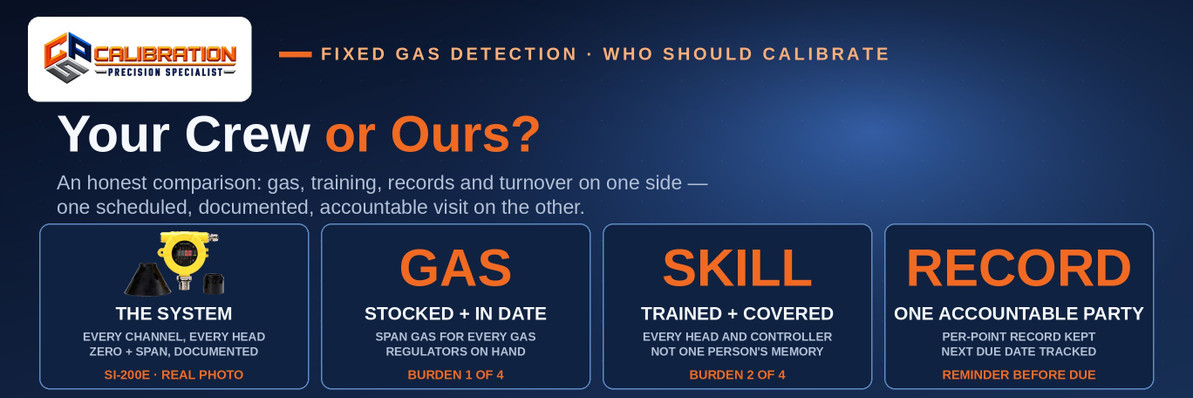
Both routes can calibrate a fixed gas detection system correctly — the honest difference is everything around the calibration itself. Doing it with your own staff means your facility owns the whole burden continuously: certified span gas and regulators on hand and in date for every gas the system uses, people trained on each head and controller you run, records kept per point with discipline that survives staff turnover, and due dates somebody watches. A scheduled service provider concentrates that burden into a visit: the gas, the procedure, the alarm and response testing, and the documentation arrive together, and one accountable party holds the records and the next due date. Neither answer is right for every facility — this post lays out both honestly so you can judge yours.
This is not a sales argument dressed as a comparison. Facilities with strong instrument shops calibrate fixed systems in-house for years and do it well, and this post will describe exactly what "well" requires so you can measure your own operation against it. Facilities without that depth are often not choosing between two working options — they are choosing between a service provider and a calibration that quietly does not happen, or happens without gas, without records, or without the response testing that makes it a system calibration. The companion posts fill in the rest: how often fixed gas detectors need calibration, what happens on a fixed gas detection calibration visit, and 5 signs your fixed gas detection system is being neglected, with CPS's own service at fixed system installation and service.
What Does Calibrating In-House Actually Require?
Four things, all of them continuous. Gas and regulators, on hand and in date. Every gas the system measures needs its certified span gas, with the correct regulator, physically present and within its usable life when calibration day arrives — not on order, not expired in the back of the cabinet. A mixed system can mean several gases and regulators to stock, track, and replace on a schedule of their own. Training that covers your actual equipment. The person calibrating has to know each head and controller you run: how to enter calibration mode, set zero and span, verify setpoints, and exercise relays, interlocks, and ventilation without creating a hazard or a production incident — and that knowledge has to exist in more than one person's head. Records discipline. Every point, every visit: as-found and as-left readings, setpoint and response verification, gas used, findings. Records kept "in the shop" in a format only one person understands are records with an expiration date. Coverage through turnover. The day your trained calibrator leaves, retires, or is on vacation during the due window, the system's schedule depends on whoever inherits it — and what they inherit is whatever the records and stock say, which is why the first three requirements matter.
None of that is impossible. It is, however, a small standing program — and the facilities that run it well treat it as one, with named owners, stocked consumables, and audits of their own records. The facilities that struggle are the ones where in-house calibration is a task rather than a program: it happens when someone remembers, with whatever gas is on the shelf, and leaves whatever paperwork time allows.
What Does a Scheduled Service Provider Actually Take On?
A calibration visit from a service provider compresses the program into an event. The provider arrives with certified gas and regulators matched to your gases, performs zero and span on every channel of every head, records as-found readings before adjustment, verifies alarm setpoints, tests the relay, interlock, and ventilation responses, confirms readouts at the controller, and hands you written documentation per point when the visit ends. The records burden moves with the work: under the CPS Calibration Program, each point keeps one record — its calibration history, its interval, its next due date — and the reminder comes to you before the date arrives instead of the date being discovered afterward. Accountability concentrates too: one party performed the work, signed the documentation, and owns the schedule, which is the position you want to be in when an auditor, an insurer, or an incident review asks who calibrated point seven and what it read when they arrived. What a provider does not remove is your part of the day: access to heads, a heads-up about known problems, and operations awareness that alarms and ventilation will be exercised — the preparation described in what happens on a fixed gas detection calibration visit.
How Should You Decide for Your Facility?
Judge the in-house option by its weakest link, because drift exploits exactly that. If gas stock, trained coverage, records, and due-date ownership are all genuinely in place — verified, not assumed — in-house calibration is a legitimate, working answer, and the discipline you already have is the asset. If any one of the four is shaky, be honest about which failure it produces: expired gas means calibrations slip or get done with gas that cannot certify the reading; single-person knowledge means the schedule is one resignation away from the neglect pattern; thin records mean you cannot prove protection during an audit even if the work was done. Many facilities also land on a hybrid honestly: their staff handle routine checks and call a provider for the full documented calibration — the visit that produces the as-found record, the response testing, and the per-point certificate. The deciding question is not who can turn the adjustment. It is who owns the whole chain — gas, skill, records, dates — on the worst week of the year, not the best one. If that answer is unclear, it is the answer.
CPS calibrates fixed systems on site as that accountable party: every channel, documented per point, repairs and parts quoted in writing before work, and each point's next due date tracked with a reminder. To talk through which route fits your facility — including an honest "your crew has this covered" if they do — call 865-900-8844.
Frequently Asked Questions
Can our own staff calibrate our fixed gas detection system?
Yes — if the full chain is in place. That means certified span gas and the correct regulators on hand and in date for every gas the system uses, people trained on each head and controller you run (with coverage beyond one person), per-point records kept with real discipline, and a named owner for due dates. Facilities with a strong instrument shop do this well for years. The question is never whether a person can perform the adjustment; it is whether those four supports exist continuously.
What calibration gas and equipment do we need to calibrate fixed detectors in-house?
Certified span gas for every gas and channel your system measures, plus the correct regulator for each cylinder type — stocked in advance and within its usable life on calibration day, not ordered when the due date arrives. A mixed-gas system can require several gases and regulators, each with its own replacement rhythm. Expired or missing gas is the most common quiet reason in-house calibrations slip a month, then a quarter.
What training does in-house fixed calibration require?
Working knowledge of every head and controller model on your system: entering calibration mode, performing zero and span adjustments, verifying alarm setpoints, and exercising relay, interlock, and ventilation responses safely — including coordinating with operations before alarms are deliberately triggered. It also needs depth: if exactly one employee holds that knowledge, the calibration program has the same single point of failure as any other one-person system in the plant.
What records do we need to keep if we calibrate in-house?
Per point, per visit: the head identified, its as-found reading before adjustment, its as-left reading after, alarm setpoint verification, the response tests performed, the calibration gas used, and any findings. That record is what proves protection during an audit or an incident review — "we calibrated it" without the as-found data is an assertion, not evidence. It also has to survive staff turnover in a form the next person can actually use.
What does a service provider do that our staff would otherwise have to handle?
The whole chain, in one scheduled visit: certified gas and regulators matched to your gases, zero and span on every channel of every head, as-found readings recorded before adjustment, setpoint verification, relay, interlock, and ventilation response testing, controller readout confirmation, and written documentation per point handed to you. The provider also carries the schedule — under the CPS Calibration Program each point's record and next due date are tracked, with a reminder before it arrives.
Is using a service provider better than calibrating in-house?
Neither is automatically better — they are different allocations of the same burden. A facility with stocked gas, trained depth, disciplined records, and owned due dates runs in-house calibration legitimately and well. A facility missing any of those is often not really running in-house calibration; it is running good intentions with gaps that drift exploits. A provider concentrates the burden into a visit with one accountable party. Judge your facility against the four requirements honestly and the answer usually names itself.
What happens to our calibration program when the employee who handles it leaves?
Whatever the records and stock say — which is why turnover is the stress test of every in-house program. If gas inventory, procedures, per-point records, and due dates exist as a system a successor can pick up, the program survives the departure. If they existed as one person's habits, the schedule slips until somebody notices, and fixed heads drift silently in the meantime. It is the most common path from a working system to a neglected one.
Can we handle some of it in-house and use a provider for the rest?
Yes, and it is a common honest arrangement. Staff who know the system can handle routine checks and first response to alarm events, while a provider performs the full documented calibration — the visit that produces per-point as-found and as-left records, gas-traceable certificates, and end-to-end response testing. That split keeps daily familiarity in-house and puts the auditable record on a scheduled, accountable footing. What matters is that the boundary between the two is explicit, not assumed.
Who is accountable if a fixed detector was out of calibration during an incident?
Whoever owned the calibration — which is precisely why ownership has to be explicit before anything happens. With in-house calibration, accountability sits with the facility and its records: the per-point history is the evidence of what was done and when. With a service provider, the provider's signed per-point documentation and tracked schedule are that evidence. Either way, the worst position is ambiguity — dates nobody owned and records nobody can produce.
How do we switch from in-house to a service provider without a gap?
Call CPS Calibrations at 865-900-8844 and bring whatever records you have — even partial ones. The first visit establishes the baseline: every point located and identified, as-found readings recorded for every channel, setpoints and responses verified, and documentation per point. From that visit forward, each point lives in the CPS Calibration Program with its interval, history, and next due date tracked, so the handover is a record, not a memory. Start at fixed system installation and service or calibration services.
The Bottom Line
In-house fixed calibration works when four things hold continuously — certified gas and regulators stocked and in date, trained people with depth, disciplined per-point records, and a named owner for every due date. A service provider exists for every facility where one of those four is shaky: the same work, delivered as a scheduled visit, with documentation handed to you and one accountable party holding the schedule. Decide by your weakest link, not your best week.
Want a straight read on which route fits your system? Call CPS Calibrations at 865-900-8844 — we will tell you honestly if your crew already has it covered.
CPS Calibrations · 109 S. Front Street, Rockwood, TN 37854 · Calibration Services · Fixed System Installation · What Happens on a Fixed Gas Detection Calibration Visit?
Ready to mail yours in?
Start the ship-in request, pack the meter, and we handle the rest — every channel calibrated as configured, full certificate returned with it.
Start Your Ship-In Requestor call 865-900-8844
Recent Posts
-

Can You Add a Pump to a SENKO SGT-P or MGT?
Yes — SENKO's SP-Pump101 external sampling pump ($330, part AAA006000) fits the SGT, SGT-P, and MGT, …Nov 12th 2026 -

What Refrigerant Detection Does a Grocery Store Need?
A grocery store needs refrigerant detection in three places: low-mounted carbon dioxide (R-744) sens …Nov 11th 2026 -

What Is LEL and UEL? The Explosive Range, Gas by Gas
The LEL is the lowest concentration of a gas in air that can explode, and the UEL is the highest: me …Nov 10th 2026