
How Often Do Fixed Gas Detectors Need Calibration?
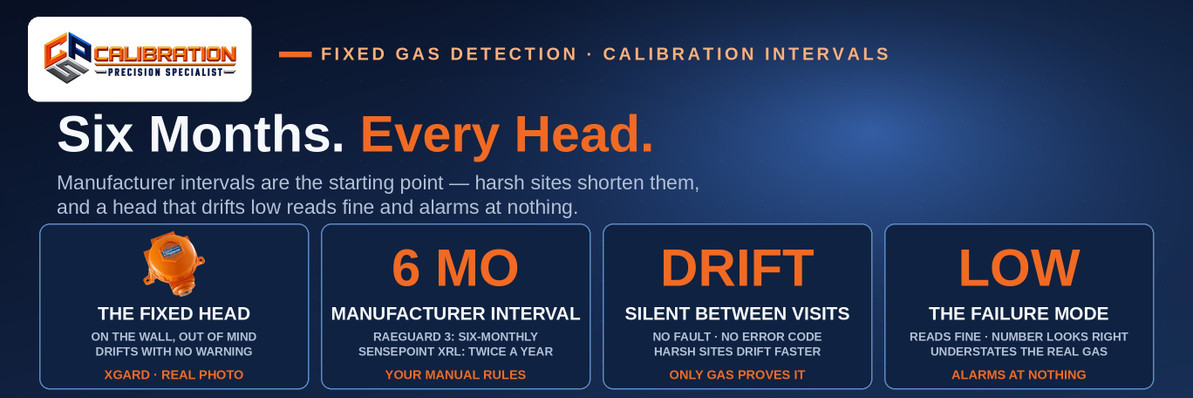
Fixed gas detectors should be calibrated at the interval in the manual for your specific head — and for many fixed heads that interval is six months: Honeywell Analytics recommends that its fixed RAEGuard 3 detectors be tested and recalibrated on a six-monthly basis, and its fixed Sensepoint XRL manual calls for gas calibration at least twice a year. Treat six months as the starting point, shorten it in harsh environments, and never let a head run past its manufacturer's interval, because a fixed head drifts silently between calibrations and gives no warning when it has drifted low.
A portable detector gets handled every day. Somebody bumps it, charges it, looks at its screen, and notices when it behaves strangely. A fixed head gets none of that attention. It sits on a wall or a pipe rack doing its job in silence — which is exactly why its calibration date matters more, not less. Nothing about a fixed head announces that its readings have slid. The display still lights up, the controller still shows a number, and the system looks healthy right up until the day the number is wrong. This post covers how often that calibration needs to happen, what shortens the interval, and why the failure mode is worse than most people expect. When you are ready to put dates on a calendar, fixed system installation and service is where CPS starts, and the companion posts — what happens on a fixed gas detection calibration visit, 5 signs your fixed gas detection system is being neglected, and fixed system calibration: your own staff or a service provider? — cover the visit itself, the warning signs, and who should do the work.
What Interval Do Manufacturers Actually Specify?
Start with the manual for the head you own — that document, not a rule of thumb, sets your interval. The pattern across manufacturers is consistent enough to plan around. Honeywell's RAEGuard 3 is a fixed gas detector, and its user manual states that Honeywell Analytics recommends gas detectors be tested and recalibrated on a six-monthly basis, or according to site practice, with recalibration as soon as possible after a toxic sensor is exposed to a concentration significantly above its measuring range. Honeywell's fixed Sensepoint XRL manual likewise requires gas calibration at least twice a year — a six-month interval — to maintain its UL 2075 evaluation for carbon monoxide and methane. Other fixed-detector manuals land in the same place: the interval is measured in months, not years, and the manual frames it as a maximum, not a target to stretch.
Two honest limits on that guidance. First, these are examples from manuals we read for this post — your head's manual is the authority for your system, and some heads and sensor types specify shorter intervals. Second, "according to site practice" cuts one way only: a documented site practice can justify calibrating more often, backed by as-found drift data. It is not a license to let dates slide because nothing has gone wrong yet. Nothing going wrong yet is what drift looks like from the outside.
Why Do Harsh Environments Shorten the Interval?
Calibration intervals assume a reasonably kind environment, and many fixed heads do not live in one. Heat, humidity, dust, corrosive vapors, vibration, and repeated exposure to the target gas itself all work on a sensor between calibrations, and the established pattern is simple: harsh environments accelerate drift. A head watching a wastewater wet well, a loading dock in summer, or a process area with routine low-level gas exposure is working harder than the same head in a clean electrical room, and its readings will move sooner.
The practical response is to let the as-found data set the interval. Every proper calibration records what the head was reading before adjustment. If visit after visit shows a head arriving well within tolerance, its interval is holding. If a head keeps arriving significantly off — especially reading low — that head's environment is telling you the interval is too long for it, whatever the calendar says. Shorten it for that point, note why in the record, and let the next as-found reading judge the decision. That is what a record per point is for, and it is how the CPS Calibration Program approach treats fixed points: one record per point, with due-date reminders set from the interval that point actually needs.
What Is the Failure Mode That Actually Matters?
Drift has a direction, and the dangerous direction is down. A head that drifts high is a nuisance — it alarms when it should not, people investigate, and the problem announces itself. A head that drifts low is silent. It reads fine. It shows a plausible number on the controller. It simply reads less gas than is actually there — so at the moment a real leak pushes the atmosphere to the alarm setpoint, the head's understated reading stays below it, and it alarms at nothing. No fault light, no error code, no warning: the sensor is still alive and still responding, just responding less than it should.
That is why "the system seems fine" proves nothing about a fixed system. The only test that catches low drift is putting certified gas on the head at a known concentration and comparing what it reads — which is precisely what a calibration visit does, head by head, with the as-found reading written down before anything is adjusted. A head that has never had gas applied to it between installations has never actually been tested at all; it has only been observed not to be obviously broken.
How Do You Keep Fixed Calibrations From Slipping?
Treat fixed points the way you treat any other dated safety device. Every point gets a named interval from its manual, a due date derived from its last calibration, and an owner — a person or a service provider whose job it is to see the date coming. Records are kept per point, not per system, because heads on the same controller live in different environments and drift at different rates. And the schedule is set from the shortest-interval point outward, so one neglected head cannot hide inside a system that was "done last year."
If nobody at your facility currently owns those dates, that gap — not the hardware — is the first thing to fix. CPS calibrates fixed systems on site: we calibrate every channel on every head with certified gas, verify alarm setpoints and the responses they trigger, and leave written documentation per point, with each point's next due date tracked and a reminder ahead of it. Call 865-900-8844 to put your fixed points on a schedule.
Frequently Asked Questions
How often do fixed gas detectors need calibration?
At the interval in the manual for your specific head — and for many fixed heads that is six months. Honeywell Analytics recommends six-monthly testing and recalibration for its fixed RAEGuard 3, and its fixed Sensepoint XRL manual requires gas calibration at least twice a year. Start with your manual's interval, shorten it where the environment is harsh or as-found readings show drift, and never exceed the manufacturer's maximum.
Is a six-month calibration interval right for every fixed detector?
No. Six months is a common manufacturer interval, not a universal one. Your head's manual is the authority — some heads and sensor types specify shorter intervals, and a toxic sensor that has been exposed to gas significantly above its measuring range should be recalibrated as soon as possible afterward, whatever the calendar says. Use the manual first, then your own as-found drift records.
What happens if a fixed gas detector is not calibrated on time?
It keeps running and keeps displaying readings — that is the problem. Sensors drift silently between calibrations, and a head that has drifted low understates the gas that is actually present, so it can fail to alarm at its setpoint during a real release. There is typically no fault indication for drift. The system looks healthy while its protection quietly shrinks, which is why overdue fixed calibration is a safety gap, not a paperwork gap.
Does a bump test or function check replace fixed detector calibration?
No. Applying gas to confirm a head responds and alarms is a useful function check, but it does not adjust the head's reading to a known concentration. Calibration is a zero and span adjustment on every head using certified gas, with the as-found reading recorded before adjustment and the as-left reading after. A head can pass a quick response check while still reading significantly low — only a span calibration against certified gas measures and corrects that.
How does the environment affect how often a fixed detector needs calibration?
Harsh conditions accelerate drift: heat, humidity, dust, corrosive vapors, vibration, and repeated exposure to the target gas all move a sensor's reading sooner than the manual's baseline interval assumes. Heads in wet wells, process areas, and outdoor or dusty locations commonly need shorter intervals than identical heads in clean indoor rooms. Your as-found calibration records are the evidence — heads that repeatedly arrive out of tolerance need a shorter interval.
Can a fixed gas detector look fine and still be wrong?
Yes — that is the normal failure mode. Drift does not usually produce a fault or an error; the head keeps producing a smooth, plausible reading that is simply lower (or higher) than the truth. A low-reading head is the dangerous case: at a real leak it can stay below its alarm setpoint and alarm at nothing. The only way to know a head reads correctly is to apply certified gas at a known concentration and compare.
Who is responsible for tracking fixed detector calibration dates?
Whoever owns the system — and the honest answer at many facilities is nobody, which is how dates slip. Every fixed point needs a named owner for its due date: a staff member with the records and reminders to do it, or a service provider who tracks each point and schedules the visit. CPS's Calibration Program keeps one record per point with due-date reminders, so the date is flagged before it passes instead of discovered after.
Does calibration include checking alarms and relays, or just the sensors?
A proper fixed calibration is more than the sensor adjustment. It includes zero and span calibration on every head with certified gas, verification of alarm setpoints, testing that relay, interlock, and ventilation responses actually operate, confirmation of the readout at the controller, and written documentation per point. Adjusting the head without testing what its alarm triggers leaves half the safety function unverified.
What records should I have for each fixed detector calibration?
Written documentation per point: which head, its as-found reading before adjustment, its as-left reading after, the alarm setpoint verification and response tests, and the calibration gas used. CPS certificates are a single tier — every certificate carries the full breakdown, including as-found and as-left data and a clickable Certificate of Analysis link for each gas bottle used — so the record shows both what the head was doing and the documented gas the numbers trace back to.
How do I get my fixed gas detection system on a calibration schedule?
Call CPS Calibrations at 865-900-8844. We will go through your points, set each head's interval from its manual, and schedule the on-site visit — calibrating every channel on every head, verifying setpoints and responses, and leaving per-point documentation with the next due dates tracked. Fixed-system service is arranged per system; start with fixed system installation and service or the call.
The Bottom Line
Calibrate fixed gas detectors on the manufacturer's interval for each head — commonly six months, as Honeywell specifies for fixed heads like the RAEGuard 3 and Sensepoint XRL — shorten it where the environment or your as-found records demand, and never trust a head's calm display as evidence it reads correctly. Drift is silent, the dangerous direction is down, and the only proof is certified gas on the head and the reading written down.
Not sure when your fixed heads were last calibrated? Call CPS Calibrations at 865-900-8844 and we will build the schedule point by point.
CPS Calibrations · 109 S. Front Street, Rockwood, TN 37854 · Calibration Services · Fixed System Installation · What Happens on a Fixed Gas Detection Calibration Visit?
Ready to mail yours in?
Start the ship-in request, pack the meter, and we handle the rest — every channel calibrated as configured, full certificate returned with it.
Start Your Ship-In Requestor call 865-900-8844
Recent Posts
-

Can You Add a Pump to a SENKO SGT-P or MGT?
Yes — SENKO's SP-Pump101 external sampling pump ($330, part AAA006000) fits the SGT, SGT-P, and MGT, …Nov 12th 2026 -

What Refrigerant Detection Does a Grocery Store Need?
A grocery store needs refrigerant detection in three places: low-mounted carbon dioxide (R-744) sens …Nov 11th 2026 -

What Is LEL and UEL? The Explosive Range, Gas by Gas
The LEL is the lowest concentration of a gas in air that can explode, and the UEL is the highest: me …Nov 10th 2026