
What Does LEL Mean? Percent LEL Explained
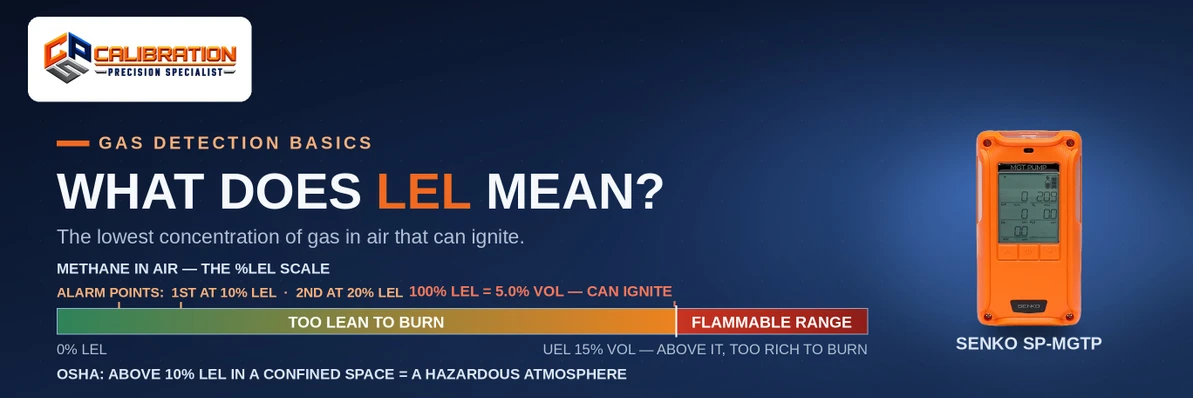
LEL stands for Lower Explosive Limit — the lowest concentration of a flammable gas in air that can ignite — and a reading in %LEL tells you what fraction of that limit is present. For methane, whose LEL is 5% by volume, 100% LEL means 5% gas in air (50,000 ppm), 50% LEL means 2.5% gas, and the familiar 10% LEL first alarm means just 0.5% gas — one-tenth of the way to an ignitable atmosphere.
That one idea — %LEL is a fraction of a gas-specific limit, not a concentration in its own right — explains almost everything else about combustible gas detection: why the same alarm setting works for different gases, why 10% LEL is the line regulators draw, and why a reading can look small while the margin it describes is doing all the work.
What Does LEL Mean, Exactly?
Every flammable gas ignites only inside a concentration window. Below the window there is too little fuel for a flame to sustain itself; above it there is too little oxygen. The bottom of the window is the LEL. Fire needs fuel, oxygen, and an ignition source, and the LEL is the point where the fuel leg of that triangle first becomes sufficient.
Two consequences follow. First, each gas has its own LEL, because each fuel needs a different mixture strength to burn. Second, the LEL is expressed as a concentration in its own right — a % by volume figure — and %LEL is then built on top of it: 100% LEL is defined as exactly that concentration, whatever the gas. When your detector reads 25% LEL, it is saying the atmosphere holds one quarter of the amount of that gas needed to ignite.
What Is the Difference Between %LEL and % Volume?
% volume is an absolute measurement: the gas's actual share of the air. %LEL is a relative one: the reading as a percentage of that particular gas's explosive limit. The same atmosphere can be described either way, and the numbers look nothing alike:
| Methane in air | % volume | %LEL | ppm |
|---|---|---|---|
| First alarm point | 0.5% | 10% LEL | 5,000 ppm |
| Halfway to ignitable | 2.5% | 50% LEL | 25,000 ppm |
| Ignitable mixture reached | 5.0% | 100% LEL | 50,000 ppm |
Detectors use %LEL for combustibles because the hazard itself is relative. A 10% LEL alarm means "one-tenth of the way to a fire" for methane, for propane, and for solvent vapor alike — the safety margin is identical even though the actual gas concentrations differ by more than two to one. If monitors read combustibles in % volume instead, every gas would need its own alarm number memorized, and a setting that was prudent for methane would be far too late for a gas with a lower LEL. %LEL is the scale that makes different gases comparable by risk — which is exactly why it, and not % volume, is what the combustible channel of your monitor displays.
What Are the LEL and UEL of Common Gases?
The top of the flammable window is the UEL — the Upper Explosive Limit — above which the mixture is too rich to burn. The figures below are from RKI Instruments' published chart of common combustible gas LELs and UELs (authorities quote slightly different values, because the limits are measured experimentally):
| Gas | LEL (% by volume) | UEL (% by volume) |
|---|---|---|
| Methane | 5.0% | 15.0% |
| Propane | 2.1% | 9.5% |
| Hydrogen | 4.0% | 75.6% |
| Pentane | 1.5% | 7.8% |
| Hexane | 1.1% | 7.5% |
| Acetone | 2.15% | 13.0% |
| Ethyl alcohol | 3.3% | 19.0% |
| Methanol | 6.0% | 36.0% |
| Toluene | 1.2% | 7.0% |
| Acetylene | 2.5% | 100% |
Read the methane and propane rows against each other. A leak that fills a space to 2% gas by volume is 40% LEL if the gas is methane — serious, but below the limit — and roughly 95% LEL if it is propane, on the edge of ignitable. Same concentration, completely different emergency. That is why "how much gas is in the air?" is the wrong first question and "how close is it to its LEL?" is the right one.
Note acetylene's UEL of 100%: there is effectively no "too rich" for acetylene in this chart, and hydrogen's flammable window runs from 4% all the way to 75.6% — which is part of why hydrogen leaks are treated with such respect.
Why Do Gas Detectors Alarm at 10% and 20% LEL?
Because the alarm's job is to fire while there is still a wide margin to act. A first alarm at 10% LEL sounds when the atmosphere reaches one-tenth of an ignitable mixture — time to stop work, find the source, and ventilate while the situation is still a leak and not yet a fire risk. A second-stage alarm, commonly 20% LEL, escalates the response: evacuate, kill ignition sources, treat it as an emergency in progress.
The 10% figure is not just convention — it is written into U.S. regulation. OSHA's confined-space standard, 29 CFR 1910.146, defines a hazardous atmosphere to include flammable gas, vapor, or mist in excess of 10 percent of its lower flammable limit. In other words, federal law treats anything above 10% LEL in a permit space as a hazardous atmosphere by definition, and entry decisions turn on it — the sequence is covered in our walkthrough of how to test a confined space before entry. Alarm setpoints are adjustable on most instruments and vary by manufacturer and application, but the logic of the defaults is the factor-of-ten margin: alarm at a tenth of the danger point, not at nine-tenths of it.
Can a Gas Mixture Be Too Rich to Burn?
Yes — above the UEL, a mixture will not ignite because there is not enough oxygen in it. Treat that as a warning, not a comfort. A too-rich atmosphere is one ventilation fan, one opened hatch, or one leaking seal away from diluting down through the flammable range: the mixture does not jump from "too rich" to "safe," it passes through "explosive" on the way. Tank and vessel work lives with this daily — a space that reads over-range on an LEL channel is not cleared; it is unmeasured, which is a different and worse thing. It is also why a standard %LEL sensor, which tops out at 100% LEL, cannot tell you where you are inside a rich mixture: past its range, you know only that you are at or beyond the LEL.
What Does an LEL Sensor Actually Measure?
The sensor in a portable monitor does not count gas molecules; it produces a signal proportional to how much combustible gas is present relative to the gas it was calibrated with. The two common technologies — catalytic bead and infrared — respond differently to different gases, which is why they each have situations where they win; our comparison of catalytic bead vs. infrared LEL sensors works through that choice. The practical consequence to carry from this page: a %LEL reading is exact for the calibration gas and approximate for everything else, because each gas produces a different response per %LEL. That gap is handled with published correction factors — a subject important enough to get its own explainer in this series.
The Bottom Line
LEL is the lowest concentration of a gas in air that can burn, stated in % by volume — 5.0% for methane, 2.1% for propane, 4.0% for hydrogen. %LEL restates any reading as a fraction of that limit, so an alarm at 10% LEL always means a tenfold margin to an ignitable atmosphere, whatever the gas. UEL marks the top of the flammable range, and a mixture above it is a hazard in transit, not a safe one.
Every 4-gas monitor we sell reads its combustible channel in %LEL — the RKI GX-3R at $640 and the SENKO SP-MGT at $485 are the two most common starting points, and the full range is in our portable multi-gas monitors category. If your crew is reading %LEL daily but the numbers have never been explained, that is a training gap worth closing — and if the instrument behind the numbers is due for service, we calibrate every channel. Call 865-900-8844 or reach us through Contact Us.
Frequently Asked Questions
What does LEL stand for? LEL stands for Lower Explosive Limit: the lowest concentration of a flammable gas in air, expressed in % by volume, at which the mixture can ignite. Below the LEL the mixture is too lean to burn. Detectors restate readings as %LEL — the percentage of that limit currently present — so 100% LEL is exactly the ignitable concentration and 10% LEL is one-tenth of it.
What is the LEL of methane? The LEL of methane is 5.0% by volume in air, per RKI Instruments' published chart, and its UEL is 15.0%. In detector terms: 100% LEL methane = 5% gas = 50,000 ppm, 50% LEL = 2.5% gas = 25,000 ppm, and a 10% LEL alarm = 0.5% gas = 5,000 ppm.
What does 50% LEL mean? It means the atmosphere contains half the concentration of that gas needed to form an ignitable mixture. For methane, 50% LEL is 2.5% gas by volume (25,000 ppm); for propane, whose LEL is 2.1% by volume, 50% LEL is about 1.05% gas by volume. The %LEL figure is the same safety statement for both — halfway to a flammable atmosphere.
What is the difference between LEL and UEL? The LEL is the bottom of the flammable range — below it, too little fuel to burn. The UEL (Upper Explosive Limit) is the top — above it, too little oxygen to burn. Only between the two can the mixture ignite. For methane that window is 5.0% to 15.0% by volume; for hydrogen it is a much wider 4.0% to 75.6%.
At what %LEL do gas detectors alarm? Common factory practice is a first alarm at 10% LEL and a second stage at 20% LEL, though setpoints are adjustable and vary by manufacturer and application. The 10% level has regulatory weight: OSHA's confined-space standard (29 CFR 1910.146) defines flammable gas in excess of 10% of its lower flammable limit as a hazardous atmosphere.
Is 100% LEL the same as 100% gas? No. 100% LEL means the gas has reached its Lower Explosive Limit concentration, which for most fuels is a small fraction of the air: 5% gas for methane, 2.1% for propane, 1.5% for pentane. A space at 100% LEL is not full of gas — it holds exactly enough gas to ignite, which is the point of the scale.
What is the LEL of propane? Propane's LEL is 2.1% by volume and its UEL is 9.5% by volume. So 100% LEL propane = 2.1% gas = 21,000 ppm, and a 10% LEL alarm sounds at just 0.21% gas (2,100 ppm) — propane reaches its explosive limit at well under half the concentration methane needs.
Can a gas be too concentrated to burn? Yes — above its UEL a mixture is too rich to ignite for lack of oxygen. It is still dangerous: any fresh air leaking in or ventilation applied dilutes the mixture down through the flammable range on its way to safe. Acetylene is the exception that proves the rule, with a published UEL of 100% — effectively no too-rich region at all.
Why does my gas detector read %LEL instead of % volume? Because %LEL makes the risk comparable across gases. A 10% LEL alarm means a tenfold margin to an ignitable mixture whether the gas is methane (0.5% by volume at that point) or propane (0.21% by volume). Reading % volume instead would force a different safe number for every gas and invite exactly the wrong comparison.
Does an LEL reading tell me which gas is present? No. A combustible sensor responds to flammable gases generally and cannot identify them; its reading is calibrated against one reference gas — commonly methane — and is exact only for that gas. Other gases produce different responses per %LEL, which is why manufacturers publish correction factors, and why a factored reading is an estimate rather than an identification.
CPS Calibrations · 109 S. Front Street, Rockwood, TN 37854 · Portable Gas Detection · Calibration Gas · Calibration Services · Contact Us
Recent Posts
-
Flame Detector vs. Gas Detector: What's the Difference — and Do You Need Both?
A gas detector and a flame detector guard opposite ends of the same incident: a gas detector reads l …Oct 21st 2026 -

How Do You Test a Flame Detector? Self-Tests, Test Lamps, and NFPA 72
You test a flame detector with light, not gas — there is no span gas, no zero gas, and never an open …Oct 21st 2026 -

Why Does a Flame Detector False Alarm — and Which Type Won't?
A flame detector false alarms because something that is not a fire is producing the signal it watche …Oct 21st 2026