
LEL Correction Factors: Why a Methane-Calibrated Detector Reads Other Gases Wrong
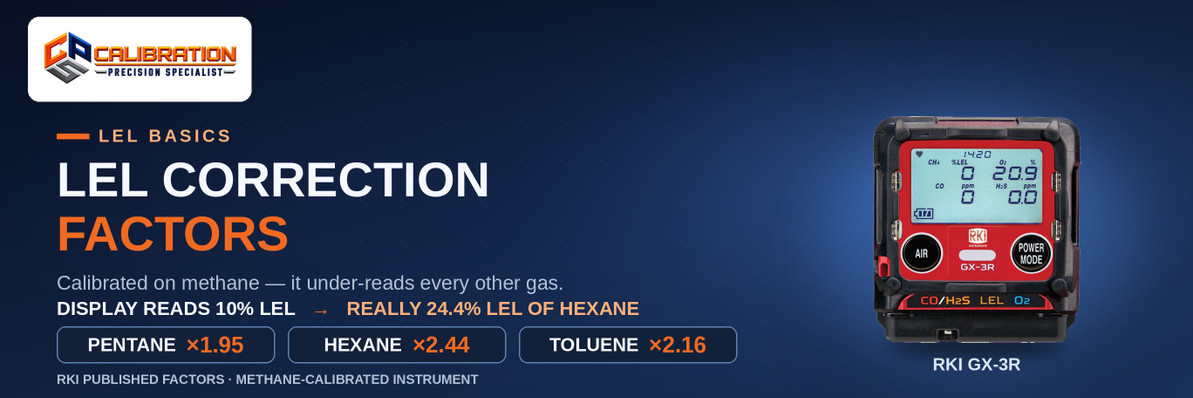
A catalytic LEL sensor calibrated on methane does not respond equally to other gases — it responds less to most of them. In RKI Instruments' published conversion table for a methane-calibrated instrument, pentane's LEL factor is 1.95 and hexane's is 2.44, meaning the display shows roughly half the true pentane concentration and about 40% of the true hexane concentration: a calm 10% LEL reading over hexane vapor is really 24.4% LEL. The fixes are to calibrate to the target gas, apply the manufacturer's published factor, or both.
This is the quietest dangerous error in gas detection. The instrument is working. The sensor is healthy, the calibration is current, the reading is steady — and it is wrong by a factor of two in the unsafe direction, for a reason built into the physics of the sensor.
Why Does a Methane-Calibrated Sensor Read Other Gases Wrong?
A catalytic bead sensor measures combustible gas by burning it on a heated bead and reading the heat released. Two things differ between gases. First, each gas releases a different amount of heat per %LEL burned. Second, each gas reaches the bead at a different rate — heavy solvent molecules diffuse more slowly than light methane molecules. The combined output is a response curve that is exact for one gas only: the one in the calibration cylinder.
Manufacturers calibrate LEL channels to a reference gas — methane is the most common — and express every other gas's response relative to it as a correction factor (also called a conversion or response factor). The calibration makes the instrument perfectly accurate for methane in percent LEL terms, and systematically approximate for everything else. In RKI's table, every listed gas except methane itself has a factor above 1.00 — which means a methane-calibrated catalytic sensor under-reads all of them. Under-reading is the dangerous direction: the true atmosphere is always worse than the number on the screen.
What Is an LEL Correction Factor, and How Do You Use It?
RKI publishes its factors as a multiplier:
True concentration (%LEL of the target gas) = displayed reading × LEL factor
The table below is RKI's published Table 4 from the Eagle instruction manual — "Full Response Mode Conversion Factors (Methane Calibration)" — with two columns of our arithmetic added so you can see what the factor costs you in practice. Factors differ between manufacturers and between sensor models; this table corrects one maker's methane-calibrated catalytic instruments, and your instrument's own manual is the only authoritative source for yours.
| Target gas | RKI LEL factor | Display reads 10% LEL — actual is | Display reads 50% LEL — actual is |
|---|---|---|---|
| Methane (calibration gas) | 1.00 | 10% LEL | 50% LEL |
| Hydrogen | 1.16 | 11.6% LEL | 58% LEL |
| Methanol | 1.23 | 12.3% LEL | 61.5% LEL |
| Ethyl alcohol | 1.38 | 13.8% LEL | 69% LEL |
| Acetone | 1.40 | 14% LEL | 70% LEL |
| Propane | 1.50 | 15% LEL | 75% LEL |
| Isobutane | 1.61 | 16.1% LEL | 80.5% LEL |
| Benzene | 1.75 | 17.5% LEL | 87.5% LEL |
| Cyclohexane | 1.82 | 18.2% LEL | 91% LEL |
| Pentane | 1.95 | 19.5% LEL | 97.5% LEL |
| Toluene | 2.16 | 21.6% LEL | 108% LEL — over the LEL |
| Isopropanol | 2.22 | 22.2% LEL | 111% LEL — over the LEL |
| Mixed xylenes | 2.36 | 23.6% LEL | 118% LEL — over the LEL |
| Hexane | 2.44 | 24.4% LEL | 122% LEL — over the LEL |
| Methyl ethyl ketone | 2.53 | 25.3% LEL | 126.5% LEL — over the LEL |
| Styrene | 2.94 | 29.4% LEL | 147% LEL — over the LEL |
Read the right-hand column slowly. A half-scale display — 50% LEL, the reading that tells a crew "significant leak, but below the limit" — over toluene, hexane, MEK, or styrene vapor is in truth an atmosphere at or above the Lower Explosive Limit. The sensor is not broken. It is answering a methane question in a solvent room.
Worked Example: The Alarm Problem Is Worse Than the Reading Problem
Correction factors corrupt alarms, not just readings — and this is the part RKI's own manual calls out with a warning. On a straightforward instrument, alarms trip on the displayed value, not the factored value. So with a factor of 2.44 for hexane and a low alarm set at the customary 10% LEL:
- The display reaches 10% LEL — and the alarm sounds — only when the true hexane concentration is already 24.4% LEL.
- If your procedure says "evacuate at 20% LEL," the high alarm sounds when true hexane reaches 48.8% LEL — nearly halfway to an ignitable mixture, not one-fifth of the way.
The correction for setpoints is the same arithmetic run backward: to alarm at a true 10% LEL of hexane on a methane-calibrated instrument, the displayed setpoint would be 10 ÷ 2.44 ≈ 4% LEL. Facilities that work with one known solvent do exactly this — or better, they remove the factor from the equation entirely, as the next sections cover.
Why Don't All Manufacturers Publish the Same Factors?
Because the factor belongs to the sensor, not to the gas. RAE Systems' published LEL correction factor chart lists hexane at 2.1 where RKI's table says 2.44, and gasoline at 2.6 — different values because different catalytic beads, coatings, and operating temperatures genuinely respond differently to the same vapor. Neither table is wrong; each is right for its own hardware and wrong for anyone else's.
Two more cautions follow. Factors are usually published for new sensors under laboratory conditions: an aged, partially poisoned, or contaminated bead will not hold its published response, which is one more reason a factored reading never replaces calibration. And infrared LEL sensors have their own, entirely separate response behavior by gas, which is part of the catalytic bead vs. infrared decision: an IR instrument's correction table is not interchangeable with a catalytic one.
How Do You Fix It? Three Ways, in Order of Preference
- Calibrate to the target gas. If you know the hazard is pentane, propane, or a specific solvent, calibrate the LEL channel with that gas and the factor becomes 1.00 — the reading is the reading. This is the only method with no residual arithmetic and the one manufacturers recommend when the target gas is known. It is why specialty calibration gas mixes exist beyond the standard methane quad mix.
- Calibrate to a mid-response compromise. When the target gas varies, MSA's published guidance describes the industry-standard alternative: calibrate with a mid-range response gas such as pentane, so the sensor's errors across common fuels are smaller and more balanced than a methane calibration produces. The reading is still approximate for other gases — the compromise shrinks the error, it does not eliminate it.
- Apply the factor — in the instrument or by hand. Some instruments let you select the target gas and apply the maker's factor internally. Otherwise the crew multiplies the reading by the published factor and, just as important, the alarm setpoints get divided by it, so alarms sound at the true concentrations your procedure intends.
The Limits of Correction Factors
A correction factor is a published approximation, not a rescue. It assumes the maker's sensor, in good condition, in air — catalytic beads need oxygen to burn gas at all, and they under-read or fail in inerted atmospheres. It is defined for a single gas; an unknown mixture of vapors has no single correct factor, and the honest reading for a mixed solvent atmosphere is "somewhere within the spread of the components' factors." And it cannot fix a sensor whose response has drifted or been poisoned — that sensor needs calibration against a known gas, which is the moment the factor discussion properly ends.
The Bottom Line
A methane-calibrated LEL channel tells the truth about methane and a discounted version of the truth about everything else: on RKI's published table the discount runs from ×1.16 (hydrogen) to ×2.94 (styrene), with pentane at ×1.95 and hexane at ×2.44 — and the discount applies to the alarms as well as the display. Know your target gas and calibrate to it; work with varied fuels and calibrate to a mid-response gas like pentane; otherwise apply your own manufacturer's factor to readings and setpoints. The standard methane quad mix — our RKI-equivalent 4-gas cylinder — and the instruments it serves, like the RKI GX-3R at $640, are starting points; matching the calibration gas to your actual hazard is a conversation we are glad to have. We calibrate every channel — call 865-900-8844 or reach us through Contact Us.
Frequently Asked Questions
What is an LEL correction factor? A multiplier that converts a combustible sensor's displayed reading into the true concentration of the gas actually present, when that gas is not the one the sensor was calibrated with. RKI publishes its factors for methane-calibrated catalytic instruments (pentane 1.95, hexane 2.44, toluene 2.16): multiply the display by the factor to get the true %LEL of the target gas.
How do you use an LEL correction factor? Multiply the displayed reading by the factor: a display of 10% LEL over hexane, factor 2.44, is 24.4% LEL of hexane in truth. Run the same arithmetic backward for alarms — divide the desired true setpoint by the factor to get the displayed setpoint (a true 10% LEL hexane alarm means setting ≈4% LEL on the display). And confirm your manufacturer's convention in its manual: RKI publishes multipliers, and your instrument's table governs.
What is the correction factor for hexane on a methane-calibrated detector? On RKI's published table (Eagle manual, methane calibration), 2.44: the instrument shows about 41% of the true hexane concentration. RAE Systems' LEL chart lists hexane at 2.1 for its sensors. The difference is the point — factors belong to a specific sensor, so use the table published for your instrument.
What is the correction factor for pentane? 1.95 in RKI's methane-calibration table. A 50% LEL display over pentane vapor is 97.5% LEL in truth — effectively at the explosive limit. Pentane is also widely used as the calibration gas itself for mixed-fuel work, because its mid-range response balances the errors across other fuels better than a methane calibration does.
Why does my detector read low on propane? Because on a methane-calibrated catalytic sensor, propane's factor is 1.50 (RKI's table): the bead responds less to propane per %LEL than to methane, so the display shows two-thirds of the truth. A 10% LEL display is 15% LEL of propane; a 50% display is 75% LEL. Calibrating the channel with propane removes the factor entirely.
Do correction factors affect gas detector alarms? Yes — and this is the dangerous part. Alarms trip on the displayed reading, not the corrected one, a behavior RKI's own manual warns about explicitly. With hexane's 2.44 factor, a 10% LEL display alarm sounds at a true 24.4% LEL, and a 20% high alarm at a true 48.8% LEL. Setpoints must be divided by the factor, or the calibration gas changed, for alarm procedures to mean what they say.
Should I calibrate my LEL sensor with methane or pentane? With the gas you actually expect to meet, if you know it — that makes the factor 1.00. For varied or unknown fuels, pentane is the common compromise: MSA's published guidance describes pentane as the mid-range response gas often chosen so errors across gases stay smaller and more balanced than under a methane calibration. Either way, a known mismatch is handled by applying the maker's factor.
Do infrared LEL sensors need correction factors too? Yes. An infrared sensor's response per %LEL also varies by gas — hydrocarbons absorb infrared differently — and IR instruments carry their own manufacturer response tables. The numbers are not interchangeable with catalytic factors, and neither technology's table corrects the other. This gas-dependence is one of the real differences in choosing between the two sensor types.
Can I use one correction factor for a mixture of gases? Not honestly. A factor is defined for a single gas; a mixed vapor has no single true factor, and the correct reading lies somewhere within the spread of its components' factors — for solvent mixtures on RKI's table, anywhere from ×1.4 to ×2.94. For mixed atmospheres, treat the displayed number as a floor estimate, calibrate to the dominant or least-responsive expected component, and work to the conservative end.
Where do I find the correction factor for my detector? In the manufacturer's published table for your exact instrument and sensor — RKI prints its conversion factors in the instrument manual (the table in this post is the Eagle's Table 4), and other makers publish equivalent charts. Never borrow another brand's table: RKI lists hexane at 2.44 and RAE Systems at 2.1, and each is correct only for its own hardware.
CPS Calibrations · 109 S. Front Street, Rockwood, TN 37854 · Portable Gas Detection · Calibration Gas · Calibration Services · Contact Us
Need a calibration you can file?
In-house calibration at CPS in Rockwood, Tennessee — $55 for single-gas instruments, $90 for 4- and 5-gas — every channel, as-found and as-left data, full certificate.
See Calibration Servicesor call 865-900-8844
Recent Posts
-
Can You Add a Pump to a SENKO SGT-P or MGT?
Yes — SENKO's SP-Pump101 external sampling pump ($330, part AAA006000) fits the SGT, SGT-P, and MGT, …Nov 12th 2026 -

What Refrigerant Detection Does a Grocery Store Need?
A grocery store needs refrigerant detection in three places: low-mounted carbon dioxide (R-744) sens …Nov 11th 2026 -

What Is LEL and UEL? The Explosive Range, Gas by Gas
The LEL is the lowest concentration of a gas in air that can explode, and the UEL is the highest: me …Nov 10th 2026