
How Do You Convert ppm to %LEL and % Volume?
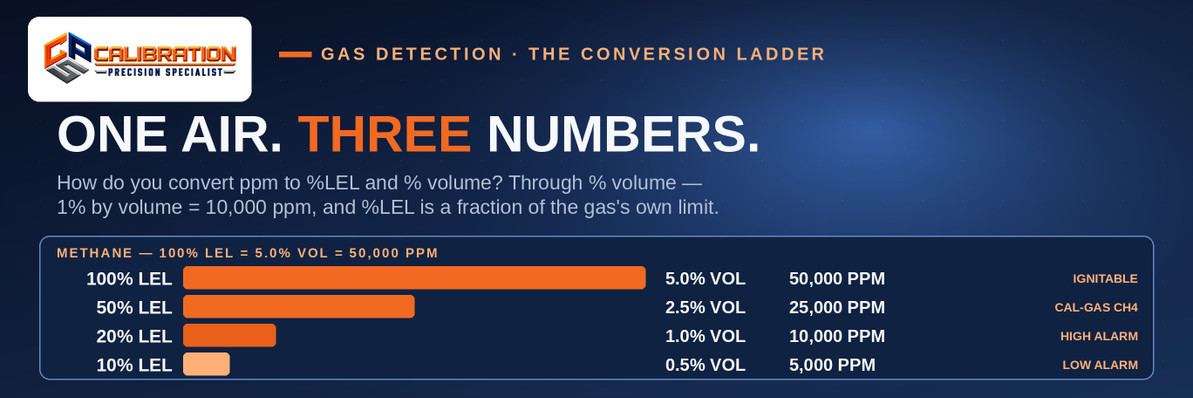
To convert between ppm, %LEL, and % volume, go through % volume: 1% by volume equals 10,000 ppm, and 100% LEL is that gas's Lower Explosive Limit expressed in % volume — so for methane, whose LEL is 5.0% by volume, 100% LEL = 5% volume = 50,000 ppm, 20% LEL = 1% volume = 10,000 ppm, and the standard 10% LEL low alarm = 0.5% volume = 5,000 ppm. The same %LEL is a different number of ppm for every gas — 10% LEL of propane is 2,100 ppm, not 5,000 — because each gas's LEL sits at a different concentration.
Three scales describe the same air on every 4-gas monitor: the combustible channel reads %LEL, the toxic channels read ppm, and datasheets, exposure limits, and calibration certificates keep quoting % volume. Converting between them is two multiplications — but only one of the three conversions is universal, and mixing up which one is which produces numbers that are wrong by a factor of two or more. Our companion post on ppm vs. %LEL vs. % volume explains what each scale means and when each is used; this post is the arithmetic — the formulas, the worked examples, and the two traps that make converted numbers lie. If %LEL itself is new, start with what LEL means.
What Is the Bridge Between ppm and % Volume?
Percent volume and ppm are the same measurement — a fraction of the air — written at two different resolutions. One percent of anything is 10,000 parts per million, so:
% volume × 10,000 = ppm and ppm ÷ 10,000 = % volume
This conversion needs no gas chart and no instrument. It is true for methane, for oxygen, for water vapor, for anything, because both sides are pure fractions. The anchors worth memorizing:
| ppm | % by volume |
|---|---|
| 1 ppm | 0.0001% |
| 10 ppm | 0.001% |
| 100 ppm | 0.01% |
| 1,000 ppm | 0.1% |
| 10,000 ppm | 1% |
| 100,000 ppm | 10% |
| 1,000,000 ppm | 100% (pure gas) |
Each scale exists because the other is unwieldy somewhere. Fresh air is 20.9% oxygen by volume — writing that as 209,000 ppm is technically correct and practically useless. Hydrogen sulfide's NIOSH ceiling is 10 ppm — writing it as 0.001% by volume is equally correct and equally useless. ppm is the scale for traces; % volume is the scale for bulk constituents. They meet at 10,000 ppm = 1%, and that meeting point is the bridge every %LEL conversion crosses.
How Do You Convert %LEL to % Volume and ppm?
%LEL is not a fraction of the air. It is a fraction of a limit — the percentage of the gas's Lower Explosive Limit that is present. That means converting out of %LEL always takes two steps, and the first step needs one fact about the specific gas: its LEL in % volume. For the fuels used throughout this post — the same figures published in our LEL explainer — methane's LEL is 5.0% by volume, propane's is 2.1%, and pentane's is 1.5%.
Step 1 — %LEL to % volume: (%LEL ÷ 100) × the gas's LEL in % volume
Step 2 — % volume to ppm: % volume × 10,000
Run both steps for methane at 25% LEL. Step 1: (25 ÷ 100) × 5.0% = 1.25% by volume. Step 2: 1.25 × 10,000 = 12,500 ppm. There is also a one-line version of the same math: work out the gas's LEL in ppm once — methane's is 5.0 × 10,000 = 50,000 ppm — and then %LEL is simply that fraction of it. 25% of 50,000 is 12,500. Same answer, because it is the same arithmetic.
Going the other way — ppm to %LEL — reverses the steps. A propane reading of 4,200 ppm: Step 1, 4,200 ÷ 10,000 = 0.42% by volume. Step 2, 0.42 ÷ 2.1 × 100 = 20% LEL. The reading that sounds small in ppm is a fifth of the way to an ignitable propane atmosphere — which is exactly why the combustible channel displays %LEL and not ppm in the first place.
The Conversion Table: Methane and Propane Side by Side
| Reading | Methane — % volume | Methane — ppm | Propane — % volume | Propane — ppm |
|---|---|---|---|---|
| 10% LEL (low alarm) | 0.5% | 5,000 ppm | 0.21% | 2,100 ppm |
| 20% LEL (high alarm) | 1.0% | 10,000 ppm | 0.42% | 4,200 ppm |
| 50% LEL | 2.5% | 25,000 ppm | 1.05% | 10,500 ppm |
| 100% LEL (ignitable) | 5.0% | 50,000 ppm | 2.1% | 21,000 ppm |
Read any row across and the lesson lands: at every identical %LEL, propane needs well under half the molecules methane needs — 2,100 ppm against 5,000 ppm at the low alarm — because propane's explosive limit itself sits at 2.1% by volume instead of 5.0%. The %LEL column is the only one where the two gases mean the same thing, and the thing they mean is risk: each row is the same fraction of the way to a fire. That equivalence is the entire reason the %LEL scale exists, and it is why converting a %LEL reading into ppm without naming the gas is a meaningless exercise — the answer changes with the fuel.
Pentane stretches the same point further. Its LEL is 1.5% by volume, so 100% LEL pentane is 15,000 ppm and a 10% LEL alarm sounds at just 1,500 ppm. One alarm setpoint — 10% LEL — is 5,000 ppm of methane, 2,100 ppm of propane, or 1,500 ppm of pentane, and all three are the identical safety statement: one-tenth of an ignitable atmosphere.
Worked Example: Reading a Calibration Gas Label in All Three Scales
The standard 4-gas calibration cylinder — covered in our guide to what calibration gas a 4-gas detector needs — is labeled H₂S 25 ppm, CO 50 ppm, CH₄ 50% LEL, O₂ 12%. Converted onto one scale, that label reads:
- Methane, 50% LEL = 2.5% by volume = 25,000 ppm. (Step 1: 50 ÷ 100 × 5.0% = 2.5%. Step 2: 2.5 × 10,000.)
- Carbon monoxide, 50 ppm = 0.005% by volume.
- Hydrogen sulfide, 25 ppm = 0.0025% by volume.
- Oxygen, 12% by volume = 120,000 ppm — a conversion nobody performs, because oxygen is a bulk constituent and % volume is its natural scale.
The label mixes three scales on one cylinder because each channel of the instrument it calibrates speaks a different one — and notice the methane value: the calibration point for the combustible channel is half of the explosive limit, 25,000 ppm of methane, chosen so the sensor is adjusted mid-scale rather than at a trace level.
Why Are Toxic Gases Never Expressed in %LEL?
Technically, CO and H₂S have LELs — both gases will burn. Practically, converting their readings to %LEL produces numbers so small they are meaningless, because these gases poison people at concentrations thousands of times below the level where they could ignite.
Run the math. Hydrogen sulfide's LEL is 4.3% by volume — 43,000 ppm. But OSHA's ceiling for H₂S is 20 ppm, and NIOSH sets 100 ppm as immediately dangerous to life and health. In %LEL terms, the IDLH is 100 ÷ 43,000 × 100 = about 0.23% LEL. Go the other direction and it gets worse: 1% LEL of H₂S is 430 ppm — more than four times the concentration considered immediately dangerous. The smallest step on the %LEL scale overshoots the lethal zone entirely.
Carbon monoxide is the same story with bigger numbers. Its LEL is 12.5% by volume — 125,000 ppm — while OSHA's permissible exposure limit is 50 ppm as an 8-hour average. Fifty ppm of CO is 50 ÷ 125,000 × 100 = 0.04% LEL. No combustible channel on earth displays hundredths of a percent of LEL, and none should: by the time a CO atmosphere registered even 1% LEL (1,250 ppm), everyone in it would have been in mortal danger for a long time. Toxic gases live in ppm because ppm is where their hazard lives. The %LEL scale was built for a different emergency — proximity to ignition — and for toxics the ignition emergency is never the one that arrives first.
When Is a Converted %LEL Number Wrong? The Calibration Trap
Every conversion above assumes the %LEL on the screen is a true %LEL of the gas in front of the sensor. On a real instrument, that assumption holds for exactly one gas: the one the sensor was calibrated with. A catalytic LEL sensor calibrated on methane responds differently to other gases — less to most of them — and manufacturers publish the gap as a correction factor. As our post on LEL correction factors works through, RKI's factor for hexane is 2.44: a display reading 10% LEL over hexane vapor is really 24.4% LEL of hexane.
Now convert that reading to ppm two ways. Using methane's ladder, as the display invites: 10% LEL → 0.5% by volume → 5,000 ppm. The truth: 24.4% of hexane's LEL — hexane's LEL is 1.1% by volume, or 11,000 ppm — is 0.244 × 11,000 = about 2,684 ppm. The naive conversion is wrong in both directions at once: it overstates the molecule count and understates the danger, because in %LEL terms the atmosphere is at 24.4% of an explosive limit, not 10%. Converting a displayed %LEL into ppm or % volume only tells the truth when the gas present is the calibration gas, or after the manufacturer's correction factor has been applied to the reading. The ladder is exact; the number you feed into it may not be.
The Shortcut Worth Memorizing
For field use, two facts do nearly all the work. First: 1% by volume = 10,000 ppm — move the decimal four places and you have crossed between the absolute scales. Second: learn your gas's LEL in ppm — methane 50,000, propane 21,000, pentane 15,000 — and %LEL becomes a percentage of that number: 10% LEL is a tenth of it, 20% is a fifth, 50% is half. With those two facts and your target gas's LEL, every conversion in this post is a ten-second mental calculation, on any instrument, for any reading — provided the sensor was calibrated for the gas it is looking at, which is the one condition no shortcut can waive.
Frequently Asked Questions
How do you convert ppm to %LEL? In two steps, and you need the gas's LEL in % volume. First convert ppm to % volume by dividing by 10,000, then divide that % volume by the gas's LEL and multiply by 100. Example: 4,200 ppm of propane is 0.42% by volume; propane's LEL is 2.1% by volume, so 0.42 ÷ 2.1 × 100 = 20% LEL. There is no gas-independent ppm-to-%LEL conversion.
How do you convert %LEL to ppm? Multiply the %LEL (as a fraction) by the gas's LEL expressed in ppm. Methane's LEL is 5.0% by volume = 50,000 ppm, so 25% LEL methane is 0.25 × 50,000 = 12,500 ppm. Propane's LEL is 2.1% by volume = 21,000 ppm, so 25% LEL propane is 0.25 × 21,000 = 5,250 ppm. Same %LEL, different ppm — the gas's own LEL sets the answer.
What is 100% LEL in ppm? It depends entirely on the gas, because 100% LEL means the gas has reached its own Lower Explosive Limit. For methane (LEL 5.0% by volume) it is 50,000 ppm; for propane (LEL 2.1%) it is 21,000 ppm; for pentane (LEL 1.5%) it is 15,000 ppm. Anyone who quotes one ppm figure for 100% LEL without naming the gas is leaving out the fact that decides the answer.
How many ppm is 10% LEL? For methane, 5,000 ppm — one-tenth of its 50,000 ppm LEL, and the concentration at the standard low alarm. For propane, 2,100 ppm; for pentane, 1,500 ppm. The %LEL figure is identical (one-tenth of an ignitable atmosphere) in all three cases; only the molecule count changes, because each gas reaches its explosive limit at a different concentration.
How do you convert %LEL to % volume? Multiply the %LEL fraction by the gas's LEL in % volume: (%LEL ÷ 100) × LEL. At 20% LEL, methane is 0.20 × 5.0% = 1.0% by volume, and propane is 0.20 × 2.1% = 0.42% by volume. From % volume, multiply by 10,000 to finish the trip to ppm.
What is 1% by volume in ppm? 10,000 ppm — always, for every gas. Percent volume and ppm are both simple fractions of the air (percent counts per hundred, ppm counts per million), so the conversion between them is fixed arithmetic: multiply % volume by 10,000 to get ppm, divide ppm by 10,000 to get % volume. It is the %LEL scale, not this one, that changes from gas to gas.
Is 25% LEL the same as 25% gas in the air? No — not close. 25% LEL means one quarter of the gas's Lower Explosive Limit is present. For methane, whose LEL is 5.0% by volume, 25% LEL is 1.25% gas in the air (12,500 ppm). A reading of 25% LEL sounds large because it is measured against the danger threshold, not against the whole atmosphere; the actual gas fraction is twenty times smaller.
Why can't you convert %LEL to ppm without knowing which gas it is? Because %LEL is a fraction of a gas-specific limit, and each gas's limit sits at a different concentration: methane's LEL is 5.0% by volume, propane's is 2.1%, pentane's is 1.5%. The conversion multiplies by that limit, so 50% LEL is 25,000 ppm of methane but 10,500 ppm of propane. Without the gas, the multiplication has no second number.
Can you express a carbon monoxide reading in %LEL? The arithmetic exists but the number is useless. CO's LEL is 12.5% by volume (125,000 ppm), while OSHA's exposure limit is 50 ppm — which converts to 0.04% LEL. Toxic gases endanger people at concentrations thousands of times below their explosive limits (H₂S is immediately dangerous at 100 ppm against an LEL of 43,000 ppm), so their channels are built and read in ppm, where the hazard actually lives.
Does a %LEL reading convert the same way for every gas the detector sees? No. The conversions in this post are exact only for the gas the sensor was calibrated with — commonly methane. Other gases produce a different response per %LEL, published by manufacturers as correction factors: on RKI's table, a methane-calibrated sensor displaying 10% LEL over hexane is really seeing 24.4% LEL. Convert the displayed number with methane's ladder and you get 5,000 ppm; the true figure is about 2,684 ppm of hexane at nearly two and a half times the displayed fraction of its limit. Calibrate to the target gas or apply the factor first, then convert.
The Bottom Line
Converting ppm, %LEL, and % volume is one bridge crossed twice: % volume and ppm differ only by a factor of 10,000, and %LEL joins the system through each gas's own LEL — 100% LEL methane is 5.0% by volume is 50,000 ppm, while 100% LEL propane is 2.1% is 21,000 ppm. Keep the gas's LEL in ppm in your head and every conversion is seconds of arithmetic. Respect the two limits of that arithmetic: toxic gases stay in ppm because their danger sits thousands of times below their LELs, and a displayed %LEL only converts truthfully for the gas the sensor was calibrated on — everything else needs its correction factor first.
Every monitor we sell displays all three scales across its channels — the RKI GX-3R at $640 is the most common starting point — and the full range is in our portable multi-gas monitors category. If your crew converts readings on the fly, the LEL of your actual target gas — and whether your instruments are calibrated to it — is a conversation worth having before the next entry, not during it. We calibrate every channel — call 865-900-8844 or reach us through Contact Us. CPS also stocks the calibration gas those calibrations run on.
CPS Calibrations · 109 S. Front Street, Rockwood, TN 37854 · Calibration Gas · Calibration Services · Contact Us
Need a calibration you can file?
In-house calibration at CPS in Rockwood, Tennessee — $55 for single-gas instruments, $90 for 4- and 5-gas — every channel, as-found and as-left data, full certificate.
See Calibration Servicesor call 865-900-8844
Recent Posts
-

Can You Add a Pump to a SENKO SGT-P or MGT?
Yes — SENKO's SP-Pump101 external sampling pump ($330, part AAA006000) fits the SGT, SGT-P, and MGT, …Nov 12th 2026 -

What Refrigerant Detection Does a Grocery Store Need?
A grocery store needs refrigerant detection in three places: low-mounted carbon dioxide (R-744) sens …Nov 11th 2026 -

What Is LEL and UEL? The Explosive Range, Gas by Gas
The LEL is the lowest concentration of a gas in air that can explode, and the UEL is the highest: me …Nov 10th 2026