
SENKO SGT vs. SGT-P: Disposable or Maintainable Single-Gas Detector?
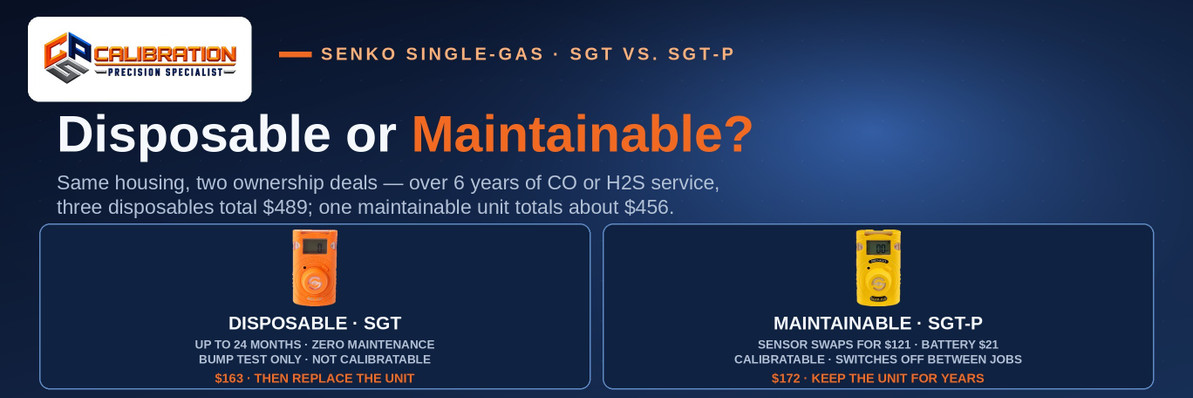
The SENKO SGT is the disposable: $163 for CO or H2S, it runs continuously for up to 24 months with no calibration and no maintenance, and at end of life you replace the whole unit. The SENKO SGT-P is the maintainable build of the same detector: $172 up front, but its sensor swaps for $121 and its battery for $21, it can be calibrated and switched off between jobs — and over 6 years of CO or H2S service the two cost nearly the same, about $489 for three SGT disposables versus about $456 to keep one SGT-P running.
The two detectors wear the same orange housing, come from the same SENKO family (the store model names are SP-SGT and SP-SGTP), and do the same job: warn one worker about one gas. What you are actually choosing between is two ownership models — a sealed unit you run to death and replace, or a serviceable instrument you maintain for as long as you care to own it. Neither answer is right for everybody, and the honest deciding factors are how long the detector needs to serve, which gas it has to detect, and whether your safety program requires real calibration or a bump test is enough. This post puts the two side by side, shows the year-by-year cost math with nothing rounded in either one's favor, and ends with a straight recommendation by use case.
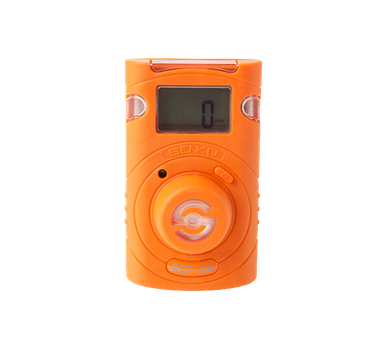
SENKO SP-SGT Disposable Single Gas Detector
SENKO SGT vs. SGT-P: the disposable SGT is $163 and runs 24 months maintenance-free; the maintainable SGT-P is $172 with $121 sensor swaps. Six-year CO/H2S cost: $489 vs. about $456.
$163–$412 configured
See the SP-SGTSGT vs. SGT-P at a Glance
| SENKO SGT (SP-SGT) — Disposable | SENKO SGT-P (SP-SGTP) — Maintainable | |
|---|---|---|
| Price, CO / H2S | $163 | $172 |
| Price, O2 | $165 | $177 |
| Price range across gases | $163–$412 | $172–$578 |
| Gases available | 7: O2, CO, H2S, H2, SO2, NH3, NO2 | 12: the SGT's 7, plus Cl2, HCN, PH3, ClO2, HCl |
| Widest CO range | 0–1,000 ppm | 0–2,000 ppm |
| Service model | Sealed unit; runs up to 24 months, then replace the whole detector | Replaceable sensor and replaceable battery; no fixed end of life |
| Calibration | Not calibratable — bump test only | Fully calibratable |
| Alarm settings | Fixed | Adjustable |
| Power | Always on from activation to end of life | Can be switched on and off |
| Replacement sensor | None — not serviceable | $121 (CO, H2S, O2); $228 (NO2, H2, SO2) |
| Replacement battery | None — sealed in | $21 |
| Alarms | 90 dB at 10 cm + LED + vibration | 90 dB at 10 cm + LED + vibration |
| Display / event log | LCD; logs last 30 alarm events | LCD; logs last 30 alarm events |
| Ingress rating | IP67 | IP67 |
| Housing | 49 × 85 × 40 mm; 93 g toxic, 104 g O2 | Same housing size |
| Sampling | Diffusion; optional external pump | Diffusion; optional external pump |
| 6-year cost, CO or H2S | $489 (three units) | About $456 (unit + two sensor/battery cycles) |
What Is the SENKO SGT?
The SENKO SGT disposable single-gas detector is built around one idea: zero maintenance. You activate it, clip it on, and it runs continuously for up to 24 months (rated at 2 minutes of alarm time per day). The CO and H2S models are maintenance-free for that entire two years — no charging, no sensor swaps, no calibration. When the unit reaches end of life, you replace the whole detector.
That simplicity comes with two hard limits you should know before you buy. First, the SGT cannot be calibrated — it accepts a bump test to prove the sensor responds and the alarms fire, but there is no way to adjust its readings against calibration gas. Second, it cannot be switched off — from activation to end of life it is running, whether it is on a worker's collar or in a drawer. Seven gases are offered: O2 (0–30% vol), CO (0–500 or 0–1,000 ppm), H2S (0–100 or 0–200 ppm), H2 (0–1,000 ppm), SO2 (0–50 ppm), NH3 (0–100 ppm), and NO2 (0–20 ppm). Prices run $163 for CO and H2S, $165 for O2, $386 for H2 and SO2, and $412 for NH3 and NO2. It carries the full alarm set — 90 dB audible at 10 cm, LED, and vibration — an IP67 housing, a log of the last 30 alarm events, an automatic sensor trouble check, optional IR Link for configuration and data, and compatibility with SENKO's docking station. We covered the disposable on its own terms in SENKO SP-SGT: Is a Disposable Single-Gas Detector Worth It? — this post is about the choice between the two.
What Is the SENKO SGT-P?
The SENKO SGT-P maintainable single-gas detector is the same detector concept built to be kept. The sensor is replaceable, the lithium battery is replaceable, the unit can be powered on and off between jobs, alarm settings are adjustable, and — the difference that decides many purchases — it can be calibrated, so a program that requires documented calibration, not just bump tests, can run on it.
It also detects more. The SGT-P covers twelve gases: everything the SGT has, plus chlorine (Cl2, 0–20 ppm), hydrogen cyanide (HCN, 0–50 ppm), phosphine (PH3, 0–5/20 ppm), chlorine dioxide (ClO2, 0–5 ppm), and hydrogen chloride (HCl, 0–20 ppm) — and it offers wider ranges on several shared gases, including CO up to 2,000 ppm, NH3 up to 500 ppm, and SO2 up to 100 ppm. Prices run $172 for CO and H2S, $177 for O2, $403 for H2 and SO2, $430 for NH3, NO2, and Cl2, and $578 for HCN, HCl, and PH3. The parts that keep it alive are priced like parts, not detectors: replacement sensors are $121 for CO, H2S, and O2, $228 for NO2, H2, and SO2, and the replacement battery is $21. Alarms (90 dB at 10 cm, LED, vibration), the IP67 housing, the 30-event log, and the optional IR Link match the disposable; the housing is the same size.
The Honest Cost Math: Disposable vs. Maintainable Over 6 Years
Up-front prices — $163 against $172 for CO or H2S — tell you almost nothing, because the two units spend money on completely different schedules. Here is the same six years with both, using CO or H2S, planning on a sensor swap about every two years on the maintainable unit:
| SENKO SGT (disposable) | SENKO SGT-P (maintainable) | |
|---|---|---|
| Day one | $163 (unit #1) | $172 (unit) |
| Year 2 | $163 (unit #2 — first unit at end of life) | $121 sensor + $21 battery = $142 |
| Year 4 | $163 (unit #3) | $121 sensor + $21 battery = $142 |
| Maintenance in between | None — and none possible | Bump tests and calibrations as your program requires |
| 6-year total | $489 | $456 |
| Cost per year | About $82 | About $76 |
| What you own at year 6 | A third disposable partway through its life | A working detector that takes another $142 cycle |
Two honest conclusions fall out of that table. First, inside six years, on the common gases, it is nearly a wash — $33 apart, which is less than the price difference between two configurations of the same unit. Anyone who tells you one of these "crushes" the other on CO or H2S cost is selling, not counting. Second, the curves diverge from there: every additional two-year cycle costs $142 on the SGT-P against $163 for another disposable, and the gap widens with every cycle the SGT-P stays in service.
On the expensive gases the gap is not a wash at all. Run hydrogen for the same six years: the disposable path is three H2 units at $386 — $1,158. The maintainable path is a $403 unit plus two $228 sensor swaps and two $21 batteries — $901. The pattern holds across the exotic list, because a sensor is always cheaper than a whole detector: on the SGT-P you are replacing the one part that wears out, while on the SGT the sensor's end of life takes the housing, battery, electronics, and display with it — which is also the waste argument, for buyers who track it: three complete detectors in the bin over six years, versus one detector and two sensor cells.
Pros and Cons
SENKO SGT (Disposable)
Pros
- Truly zero maintenance: no charging, no sensor swaps, no calibration appointments for up to 24 months (CO/H2S models maintenance-free for the full term).
- Lowest possible entry price: $163 for CO or H2S, $165 for O2.
- Nothing to switch off or misconfigure — it is always on and always monitoring from activation, which is exactly what you want on a borrowed collar.
- Predictable budgeting: the entire cost of two years of protection is known the day you buy it.
- Docking-station compatible, 30-event alarm log, and an auto sensor trouble check, despite the throwaway design.
Cons
- Cannot be calibrated — bump test only. If your program, your customer, or your insurer requires documented calibration, this unit cannot satisfy it.
- End of life means the whole detector is replaced, including parts that still work.
- Always on: the 24-month clock runs in the drawer as surely as on the job, so stock bought early expires early.
- Seven gases only, and narrower ranges — no Cl2, HCN, PH3, ClO2, or HCl version exists.
- On expensive gases the replacement math turns against it fast ($386 for a new H2 unit vs. a $228 sensor on the SGT-P).
SENKO SGT-P (Maintainable)
Pros
- Calibratable, with adjustable alarm settings — it satisfies programs the disposable cannot.
- Sensor swaps at $121 (CO/H2S/O2) or $228 (NO2/H2/SO2) and a $21 battery keep it in service indefinitely; every cycle after purchase is cheaper than a new disposable.
- Twelve gases, including Cl2, HCN, PH3, ClO2, and HCl, and wider ranges (CO to 2,000 ppm, NH3 to 500 ppm, SO2 to 100 ppm).
- Switches off between jobs — no service life burned sitting in storage.
- One detector owned for years instead of a detector in the bin every two years.
Cons
- It has to be maintained: sensors and batteries on a schedule, calibrations performed and documented. Somebody has to own that task.
- The up-front price is higher, and the gap is real on exotic gases ($578 for HCN/HCl/PH3).
- The savings only arrive over time — inside a single short project, the sensor-swap advantage may never be used.
- A neglected SGT-P (missed sensor swap, skipped calibration) is worse than a disposable that asks nothing of you.
Which One Should You Buy?
A fixed-length project — a turnaround, a shutdown, a contract job with an end date: buy the SGT. The unit's 24-month life covers the job with margin, there is nothing to calibrate, charge, or maintain while your crew is busy doing the actual work, and when the job ends the detector question ends with it. This is the disposable's home turf, and the small long-run cost difference never gets a chance to matter.
Detectors you hand to contractors, visitors, or seasonal help: buy the SGT. It cannot be switched off, turned down, or handed back dead-but-looks-fine — it alarms or it visibly doesn't work, it logs its last 30 alarm events, and there is no maintenance state for a stranger to neglect.
A permanent fleet for your own workforce: buy the SGT-P. Over six years it already edges the disposable on cost ($456 vs. $489 on CO/H2S), it pulls further ahead every cycle after that, it can be calibrated and documented properly, and switching units off between jobs stops the clock the disposable can't stop. The maintainable unit is the fleet instrument; the disposable is the project instrument.
Exotic or high-range gases: buy the SGT-P — in several cases it is the only choice. Chlorine, hydrogen cyanide, phosphine, chlorine dioxide, and hydrogen chloride do not exist in the disposable line at all, and neither do the wide ranges (CO to 2,000 ppm, NH3 to 500 ppm). Even where both exist — H2, SO2, NH3, NO2 — the sensor-swap math ($228 against $386–$412 for a whole unit) favors the SGT-P from the first replacement onward.
A program that requires documented calibration: buy the SGT-P, full stop. The SGT cannot be calibrated, only bump tested. If your written program, your customer's contractor requirements, or your insurer asks for calibration records, the disposable is disqualified no matter how attractive the price looks — this one is not a judgment call. For the wider framing of when maintenance-free makes sense across brands, see disposable single-gas monitors: when is maintenance-free the right call?
What If You Need a Pump?
Neither unit has one — both the SGT and the SGT-P are diffusion detectors, sampling the air that reaches the sensor. For remote sampling — drawing from a space before entry, or from a sump, duct, or tank — the family's external SENKO SP-Pump101 pump accessory ($330) fits both, so the pump question does not have to drive the disposable-vs.-maintainable decision: pick the ownership model first, and add the pump to either.
Frequently Asked Questions
What is the difference between the SENKO SGT and SGT-P?
The SENKO SGT (SP-SGT) is a sealed disposable: $163 for CO or H2S, it runs continuously for up to 24 months with no maintenance and no calibration, and at end of life the whole unit is replaced. The SENKO SGT-P (SP-SGTP) is the maintainable build of the same detector: $172 for CO or H2S, with a replaceable sensor ($121 for CO/H2S/O2), a replaceable battery ($21), full calibration, adjustable alarms, and an on/off switch. The SGT-P also covers 12 gases to the SGT's 7, adding Cl2, HCN, PH3, ClO2, and HCl.
How long does a SENKO SGT last?
Up to 24 months of continuous operation, rated at 2 minutes of alarm time per day. The clock starts at activation and runs whether the detector is being worn or sitting in a drawer, because the SGT cannot be switched off. The CO and H2S models are maintenance-free for that full two years; at end of life the whole unit is replaced — there is no battery or sensor service that extends it.
Can you calibrate a SENKO SGT?
No. The disposable SGT cannot be calibrated — it accepts a bump test, which proves the sensor responds to gas and the alarms fire, but its readings cannot be adjusted against calibration gas. If your safety program, a customer's contractor requirements, or your insurer requires documented calibration, you need the SGT-P, which is fully calibratable. This is the single hardest dividing line between the two models.
Can you replace the battery in a SENKO SGT?
No — the SGT's battery is sealed in for the unit's 24-month life, and when it is done, the detector is done. The SGT-P is the serviceable one: its lithium battery is a replaceable part that costs $21 at CPS, and its sensor swaps separately ($121 for CO, H2S, and O2; $228 for NO2, H2, and SO2), so neither wear item takes the whole instrument with it.
How much does a SENKO SGT cost?
By gas: CO $163, H2S $163, O2 $165, H2 $386, SO2 $386, NH3 $412, and NO2 $412. That price is the entire cost of the detector for its life — up to 24 months of continuous, maintenance-free operation, with no sensors, batteries, or calibration to buy in between. Per year of service, the CO and H2S models work out to about $82.
How much does it cost to replace a SENKO SGT-P sensor?
At CPS, $121 for the CO, H2S, and O2 sensors and $228 for the NO2, H2, and SO2 sensors; the replacement battery is $21. Planning on a sensor swap about every two years, a CO or H2S SGT-P costs $172 up front plus $142 per two-year cycle (sensor + battery) — about $456 total across six years, against $489 for three disposable SGTs covering the same span.
Is a disposable gas detector cheaper than a maintainable one?
Up front, slightly: $163 for a disposable SENKO SGT against $172 for the maintainable SGT-P in CO or H2S. Over time, no — but it is closer than most people expect. Across six years the disposable path costs $489 (three units, zero maintenance) and the maintainable path about $456 (one unit, two sensor-and-battery cycles), and the SGT-P pulls further ahead every cycle after that. On expensive gases the maintainable unit wins outright: six years of hydrogen detection is $1,158 in disposables against $901 keeping an SGT-P in service.
Which gases can the SENKO SGT-P detect that the SGT can't?
Five: chlorine (Cl2, 0–20 ppm), hydrogen cyanide (HCN, 0–50 ppm), phosphine (PH3, 0–5/20 ppm), chlorine dioxide (ClO2, 0–5 ppm), and hydrogen chloride (HCl, 0–20 ppm). The SGT-P also offers wider ranges on gases both models share — CO up to 2,000 ppm against the SGT's 1,000, NH3 up to 500 ppm against 100, and SO2 up to 100 ppm against 50. The SGT covers seven gases: O2, CO, H2S, H2, SO2, NH3, and NO2.
Can you turn off a SENKO SGT?
No. The disposable SGT runs continuously from the moment it is activated until it reaches end of life at up to 24 months — there is no off switch, which is a genuine advantage for detectors handed to contractors (nobody can switch it off and forget) and a genuine cost for stock kept on a shelf (the clock runs in storage). The SGT-P can be powered on and off, so its service life is only spent while it is actually working.
Does the SENKO SGT or SGT-P have a pump?
No — both are diffusion detectors with no internal pump, sampling the air that reaches the sensor. For remote sampling, such as drawing a sample from a space before entry, SENKO's external SP-Pump101 pump accessory ($330) fits the family and works with either model, so needing a pump does not force the disposable-vs.-maintainable choice either way.
The Bottom Line
The SGT and the SGT-P are the same detector wearing two different ownership deals: the disposable trades a $163, zero-maintenance, 24-month life — and no calibration, ever — for total simplicity, while the maintainable unit trades a little upkeep for $121 sensor swaps, a $21 battery, real calibration, an off switch, and five gases the disposable doesn't offer. Inside six years on CO or H2S the money is nearly a wash ($489 vs. about $456); past that, on exotic gases, and in any program that requires calibration, the SGT-P wins — and for a fixed-length job or detectors handed to people you don't supervise, the disposable is the right tool precisely because there is nothing on it to neglect.
Not sure which model your program needs — or which gas and range fit your hazard assessment? Call 865-900-8844 or reach us through Contact Us. Tell us the gas, the job, and how long the detector has to serve, and we will tell you plainly whether the disposable or the maintainable unit is the better buy — including when the answer is the cheaper one.
CPS Calibrations · 109 S. Front Street, Rockwood, TN 37854 · Calibration Gas · Calibration Services · Contact Us
Need a calibration you can file?
In-house calibration at CPS in Rockwood, Tennessee — $55 for single-gas instruments, $90 for 4- and 5-gas — every channel, as-found and as-left data, full certificate.
See Calibration Servicesor call 865-900-8844
Recent Posts
-

Can You Add a Pump to a SENKO SGT-P or MGT?
Yes — SENKO's SP-Pump101 external sampling pump ($330, part AAA006000) fits the SGT, SGT-P, and MGT, …Nov 12th 2026 -

What Refrigerant Detection Does a Grocery Store Need?
A grocery store needs refrigerant detection in three places: low-mounted carbon dioxide (R-744) sens …Nov 11th 2026 -

What Is LEL and UEL? The Explosive Range, Gas by Gas
The LEL is the lowest concentration of a gas in air that can explode, and the UEL is the highest: me …Nov 10th 2026