
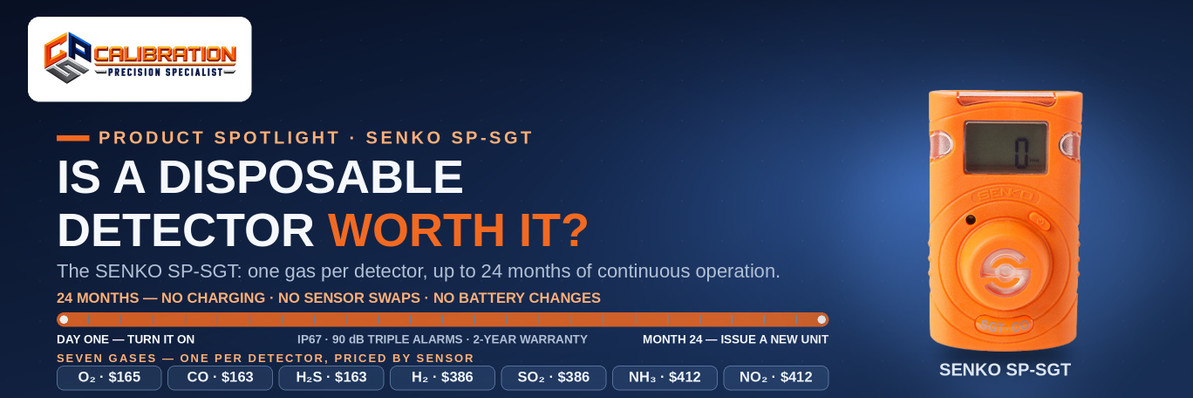
SENKO SP-SGT: Is a Disposable Single-Gas Detector Worth It?
The SENKO SP-SGT is a disposable, diffusion-type single-gas detector with an electrochemical sensor that runs continuously for up to 24 months with no sensor or battery replacement, in seven gas configurations — O₂ (0–30% vol), CO (0–500 ppm), H₂S (0–100 ppm), H₂ (0–1,000 ppm), SO₂ (0–50 ppm), NH₃ (0–100 ppm), and NO₂ (0–20 ppm) — priced from $163 to $412. It's IP67-rated, weighs 3.28 oz (93 g) in toxic-gas configurations, alarms at 90 dB with visual and vibration alerts, logs its most recent 30 alarm events, and carries a 2-year warranty — so for a worker whose hazard is one known gas, it's two years of personal monitoring with no parts to swap.
That's the short answer. The rest of this post is what "disposable" really means on this instrument (and what it doesn't), the per-gas pricing, how it differs from SENKO's maintainable SP-SGTP, and the checklist for deciding which side of that line your fleet belongs on.
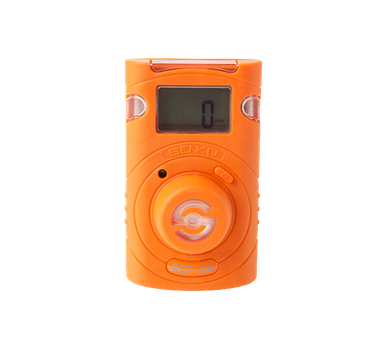
SENKO SP-SGT Disposable Single Gas Detector
Is the SENKO SP-SGT worth it? A disposable single-gas detector that runs up to 24 months — 7 gases, electrochemical sensor, IP67, $163–$412, 2-year warranty.
$163–$412 configured
See the SP-SGTWhat Is the SENKO SP-SGT, and Who Is It For?
The SENKO SP-SGT is a compact personal detector built around a single job: watch one gas, all shift, every shift, for one worker. It's a diffusion instrument — it samples the air immediately around the wearer, which is what personal monitoring means — with a dedicated electrochemical sensor for the gas you choose at ordering. It is not a 4-gas monitor and doesn't pretend to be: if your hazard assessment names one gas, this is the instrument class that answers it.
That makes it a fit for the places single-gas hazards actually live: CO around furnaces, boilers, and engine exhaust; H₂S in wastewater, oil and gas, and rendering; O₂ monitoring where nitrogen or other gases can displace air; NH₃ around refrigeration; SO₂, NO₂, and H₂ in chemical and process work. It's also the natural issue-and-forget detector for contractors, temporary crews, and turnaround work, where the alternative is handing a maintainable instrument to someone who will never maintain it.
Which Gases Does the SP-SGT Detect — and What Does Each One Cost?
One detector, one gas. You pick the configuration when you order, and the price follows the sensor:
- Oxygen (O₂), 0–30% vol — $165
- Carbon monoxide (CO), 0–500 ppm — $163
- Hydrogen sulfide (H₂S), 0–100 ppm — $163
- Hydrogen (H₂), 0–1,000 ppm — $386
- Sulfur dioxide (SO₂), 0–50 ppm — $386
- Ammonia (NH₃), 0–100 ppm — $412
- Nitrogen dioxide (NO₂), 0–20 ppm — $412
Every configuration ships with a calibration cap, the manual, and a calibration and test certificate in the box. Note what's not on the list: chlorine, hydrogen cyanide, phosphine, and the other specialty toxics. SENKO covers those in the maintainable sibling covered below — if your gas isn't one of the seven above, that's your answer, and it's a clean one.
"Disposable" — What Does That Actually Mean Here?
Disposable is a design decision, not a quality grade, and on the SP-SGT it means three specific things:
- Nothing inside is replaced. The electrochemical sensor and the 3.6 V lithium primary battery (1.2 Ah) are sealed in for the life of the unit. There is no sensor to order, no battery to stock, and no parts drawer for this instrument at all.
- The life is up to 24 months of continuous operation, rated on a basis of 2 minutes of alarm per day. The LCD doesn't just show gas readings — it tracks the detector's remaining operating life, so end-of-life is a countdown you can see coming, not a surprise failure. SENKO backs the unit with a 2-year warranty, matching the operating life.
- The CO and H₂S models are designed for maintenance-free operation across that two-year period — no routine sensor or battery replacement, by design.
Do the ownership math on the most common configuration: a CO or H₂S SP-SGT at $163, spread over 24 months, is under $7 a month for continuous personal coverage — with zero spent on replacement sensors, batteries, or the labor to swap them. A maintainable detector can beat that figure over a long enough life, but only if somebody actually does the maintaining. The disposable deal trades a longer theoretical lifespan for a guaranteed one: two years of known cost and known performance, then a fresh unit.
What disposable does not mean is exempt from your program. Your site's bump-test and calibration policy still governs — the SP-SGT supports both, through the calibration cap in the box, the optional IR Link, and the docking station covered below. Disposable removes the parts, not the proof.
How Is It Built for the Field?
The SP-SGT wears like it was designed by people who knew where it would live. The rubber-enclosed housing is rated IP67 — dust-tight, and sealed against immersion — so rain, washdowns, dust, and a drop into a puddle are survivable events, not replacement events. It weighs 3.28 oz (93 g) in toxic-gas configurations and 3.67 oz (104 g) for the O₂ model, at 1.93 × 3.35 × 1.57 in. — small and light enough that "forgot to wear it" stops being a plausible excuse.
- Triple alarms: audible at 90 dB at 10 cm, red flashing LEDs with LCD indication, and vibration — because a detector that only beeps is useless next to running equipment, and one that only flashes is useless in a pocket.
- Real temperature range: −40°F to +122°F (−40°C to +50°C) for the CO, H₂S, H₂, NH₃, and NO₂ models; −31°F to +122°F (−35°C to +50°C) for O₂ and SO₂.
- Automatic sensor trouble checking, so a sensor fault announces itself instead of reading clean air quietly.
- Hazardous-location approvals: the data sheet lists IECEx and ATEX (Ex ia IIC T4 Ga) and CSA/UL (Class I, Zone 0, AEx ia IIC T4 Ga; Class I, Division 1, Groups A, B, C, D, T4) — intrinsically safe ratings that matter in exactly the atmospheres this detector is bought for.
SP-SGT or SP-SGTP: Disposable or Maintainable?
This is the real decision in the SENKO single-gas line, because the SENKO SP-SGTP is the same idea executed the other way. Both are compact diffusion detectors with electrochemical sensors, IP67 housings, 90 dB triple alarms, the same dimensions and weights, 30-event logging, IR Link compatibility, and docking-station support. They differ on service model and gas list:
The SP-SGT (disposable, $163–$412) seals the sensor and battery in for up to 24 months. Seven gases. Nothing to replace, nothing to stock, nothing to forget. At the end of the countdown, the unit is done and you issue a new one.
The SP-SGTP (maintainable, $172–$578) keeps the same form but lets you replace the sensor and the battery, and turn the unit on and off — so its service life extends past the first sensor instead of ending with it. It also widens the menu to eleven gases, adding Cl₂, HCN, PH₃, and HCl, and offers wider ranges on several gases the two share (CO up to 2,000 ppm, NH₃ up to 500 ppm, SO₂ up to 100 ppm, for example). The shared gases start just a few dollars above the SP-SGT — $172 vs. $163 for CO or H₂S — so the premium isn't the point. The point is whether your program will actually perform the sensor and battery swaps the maintainable model depends on.
One clarification, because the naming invites it: neither unit has an internal pump. Both are diffusion instruments. If an application needs remote sampling — drawing from a tank, a pit, or a space before entry — SENKO's answer for this family is the optional SP-Pump101 external sampling pump ($330) with 5 m and 10 m extension probes, which both models support. Choose diffusion for personal monitoring on the worker; add the pump when the sample has to travel to the instrument.
What About Bump Tests, Calibration, and Records?
A two-year detector still has to prove itself, and the SP-SGT is built to fit a documented program rather than dodge one:
- Event logging on board. The unit automatically stores its most recent 30 alarm events. When a supervisor or an investigator asks what a specific detector saw, the answer is in the instrument.
- Configuration and downloads via IR Link. The optional SENKO IR Link ($64) connects the detector to a computer for configuration changes and event-log downloads — the same link used across the SENKO SGT and MGT families.
- Docking for fleets. The SENKO SGT Docking Station II (part # AAA072000, $2,505) streamlines bump testing and calibration management for SGT fleets — the same automate-the-routine logic we covered in our spotlight on the SENKO SP-MGT and its Docking Station II: the test runs the same way every time, and the record exists whether or not the morning was busy.
- Fresh gas, in date. Whatever route you test by — cap and cylinder by hand, or dock — the gas has to be fresh and matched to the channel. Our calibration gas selection covers the single-gas and multi-gas mixes these detectors bump and calibrate against.
And when a unit misbehaves — fails a bump on a proven rig, won't hold calibration, alarms erratically — it comes out of service. Ship it to our Rockwood lab or have us come to your facility, and we'll work from the as-found data. We calibrate every channel — including the single-gas channels too many programs treat as an afterthought.
Choose the SP-SGT When… / Choose Something Else When…
Choose the SP-SGT when:
- Your hazard assessment names one gas from its list of seven, and that gas is the job.
- The wearers won't maintain an instrument — contractors, temps, turnaround crews, seasonal staff — or your program honestly won't track sensor and battery swaps.
- You want known, fixed cost per worker: $163–$412 buys up to 24 months, with no parts spend in between.
- You're issuing at fleet scale and want every unit on the same life clock, replaced on a schedule instead of repaired on a case-by-case basis.
Choose something else when:
- Your gas is Cl₂, HCN, PH₃, or HCl, or you need a wider range than the SP-SGT offers — that's the SP-SGTP, with replaceable sensor and battery.
- You need more than one gas at once — step up to a multi-gas monitor from the SENKO category or our wider portable gas detection lineup.
- The job needs remote sampling before entry — add the SP-Pump101 to either SGT model, or look at a pumped instrument.
- Your program is built around long-life maintainable assets with a bench that actually services them — in that world, a detector you can't open is the wrong tool, and the SP-SGTP is the honest pick.
The Bottom Line
The SENKO SP-SGT is worth it when the job is exactly what it's built for: one known gas, one worker, worn every shift, with no maintenance program standing between the detector and its second year. Seven gases from $163 to $412, up to 24 months of continuous operation, IP67, triple alarms, intrinsically safe approvals, and a 2-year warranty — and at the end, you replace a $163 instrument instead of discovering a replacement sensor was due six months ago. If your fleet's discipline is strong and your gas list is longer, buy the maintainable SP-SGTP and service it. If it isn't, the disposable is not the cheap option. It's the honest one.
Ready to issue? Start with the SENKO SP-SGT, add the IR Link or the SGT Docking Station II if your program documents tests centrally, and keep fresh calibration gas on the shelf. Not sure which gas or range your hazard assessment calls for? Call us at 865-900-8844 — we'll talk through the application, not just the catalog.
Frequently Asked Questions
How much does the SENKO SP-SGT cost? From $163 to $412, depending on the gas. CO (0–500 ppm) and H₂S (0–100 ppm) are $163, O₂ (0–30% vol) is $165, H₂ (0–1,000 ppm) and SO₂ (0–50 ppm) are $386, and NH₃ (0–100 ppm) and NO₂ (0–20 ppm) are $412. Each unit ships with a calibration cap, manual, and calibration and test certificate.
How long does the SP-SGT last? Up to 24 months of continuous operation, rated on a basis of 2 minutes of alarm per day. The sensor and battery are sealed in and are not replaced — when the operating life ends, you replace the detector. The display tracks the unit's remaining operating life, and SENKO warrants the detector for 2 years from purchase.
Which gases can the SP-SGT detect? Seven, one per detector: oxygen (O₂, 0–30% vol), carbon monoxide (CO, 0–500 ppm), hydrogen sulfide (H₂S, 0–100 ppm), hydrogen (H₂, 0–1,000 ppm), sulfur dioxide (SO₂, 0–50 ppm), ammonia (NH₃, 0–100 ppm), and nitrogen dioxide (NO₂, 0–20 ppm) — each through a dedicated electrochemical sensor chosen when you order.
What's the difference between the SENKO SP-SGT and the SP-SGTP? Service model and gas list. The SP-SGT is disposable: sensor and battery are sealed in for its up-to-24-month life, across seven gases, at $163–$412. The SP-SGTP is maintainable: its sensor and battery are replaceable and it can be switched on and off, extending its service life — and it covers eleven gases (adding Cl₂, HCN, PH₃, and HCl) plus wider ranges on some shared gases, at $172–$578. Same size, weight class, IP67 rating, and alarm package either way.
Does the SP-SGT have a pump? No — it's a diffusion detector, sampling the air immediately around the wearer, which is the right arrangement for personal monitoring. For remote sampling, SENKO offers the SP-Pump101 external sampling pump ($330) and 5 m / 10 m extension probes, which the SP-SGT supports.
Is the SP-SGT waterproof? It's rated IP67: dust-tight, and sealed against immersion. Rain, washdowns, and dust are normal service for it, and its operating range runs from −40°F to +122°F on most gas configurations (−31°F to +122°F for the O₂ and SO₂ models).
Does the SP-SGT keep records of alarms? Yes. It automatically logs its most recent 30 alarm events, and the optional SENKO IR Link ($64) connects it to a computer for configuration changes and event-log downloads. For fleets, the SGT Docking Station II ($2,505) streamlines bump testing and calibration management across units.
Can the SP-SGT's sensor or battery be replaced when it runs out? No — that's the design. The electrochemical sensor and lithium battery are sealed in for the detector's operating life, which is what removes sensor swaps, battery stock, and parts tracking from your program. If you want the same form factor with replaceable parts, that's the SP-SGTP.
CPS Calibrations · 109 S. Front Street, Rockwood, TN 37854 · Portable Gas Detection · Calibration Gas · Calibration Services · Contact Us
Need a calibration you can file?
In-house calibration at CPS in Rockwood, Tennessee — $55 for single-gas instruments, $90 for 4- and 5-gas — every channel, as-found and as-left data, full certificate.
See Calibration Servicesor call 865-900-8844
Recent Posts
-

Can You Add a Pump to a SENKO SGT-P or MGT?
Yes — SENKO's SP-Pump101 external sampling pump ($330, part AAA006000) fits the SGT, SGT-P, and MGT, …Nov 12th 2026 -

What Refrigerant Detection Does a Grocery Store Need?
A grocery store needs refrigerant detection in three places: low-mounted carbon dioxide (R-744) sens …Nov 11th 2026 -

What Is LEL and UEL? The Explosive Range, Gas by Gas
The LEL is the lowest concentration of a gas in air that can explode, and the UEL is the highest: me …Nov 10th 2026